SUBSCRIBE TO OUR FREE NEWSLETTER
Daily news & progressive opinion—funded by the people, not the corporations—delivered straight to your inbox.
5
#000000
#FFFFFF
To donate by check, phone, or other method, see our More Ways to Give page.
Daily news & progressive opinion—funded by the people, not the corporations—delivered straight to your inbox.
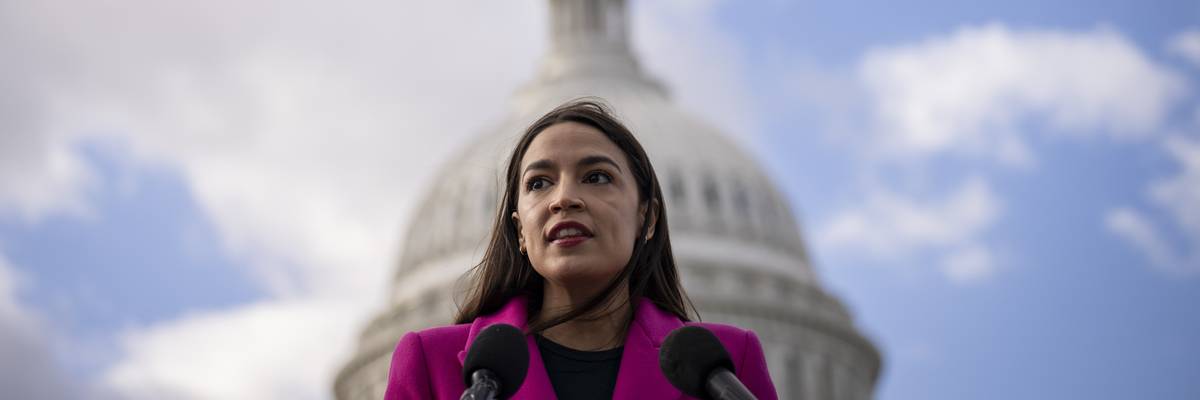
Rep. Alexandria Ocasio-Cortez (D-N.Y.) speaks during a news conference outside the U.S. Capitol in Washington, D.C. on January 26, 2023.
"Our first priority should be in protecting your ability to exist without social media companies harvesting and commodifying every single piece of data about you without you and without your consent," the Democrat argues.
Amid a national debate over whether Congress should ban TikTok, U.S. Rep. Alexandria Ocasio-Cortez on Saturday posted her first video on the social media platform to make the case for shifting the focus to broad privacy protections for Americans.
The New York Democrat's move follows TikTok CEO Shou Zi Chew testifying before the U.S. House Energy and Commerce Committee as well as rights content creators, privacy advocates, and other progressive lawmakers rallying against a company-specific ban on Capitol Hill earlier this week.
Supporters of banning TikTok—which experts say would benefit its Big Tech competitors, Google, Meta, and Snap—claim to be concerned that ByteDance, the company behind the video-sharing platform, could share data with the Chinese government.
Meanwhile, digital rights advocates such as Fight for the Future director Evan Greer have argued that if really policymakers want to protect Americans from the surveillance capitalist business model also embraced by U.S. tech giants, "they should advocate for strong data privacy laws that prevent all companies (including TikTok!) from collecting so much sensitive data about us in the first place, rather than engaging in what amounts to xenophobic showboating that does exactly nothing to protect anyone."
Ocasio-Cortez embraced that argument, saying in her inaugural video: "Do I believe TikTok should be banned? No."
"I think it's important to discuss how unprecedented of a move this would be," Ocasio-Cortez says. "The United States has never before banned a social media company from existence, from operating in our borders, and this is an app that has over 150 million Americans on it."
Advocates of banning TikTok "say because of this egregious amount of data harvesting, we should ban this app," she explains. "However, that doesn't really address the core of the issue, which is the fact that major social media companies are allowed to collect troves of deeply personal data about you that you don't know about without really any significant regulation whatsoever."
"In fact, the United States is one of the only developed nations in the world that has no significant data or privacy protection laws on the books," the congresswoman stresses, pointing to the European Union's legislation as an example. "So to me, the solution here is not to ban an individual company, but to actually protect Americans from this kind of egregious data harvesting that companies can do without your significant ability to say no."
"Usually when the United States is proposing a very major move that has something to do with significant risk to national security, one of the first things that happens is that Congress receives a classified briefing," she notes, adding that no such event has happened. "So why would we be proposing a ban regarding such a significant issue without being clued in on this at all? It just doesn't feel right to me."
The "Squad" member further argues that "we are a government by the people and for the people—and if we want to make a decision as significant as banning TikTok," any information that could justify such a policy "should be shared with the public."
"Our first priority," Ocasio-Cortez concludes, "should be in protecting your ability to exist without social media companies harvesting and commodifying every single piece of data about you without you and without your consent."
Dear Common Dreams reader, It’s been nearly 30 years since I co-founded Common Dreams with my late wife, Lina Newhouser. We had the radical notion that journalism should serve the public good, not corporate profits. It was clear to us from the outset what it would take to build such a project. No paid advertisements. No corporate sponsors. No millionaire publisher telling us what to think or do. Many people said we wouldn't last a year, but we proved those doubters wrong. Together with a tremendous team of journalists and dedicated staff, we built an independent media outlet free from the constraints of profits and corporate control. Our mission has always been simple: To inform. To inspire. To ignite change for the common good. Building Common Dreams was not easy. Our survival was never guaranteed. When you take on the most powerful forces—Wall Street greed, fossil fuel industry destruction, Big Tech lobbyists, and uber-rich oligarchs who have spent billions upon billions rigging the economy and democracy in their favor—the only bulwark you have is supporters who believe in your work. But here’s the urgent message from me today. It's never been this bad out there. And it's never been this hard to keep us going. At the very moment Common Dreams is most needed, the threats we face are intensifying. We need your support now more than ever. We don't accept corporate advertising and never will. We don't have a paywall because we don't think people should be blocked from critical news based on their ability to pay. Everything we do is funded by the donations of readers like you. When everyone does the little they can afford, we are strong. But if that support retreats or dries up, so do we. Will you donate now to make sure Common Dreams not only survives but thrives? —Craig Brown, Co-founder |
Amid a national debate over whether Congress should ban TikTok, U.S. Rep. Alexandria Ocasio-Cortez on Saturday posted her first video on the social media platform to make the case for shifting the focus to broad privacy protections for Americans.
The New York Democrat's move follows TikTok CEO Shou Zi Chew testifying before the U.S. House Energy and Commerce Committee as well as rights content creators, privacy advocates, and other progressive lawmakers rallying against a company-specific ban on Capitol Hill earlier this week.
Supporters of banning TikTok—which experts say would benefit its Big Tech competitors, Google, Meta, and Snap—claim to be concerned that ByteDance, the company behind the video-sharing platform, could share data with the Chinese government.
Meanwhile, digital rights advocates such as Fight for the Future director Evan Greer have argued that if really policymakers want to protect Americans from the surveillance capitalist business model also embraced by U.S. tech giants, "they should advocate for strong data privacy laws that prevent all companies (including TikTok!) from collecting so much sensitive data about us in the first place, rather than engaging in what amounts to xenophobic showboating that does exactly nothing to protect anyone."
Ocasio-Cortez embraced that argument, saying in her inaugural video: "Do I believe TikTok should be banned? No."
"I think it's important to discuss how unprecedented of a move this would be," Ocasio-Cortez says. "The United States has never before banned a social media company from existence, from operating in our borders, and this is an app that has over 150 million Americans on it."
Advocates of banning TikTok "say because of this egregious amount of data harvesting, we should ban this app," she explains. "However, that doesn't really address the core of the issue, which is the fact that major social media companies are allowed to collect troves of deeply personal data about you that you don't know about without really any significant regulation whatsoever."
"In fact, the United States is one of the only developed nations in the world that has no significant data or privacy protection laws on the books," the congresswoman stresses, pointing to the European Union's legislation as an example. "So to me, the solution here is not to ban an individual company, but to actually protect Americans from this kind of egregious data harvesting that companies can do without your significant ability to say no."
"Usually when the United States is proposing a very major move that has something to do with significant risk to national security, one of the first things that happens is that Congress receives a classified briefing," she notes, adding that no such event has happened. "So why would we be proposing a ban regarding such a significant issue without being clued in on this at all? It just doesn't feel right to me."
The "Squad" member further argues that "we are a government by the people and for the people—and if we want to make a decision as significant as banning TikTok," any information that could justify such a policy "should be shared with the public."
"Our first priority," Ocasio-Cortez concludes, "should be in protecting your ability to exist without social media companies harvesting and commodifying every single piece of data about you without you and without your consent."
Amid a national debate over whether Congress should ban TikTok, U.S. Rep. Alexandria Ocasio-Cortez on Saturday posted her first video on the social media platform to make the case for shifting the focus to broad privacy protections for Americans.
The New York Democrat's move follows TikTok CEO Shou Zi Chew testifying before the U.S. House Energy and Commerce Committee as well as rights content creators, privacy advocates, and other progressive lawmakers rallying against a company-specific ban on Capitol Hill earlier this week.
Supporters of banning TikTok—which experts say would benefit its Big Tech competitors, Google, Meta, and Snap—claim to be concerned that ByteDance, the company behind the video-sharing platform, could share data with the Chinese government.
Meanwhile, digital rights advocates such as Fight for the Future director Evan Greer have argued that if really policymakers want to protect Americans from the surveillance capitalist business model also embraced by U.S. tech giants, "they should advocate for strong data privacy laws that prevent all companies (including TikTok!) from collecting so much sensitive data about us in the first place, rather than engaging in what amounts to xenophobic showboating that does exactly nothing to protect anyone."
Ocasio-Cortez embraced that argument, saying in her inaugural video: "Do I believe TikTok should be banned? No."
"I think it's important to discuss how unprecedented of a move this would be," Ocasio-Cortez says. "The United States has never before banned a social media company from existence, from operating in our borders, and this is an app that has over 150 million Americans on it."
Advocates of banning TikTok "say because of this egregious amount of data harvesting, we should ban this app," she explains. "However, that doesn't really address the core of the issue, which is the fact that major social media companies are allowed to collect troves of deeply personal data about you that you don't know about without really any significant regulation whatsoever."
"In fact, the United States is one of the only developed nations in the world that has no significant data or privacy protection laws on the books," the congresswoman stresses, pointing to the European Union's legislation as an example. "So to me, the solution here is not to ban an individual company, but to actually protect Americans from this kind of egregious data harvesting that companies can do without your significant ability to say no."
"Usually when the United States is proposing a very major move that has something to do with significant risk to national security, one of the first things that happens is that Congress receives a classified briefing," she notes, adding that no such event has happened. "So why would we be proposing a ban regarding such a significant issue without being clued in on this at all? It just doesn't feel right to me."
The "Squad" member further argues that "we are a government by the people and for the people—and if we want to make a decision as significant as banning TikTok," any information that could justify such a policy "should be shared with the public."
"Our first priority," Ocasio-Cortez concludes, "should be in protecting your ability to exist without social media companies harvesting and commodifying every single piece of data about you without you and without your consent."