SUBSCRIBE TO OUR FREE NEWSLETTER
Daily news & progressive opinion—funded by the people, not the corporations—delivered straight to your inbox.
5
#000000
#FFFFFF
To donate by check, phone, or other method, see our More Ways to Give page.
Daily news & progressive opinion—funded by the people, not the corporations—delivered straight to your inbox.
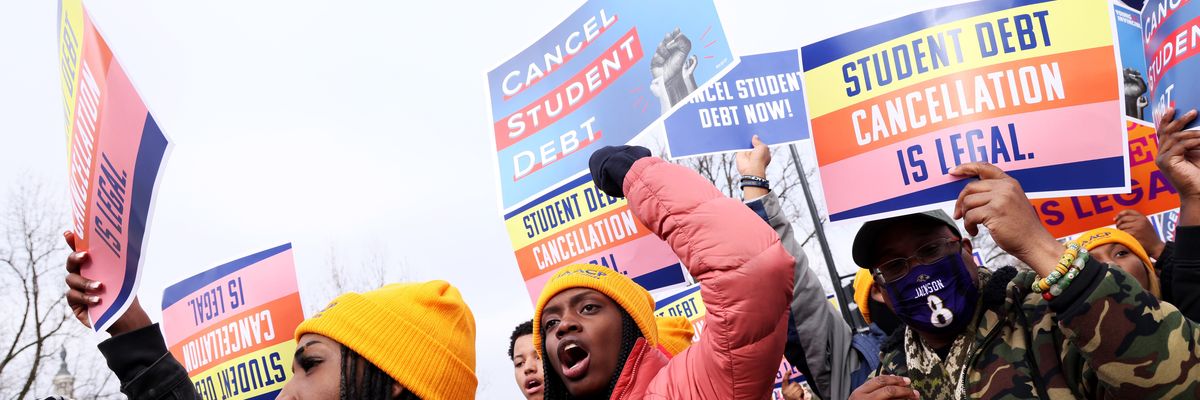
Student loan borrowers and advocates rally outside of the Supreme Court on February 28, 2023 in Washington, D.C.
"The Supreme Court can strike this iteration of relief down, but it won't have the last word," said one organizer.
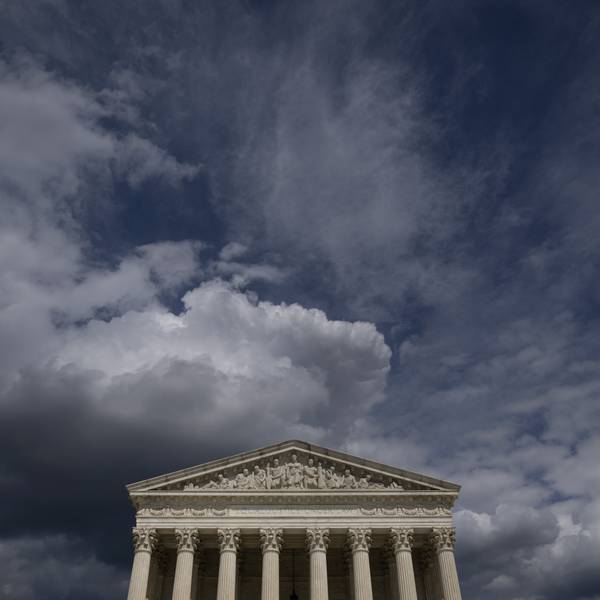
The U.S. Supreme Court on Friday sided with a group of Republican attorneys general and struck down the Biden administration's student debt cancellation program, undercutting efforts to deliver relief to tens of millions of borrowers.
In a 6-3 ruling along ideological lines, the high court's six conservative justices ruled that the GOP officials had standing to sue even though the Missouri student loan servicer they alleged would be harmed by the debt relief program was not part of the case.
Chief Justice John Roberts wrote the majority opinion, which ruled that the emergency power the Biden administration cited—the 2003 HEROES Act—"does not authorize" the Education Department's debt cancellation program.
The Supreme Court unanimously dismissed a separate challenge to the student debt relief program brought by two individual plaintiffs whose lawsuit was funded by the billionaire-backed Job Creators Network Foundation.
In her dissent in Biden v. Nebraska, liberal Justice Elena Kagan wrote that "at the behest of a party that has suffered no injury, the majority decides a contested public policy issue properly belonging to the politically accountable branches and the people they represent."
"So in a case not a case," Kagan added, "the majority overrides the combined judgment of the legislative and executive branches, with the consequence of eliminating loan forgiveness for 43 million Americans."
Debt relief campaigners pledged to keep up the fight, imploring the Biden administration to swiftly use his authority under the Higher Education Act of 1965 to enact broad-based debt cancellation.
"Debtors getting angry, hopeful, and organized is what put student debt cancellation on the political map," said Astra Taylor, co-founder of the Debt Collective. "We've won billions of dollars of relief so far, and we're just getting started. The Supreme Court can strike this iteration of relief down, but it won't have the last word."
The Supreme Court's decision to block debt relief sets the stage for an economic disaster.
In October, after being paused during the coronavirus pandemic, student loan repayments are set to resume, leaving borrowers who are already struggling financially with hundreds of dollars in additional payments each month.
"Student loan relief is a promise from President Biden to more than 40 million families," said Melissa Byrne, a debt relief campaigner and executive director of We the 45 Million. "It is our chance for dignity. He must immediately implement a plan B including finding a different path to ensure no repayment begins until cancellation is delivered."
"Failure to deliver student loan relief," Byrne added, "is not an option."
Dear Common Dreams reader, It’s been nearly 30 years since I co-founded Common Dreams with my late wife, Lina Newhouser. We had the radical notion that journalism should serve the public good, not corporate profits. It was clear to us from the outset what it would take to build such a project. No paid advertisements. No corporate sponsors. No millionaire publisher telling us what to think or do. Many people said we wouldn't last a year, but we proved those doubters wrong. Together with a tremendous team of journalists and dedicated staff, we built an independent media outlet free from the constraints of profits and corporate control. Our mission has always been simple: To inform. To inspire. To ignite change for the common good. Building Common Dreams was not easy. Our survival was never guaranteed. When you take on the most powerful forces—Wall Street greed, fossil fuel industry destruction, Big Tech lobbyists, and uber-rich oligarchs who have spent billions upon billions rigging the economy and democracy in their favor—the only bulwark you have is supporters who believe in your work. But here’s the urgent message from me today. It's never been this bad out there. And it's never been this hard to keep us going. At the very moment Common Dreams is most needed, the threats we face are intensifying. We need your support now more than ever. We don't accept corporate advertising and never will. We don't have a paywall because we don't think people should be blocked from critical news based on their ability to pay. Everything we do is funded by the donations of readers like you. When everyone does the little they can afford, we are strong. But if that support retreats or dries up, so do we. Will you donate now to make sure Common Dreams not only survives but thrives? —Craig Brown, Co-founder |
The U.S. Supreme Court on Friday sided with a group of Republican attorneys general and struck down the Biden administration's student debt cancellation program, undercutting efforts to deliver relief to tens of millions of borrowers.
In a 6-3 ruling along ideological lines, the high court's six conservative justices ruled that the GOP officials had standing to sue even though the Missouri student loan servicer they alleged would be harmed by the debt relief program was not part of the case.
Chief Justice John Roberts wrote the majority opinion, which ruled that the emergency power the Biden administration cited—the 2003 HEROES Act—"does not authorize" the Education Department's debt cancellation program.
The Supreme Court unanimously dismissed a separate challenge to the student debt relief program brought by two individual plaintiffs whose lawsuit was funded by the billionaire-backed Job Creators Network Foundation.
In her dissent in Biden v. Nebraska, liberal Justice Elena Kagan wrote that "at the behest of a party that has suffered no injury, the majority decides a contested public policy issue properly belonging to the politically accountable branches and the people they represent."
"So in a case not a case," Kagan added, "the majority overrides the combined judgment of the legislative and executive branches, with the consequence of eliminating loan forgiveness for 43 million Americans."
Debt relief campaigners pledged to keep up the fight, imploring the Biden administration to swiftly use his authority under the Higher Education Act of 1965 to enact broad-based debt cancellation.
"Debtors getting angry, hopeful, and organized is what put student debt cancellation on the political map," said Astra Taylor, co-founder of the Debt Collective. "We've won billions of dollars of relief so far, and we're just getting started. The Supreme Court can strike this iteration of relief down, but it won't have the last word."
The Supreme Court's decision to block debt relief sets the stage for an economic disaster.
In October, after being paused during the coronavirus pandemic, student loan repayments are set to resume, leaving borrowers who are already struggling financially with hundreds of dollars in additional payments each month.
"Student loan relief is a promise from President Biden to more than 40 million families," said Melissa Byrne, a debt relief campaigner and executive director of We the 45 Million. "It is our chance for dignity. He must immediately implement a plan B including finding a different path to ensure no repayment begins until cancellation is delivered."
"Failure to deliver student loan relief," Byrne added, "is not an option."
The U.S. Supreme Court on Friday sided with a group of Republican attorneys general and struck down the Biden administration's student debt cancellation program, undercutting efforts to deliver relief to tens of millions of borrowers.
In a 6-3 ruling along ideological lines, the high court's six conservative justices ruled that the GOP officials had standing to sue even though the Missouri student loan servicer they alleged would be harmed by the debt relief program was not part of the case.
Chief Justice John Roberts wrote the majority opinion, which ruled that the emergency power the Biden administration cited—the 2003 HEROES Act—"does not authorize" the Education Department's debt cancellation program.
The Supreme Court unanimously dismissed a separate challenge to the student debt relief program brought by two individual plaintiffs whose lawsuit was funded by the billionaire-backed Job Creators Network Foundation.
In her dissent in Biden v. Nebraska, liberal Justice Elena Kagan wrote that "at the behest of a party that has suffered no injury, the majority decides a contested public policy issue properly belonging to the politically accountable branches and the people they represent."
"So in a case not a case," Kagan added, "the majority overrides the combined judgment of the legislative and executive branches, with the consequence of eliminating loan forgiveness for 43 million Americans."
Debt relief campaigners pledged to keep up the fight, imploring the Biden administration to swiftly use his authority under the Higher Education Act of 1965 to enact broad-based debt cancellation.
"Debtors getting angry, hopeful, and organized is what put student debt cancellation on the political map," said Astra Taylor, co-founder of the Debt Collective. "We've won billions of dollars of relief so far, and we're just getting started. The Supreme Court can strike this iteration of relief down, but it won't have the last word."
The Supreme Court's decision to block debt relief sets the stage for an economic disaster.
In October, after being paused during the coronavirus pandemic, student loan repayments are set to resume, leaving borrowers who are already struggling financially with hundreds of dollars in additional payments each month.
"Student loan relief is a promise from President Biden to more than 40 million families," said Melissa Byrne, a debt relief campaigner and executive director of We the 45 Million. "It is our chance for dignity. He must immediately implement a plan B including finding a different path to ensure no repayment begins until cancellation is delivered."
"Failure to deliver student loan relief," Byrne added, "is not an option."