SUBSCRIBE TO OUR FREE NEWSLETTER
Daily news & progressive opinion—funded by the people, not the corporations—delivered straight to your inbox.
5
#000000
#FFFFFF
To donate by check, phone, or other method, see our More Ways to Give page.
Daily news & progressive opinion—funded by the people, not the corporations—delivered straight to your inbox.
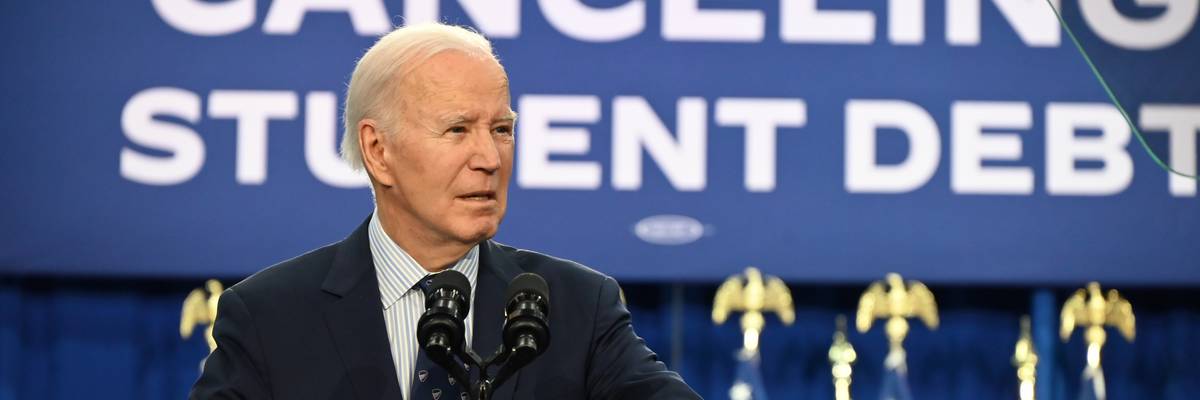
U.S. President Joe Biden delivers remarks on student debt and lowering costs for Americans at Madison College in Madison, Wisconsin on April 8, 2024.
"I reckon the U.S. Supreme Court does not like millions of people being able to afford to make payments on their student loans," said one journalist who had benefited from the SAVE program.
Millions of student loan borrowers whose monthly payments had been reduced by U.S. President Joe Biden's latest attempt to achieve debt relief were thrown into limbo Wednesday as the right-wing majority on the Supreme Court ruled in favor of a sweeping suspension of the president's policy.
After several Republican-led states filed lawsuits against the Saving on a Valuable Education (SAVE) program, the U.S. Court of Appeals for the 8th Circuit ruled last month that the program should be paused while it evaluated the merits of the case.
The Biden administration had asked the high court to clear the way for SAVE to go back into effect, allowing 8 million Americans enrolled in the program to make monthly loan payments based on their incomes.
Mike Pierce, executive director of the Student Borrower Protection Center, said the Supreme Court "bought into the 8th Circuit's legal fiction that pausing affordable payments is 'preserving the status quo,'" issuing a ruling he denounced as "bullshit."
Under SAVE, which has already cleared debts for 400,000 borrowers, the Biden administration reduced monthly payments for undergraduate loans to 5% of the borrower's discretionary income, down from 10%. Loans of $12,000 or less were to be canceled after 10 years instead of 20-25 years, as long as the borrower made required payments.
The administration argued that the program was in accordance with a 1993 law allowing the secretary of education to establish "income contingent repayment" plans based on "the appropriate portion of the annual income of the borrower."
After the lower court's earlier ruling, Education Secretary Miguel Cardona said the court had rejected "a practice of providing loan forgiveness that goes back 30 years."
Ashton Pittman, an editor for the Mississippi Free Press, said the program had reduced his monthly student loan payments so that he was "finally able to reliably make them each month."
"But I reckon the U.S. Supreme Court does not like millions of people being able to afford to make payments on their student loans," said Pittman.
The Debt Collective, a national student loan borrowers union, suggested the latest ruling—which comes over a year after the Supreme Court struck down a broader student debt relief plan from Biden—shows that the fight for debt forgiveness cannot be won through the federal court system.
The Debt Collective has joined progressive lawmakers and other groups in calling for the Department of Education to cut ties with the Missouri Higher Education Loan Authority (MOHELA), which services federal student loans and which Missouri Attorney General Andrew Bailey said would lose revenue if student debt cancellation is allowed to move forward.
"Biden is losing in court because he is not being politically or legally savvy," said the group after the 8th Circuit ruling was announced. "He should fire MOHELA and issue cancellation swiftly and automatically through an executive order and issue pause."
Dear Common Dreams reader, It’s been nearly 30 years since I co-founded Common Dreams with my late wife, Lina Newhouser. We had the radical notion that journalism should serve the public good, not corporate profits. It was clear to us from the outset what it would take to build such a project. No paid advertisements. No corporate sponsors. No millionaire publisher telling us what to think or do. Many people said we wouldn't last a year, but we proved those doubters wrong. Together with a tremendous team of journalists and dedicated staff, we built an independent media outlet free from the constraints of profits and corporate control. Our mission has always been simple: To inform. To inspire. To ignite change for the common good. Building Common Dreams was not easy. Our survival was never guaranteed. When you take on the most powerful forces—Wall Street greed, fossil fuel industry destruction, Big Tech lobbyists, and uber-rich oligarchs who have spent billions upon billions rigging the economy and democracy in their favor—the only bulwark you have is supporters who believe in your work. But here’s the urgent message from me today. It's never been this bad out there. And it's never been this hard to keep us going. At the very moment Common Dreams is most needed, the threats we face are intensifying. We need your support now more than ever. We don't accept corporate advertising and never will. We don't have a paywall because we don't think people should be blocked from critical news based on their ability to pay. Everything we do is funded by the donations of readers like you. When everyone does the little they can afford, we are strong. But if that support retreats or dries up, so do we. Will you donate now to make sure Common Dreams not only survives but thrives? —Craig Brown, Co-founder |
Millions of student loan borrowers whose monthly payments had been reduced by U.S. President Joe Biden's latest attempt to achieve debt relief were thrown into limbo Wednesday as the right-wing majority on the Supreme Court ruled in favor of a sweeping suspension of the president's policy.
After several Republican-led states filed lawsuits against the Saving on a Valuable Education (SAVE) program, the U.S. Court of Appeals for the 8th Circuit ruled last month that the program should be paused while it evaluated the merits of the case.
The Biden administration had asked the high court to clear the way for SAVE to go back into effect, allowing 8 million Americans enrolled in the program to make monthly loan payments based on their incomes.
Mike Pierce, executive director of the Student Borrower Protection Center, said the Supreme Court "bought into the 8th Circuit's legal fiction that pausing affordable payments is 'preserving the status quo,'" issuing a ruling he denounced as "bullshit."
Under SAVE, which has already cleared debts for 400,000 borrowers, the Biden administration reduced monthly payments for undergraduate loans to 5% of the borrower's discretionary income, down from 10%. Loans of $12,000 or less were to be canceled after 10 years instead of 20-25 years, as long as the borrower made required payments.
The administration argued that the program was in accordance with a 1993 law allowing the secretary of education to establish "income contingent repayment" plans based on "the appropriate portion of the annual income of the borrower."
After the lower court's earlier ruling, Education Secretary Miguel Cardona said the court had rejected "a practice of providing loan forgiveness that goes back 30 years."
Ashton Pittman, an editor for the Mississippi Free Press, said the program had reduced his monthly student loan payments so that he was "finally able to reliably make them each month."
"But I reckon the U.S. Supreme Court does not like millions of people being able to afford to make payments on their student loans," said Pittman.
The Debt Collective, a national student loan borrowers union, suggested the latest ruling—which comes over a year after the Supreme Court struck down a broader student debt relief plan from Biden—shows that the fight for debt forgiveness cannot be won through the federal court system.
The Debt Collective has joined progressive lawmakers and other groups in calling for the Department of Education to cut ties with the Missouri Higher Education Loan Authority (MOHELA), which services federal student loans and which Missouri Attorney General Andrew Bailey said would lose revenue if student debt cancellation is allowed to move forward.
"Biden is losing in court because he is not being politically or legally savvy," said the group after the 8th Circuit ruling was announced. "He should fire MOHELA and issue cancellation swiftly and automatically through an executive order and issue pause."
Millions of student loan borrowers whose monthly payments had been reduced by U.S. President Joe Biden's latest attempt to achieve debt relief were thrown into limbo Wednesday as the right-wing majority on the Supreme Court ruled in favor of a sweeping suspension of the president's policy.
After several Republican-led states filed lawsuits against the Saving on a Valuable Education (SAVE) program, the U.S. Court of Appeals for the 8th Circuit ruled last month that the program should be paused while it evaluated the merits of the case.
The Biden administration had asked the high court to clear the way for SAVE to go back into effect, allowing 8 million Americans enrolled in the program to make monthly loan payments based on their incomes.
Mike Pierce, executive director of the Student Borrower Protection Center, said the Supreme Court "bought into the 8th Circuit's legal fiction that pausing affordable payments is 'preserving the status quo,'" issuing a ruling he denounced as "bullshit."
Under SAVE, which has already cleared debts for 400,000 borrowers, the Biden administration reduced monthly payments for undergraduate loans to 5% of the borrower's discretionary income, down from 10%. Loans of $12,000 or less were to be canceled after 10 years instead of 20-25 years, as long as the borrower made required payments.
The administration argued that the program was in accordance with a 1993 law allowing the secretary of education to establish "income contingent repayment" plans based on "the appropriate portion of the annual income of the borrower."
After the lower court's earlier ruling, Education Secretary Miguel Cardona said the court had rejected "a practice of providing loan forgiveness that goes back 30 years."
Ashton Pittman, an editor for the Mississippi Free Press, said the program had reduced his monthly student loan payments so that he was "finally able to reliably make them each month."
"But I reckon the U.S. Supreme Court does not like millions of people being able to afford to make payments on their student loans," said Pittman.
The Debt Collective, a national student loan borrowers union, suggested the latest ruling—which comes over a year after the Supreme Court struck down a broader student debt relief plan from Biden—shows that the fight for debt forgiveness cannot be won through the federal court system.
The Debt Collective has joined progressive lawmakers and other groups in calling for the Department of Education to cut ties with the Missouri Higher Education Loan Authority (MOHELA), which services federal student loans and which Missouri Attorney General Andrew Bailey said would lose revenue if student debt cancellation is allowed to move forward.
"Biden is losing in court because he is not being politically or legally savvy," said the group after the 8th Circuit ruling was announced. "He should fire MOHELA and issue cancellation swiftly and automatically through an executive order and issue pause."