SUBSCRIBE TO OUR FREE NEWSLETTER
Daily news & progressive opinion—funded by the people, not the corporations—delivered straight to your inbox.
5
#000000
#FFFFFF
To donate by check, phone, or other method, see our More Ways to Give page.
Daily news & progressive opinion—funded by the people, not the corporations—delivered straight to your inbox.
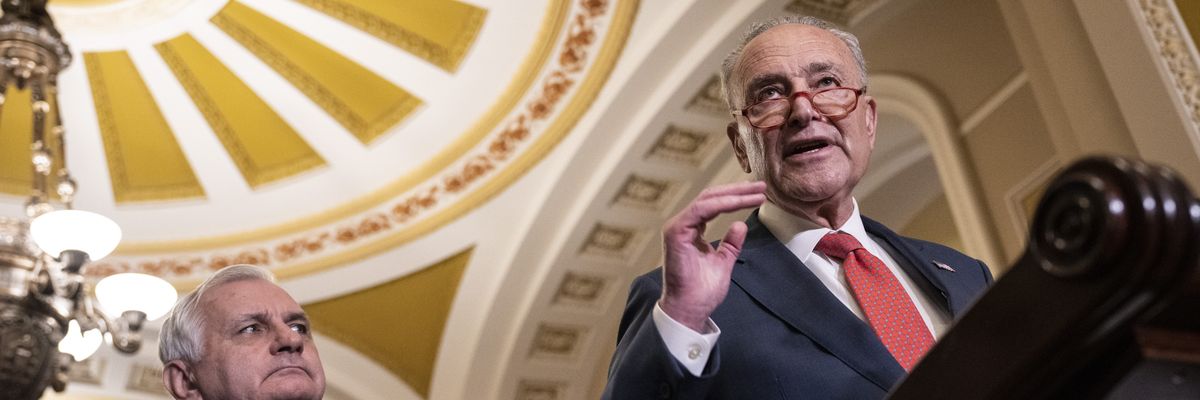
Sen. Jack Reed (D-R.I.) looks on as Senate Majority Leader Chuck Schumer (D-N.Y.) speaks during a news conference on July 26, 2023 in Washington, D.C.
The U.S. Senate passed its version of the National Defense Authorization Act in an overwhelming bipartisan vote on Thursday after rejecting Sen. Bernie Sanders' push for a 10% cut to military spending.
Just 11 senators, including Sanders (I-Vt.), voted against final passage of the sprawling NDAA, which would authorize a record $886 billion in military spending for the coming fiscal year—including over $844 billion for the Pentagon and roughly $32 billion for the Energy Department's nuclear weapons programs.
The Congressional Budget Office estimated earlier this month that U.S. nuclear forces will cost the nation $756 billion over the next decade, or over $75 billion a year. By comparison, the student debt cancellation plan that the Supreme Court struck down last month would have cost $30 billion annually over ten years, according to the Education Department.
Sanders' amendment, which was blocked in an 11-88 vote, would have cut the total amount of funding authorized in the NDAA by $88.6 billion.
In a floor speech ahead of Thursday's vote, Sanders lamented that "year after year, with very little debate, we pour hundreds of billions of dollars into the military-industrial complex" while neglecting healthcare, education, housing, and the boiling planet.
"While defense contractors make huge profits, while the Pentagon remains unordered—with massive waste and fraud—we now spend more than the next 10 nations combined," said Sanders. "Enough is enough. It's time to change our national priorities, and cutting military spending by 10% is a good way to begin."
Sen. Ed Markey (D-Mass.), one of the few senators to both support Sanders' amendment and vote against the NDAA, said in a statement that "the Senate voted to pad the Pentagon with a cushy, near trillion-dollar spending package to the tune of $886 billion—a ridiculous dollar figure that the military does not need."
"The American people have repeatedly heard from Republicans that we need to cut government spending—for education, for healthcare, for food assistance—and now they are enthusiastically throwing every nickel and dime they can find between the couch cushions to their defense contractor friends," Markey added. "It's shameful."
The Senate and House will now begin the process of reconciling the differences between their respective versions of the NDAA. Earlier this month, the Republican-controlled House—with the support of four Democrats—passed an NDAA loaded with right-wing amendments that would roll back abortion access and gender-affirming care for servicemembers.
But what the two chambers' bills have in common is the $886 billion topline, which is in step with President Joe Biden's original request for fiscal year 2024 and a $28 billion increase over the military spending level authorized for the current fiscal year.
As Politico reported, the Senate bill "includes nonbinding language that warns the $886 billion national defense spending limit set by a recent debt ceiling deal isn't sufficient and urges Biden to request emergency supplemental funding for Ukraine, munitions production, and other necessities." Critics have warned that such supplemental spending could become a new Pentagon "slush fund."
Following Thursday's vote, Public Citizen president Robert Weissman wrote that "we're told that we don't have enough money for daycare, universal pre-K, housing the homeless, providing hearing aids for seniors, tackling the climate crisis."
"We do not need to spend $886 billion on the Pentagon," he added. "Spending $886 billion on the Pentagon will not make us safer. "Redirecting 10% of that total for healthcare, education, climate, and other priorities—as Sen. Bernie Sanders proposed—would."
Dear Common Dreams reader, It’s been nearly 30 years since I co-founded Common Dreams with my late wife, Lina Newhouser. We had the radical notion that journalism should serve the public good, not corporate profits. It was clear to us from the outset what it would take to build such a project. No paid advertisements. No corporate sponsors. No millionaire publisher telling us what to think or do. Many people said we wouldn't last a year, but we proved those doubters wrong. Together with a tremendous team of journalists and dedicated staff, we built an independent media outlet free from the constraints of profits and corporate control. Our mission has always been simple: To inform. To inspire. To ignite change for the common good. Building Common Dreams was not easy. Our survival was never guaranteed. When you take on the most powerful forces—Wall Street greed, fossil fuel industry destruction, Big Tech lobbyists, and uber-rich oligarchs who have spent billions upon billions rigging the economy and democracy in their favor—the only bulwark you have is supporters who believe in your work. But here’s the urgent message from me today. It's never been this bad out there. And it's never been this hard to keep us going. At the very moment Common Dreams is most needed, the threats we face are intensifying. We need your support now more than ever. We don't accept corporate advertising and never will. We don't have a paywall because we don't think people should be blocked from critical news based on their ability to pay. Everything we do is funded by the donations of readers like you. When everyone does the little they can afford, we are strong. But if that support retreats or dries up, so do we. Will you donate now to make sure Common Dreams not only survives but thrives? —Craig Brown, Co-founder |
The U.S. Senate passed its version of the National Defense Authorization Act in an overwhelming bipartisan vote on Thursday after rejecting Sen. Bernie Sanders' push for a 10% cut to military spending.
Just 11 senators, including Sanders (I-Vt.), voted against final passage of the sprawling NDAA, which would authorize a record $886 billion in military spending for the coming fiscal year—including over $844 billion for the Pentagon and roughly $32 billion for the Energy Department's nuclear weapons programs.
The Congressional Budget Office estimated earlier this month that U.S. nuclear forces will cost the nation $756 billion over the next decade, or over $75 billion a year. By comparison, the student debt cancellation plan that the Supreme Court struck down last month would have cost $30 billion annually over ten years, according to the Education Department.
Sanders' amendment, which was blocked in an 11-88 vote, would have cut the total amount of funding authorized in the NDAA by $88.6 billion.
In a floor speech ahead of Thursday's vote, Sanders lamented that "year after year, with very little debate, we pour hundreds of billions of dollars into the military-industrial complex" while neglecting healthcare, education, housing, and the boiling planet.
"While defense contractors make huge profits, while the Pentagon remains unordered—with massive waste and fraud—we now spend more than the next 10 nations combined," said Sanders. "Enough is enough. It's time to change our national priorities, and cutting military spending by 10% is a good way to begin."
Sen. Ed Markey (D-Mass.), one of the few senators to both support Sanders' amendment and vote against the NDAA, said in a statement that "the Senate voted to pad the Pentagon with a cushy, near trillion-dollar spending package to the tune of $886 billion—a ridiculous dollar figure that the military does not need."
"The American people have repeatedly heard from Republicans that we need to cut government spending—for education, for healthcare, for food assistance—and now they are enthusiastically throwing every nickel and dime they can find between the couch cushions to their defense contractor friends," Markey added. "It's shameful."
The Senate and House will now begin the process of reconciling the differences between their respective versions of the NDAA. Earlier this month, the Republican-controlled House—with the support of four Democrats—passed an NDAA loaded with right-wing amendments that would roll back abortion access and gender-affirming care for servicemembers.
But what the two chambers' bills have in common is the $886 billion topline, which is in step with President Joe Biden's original request for fiscal year 2024 and a $28 billion increase over the military spending level authorized for the current fiscal year.
As Politico reported, the Senate bill "includes nonbinding language that warns the $886 billion national defense spending limit set by a recent debt ceiling deal isn't sufficient and urges Biden to request emergency supplemental funding for Ukraine, munitions production, and other necessities." Critics have warned that such supplemental spending could become a new Pentagon "slush fund."
Following Thursday's vote, Public Citizen president Robert Weissman wrote that "we're told that we don't have enough money for daycare, universal pre-K, housing the homeless, providing hearing aids for seniors, tackling the climate crisis."
"We do not need to spend $886 billion on the Pentagon," he added. "Spending $886 billion on the Pentagon will not make us safer. "Redirecting 10% of that total for healthcare, education, climate, and other priorities—as Sen. Bernie Sanders proposed—would."
The U.S. Senate passed its version of the National Defense Authorization Act in an overwhelming bipartisan vote on Thursday after rejecting Sen. Bernie Sanders' push for a 10% cut to military spending.
Just 11 senators, including Sanders (I-Vt.), voted against final passage of the sprawling NDAA, which would authorize a record $886 billion in military spending for the coming fiscal year—including over $844 billion for the Pentagon and roughly $32 billion for the Energy Department's nuclear weapons programs.
The Congressional Budget Office estimated earlier this month that U.S. nuclear forces will cost the nation $756 billion over the next decade, or over $75 billion a year. By comparison, the student debt cancellation plan that the Supreme Court struck down last month would have cost $30 billion annually over ten years, according to the Education Department.
Sanders' amendment, which was blocked in an 11-88 vote, would have cut the total amount of funding authorized in the NDAA by $88.6 billion.
In a floor speech ahead of Thursday's vote, Sanders lamented that "year after year, with very little debate, we pour hundreds of billions of dollars into the military-industrial complex" while neglecting healthcare, education, housing, and the boiling planet.
"While defense contractors make huge profits, while the Pentagon remains unordered—with massive waste and fraud—we now spend more than the next 10 nations combined," said Sanders. "Enough is enough. It's time to change our national priorities, and cutting military spending by 10% is a good way to begin."
Sen. Ed Markey (D-Mass.), one of the few senators to both support Sanders' amendment and vote against the NDAA, said in a statement that "the Senate voted to pad the Pentagon with a cushy, near trillion-dollar spending package to the tune of $886 billion—a ridiculous dollar figure that the military does not need."
"The American people have repeatedly heard from Republicans that we need to cut government spending—for education, for healthcare, for food assistance—and now they are enthusiastically throwing every nickel and dime they can find between the couch cushions to their defense contractor friends," Markey added. "It's shameful."
The Senate and House will now begin the process of reconciling the differences between their respective versions of the NDAA. Earlier this month, the Republican-controlled House—with the support of four Democrats—passed an NDAA loaded with right-wing amendments that would roll back abortion access and gender-affirming care for servicemembers.
But what the two chambers' bills have in common is the $886 billion topline, which is in step with President Joe Biden's original request for fiscal year 2024 and a $28 billion increase over the military spending level authorized for the current fiscal year.
As Politico reported, the Senate bill "includes nonbinding language that warns the $886 billion national defense spending limit set by a recent debt ceiling deal isn't sufficient and urges Biden to request emergency supplemental funding for Ukraine, munitions production, and other necessities." Critics have warned that such supplemental spending could become a new Pentagon "slush fund."
Following Thursday's vote, Public Citizen president Robert Weissman wrote that "we're told that we don't have enough money for daycare, universal pre-K, housing the homeless, providing hearing aids for seniors, tackling the climate crisis."
"We do not need to spend $886 billion on the Pentagon," he added. "Spending $886 billion on the Pentagon will not make us safer. "Redirecting 10% of that total for healthcare, education, climate, and other priorities—as Sen. Bernie Sanders proposed—would."