SUBSCRIBE TO OUR FREE NEWSLETTER
Daily news & progressive opinion—funded by the people, not the corporations—delivered straight to your inbox.
5
#000000
#FFFFFF
To donate by check, phone, or other method, see our More Ways to Give page.
Daily news & progressive opinion—funded by the people, not the corporations—delivered straight to your inbox.
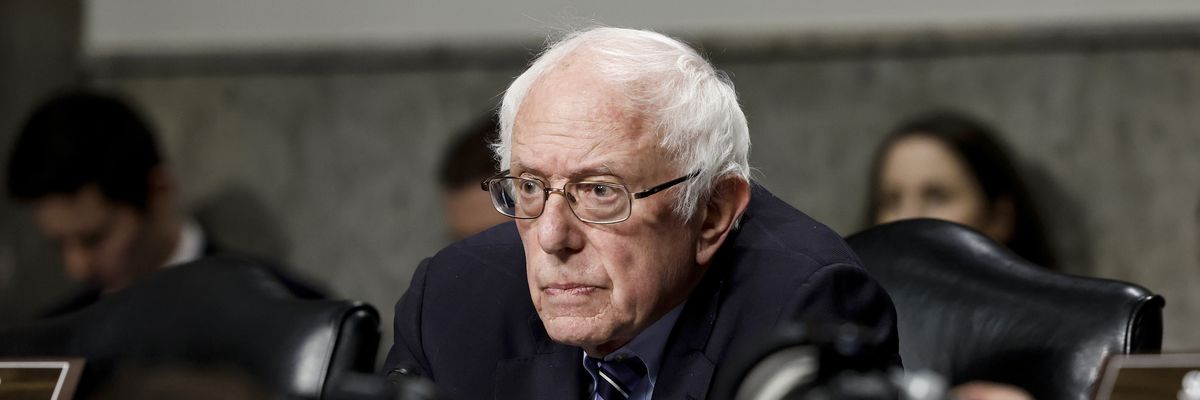
Sen. Bernie Sanders (I-Vt.) presides over a hearing on March 29, 2023 in Washington, D.C.
Five U.S. senators wrote that the Pentagon "can no longer expect Congress or the American taxpayer to underwrite record military spending while simultaneously failing to account for the hundreds of billions it hands out every year."
Sen. Bernie Sanders on Thursday led a group of senators in urging the Pentagon to investigate price gouging by military contractors after a CBS News probe that aired on "60 Minutes" earlier this week confirmed that private corporations are drastically overcharging the Defense Department for weaponry and other equipment, resulting in hundreds of millions of dollars in excess taxpayer spending and huge profits for the arms industry.
"The six-month investigation by CBS News, including extensive interviews with former DOD contracting officials, uncovered massive overcharges from defense contractors accounting for hundreds of millions of dollars," reads a letter that Sanders and four of his Senate colleagues—Sens. Elizabeth Warren (D-Mass.), Ron Wyden (D-Ore.), Mike Braun (R-Ind.), and Chuck Grassley (R-Iowa)—sent to Defense Secretary Lloyd Austin.
"As CBS reported, DOD's fixed price contracts would often provide for private profits of 12-15%," the letter continues. "Pentagon analysts found overcharges that boosted total profits to nearly 40% and sometimes as high as 4,000%. Lockheed Martin, Boeing, Raytheon, and TransDigm are among the offenders, dramatically overcharging the department and U.S. taxpayers while reaping enormous profits, seeing their stock prices soar, and handing out massive executive compensation packages."
The senators also fault the Pentagon for staggering oversight failures, noting that the "60 Minutes" investigation "underlines longstanding concerns around the department's inability to pass an audit, accurately track its finances, or mitigate against fraud risk in the hundreds of billions of dollars in contracts it awards every year."
In 2021, Sanders, Wyden, Grassley, and other lawmakers teamed up to introduce legislation that would require the Pentagon to pass a full, independent audit. The bill did not get a floor vote in either chamber of Congress.
"The DOD can no longer expect Congress or the American taxpayer to underwrite record military spending while simultaneously failing to account for the hundreds of billions it hands out every year to spectacularly profitable private corporations," the letter reads. "We ask that you please provide us an update on the department’s efforts to implement outstanding GAO recommendations related to financial management and fraud risk reduction, as well as your efforts to investigate the price gouging uncovered by CBS' recent reporting."
"Proposals to push weapons out the door more quickly with less scrutiny, coupled with the sheer volume of systems being produced, will open the way to additional price gouging."
The senators' letter comes as the Pentagon is requesting $842 billion for fiscal year 2024 and as Republicans are pushing for higher military spending in debt ceiling talks with the Biden White House, even amid fresh evidence of wasteful spending that they claim to oppose.
The U.S. currently spends more on its military than over 144 countries combined, and roughly half of the Pentagon's annual budget ends up in the coffers of private corporations which—according to a recent Defense Department-backed study—are "profitable" and "generate substantial amounts of cash beyond their needs for operations or capital investment."
William Hartung, a senior research fellow at the Quincy Institute for Responsible Statecraft, wrote earlier this week that the Pentagon's systematic and persistent oversight lapses will likely "be exacerbated by the push to rapidly expand production to deal with supplying Ukraine and stockpiling systems relevant to a potential conflict with China."
"Proposals to push weapons out the door more quickly with less scrutiny, coupled with the sheer volume of systems being produced, will open the way to additional price gouging," Hartung warned.
"As spending rises and vetting decreases, the prospects for fraud, waste, and abuse will grow," he added. "And the arms industry and its allies in Congress and the Pentagon are intent on making any changes made to deal with the Ukraine emergency permanent, which could supersize the weapons industry while reducing oversight and accountability—a recipe for relentless, unnecessary price increases that could continue well beyond the end of the Ukraine war."
Dear Common Dreams reader, It’s been nearly 30 years since I co-founded Common Dreams with my late wife, Lina Newhouser. We had the radical notion that journalism should serve the public good, not corporate profits. It was clear to us from the outset what it would take to build such a project. No paid advertisements. No corporate sponsors. No millionaire publisher telling us what to think or do. Many people said we wouldn't last a year, but we proved those doubters wrong. Together with a tremendous team of journalists and dedicated staff, we built an independent media outlet free from the constraints of profits and corporate control. Our mission has always been simple: To inform. To inspire. To ignite change for the common good. Building Common Dreams was not easy. Our survival was never guaranteed. When you take on the most powerful forces—Wall Street greed, fossil fuel industry destruction, Big Tech lobbyists, and uber-rich oligarchs who have spent billions upon billions rigging the economy and democracy in their favor—the only bulwark you have is supporters who believe in your work. But here’s the urgent message from me today. It's never been this bad out there. And it's never been this hard to keep us going. At the very moment Common Dreams is most needed, the threats we face are intensifying. We need your support now more than ever. We don't accept corporate advertising and never will. We don't have a paywall because we don't think people should be blocked from critical news based on their ability to pay. Everything we do is funded by the donations of readers like you. When everyone does the little they can afford, we are strong. But if that support retreats or dries up, so do we. Will you donate now to make sure Common Dreams not only survives but thrives? —Craig Brown, Co-founder |
Sen. Bernie Sanders on Thursday led a group of senators in urging the Pentagon to investigate price gouging by military contractors after a CBS News probe that aired on "60 Minutes" earlier this week confirmed that private corporations are drastically overcharging the Defense Department for weaponry and other equipment, resulting in hundreds of millions of dollars in excess taxpayer spending and huge profits for the arms industry.
"The six-month investigation by CBS News, including extensive interviews with former DOD contracting officials, uncovered massive overcharges from defense contractors accounting for hundreds of millions of dollars," reads a letter that Sanders and four of his Senate colleagues—Sens. Elizabeth Warren (D-Mass.), Ron Wyden (D-Ore.), Mike Braun (R-Ind.), and Chuck Grassley (R-Iowa)—sent to Defense Secretary Lloyd Austin.
"As CBS reported, DOD's fixed price contracts would often provide for private profits of 12-15%," the letter continues. "Pentagon analysts found overcharges that boosted total profits to nearly 40% and sometimes as high as 4,000%. Lockheed Martin, Boeing, Raytheon, and TransDigm are among the offenders, dramatically overcharging the department and U.S. taxpayers while reaping enormous profits, seeing their stock prices soar, and handing out massive executive compensation packages."
The senators also fault the Pentagon for staggering oversight failures, noting that the "60 Minutes" investigation "underlines longstanding concerns around the department's inability to pass an audit, accurately track its finances, or mitigate against fraud risk in the hundreds of billions of dollars in contracts it awards every year."
In 2021, Sanders, Wyden, Grassley, and other lawmakers teamed up to introduce legislation that would require the Pentagon to pass a full, independent audit. The bill did not get a floor vote in either chamber of Congress.
"The DOD can no longer expect Congress or the American taxpayer to underwrite record military spending while simultaneously failing to account for the hundreds of billions it hands out every year to spectacularly profitable private corporations," the letter reads. "We ask that you please provide us an update on the department’s efforts to implement outstanding GAO recommendations related to financial management and fraud risk reduction, as well as your efforts to investigate the price gouging uncovered by CBS' recent reporting."
"Proposals to push weapons out the door more quickly with less scrutiny, coupled with the sheer volume of systems being produced, will open the way to additional price gouging."
The senators' letter comes as the Pentagon is requesting $842 billion for fiscal year 2024 and as Republicans are pushing for higher military spending in debt ceiling talks with the Biden White House, even amid fresh evidence of wasteful spending that they claim to oppose.
The U.S. currently spends more on its military than over 144 countries combined, and roughly half of the Pentagon's annual budget ends up in the coffers of private corporations which—according to a recent Defense Department-backed study—are "profitable" and "generate substantial amounts of cash beyond their needs for operations or capital investment."
William Hartung, a senior research fellow at the Quincy Institute for Responsible Statecraft, wrote earlier this week that the Pentagon's systematic and persistent oversight lapses will likely "be exacerbated by the push to rapidly expand production to deal with supplying Ukraine and stockpiling systems relevant to a potential conflict with China."
"Proposals to push weapons out the door more quickly with less scrutiny, coupled with the sheer volume of systems being produced, will open the way to additional price gouging," Hartung warned.
"As spending rises and vetting decreases, the prospects for fraud, waste, and abuse will grow," he added. "And the arms industry and its allies in Congress and the Pentagon are intent on making any changes made to deal with the Ukraine emergency permanent, which could supersize the weapons industry while reducing oversight and accountability—a recipe for relentless, unnecessary price increases that could continue well beyond the end of the Ukraine war."
Sen. Bernie Sanders on Thursday led a group of senators in urging the Pentagon to investigate price gouging by military contractors after a CBS News probe that aired on "60 Minutes" earlier this week confirmed that private corporations are drastically overcharging the Defense Department for weaponry and other equipment, resulting in hundreds of millions of dollars in excess taxpayer spending and huge profits for the arms industry.
"The six-month investigation by CBS News, including extensive interviews with former DOD contracting officials, uncovered massive overcharges from defense contractors accounting for hundreds of millions of dollars," reads a letter that Sanders and four of his Senate colleagues—Sens. Elizabeth Warren (D-Mass.), Ron Wyden (D-Ore.), Mike Braun (R-Ind.), and Chuck Grassley (R-Iowa)—sent to Defense Secretary Lloyd Austin.
"As CBS reported, DOD's fixed price contracts would often provide for private profits of 12-15%," the letter continues. "Pentagon analysts found overcharges that boosted total profits to nearly 40% and sometimes as high as 4,000%. Lockheed Martin, Boeing, Raytheon, and TransDigm are among the offenders, dramatically overcharging the department and U.S. taxpayers while reaping enormous profits, seeing their stock prices soar, and handing out massive executive compensation packages."
The senators also fault the Pentagon for staggering oversight failures, noting that the "60 Minutes" investigation "underlines longstanding concerns around the department's inability to pass an audit, accurately track its finances, or mitigate against fraud risk in the hundreds of billions of dollars in contracts it awards every year."
In 2021, Sanders, Wyden, Grassley, and other lawmakers teamed up to introduce legislation that would require the Pentagon to pass a full, independent audit. The bill did not get a floor vote in either chamber of Congress.
"The DOD can no longer expect Congress or the American taxpayer to underwrite record military spending while simultaneously failing to account for the hundreds of billions it hands out every year to spectacularly profitable private corporations," the letter reads. "We ask that you please provide us an update on the department’s efforts to implement outstanding GAO recommendations related to financial management and fraud risk reduction, as well as your efforts to investigate the price gouging uncovered by CBS' recent reporting."
"Proposals to push weapons out the door more quickly with less scrutiny, coupled with the sheer volume of systems being produced, will open the way to additional price gouging."
The senators' letter comes as the Pentagon is requesting $842 billion for fiscal year 2024 and as Republicans are pushing for higher military spending in debt ceiling talks with the Biden White House, even amid fresh evidence of wasteful spending that they claim to oppose.
The U.S. currently spends more on its military than over 144 countries combined, and roughly half of the Pentagon's annual budget ends up in the coffers of private corporations which—according to a recent Defense Department-backed study—are "profitable" and "generate substantial amounts of cash beyond their needs for operations or capital investment."
William Hartung, a senior research fellow at the Quincy Institute for Responsible Statecraft, wrote earlier this week that the Pentagon's systematic and persistent oversight lapses will likely "be exacerbated by the push to rapidly expand production to deal with supplying Ukraine and stockpiling systems relevant to a potential conflict with China."
"Proposals to push weapons out the door more quickly with less scrutiny, coupled with the sheer volume of systems being produced, will open the way to additional price gouging," Hartung warned.
"As spending rises and vetting decreases, the prospects for fraud, waste, and abuse will grow," he added. "And the arms industry and its allies in Congress and the Pentagon are intent on making any changes made to deal with the Ukraine emergency permanent, which could supersize the weapons industry while reducing oversight and accountability—a recipe for relentless, unnecessary price increases that could continue well beyond the end of the Ukraine war."