5
#000000
#FFFFFF
To donate by check, phone, or other method, see our More Ways to Give page.
Daily news & progressive opinion—funded by the people, not the corporations—delivered straight to your inbox.
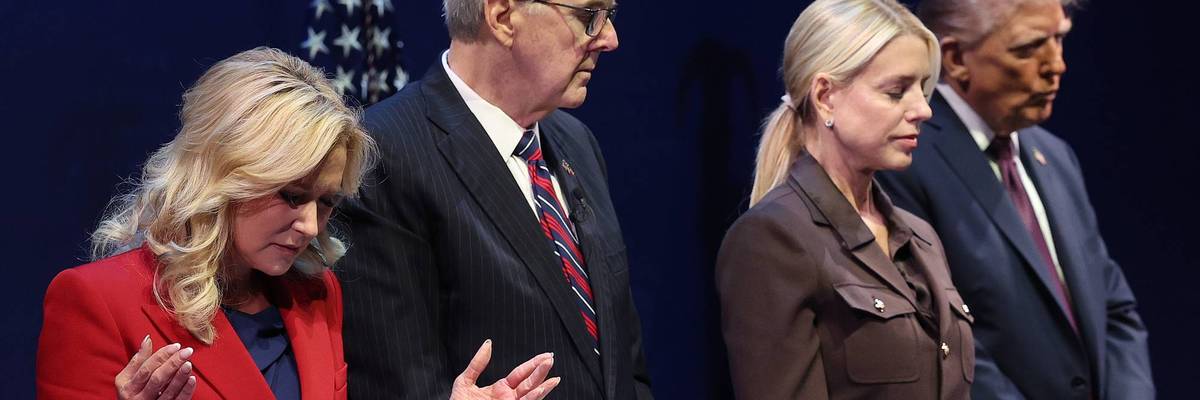
Pastor Paula White bows her head in prayer with Texas Lt. Gov. Dan Patrick, US Attorney General Pam Bondi, and President Donald Trump at the Museum of the Bible on September 8, 2025 in Washington, DC, where Trump addressed his Religious Liberty Commission.
"The Religious Liberty Commission isn't about protecting religious liberty for all; it's about rejecting our nation's religious diversity and prioritizing one narrow set of conservative 'Judeo-Christian' beliefs," said one critic.
"Religious freedom for some is religious freedom for none."
That's what Rev. Paul Brandeis Raushenbush, president and CEO of Interfaith Alliance, said in a Monday statement as faith groups filed a federal lawsuit in the Southern District of New York over President Donald Trump's so-called Religious Liberty Commission.
Since Trump launched the commission last year, critics have warned that its true intent is to advance a Christian nationalist agenda. Brandeis Raushenbush, his alliance, Hindus for Human Rights, Muslims for Progressive Values, and the Sikh American Legal Defense and Education Fund renewed that argument in the complaint, which names Trump, US Attorney General Pam Bondi, the Department of Justice, the commission, and its leader, Mary Margaret Bush, as defendants.
"The government has no right to pick and choose which religious beliefs to promote, and which to marginalize," said Brandeis Raushenbush. "The Trump administration has failed to uphold our country's proud religious freedom tradition, and we will hold them accountable. Today's lawsuit is our recommitment to fight for religious liberty for all with every tool available to us."
The complaint argues that "the composition and operations of the commission violate the Federal Advisory Committee Act (FACA)," which Congress enacted in 1972 "to curb the executive branch's reliance on superfluous, secretive, and biased 'advisory committees.'" Under the law, "every advisory committee must meet public transparency requirements, be in the public interest, be fairly balanced among competing points of view, and be structured to avoid inappropriate influence by special interests."
"While this body is ostensibly designed to defend 'religious liberty for all Americans' and celebrate 'religious pluralism' it actually represents only a single 'Judeo-Christian' viewpoint," the complaint states. "It held its first three meetings at the Museum of the Bible and has closed its meetings with a Christian prayer 'in Jesus' name.'"
"Only one of its members is not Christian, and the Christian members do not represent the full diversity of the Christian faith," the filing continues. "The commission's meetings have repeatedly referenced the belief that the United States was founded as a 'Judeo-Christian nation' and the membership reflects that viewpoint. All members of the commission advocate for increased religiosity, and specifically their brand of 'Judeo-Christian' religiosity, in public life."
"The commission's members have promoted the primacy of a Judeo-Christian worldview in the public sphere, advocated for discrimination against minority groups under the guise of 'religious liberty,' and otherwise supported policies that threaten religious freedom for all those who do not conform to their particular worldview," the document details.
Ria Chakrabarty, senior policy director of Hindus for Human Rights, said Monday that "by stacking this Religious Liberty Commission with a narrow set of voices and hiding the commission's work from the public eye, the Trump administration is evading the transparency and balance that federal law requires."
"Hindus for Human Rights is proud to stand with our multifaith partners to defend a pluralistic democracy where Hindus, Muslims, Sikhs, Jews, Christians, Buddhists, and nonreligious people all belong as equals," she added.
A commission that claims “religious liberty” while excluding Muslims, Hindus, Buddhists, Sikhs—and nonreligious Americans—isn’t protecting freedom. It’s narrowing it.We’re challenging this commission in court. democracyforward.org/news/press-r...
[image or embed]
— Hindus For Human Rights (@hfhr.bsky.social) February 9, 2026 at 10:21 AM
Ani Zonneveld, president and founder of Muslims for Progressive Values, noted that "as a Muslim American organization, we have seen firsthand how elevating a singular religion above others, especially in a country as religiously diverse as the United States, leads to the oppression and possible persecution of minority faiths."
The plaintiffs are represented by Democracy Forward, which has filed over 150 lawsuits against the Trump administration since the president returned to power last year, and the decades-old Americans United for Separation of Church and State—whose president and CEO, Rachel Laser, stressed that "the Religious Liberty Commission isn't about protecting religious liberty for all; it's about rejecting our nation's religious diversity and prioritizing one narrow set of conservative 'Judeo-Christian' beliefs."
Blasting the commission's public meetings as "a vivid example of this favoritism," Laser added that its "true purpose and operations can't be squared with America's constitutional promise of church-state separation."
Specifically, Laser's group and other advocates of church-state separation have long pointed to the establishment clause of the First Amendment to the US Constitution, which bars government from making any "law respecting an establishment of religion."
"Since the nation's founding, the values of religious liberty and pluralism have been central to the American identity. These values are now under accelerated attack," declared Perryman, who's also on the Interfaith Alliance board. "The fatally flawed way this commission was assembled makes clear that the outcome isn't just un-American, it's against the law."
Dear Common Dreams reader, The U.S. is on a fast track to authoritarianism like nothing I've ever seen. Meanwhile, corporate news outlets are utterly capitulating to Trump, twisting their coverage to avoid drawing his ire while lining up to stuff cash in his pockets. That's why I believe that Common Dreams is doing the best and most consequential reporting that we've ever done. Our small but mighty team is a progressive reporting powerhouse, covering the news every day that the corporate media never will. Our mission has always been simple: To inform. To inspire. And to ignite change for the common good. Now here's the key piece that I want all our readers to understand: None of this would be possible without your financial support. That's not just some fundraising cliche. It's the absolute and literal truth. We don't accept corporate advertising and never will. We don't have a paywall because we don't think people should be blocked from critical news based on their ability to pay. Everything we do is funded by the donations of readers like you. Will you donate now to help power the nonprofit, independent reporting of Common Dreams? Thank you for being a vital member of our community. Together, we can keep independent journalism alive when it’s needed most. - Craig Brown, Co-founder |
"Religious freedom for some is religious freedom for none."
That's what Rev. Paul Brandeis Raushenbush, president and CEO of Interfaith Alliance, said in a Monday statement as faith groups filed a federal lawsuit in the Southern District of New York over President Donald Trump's so-called Religious Liberty Commission.
Since Trump launched the commission last year, critics have warned that its true intent is to advance a Christian nationalist agenda. Brandeis Raushenbush, his alliance, Hindus for Human Rights, Muslims for Progressive Values, and the Sikh American Legal Defense and Education Fund renewed that argument in the complaint, which names Trump, US Attorney General Pam Bondi, the Department of Justice, the commission, and its leader, Mary Margaret Bush, as defendants.
"The government has no right to pick and choose which religious beliefs to promote, and which to marginalize," said Brandeis Raushenbush. "The Trump administration has failed to uphold our country's proud religious freedom tradition, and we will hold them accountable. Today's lawsuit is our recommitment to fight for religious liberty for all with every tool available to us."
The complaint argues that "the composition and operations of the commission violate the Federal Advisory Committee Act (FACA)," which Congress enacted in 1972 "to curb the executive branch's reliance on superfluous, secretive, and biased 'advisory committees.'" Under the law, "every advisory committee must meet public transparency requirements, be in the public interest, be fairly balanced among competing points of view, and be structured to avoid inappropriate influence by special interests."
"While this body is ostensibly designed to defend 'religious liberty for all Americans' and celebrate 'religious pluralism' it actually represents only a single 'Judeo-Christian' viewpoint," the complaint states. "It held its first three meetings at the Museum of the Bible and has closed its meetings with a Christian prayer 'in Jesus' name.'"
"Only one of its members is not Christian, and the Christian members do not represent the full diversity of the Christian faith," the filing continues. "The commission's meetings have repeatedly referenced the belief that the United States was founded as a 'Judeo-Christian nation' and the membership reflects that viewpoint. All members of the commission advocate for increased religiosity, and specifically their brand of 'Judeo-Christian' religiosity, in public life."
"The commission's members have promoted the primacy of a Judeo-Christian worldview in the public sphere, advocated for discrimination against minority groups under the guise of 'religious liberty,' and otherwise supported policies that threaten religious freedom for all those who do not conform to their particular worldview," the document details.
Ria Chakrabarty, senior policy director of Hindus for Human Rights, said Monday that "by stacking this Religious Liberty Commission with a narrow set of voices and hiding the commission's work from the public eye, the Trump administration is evading the transparency and balance that federal law requires."
"Hindus for Human Rights is proud to stand with our multifaith partners to defend a pluralistic democracy where Hindus, Muslims, Sikhs, Jews, Christians, Buddhists, and nonreligious people all belong as equals," she added.
A commission that claims “religious liberty” while excluding Muslims, Hindus, Buddhists, Sikhs—and nonreligious Americans—isn’t protecting freedom. It’s narrowing it.We’re challenging this commission in court. democracyforward.org/news/press-r...
[image or embed]
— Hindus For Human Rights (@hfhr.bsky.social) February 9, 2026 at 10:21 AM
Ani Zonneveld, president and founder of Muslims for Progressive Values, noted that "as a Muslim American organization, we have seen firsthand how elevating a singular religion above others, especially in a country as religiously diverse as the United States, leads to the oppression and possible persecution of minority faiths."
The plaintiffs are represented by Democracy Forward, which has filed over 150 lawsuits against the Trump administration since the president returned to power last year, and the decades-old Americans United for Separation of Church and State—whose president and CEO, Rachel Laser, stressed that "the Religious Liberty Commission isn't about protecting religious liberty for all; it's about rejecting our nation's religious diversity and prioritizing one narrow set of conservative 'Judeo-Christian' beliefs."
Blasting the commission's public meetings as "a vivid example of this favoritism," Laser added that its "true purpose and operations can't be squared with America's constitutional promise of church-state separation."
Specifically, Laser's group and other advocates of church-state separation have long pointed to the establishment clause of the First Amendment to the US Constitution, which bars government from making any "law respecting an establishment of religion."
"Since the nation's founding, the values of religious liberty and pluralism have been central to the American identity. These values are now under accelerated attack," declared Perryman, who's also on the Interfaith Alliance board. "The fatally flawed way this commission was assembled makes clear that the outcome isn't just un-American, it's against the law."
"Religious freedom for some is religious freedom for none."
That's what Rev. Paul Brandeis Raushenbush, president and CEO of Interfaith Alliance, said in a Monday statement as faith groups filed a federal lawsuit in the Southern District of New York over President Donald Trump's so-called Religious Liberty Commission.
Since Trump launched the commission last year, critics have warned that its true intent is to advance a Christian nationalist agenda. Brandeis Raushenbush, his alliance, Hindus for Human Rights, Muslims for Progressive Values, and the Sikh American Legal Defense and Education Fund renewed that argument in the complaint, which names Trump, US Attorney General Pam Bondi, the Department of Justice, the commission, and its leader, Mary Margaret Bush, as defendants.
"The government has no right to pick and choose which religious beliefs to promote, and which to marginalize," said Brandeis Raushenbush. "The Trump administration has failed to uphold our country's proud religious freedom tradition, and we will hold them accountable. Today's lawsuit is our recommitment to fight for religious liberty for all with every tool available to us."
The complaint argues that "the composition and operations of the commission violate the Federal Advisory Committee Act (FACA)," which Congress enacted in 1972 "to curb the executive branch's reliance on superfluous, secretive, and biased 'advisory committees.'" Under the law, "every advisory committee must meet public transparency requirements, be in the public interest, be fairly balanced among competing points of view, and be structured to avoid inappropriate influence by special interests."
"While this body is ostensibly designed to defend 'religious liberty for all Americans' and celebrate 'religious pluralism' it actually represents only a single 'Judeo-Christian' viewpoint," the complaint states. "It held its first three meetings at the Museum of the Bible and has closed its meetings with a Christian prayer 'in Jesus' name.'"
"Only one of its members is not Christian, and the Christian members do not represent the full diversity of the Christian faith," the filing continues. "The commission's meetings have repeatedly referenced the belief that the United States was founded as a 'Judeo-Christian nation' and the membership reflects that viewpoint. All members of the commission advocate for increased religiosity, and specifically their brand of 'Judeo-Christian' religiosity, in public life."
"The commission's members have promoted the primacy of a Judeo-Christian worldview in the public sphere, advocated for discrimination against minority groups under the guise of 'religious liberty,' and otherwise supported policies that threaten religious freedom for all those who do not conform to their particular worldview," the document details.
Ria Chakrabarty, senior policy director of Hindus for Human Rights, said Monday that "by stacking this Religious Liberty Commission with a narrow set of voices and hiding the commission's work from the public eye, the Trump administration is evading the transparency and balance that federal law requires."
"Hindus for Human Rights is proud to stand with our multifaith partners to defend a pluralistic democracy where Hindus, Muslims, Sikhs, Jews, Christians, Buddhists, and nonreligious people all belong as equals," she added.
A commission that claims “religious liberty” while excluding Muslims, Hindus, Buddhists, Sikhs—and nonreligious Americans—isn’t protecting freedom. It’s narrowing it.We’re challenging this commission in court. democracyforward.org/news/press-r...
[image or embed]
— Hindus For Human Rights (@hfhr.bsky.social) February 9, 2026 at 10:21 AM
Ani Zonneveld, president and founder of Muslims for Progressive Values, noted that "as a Muslim American organization, we have seen firsthand how elevating a singular religion above others, especially in a country as religiously diverse as the United States, leads to the oppression and possible persecution of minority faiths."
The plaintiffs are represented by Democracy Forward, which has filed over 150 lawsuits against the Trump administration since the president returned to power last year, and the decades-old Americans United for Separation of Church and State—whose president and CEO, Rachel Laser, stressed that "the Religious Liberty Commission isn't about protecting religious liberty for all; it's about rejecting our nation's religious diversity and prioritizing one narrow set of conservative 'Judeo-Christian' beliefs."
Blasting the commission's public meetings as "a vivid example of this favoritism," Laser added that its "true purpose and operations can't be squared with America's constitutional promise of church-state separation."
Specifically, Laser's group and other advocates of church-state separation have long pointed to the establishment clause of the First Amendment to the US Constitution, which bars government from making any "law respecting an establishment of religion."
"Since the nation's founding, the values of religious liberty and pluralism have been central to the American identity. These values are now under accelerated attack," declared Perryman, who's also on the Interfaith Alliance board. "The fatally flawed way this commission was assembled makes clear that the outcome isn't just un-American, it's against the law."