SUBSCRIBE TO OUR FREE NEWSLETTER
Daily news & progressive opinion—funded by the people, not the corporations—delivered straight to your inbox.
5
#000000
#FFFFFF
To donate by check, phone, or other method, see our More Ways to Give page.
Daily news & progressive opinion—funded by the people, not the corporations—delivered straight to your inbox.
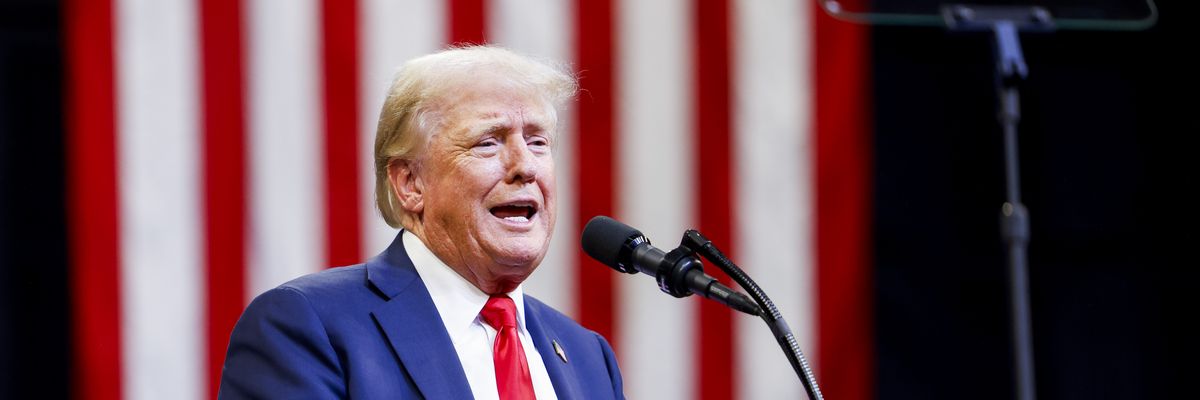
Republican presidential nominee and former U.S. President Donald Trump speaks at a rally at the Brick Breeden Fieldhouse at Montana State University on August 9, 2024 in Bozeman, Montana.
"Organized conservative constituencies for the corporate class got everything they wanted in the first Trump administration," wrote one economist. "There's no reason to expect this time to be different."
Project 2025, the right-wing policy blueprint spearheaded by the Heritage Foundation and co-authored by more than 100 former Trump administration staffers, has been denounced for several of its tax proposals, including slashing the corporate tax rate and the capital gains tax to benefit wealthy Americans—but a research group on Wednesday warned that one economic policy that hasn't gotten much attention could "greatly increase" financial hardships for millions of working families.
EPI Action, a nonpartisan research and advocacy organization affiliated with the Economic Policy Institute, published an analysis of a proposal that appears on page 7 of Project 2025's section on the Treasury Department—whose authors include at least two people who served on Republican presidential nominee Donald Trump's campaign and transition team for his term in office.
The proposal calls to tax employers on workplace benefits that exceed $12,000 per worker annually—which would undoubtedly "lead to employers cutting back on these benefits," wrote Josh Bivens, chief economist for EPI Action.
Based on health insurance benefits that are provided to more than 150 million Americans through their employers, Bivens found, more than 15 million workers would see their benefits taxed under the Project 2025 plan.
Those workers would collectively pay over $12 billion more in taxes if their employers shifted away from providing benefits as a cost-cutting measure.
"At best, employers would switch compensation away from tax-preferred benefits to taxable wages and salaries, increasing the taxes workers must pay. At worst, employers would simply cut back on benefits without offering an offsetting increase in wages and salaries."
Under the proposal, "at best, employers would switch compensation away from tax-preferred benefits to taxable wages and salaries, increasing the taxes workers must pay," wrote Bivens. "At worst, employers would simply cut back on benefits without offering an offsetting increase in wages and salaries."
The analysis explains that currently, all wages and other employee benefits can be deducted by employers when they calculate the taxes they owe, counting the wages and benefits as costs to the company. But under the policy, costs in excess of $12,000 would no longer be deductible—so "they will stop offering this compensation."
The policy would be liable to particularly cut into employer-sponsored health insurance, said Bivens:
Currently, roughly 13% of employee compensation in the United States takes the form of nonwage benefits provided by employers (not including mandatory contributions for social insurance like Social Security and Medicare or the value of paid leave). About two-thirds of this chunk of nonwage benefits is employer contributions to health insurance. Employer-provided health insurance is the dominant form of coverage in the United States, with over 150 million people receiving health insurance through employer plans (including dependents covered on another person's plan). If employers start being taxed on these benefits, they will become less and less likely to offer them going forward.
The proposal would be "damaging" for millions of families who rely on one working adult's employer-provided health insurance to cover dependents, such as children.
"If, for example, a two-earner household with young kids has one earner working part time to have more time for childcare, the part-time earner is highly unlikely to qualify for employer-provided insurance (which is usually made contingent by employers on working full time), and so this family must rely on the full-time earner having access to a family health insurance plan," wrote Bivens. "The Project 2025 plan would hence greatly increase hardship for such families."
Under the plan, employers would also be barred from deducting the cost of family health insurance plans that cover dependents over the age of 23—a clear attempt, according to Bivens, "to roll back one of the more popular parts of the Affordable Care Act (ACA), which allowed children to be covered on their parents' family health insurance plans until age 26."
Bivens emphasized that the proposal is not novel, but reflects "long-standing conservative policy efforts to reduce the generosity of health insurance plans."
The Republican Study Committee, the largest conservative caucus in the U.S. House of Representatives, called to tax employer-provided benefits in its budget proposal earlier this year.
"Trying to unravel employer-provided benefits and the public safety net for health insurance is not an idiosyncratic feature of Project 2025, it's a central goal of the conservative policymaking ecosystem," wrote Bivens.
And while Trump and his vice presidential candidate, Sen. JD Vance (R-Ohio), have attempted to distance themselves from Project 2025, Bivens noted that the Trump campaign has expressed "enthusiastic approval" of the policy agenda in meetings with the Heritage Foundation. As Common Dreams reported last week, Trump flew on a private jet with Heritage Foundation president Kevin Roberts in 2022.
"The candidates can claim Project 2025 has no influence on them, but organized conservative constituencies for the corporate class got everything they wanted in the first Trump administration," wrote Bivens. "There's no reason to expect this time to be different."
Whether the plan to tax employee benefits is enacted by a potential second Trump administration due to its inclusion in Project 2025 or as the result of "a long campaign by conservative policymakers to shift costs onto families" instead of employers, wrote Bivens, the outcome of the plan is clear: "U.S. workers will lose access to key family-sustaining benefits and face higher taxes."
Dear Common Dreams reader, It’s been nearly 30 years since I co-founded Common Dreams with my late wife, Lina Newhouser. We had the radical notion that journalism should serve the public good, not corporate profits. It was clear to us from the outset what it would take to build such a project. No paid advertisements. No corporate sponsors. No millionaire publisher telling us what to think or do. Many people said we wouldn't last a year, but we proved those doubters wrong. Together with a tremendous team of journalists and dedicated staff, we built an independent media outlet free from the constraints of profits and corporate control. Our mission has always been simple: To inform. To inspire. To ignite change for the common good. Building Common Dreams was not easy. Our survival was never guaranteed. When you take on the most powerful forces—Wall Street greed, fossil fuel industry destruction, Big Tech lobbyists, and uber-rich oligarchs who have spent billions upon billions rigging the economy and democracy in their favor—the only bulwark you have is supporters who believe in your work. But here’s the urgent message from me today. It's never been this bad out there. And it's never been this hard to keep us going. At the very moment Common Dreams is most needed, the threats we face are intensifying. We need your support now more than ever. We don't accept corporate advertising and never will. We don't have a paywall because we don't think people should be blocked from critical news based on their ability to pay. Everything we do is funded by the donations of readers like you. When everyone does the little they can afford, we are strong. But if that support retreats or dries up, so do we. Will you donate now to make sure Common Dreams not only survives but thrives? —Craig Brown, Co-founder |
Project 2025, the right-wing policy blueprint spearheaded by the Heritage Foundation and co-authored by more than 100 former Trump administration staffers, has been denounced for several of its tax proposals, including slashing the corporate tax rate and the capital gains tax to benefit wealthy Americans—but a research group on Wednesday warned that one economic policy that hasn't gotten much attention could "greatly increase" financial hardships for millions of working families.
EPI Action, a nonpartisan research and advocacy organization affiliated with the Economic Policy Institute, published an analysis of a proposal that appears on page 7 of Project 2025's section on the Treasury Department—whose authors include at least two people who served on Republican presidential nominee Donald Trump's campaign and transition team for his term in office.
The proposal calls to tax employers on workplace benefits that exceed $12,000 per worker annually—which would undoubtedly "lead to employers cutting back on these benefits," wrote Josh Bivens, chief economist for EPI Action.
Based on health insurance benefits that are provided to more than 150 million Americans through their employers, Bivens found, more than 15 million workers would see their benefits taxed under the Project 2025 plan.
Those workers would collectively pay over $12 billion more in taxes if their employers shifted away from providing benefits as a cost-cutting measure.
"At best, employers would switch compensation away from tax-preferred benefits to taxable wages and salaries, increasing the taxes workers must pay. At worst, employers would simply cut back on benefits without offering an offsetting increase in wages and salaries."
Under the proposal, "at best, employers would switch compensation away from tax-preferred benefits to taxable wages and salaries, increasing the taxes workers must pay," wrote Bivens. "At worst, employers would simply cut back on benefits without offering an offsetting increase in wages and salaries."
The analysis explains that currently, all wages and other employee benefits can be deducted by employers when they calculate the taxes they owe, counting the wages and benefits as costs to the company. But under the policy, costs in excess of $12,000 would no longer be deductible—so "they will stop offering this compensation."
The policy would be liable to particularly cut into employer-sponsored health insurance, said Bivens:
Currently, roughly 13% of employee compensation in the United States takes the form of nonwage benefits provided by employers (not including mandatory contributions for social insurance like Social Security and Medicare or the value of paid leave). About two-thirds of this chunk of nonwage benefits is employer contributions to health insurance. Employer-provided health insurance is the dominant form of coverage in the United States, with over 150 million people receiving health insurance through employer plans (including dependents covered on another person's plan). If employers start being taxed on these benefits, they will become less and less likely to offer them going forward.
The proposal would be "damaging" for millions of families who rely on one working adult's employer-provided health insurance to cover dependents, such as children.
"If, for example, a two-earner household with young kids has one earner working part time to have more time for childcare, the part-time earner is highly unlikely to qualify for employer-provided insurance (which is usually made contingent by employers on working full time), and so this family must rely on the full-time earner having access to a family health insurance plan," wrote Bivens. "The Project 2025 plan would hence greatly increase hardship for such families."
Under the plan, employers would also be barred from deducting the cost of family health insurance plans that cover dependents over the age of 23—a clear attempt, according to Bivens, "to roll back one of the more popular parts of the Affordable Care Act (ACA), which allowed children to be covered on their parents' family health insurance plans until age 26."
Bivens emphasized that the proposal is not novel, but reflects "long-standing conservative policy efforts to reduce the generosity of health insurance plans."
The Republican Study Committee, the largest conservative caucus in the U.S. House of Representatives, called to tax employer-provided benefits in its budget proposal earlier this year.
"Trying to unravel employer-provided benefits and the public safety net for health insurance is not an idiosyncratic feature of Project 2025, it's a central goal of the conservative policymaking ecosystem," wrote Bivens.
And while Trump and his vice presidential candidate, Sen. JD Vance (R-Ohio), have attempted to distance themselves from Project 2025, Bivens noted that the Trump campaign has expressed "enthusiastic approval" of the policy agenda in meetings with the Heritage Foundation. As Common Dreams reported last week, Trump flew on a private jet with Heritage Foundation president Kevin Roberts in 2022.
"The candidates can claim Project 2025 has no influence on them, but organized conservative constituencies for the corporate class got everything they wanted in the first Trump administration," wrote Bivens. "There's no reason to expect this time to be different."
Whether the plan to tax employee benefits is enacted by a potential second Trump administration due to its inclusion in Project 2025 or as the result of "a long campaign by conservative policymakers to shift costs onto families" instead of employers, wrote Bivens, the outcome of the plan is clear: "U.S. workers will lose access to key family-sustaining benefits and face higher taxes."
Project 2025, the right-wing policy blueprint spearheaded by the Heritage Foundation and co-authored by more than 100 former Trump administration staffers, has been denounced for several of its tax proposals, including slashing the corporate tax rate and the capital gains tax to benefit wealthy Americans—but a research group on Wednesday warned that one economic policy that hasn't gotten much attention could "greatly increase" financial hardships for millions of working families.
EPI Action, a nonpartisan research and advocacy organization affiliated with the Economic Policy Institute, published an analysis of a proposal that appears on page 7 of Project 2025's section on the Treasury Department—whose authors include at least two people who served on Republican presidential nominee Donald Trump's campaign and transition team for his term in office.
The proposal calls to tax employers on workplace benefits that exceed $12,000 per worker annually—which would undoubtedly "lead to employers cutting back on these benefits," wrote Josh Bivens, chief economist for EPI Action.
Based on health insurance benefits that are provided to more than 150 million Americans through their employers, Bivens found, more than 15 million workers would see their benefits taxed under the Project 2025 plan.
Those workers would collectively pay over $12 billion more in taxes if their employers shifted away from providing benefits as a cost-cutting measure.
"At best, employers would switch compensation away from tax-preferred benefits to taxable wages and salaries, increasing the taxes workers must pay. At worst, employers would simply cut back on benefits without offering an offsetting increase in wages and salaries."
Under the proposal, "at best, employers would switch compensation away from tax-preferred benefits to taxable wages and salaries, increasing the taxes workers must pay," wrote Bivens. "At worst, employers would simply cut back on benefits without offering an offsetting increase in wages and salaries."
The analysis explains that currently, all wages and other employee benefits can be deducted by employers when they calculate the taxes they owe, counting the wages and benefits as costs to the company. But under the policy, costs in excess of $12,000 would no longer be deductible—so "they will stop offering this compensation."
The policy would be liable to particularly cut into employer-sponsored health insurance, said Bivens:
Currently, roughly 13% of employee compensation in the United States takes the form of nonwage benefits provided by employers (not including mandatory contributions for social insurance like Social Security and Medicare or the value of paid leave). About two-thirds of this chunk of nonwage benefits is employer contributions to health insurance. Employer-provided health insurance is the dominant form of coverage in the United States, with over 150 million people receiving health insurance through employer plans (including dependents covered on another person's plan). If employers start being taxed on these benefits, they will become less and less likely to offer them going forward.
The proposal would be "damaging" for millions of families who rely on one working adult's employer-provided health insurance to cover dependents, such as children.
"If, for example, a two-earner household with young kids has one earner working part time to have more time for childcare, the part-time earner is highly unlikely to qualify for employer-provided insurance (which is usually made contingent by employers on working full time), and so this family must rely on the full-time earner having access to a family health insurance plan," wrote Bivens. "The Project 2025 plan would hence greatly increase hardship for such families."
Under the plan, employers would also be barred from deducting the cost of family health insurance plans that cover dependents over the age of 23—a clear attempt, according to Bivens, "to roll back one of the more popular parts of the Affordable Care Act (ACA), which allowed children to be covered on their parents' family health insurance plans until age 26."
Bivens emphasized that the proposal is not novel, but reflects "long-standing conservative policy efforts to reduce the generosity of health insurance plans."
The Republican Study Committee, the largest conservative caucus in the U.S. House of Representatives, called to tax employer-provided benefits in its budget proposal earlier this year.
"Trying to unravel employer-provided benefits and the public safety net for health insurance is not an idiosyncratic feature of Project 2025, it's a central goal of the conservative policymaking ecosystem," wrote Bivens.
And while Trump and his vice presidential candidate, Sen. JD Vance (R-Ohio), have attempted to distance themselves from Project 2025, Bivens noted that the Trump campaign has expressed "enthusiastic approval" of the policy agenda in meetings with the Heritage Foundation. As Common Dreams reported last week, Trump flew on a private jet with Heritage Foundation president Kevin Roberts in 2022.
"The candidates can claim Project 2025 has no influence on them, but organized conservative constituencies for the corporate class got everything they wanted in the first Trump administration," wrote Bivens. "There's no reason to expect this time to be different."
Whether the plan to tax employee benefits is enacted by a potential second Trump administration due to its inclusion in Project 2025 or as the result of "a long campaign by conservative policymakers to shift costs onto families" instead of employers, wrote Bivens, the outcome of the plan is clear: "U.S. workers will lose access to key family-sustaining benefits and face higher taxes."