SUBSCRIBE TO OUR FREE NEWSLETTER
Daily news & progressive opinion—funded by the people, not the corporations—delivered straight to your inbox.
5
#000000
#FFFFFF
To donate by check, phone, or other method, see our More Ways to Give page.
Daily news & progressive opinion—funded by the people, not the corporations—delivered straight to your inbox.
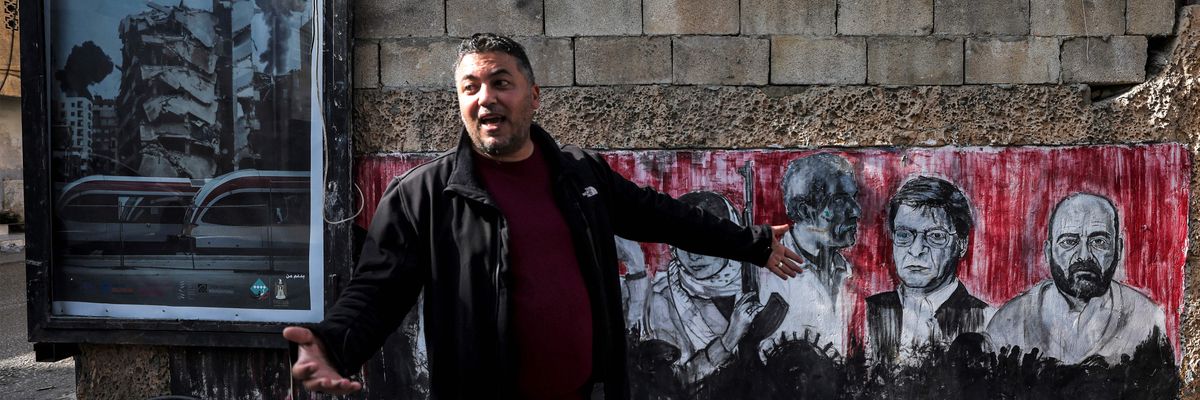
Palestinian theater director Mustafa Sheta, general manager of the Freedom Theater at the Jenin camp for Palestinian refugees in the occupied West Bank, is seen on December 12, 2022. He has been in concurrent six month periods of administrative detention since December 2023.
"We are seeing that free expression, and therefore writers, are increasingly in the crosshairs of repression in a much wider range of countries," said PEN America.
A report released Thursday by the free expression group PEN America detailed how authoritarian regimes around the world, recognizing "the role that writers play in promoting critical inquiry and cultivating visions of a better, more just world," jailed more journalists and writers last year than ever before.
The number of imprisoned writers has ticked up each year since the group began its yearly Freedom to Write Index six years ago. In 2024, the index recorded 375 writers in prison across 40 countries—up from 339 writers who were detained in 33 countries the previous year.
The group observed startling trends in governments' crackdown on freedom of expression last year. The number of women imprisoned for their writing rose, with women making up 16% of those incarcerated last year, compared with 15% in 2023 and 14% in 2022.
Writers classified as "online commentators" accounted for 203 imprisoned authors last year, while 127 journalists were jailed for their work. Other professions represented in the index include literary writers, poets, songwriters, and creative artists.
"The high numbers of writers in the online commentator and journalist categories suggest that a significant proportion of the cases included jailing or other threats because of their writing commentary on politics or official policies, economic or social themes, or advocacy for a range of human rights," reads the report.
China and Iran are the biggest jailers of writers, with the two countries accounting for 43% of imprisoned writers worldwide.
Other top offenders include Saudi Arabia with 23 writers, Israel with 21, Russia with 18, and Belarus with 15.
"Authoritarian regimes are desperate to control the narrative of history and repress the truth about what they are doing. That is why writers are so important, and why we see these regimes attempting to silence them," said Karin Deutsch Karlekar, PEN America's director of writers at risk. "Jailing one writer for their words is a miscarriage of justice, but the systematic suppression of writers around the world represents an erosion of free expression—which is often the precursor to the destruction of other fundamental human rights."
The index includes all cases in which writers are detained for at least 48 hours in its accounting of jailed writers. The report notes that as in previous years, PEN America observed an increase in the number of writers held without charge or in pre-trial detention, with 80 such cases last year—up from 76 in 2023.
The majority of writers held in administrative and pre-trial detention—"tools of repression," the report says—were detained by officials in China, Egypt, and Israel.
The index highlighted a number of cases of jailed writers, including:
Fatafta's arrest came amid Israel's U.S.-backed assault on Gaza and the West Bank, which has provoked outcry by international human rights groups, including in Israel and the United States.
The U.S. was not named as a country of concern in the index, but PEN America pointed to "recent developments in the United States," with the Trump administration revoking visas of foreign students who have protested the government's support for Israel and detaining several student organizers, as evidence of "the precarious nature of freedom of expression."
"The suppression of free expression has taken on an especially troubling dimension on college campuses where Palestinian and pro-Palestinian voices are being silenced, including via attempts to deport student activists, limiting discourse on issues of the war in Gaza and human rights," reads the report.
PEN America noted that Columbia student organizers Mahmoud Khalil and Mohsen Mahdawi and Tufts student Rumeysa Ozturk were apparently detained "purely on the grounds of speech protected by the U.S. Constitution," with Ozturk targeted specifically because she co-authored an opinion piece for a student newspaper.
Their detention, said the group, "not only undermines academic freedom but also stifles the critical exchange of ideas."
"As geopolitics continue to shift and authoritarian tendencies spread to countries that were once considered safely anchored in openness," said PEN America, "we are seeing that free expression, and therefore writers, are increasingly in the crosshairs of repression in a much wider range of countries."
Karlekar said that writers like those who have been detained in the last year "represent a threat to disinformation and encourage people to think critically about what is going on around them."
"War, conflict, and attacks against the free exchange of information and ideas go hand in hand with lies and propaganda," said Karlekar. "With the index, we want to alert the world to the jailing and mistreatment of these 375 writers. Each and every one of them should be released, and we insist that the world's jailers of writers end this repression and abuse."
Dear Common Dreams reader, It’s been nearly 30 years since I co-founded Common Dreams with my late wife, Lina Newhouser. We had the radical notion that journalism should serve the public good, not corporate profits. It was clear to us from the outset what it would take to build such a project. No paid advertisements. No corporate sponsors. No millionaire publisher telling us what to think or do. Many people said we wouldn't last a year, but we proved those doubters wrong. Together with a tremendous team of journalists and dedicated staff, we built an independent media outlet free from the constraints of profits and corporate control. Our mission has always been simple: To inform. To inspire. To ignite change for the common good. Building Common Dreams was not easy. Our survival was never guaranteed. When you take on the most powerful forces—Wall Street greed, fossil fuel industry destruction, Big Tech lobbyists, and uber-rich oligarchs who have spent billions upon billions rigging the economy and democracy in their favor—the only bulwark you have is supporters who believe in your work. But here’s the urgent message from me today. It's never been this bad out there. And it's never been this hard to keep us going. At the very moment Common Dreams is most needed, the threats we face are intensifying. We need your support now more than ever. We don't accept corporate advertising and never will. We don't have a paywall because we don't think people should be blocked from critical news based on their ability to pay. Everything we do is funded by the donations of readers like you. When everyone does the little they can afford, we are strong. But if that support retreats or dries up, so do we. Will you donate now to make sure Common Dreams not only survives but thrives? —Craig Brown, Co-founder |
A report released Thursday by the free expression group PEN America detailed how authoritarian regimes around the world, recognizing "the role that writers play in promoting critical inquiry and cultivating visions of a better, more just world," jailed more journalists and writers last year than ever before.
The number of imprisoned writers has ticked up each year since the group began its yearly Freedom to Write Index six years ago. In 2024, the index recorded 375 writers in prison across 40 countries—up from 339 writers who were detained in 33 countries the previous year.
The group observed startling trends in governments' crackdown on freedom of expression last year. The number of women imprisoned for their writing rose, with women making up 16% of those incarcerated last year, compared with 15% in 2023 and 14% in 2022.
Writers classified as "online commentators" accounted for 203 imprisoned authors last year, while 127 journalists were jailed for their work. Other professions represented in the index include literary writers, poets, songwriters, and creative artists.
"The high numbers of writers in the online commentator and journalist categories suggest that a significant proportion of the cases included jailing or other threats because of their writing commentary on politics or official policies, economic or social themes, or advocacy for a range of human rights," reads the report.
China and Iran are the biggest jailers of writers, with the two countries accounting for 43% of imprisoned writers worldwide.
Other top offenders include Saudi Arabia with 23 writers, Israel with 21, Russia with 18, and Belarus with 15.
"Authoritarian regimes are desperate to control the narrative of history and repress the truth about what they are doing. That is why writers are so important, and why we see these regimes attempting to silence them," said Karin Deutsch Karlekar, PEN America's director of writers at risk. "Jailing one writer for their words is a miscarriage of justice, but the systematic suppression of writers around the world represents an erosion of free expression—which is often the precursor to the destruction of other fundamental human rights."
The index includes all cases in which writers are detained for at least 48 hours in its accounting of jailed writers. The report notes that as in previous years, PEN America observed an increase in the number of writers held without charge or in pre-trial detention, with 80 such cases last year—up from 76 in 2023.
The majority of writers held in administrative and pre-trial detention—"tools of repression," the report says—were detained by officials in China, Egypt, and Israel.
The index highlighted a number of cases of jailed writers, including:
Fatafta's arrest came amid Israel's U.S.-backed assault on Gaza and the West Bank, which has provoked outcry by international human rights groups, including in Israel and the United States.
The U.S. was not named as a country of concern in the index, but PEN America pointed to "recent developments in the United States," with the Trump administration revoking visas of foreign students who have protested the government's support for Israel and detaining several student organizers, as evidence of "the precarious nature of freedom of expression."
"The suppression of free expression has taken on an especially troubling dimension on college campuses where Palestinian and pro-Palestinian voices are being silenced, including via attempts to deport student activists, limiting discourse on issues of the war in Gaza and human rights," reads the report.
PEN America noted that Columbia student organizers Mahmoud Khalil and Mohsen Mahdawi and Tufts student Rumeysa Ozturk were apparently detained "purely on the grounds of speech protected by the U.S. Constitution," with Ozturk targeted specifically because she co-authored an opinion piece for a student newspaper.
Their detention, said the group, "not only undermines academic freedom but also stifles the critical exchange of ideas."
"As geopolitics continue to shift and authoritarian tendencies spread to countries that were once considered safely anchored in openness," said PEN America, "we are seeing that free expression, and therefore writers, are increasingly in the crosshairs of repression in a much wider range of countries."
Karlekar said that writers like those who have been detained in the last year "represent a threat to disinformation and encourage people to think critically about what is going on around them."
"War, conflict, and attacks against the free exchange of information and ideas go hand in hand with lies and propaganda," said Karlekar. "With the index, we want to alert the world to the jailing and mistreatment of these 375 writers. Each and every one of them should be released, and we insist that the world's jailers of writers end this repression and abuse."
A report released Thursday by the free expression group PEN America detailed how authoritarian regimes around the world, recognizing "the role that writers play in promoting critical inquiry and cultivating visions of a better, more just world," jailed more journalists and writers last year than ever before.
The number of imprisoned writers has ticked up each year since the group began its yearly Freedom to Write Index six years ago. In 2024, the index recorded 375 writers in prison across 40 countries—up from 339 writers who were detained in 33 countries the previous year.
The group observed startling trends in governments' crackdown on freedom of expression last year. The number of women imprisoned for their writing rose, with women making up 16% of those incarcerated last year, compared with 15% in 2023 and 14% in 2022.
Writers classified as "online commentators" accounted for 203 imprisoned authors last year, while 127 journalists were jailed for their work. Other professions represented in the index include literary writers, poets, songwriters, and creative artists.
"The high numbers of writers in the online commentator and journalist categories suggest that a significant proportion of the cases included jailing or other threats because of their writing commentary on politics or official policies, economic or social themes, or advocacy for a range of human rights," reads the report.
China and Iran are the biggest jailers of writers, with the two countries accounting for 43% of imprisoned writers worldwide.
Other top offenders include Saudi Arabia with 23 writers, Israel with 21, Russia with 18, and Belarus with 15.
"Authoritarian regimes are desperate to control the narrative of history and repress the truth about what they are doing. That is why writers are so important, and why we see these regimes attempting to silence them," said Karin Deutsch Karlekar, PEN America's director of writers at risk. "Jailing one writer for their words is a miscarriage of justice, but the systematic suppression of writers around the world represents an erosion of free expression—which is often the precursor to the destruction of other fundamental human rights."
The index includes all cases in which writers are detained for at least 48 hours in its accounting of jailed writers. The report notes that as in previous years, PEN America observed an increase in the number of writers held without charge or in pre-trial detention, with 80 such cases last year—up from 76 in 2023.
The majority of writers held in administrative and pre-trial detention—"tools of repression," the report says—were detained by officials in China, Egypt, and Israel.
The index highlighted a number of cases of jailed writers, including:
Fatafta's arrest came amid Israel's U.S.-backed assault on Gaza and the West Bank, which has provoked outcry by international human rights groups, including in Israel and the United States.
The U.S. was not named as a country of concern in the index, but PEN America pointed to "recent developments in the United States," with the Trump administration revoking visas of foreign students who have protested the government's support for Israel and detaining several student organizers, as evidence of "the precarious nature of freedom of expression."
"The suppression of free expression has taken on an especially troubling dimension on college campuses where Palestinian and pro-Palestinian voices are being silenced, including via attempts to deport student activists, limiting discourse on issues of the war in Gaza and human rights," reads the report.
PEN America noted that Columbia student organizers Mahmoud Khalil and Mohsen Mahdawi and Tufts student Rumeysa Ozturk were apparently detained "purely on the grounds of speech protected by the U.S. Constitution," with Ozturk targeted specifically because she co-authored an opinion piece for a student newspaper.
Their detention, said the group, "not only undermines academic freedom but also stifles the critical exchange of ideas."
"As geopolitics continue to shift and authoritarian tendencies spread to countries that were once considered safely anchored in openness," said PEN America, "we are seeing that free expression, and therefore writers, are increasingly in the crosshairs of repression in a much wider range of countries."
Karlekar said that writers like those who have been detained in the last year "represent a threat to disinformation and encourage people to think critically about what is going on around them."
"War, conflict, and attacks against the free exchange of information and ideas go hand in hand with lies and propaganda," said Karlekar. "With the index, we want to alert the world to the jailing and mistreatment of these 375 writers. Each and every one of them should be released, and we insist that the world's jailers of writers end this repression and abuse."