SUBSCRIBE TO OUR FREE NEWSLETTER
Daily news & progressive opinion—funded by the people, not the corporations—delivered straight to your inbox.
5
#000000
#FFFFFF
To donate by check, phone, or other method, see our More Ways to Give page.
Daily news & progressive opinion—funded by the people, not the corporations—delivered straight to your inbox.
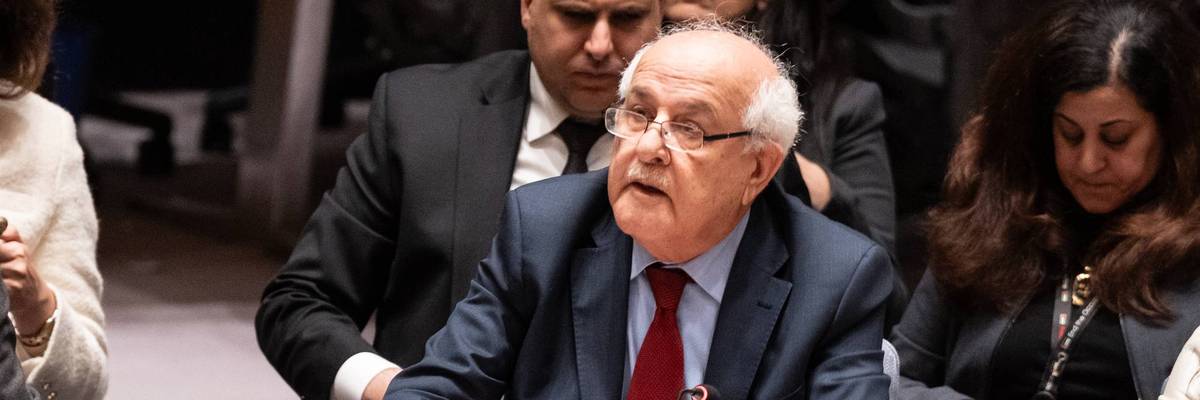
Permanent observer for the state of Palestine Riyad H. Mansour speaks during a United Nations Security Council meeting on February 18, 2026.
“A Palestinian vice presidency at the General Assembly would not change power realities on the ground, but it would normalize Palestinian statehood claims... That is precisely what the United States is attempting to block.”
The Palestinian ambassador to the United Nations withdrew his bid to become a vice president of the UN General Assembly on Thursday following threats from the Trump administration to strip the visas of the entire Palestinian delegation, according to NPR.
The Palestinian envoy, Riyad Mansour, has been an outspoken critic of Israel's actions toward Palestinians, particularly since the beginning of the genocidal war in Gaza, which he said has entailed "the collective punishment of over two million Palestinians."
He has been Palestine’s permanent UN observer for more than two decades and had earlier this year planned to run for president of the General Assembly, though he bowed out following US pressure.
The Guardian reported that on Tuesday, the US State Department sent a diplomatic cable to the US embassy in Jerusalem instructing it to pressure the Palestinian Authority (PA)—the governing body of the occupied West Bank—to withdraw its bid for one of the 21 vice presidencies of the General Assembly as well.
General Assembly vice presidents have a role in setting the body’s agenda and filling in when the president is absent. The UN is scheduled to hold elections amongst Assembly members on June 2.
The US cable said Mansour “has a history of accusing Israel of genocide"—as leading human rights groups and experts have—and that his presence would “undermine” the objectives of President Donald Trump’s so-called “Board of Peace” in Gaza, which a recent Human Rights Watch report said has fallen fall short of its promises to provide aid to Palestinians and has allowed Israeli forces to continue killing them with little pushback despite a ceasefire.
The cable said, “We will hold the PA responsible if the Palestinian delegation does not withdraw its [vice presidential] candidacy” by Friday, “and consequences will follow.”
The cable threatened to revoke the US visas of all Palestinian officials. The US already revoked most of them back in August, but rolled back the ban on those who were visiting as part of the annual UN summit. “It would be unfortunate to have to revisit any available options,” the cable said.
It also threatened that Israel would continue to withhold tax revenue that it owes to the Palestinian Authority, which was blocked by Israel's far-right finance minister, Bezalel Smotrich, at the beginning of the war in October 2023. The money being withheld by Israel accounts for 60% of the PA's revenue.
A person familiar with the matter told NPR that Mansour specifically would refrain from running for the position for the next two years, which was interpreted as a reference to the end of Trump's term as president.
The US is prohibited from blocking UN officials from visiting the body's New York headquarters under a 1947 agreement. However, the US has blocked visas for officials from enemy countries, including Russia and Iran, as well as the former leader of the Palestine Liberation Organization (PLO), Yasser Arafat.
Hady Amr, who served as a senior State Department official on Palestinian affairs under the Obama and Biden administrations, told NPR that expelling diplomats is extremely rare outside of "extreme situations like Russian espionage or election interference."
Amr said, "Generally, it's counterproductive because you need diplomats to work out problems between countries, and by expelling diplomats, you're undermining not only their ability to solve problems, but the abilities of the United States as well."
Tawfiq Al-Ghussein, a London-based researcher who specializes in modern Middle Eastern history and the displacement of Palestinians, said on social media that "the significance of this is not merely procedural."
"Washington is effectively trying to prevent even symbolic Palestinian institutional visibility within the UN system because it understands that international legitimacy matters politically, legally, and diplomatically," Al-Ghussein said. "A Palestinian vice presidency at the General Assembly would not change power realities on the ground, but it would normalize Palestinian statehood claims within the architecture of international governance itself. That is precisely what the United States is attempting to block."
“The irony is extraordinary: The same power that lectures the world endlessly about democracy and international order is reportedly threatening visas and diplomatic consequences to stop Palestinians from holding a largely ceremonial UN role,” he continued. "It reveals once again that the issue was never 'peace negotiations' as such, but control over who is permitted institutional legitimacy in the international system."
Dear Common Dreams reader, It’s been nearly 30 years since I co-founded Common Dreams with my late wife, Lina Newhouser. We had the radical notion that journalism should serve the public good, not corporate profits. It was clear to us from the outset what it would take to build such a project. No paid advertisements. No corporate sponsors. No millionaire publisher telling us what to think or do. Many people said we wouldn't last a year, but we proved those doubters wrong. Together with a tremendous team of journalists and dedicated staff, we built an independent media outlet free from the constraints of profits and corporate control. Our mission has always been simple: To inform. To inspire. To ignite change for the common good. Building Common Dreams was not easy. Our survival was never guaranteed. When you take on the most powerful forces—Wall Street greed, fossil fuel industry destruction, Big Tech lobbyists, and uber-rich oligarchs who have spent billions upon billions rigging the economy and democracy in their favor—the only bulwark you have is supporters who believe in your work. But here’s the urgent message from me today. It's never been this bad out there. And it's never been this hard to keep us going. At the very moment Common Dreams is most needed, the threats we face are intensifying. We need your support now more than ever. We don't accept corporate advertising and never will. We don't have a paywall because we don't think people should be blocked from critical news based on their ability to pay. Everything we do is funded by the donations of readers like you. When everyone does the little they can afford, we are strong. But if that support retreats or dries up, so do we. Will you donate now to make sure Common Dreams not only survives but thrives? —Craig Brown, Co-founder |
The Palestinian ambassador to the United Nations withdrew his bid to become a vice president of the UN General Assembly on Thursday following threats from the Trump administration to strip the visas of the entire Palestinian delegation, according to NPR.
The Palestinian envoy, Riyad Mansour, has been an outspoken critic of Israel's actions toward Palestinians, particularly since the beginning of the genocidal war in Gaza, which he said has entailed "the collective punishment of over two million Palestinians."
He has been Palestine’s permanent UN observer for more than two decades and had earlier this year planned to run for president of the General Assembly, though he bowed out following US pressure.
The Guardian reported that on Tuesday, the US State Department sent a diplomatic cable to the US embassy in Jerusalem instructing it to pressure the Palestinian Authority (PA)—the governing body of the occupied West Bank—to withdraw its bid for one of the 21 vice presidencies of the General Assembly as well.
General Assembly vice presidents have a role in setting the body’s agenda and filling in when the president is absent. The UN is scheduled to hold elections amongst Assembly members on June 2.
The US cable said Mansour “has a history of accusing Israel of genocide"—as leading human rights groups and experts have—and that his presence would “undermine” the objectives of President Donald Trump’s so-called “Board of Peace” in Gaza, which a recent Human Rights Watch report said has fallen fall short of its promises to provide aid to Palestinians and has allowed Israeli forces to continue killing them with little pushback despite a ceasefire.
The cable said, “We will hold the PA responsible if the Palestinian delegation does not withdraw its [vice presidential] candidacy” by Friday, “and consequences will follow.”
The cable threatened to revoke the US visas of all Palestinian officials. The US already revoked most of them back in August, but rolled back the ban on those who were visiting as part of the annual UN summit. “It would be unfortunate to have to revisit any available options,” the cable said.
It also threatened that Israel would continue to withhold tax revenue that it owes to the Palestinian Authority, which was blocked by Israel's far-right finance minister, Bezalel Smotrich, at the beginning of the war in October 2023. The money being withheld by Israel accounts for 60% of the PA's revenue.
A person familiar with the matter told NPR that Mansour specifically would refrain from running for the position for the next two years, which was interpreted as a reference to the end of Trump's term as president.
The US is prohibited from blocking UN officials from visiting the body's New York headquarters under a 1947 agreement. However, the US has blocked visas for officials from enemy countries, including Russia and Iran, as well as the former leader of the Palestine Liberation Organization (PLO), Yasser Arafat.
Hady Amr, who served as a senior State Department official on Palestinian affairs under the Obama and Biden administrations, told NPR that expelling diplomats is extremely rare outside of "extreme situations like Russian espionage or election interference."
Amr said, "Generally, it's counterproductive because you need diplomats to work out problems between countries, and by expelling diplomats, you're undermining not only their ability to solve problems, but the abilities of the United States as well."
Tawfiq Al-Ghussein, a London-based researcher who specializes in modern Middle Eastern history and the displacement of Palestinians, said on social media that "the significance of this is not merely procedural."
"Washington is effectively trying to prevent even symbolic Palestinian institutional visibility within the UN system because it understands that international legitimacy matters politically, legally, and diplomatically," Al-Ghussein said. "A Palestinian vice presidency at the General Assembly would not change power realities on the ground, but it would normalize Palestinian statehood claims within the architecture of international governance itself. That is precisely what the United States is attempting to block."
“The irony is extraordinary: The same power that lectures the world endlessly about democracy and international order is reportedly threatening visas and diplomatic consequences to stop Palestinians from holding a largely ceremonial UN role,” he continued. "It reveals once again that the issue was never 'peace negotiations' as such, but control over who is permitted institutional legitimacy in the international system."
The Palestinian ambassador to the United Nations withdrew his bid to become a vice president of the UN General Assembly on Thursday following threats from the Trump administration to strip the visas of the entire Palestinian delegation, according to NPR.
The Palestinian envoy, Riyad Mansour, has been an outspoken critic of Israel's actions toward Palestinians, particularly since the beginning of the genocidal war in Gaza, which he said has entailed "the collective punishment of over two million Palestinians."
He has been Palestine’s permanent UN observer for more than two decades and had earlier this year planned to run for president of the General Assembly, though he bowed out following US pressure.
The Guardian reported that on Tuesday, the US State Department sent a diplomatic cable to the US embassy in Jerusalem instructing it to pressure the Palestinian Authority (PA)—the governing body of the occupied West Bank—to withdraw its bid for one of the 21 vice presidencies of the General Assembly as well.
General Assembly vice presidents have a role in setting the body’s agenda and filling in when the president is absent. The UN is scheduled to hold elections amongst Assembly members on June 2.
The US cable said Mansour “has a history of accusing Israel of genocide"—as leading human rights groups and experts have—and that his presence would “undermine” the objectives of President Donald Trump’s so-called “Board of Peace” in Gaza, which a recent Human Rights Watch report said has fallen fall short of its promises to provide aid to Palestinians and has allowed Israeli forces to continue killing them with little pushback despite a ceasefire.
The cable said, “We will hold the PA responsible if the Palestinian delegation does not withdraw its [vice presidential] candidacy” by Friday, “and consequences will follow.”
The cable threatened to revoke the US visas of all Palestinian officials. The US already revoked most of them back in August, but rolled back the ban on those who were visiting as part of the annual UN summit. “It would be unfortunate to have to revisit any available options,” the cable said.
It also threatened that Israel would continue to withhold tax revenue that it owes to the Palestinian Authority, which was blocked by Israel's far-right finance minister, Bezalel Smotrich, at the beginning of the war in October 2023. The money being withheld by Israel accounts for 60% of the PA's revenue.
A person familiar with the matter told NPR that Mansour specifically would refrain from running for the position for the next two years, which was interpreted as a reference to the end of Trump's term as president.
The US is prohibited from blocking UN officials from visiting the body's New York headquarters under a 1947 agreement. However, the US has blocked visas for officials from enemy countries, including Russia and Iran, as well as the former leader of the Palestine Liberation Organization (PLO), Yasser Arafat.
Hady Amr, who served as a senior State Department official on Palestinian affairs under the Obama and Biden administrations, told NPR that expelling diplomats is extremely rare outside of "extreme situations like Russian espionage or election interference."
Amr said, "Generally, it's counterproductive because you need diplomats to work out problems between countries, and by expelling diplomats, you're undermining not only their ability to solve problems, but the abilities of the United States as well."
Tawfiq Al-Ghussein, a London-based researcher who specializes in modern Middle Eastern history and the displacement of Palestinians, said on social media that "the significance of this is not merely procedural."
"Washington is effectively trying to prevent even symbolic Palestinian institutional visibility within the UN system because it understands that international legitimacy matters politically, legally, and diplomatically," Al-Ghussein said. "A Palestinian vice presidency at the General Assembly would not change power realities on the ground, but it would normalize Palestinian statehood claims within the architecture of international governance itself. That is precisely what the United States is attempting to block."
“The irony is extraordinary: The same power that lectures the world endlessly about democracy and international order is reportedly threatening visas and diplomatic consequences to stop Palestinians from holding a largely ceremonial UN role,” he continued. "It reveals once again that the issue was never 'peace negotiations' as such, but control over who is permitted institutional legitimacy in the international system."