5
#000000
#FFFFFF
To donate by check, phone, or other method, see our More Ways to Give page.
Daily news & progressive opinion—funded by the people, not the corporations—delivered straight to your inbox.

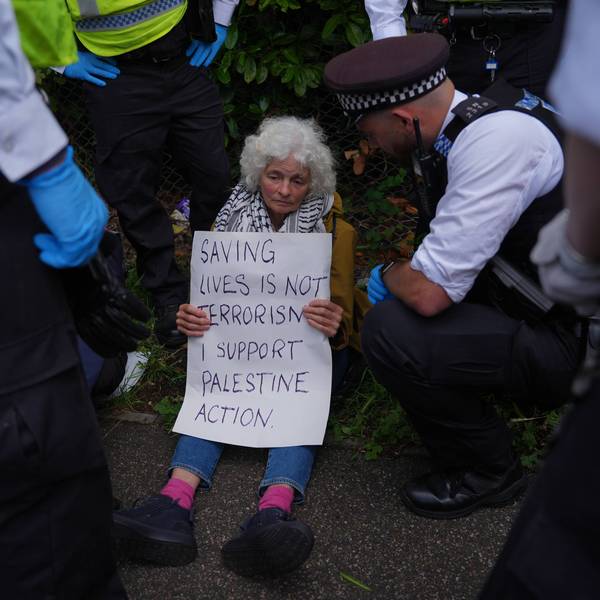
A woman is detained by police during a demonstration outside the Royal Court of Justice as the Court of Appeal ruled in favor of the Home Office’s challenge to the High Court’s Palestine Action decision on June 15, 2026 in London.
"Classifying protest through direct action as terrorism brings Parliament and our judicial system into disrepute," said one Labour MP.
A UK appeals court is being accused of flouting the law to allow the government to suppress free speech after it upheld a ban on the direct action group Palestine Action.
Just days after four young activists with the group were hit with unprecedented “terrorism” sentences over their 2024 vandalism of an Israeli-owned weapons facility that was being used to supply the genocidal assault on Gaza, the Court of Appeal in London on Monday upheld the Labour government’s proscription of Palestine Action under the Terrorism Act of 2000.
The ban was approved in Parliament in July 2025 and outlawed expressions of support for the group. According to Amnesty International, more than 3,300 people have been arrested across Britain since last July "simply for their engagement in acts of peaceful protest opposing the proscription"—including more than 2,000 who have been arrested simply for holding signs that read "I oppose genocide, I support Palestine Action.”
Outside the Royal Courts of Justice in London, where the decision was handed down, hundreds more Britons rallied in opposition.
“We acknowledge the Court of Appeal’s judgment that the home secretary’s decision to proscribe Palestine Action was lawful,” the Metropolitan Police said in a statement shortly after. “This means that expressing support for the organization remains a criminal offense, and officers will arrest those who break the law.”
“Officers are policing a protest outside the Royal Courts of Justice today where a number of people are displaying placards in support of Palestine Action," it continued. "Arrests are underway.”
Protesters were carried away, while onlookers shouted, “Shame” and “You’re complicit” at officers.
Arrests continue outside the Royal Courts of Justice after Court of Appeal find proscription of Palestine Action to be lawful.
We will continue to protest this Government’s embarrassing attempts to cover up its crimes with intimidation tactics.
Join us: https://t.co/XhFvPsZC3U pic.twitter.com/9okcFkVVtf
— Defend Our Juries (@DefendOurJuries) June 15, 2026
As The New York Times pointed out:
Palestine Action, which no longer exists in its original form, did not promote violence against individuals. But its members damaged sites linked to Elbit Systems, an Israeli weapons manufacturer, and last June broke into [Royal Air Force] Brize Norton, Britain’s largest air force base, in Oxfordshire, vandalizing two aircraft.
The activists who were given hefty sentences on Friday have argued that “innocent lives were saved” by their destruction of military equipment in the Elbit facility. Drones manufactured by the company have been documented in use during attacks on civilians, including the April 2024 strike on a World Central Kitchen convoy that killed seven aid workers.
But although members of the group have never been accused of any premeditated act of violence against other human beings, the British government’s terror designation puts it on the same level, legally speaking, as al-Qaeda, the Taliban, or the neo-Nazi Atomwaffen Division, and expressions of support can carry maximum sentences of 14 years in prison.
In February, the High Court sided with Palestine Action, ruling that the ban on support breached the rights to free expression and assembly under Articles 10 and 11 of the European Convention on Human Rights.
However, a five-judge appeals court panel overruled this decision on Monday, with Chief Justice Sue Carr writing that while the ban was “highly controversial,” and that the group “was supported by many otherwise law-abiding citizens,” it was a “fundamental mistake to overlook the fact that Palestine Action overtly promoted unlawful violence amounting to terrorism.”
Pointing to its sabotage of Elbit, she said the group's actions were “intended to close down lawful businesses” and said that "future threats and risks posed to third-party individuals and property by Palestine Action were perhaps the most important factors to weigh in the balance.”
Carr said that the ban would "not prevent public expressions of support for the Palestinian cause or opposition to Israel and to the Israel Defense Forces, or demonstrations targeted at Elbit."
But in the process, even she acknowledged that such a severe restriction on peaceful assembly in support of Palestine Action could indeed have a "chilling effect" on otherwise law-abiding citizens and cause them to be "deterred from assembling lawfully or making their strongly held anti-Israel and pro-Palestinian views public for fear of their actions being construed as support for Palestine Action."
Palestine Action co-founder Huda Ammori, who challenged the ban in court, said her group would "fight this all the way" and planned to appeal to the UK Supreme Court and potentially even the European Court of Human Rights.
"We will not stop fighting to overturn one of the most extreme attacks on free speech and the right to protest in modern British history," she said. "This unprecedented abuse of power has devastated the lives of thousands of people while silencing dissent over Israel’s slaughter of the Palestinian people during the genocide, when that dissent could not be more urgent.”
Today's ruling by the Court of Appeal is deeply disappointing.
This case remains about much more than one group.
What’s important for all of us to understand is that proscription is one of the strongest powers the government has.
Treating protest as terrorism leaves the… pic.twitter.com/WI3O05LYEn
— Amnesty UK (@AmnestyUK) June 15, 2026
The ruling was met with outrage from supporters of Palestinian rights and human rights groups.
Ammar Kazmi, the senior legal coordinator for the Derby-based Left Legal Fighting Fund, said that with this ruling, the judges allowed the political objective of criminalizing pro-Palestine speech to take precedence over the law.
"The judges allowed policy reasons to override strictly legal arguments, and they showed deference to ‘national security’ questions," he wrote on social media. "They also said that proscription is a ‘proportionate’ interference with free speech rights. In other words, they allowed the government to ride roughshod over the law."
Amnesty UK called the ruling "deeply disappointing," adding that the case "remains about much more than one group."
"What’s important for all of us to understand is that proscribing a group as a terrorist organization is one of the strongest powers the government has," the human rights group said. "The banning of Palestine Action as a terrorist organization is a grave misuse of counterterrorism powers with serious consequences for human rights."
Former Labour Party leader Jeremy Corbyn—whose successor, Prime Minister Keir Starmer—enacted the ban, said, "Today’s ruling to uphold the UK government's proscription of Palestine Action is a travesty of justice."
"One by one, the very foundations of our democracy are being destroyed—all to oil the wheels of British complicity in genocide," said Corbyn, who is leading an unofficial "tribunal" that presented evidence of UK participation in Israel's assault on Gaza to the International Criminal Court in March.
Noting the large number of pensioners who have been hauled off by police for holding protest signs opposing the ban—including dozens arrested on Friday for opposing the sentencing of those involved in the Elbit raid—Labour MP John McDonnell said, "Parliament should reverse the decision to proscribe Palestine Action urgently before we see large numbers of elderly people in particular being dragged before our courts."
He added that "classifying protest through direct action as terrorism brings Parliament and our judicial system into disrepute."
Dear Common Dreams reader, It’s been nearly 30 years since I co-founded Common Dreams with my late wife, Lina Newhouser. We had the radical notion that journalism should serve the public good, not corporate profits. It was clear to us from the outset what it would take to build such a project. No paid advertisements. No corporate sponsors. No millionaire publisher telling us what to think or do. Many people said we wouldn't last a year, but we proved those doubters wrong. Together with a tremendous team of journalists and dedicated staff, we built an independent media outlet free from the constraints of profits and corporate control. Our mission has always been simple: To inform. To inspire. To ignite change for the common good. Building Common Dreams was not easy. Our survival was never guaranteed. When you take on the most powerful forces—Wall Street greed, fossil fuel industry destruction, Big Tech lobbyists, and uber-rich oligarchs who have spent billions upon billions rigging the economy and democracy in their favor—the only bulwark you have is supporters who believe in your work. But here’s the urgent message from me today. It's never been this bad out there. And it's never been this hard to keep us going. At the very moment Common Dreams is most needed, the threats we face are intensifying. We need your support now more than ever. We don't accept corporate advertising and never will. We don't have a paywall because we don't think people should be blocked from critical news based on their ability to pay. Everything we do is funded by the donations of readers like you. When everyone does the little they can afford, we are strong. But if that support retreats or dries up, so do we. Will you donate now to make sure Common Dreams not only survives but thrives? —Craig Brown, Co-founder |
A UK appeals court is being accused of flouting the law to allow the government to suppress free speech after it upheld a ban on the direct action group Palestine Action.
Just days after four young activists with the group were hit with unprecedented “terrorism” sentences over their 2024 vandalism of an Israeli-owned weapons facility that was being used to supply the genocidal assault on Gaza, the Court of Appeal in London on Monday upheld the Labour government’s proscription of Palestine Action under the Terrorism Act of 2000.
The ban was approved in Parliament in July 2025 and outlawed expressions of support for the group. According to Amnesty International, more than 3,300 people have been arrested across Britain since last July "simply for their engagement in acts of peaceful protest opposing the proscription"—including more than 2,000 who have been arrested simply for holding signs that read "I oppose genocide, I support Palestine Action.”
Outside the Royal Courts of Justice in London, where the decision was handed down, hundreds more Britons rallied in opposition.
“We acknowledge the Court of Appeal’s judgment that the home secretary’s decision to proscribe Palestine Action was lawful,” the Metropolitan Police said in a statement shortly after. “This means that expressing support for the organization remains a criminal offense, and officers will arrest those who break the law.”
“Officers are policing a protest outside the Royal Courts of Justice today where a number of people are displaying placards in support of Palestine Action," it continued. "Arrests are underway.”
Protesters were carried away, while onlookers shouted, “Shame” and “You’re complicit” at officers.
Arrests continue outside the Royal Courts of Justice after Court of Appeal find proscription of Palestine Action to be lawful.
We will continue to protest this Government’s embarrassing attempts to cover up its crimes with intimidation tactics.
Join us: https://t.co/XhFvPsZC3U pic.twitter.com/9okcFkVVtf
— Defend Our Juries (@DefendOurJuries) June 15, 2026
As The New York Times pointed out:
Palestine Action, which no longer exists in its original form, did not promote violence against individuals. But its members damaged sites linked to Elbit Systems, an Israeli weapons manufacturer, and last June broke into [Royal Air Force] Brize Norton, Britain’s largest air force base, in Oxfordshire, vandalizing two aircraft.
The activists who were given hefty sentences on Friday have argued that “innocent lives were saved” by their destruction of military equipment in the Elbit facility. Drones manufactured by the company have been documented in use during attacks on civilians, including the April 2024 strike on a World Central Kitchen convoy that killed seven aid workers.
But although members of the group have never been accused of any premeditated act of violence against other human beings, the British government’s terror designation puts it on the same level, legally speaking, as al-Qaeda, the Taliban, or the neo-Nazi Atomwaffen Division, and expressions of support can carry maximum sentences of 14 years in prison.
In February, the High Court sided with Palestine Action, ruling that the ban on support breached the rights to free expression and assembly under Articles 10 and 11 of the European Convention on Human Rights.
However, a five-judge appeals court panel overruled this decision on Monday, with Chief Justice Sue Carr writing that while the ban was “highly controversial,” and that the group “was supported by many otherwise law-abiding citizens,” it was a “fundamental mistake to overlook the fact that Palestine Action overtly promoted unlawful violence amounting to terrorism.”
Pointing to its sabotage of Elbit, she said the group's actions were “intended to close down lawful businesses” and said that "future threats and risks posed to third-party individuals and property by Palestine Action were perhaps the most important factors to weigh in the balance.”
Carr said that the ban would "not prevent public expressions of support for the Palestinian cause or opposition to Israel and to the Israel Defense Forces, or demonstrations targeted at Elbit."
But in the process, even she acknowledged that such a severe restriction on peaceful assembly in support of Palestine Action could indeed have a "chilling effect" on otherwise law-abiding citizens and cause them to be "deterred from assembling lawfully or making their strongly held anti-Israel and pro-Palestinian views public for fear of their actions being construed as support for Palestine Action."
Palestine Action co-founder Huda Ammori, who challenged the ban in court, said her group would "fight this all the way" and planned to appeal to the UK Supreme Court and potentially even the European Court of Human Rights.
"We will not stop fighting to overturn one of the most extreme attacks on free speech and the right to protest in modern British history," she said. "This unprecedented abuse of power has devastated the lives of thousands of people while silencing dissent over Israel’s slaughter of the Palestinian people during the genocide, when that dissent could not be more urgent.”
Today's ruling by the Court of Appeal is deeply disappointing.
This case remains about much more than one group.
What’s important for all of us to understand is that proscription is one of the strongest powers the government has.
Treating protest as terrorism leaves the… pic.twitter.com/WI3O05LYEn
— Amnesty UK (@AmnestyUK) June 15, 2026
The ruling was met with outrage from supporters of Palestinian rights and human rights groups.
Ammar Kazmi, the senior legal coordinator for the Derby-based Left Legal Fighting Fund, said that with this ruling, the judges allowed the political objective of criminalizing pro-Palestine speech to take precedence over the law.
"The judges allowed policy reasons to override strictly legal arguments, and they showed deference to ‘national security’ questions," he wrote on social media. "They also said that proscription is a ‘proportionate’ interference with free speech rights. In other words, they allowed the government to ride roughshod over the law."
Amnesty UK called the ruling "deeply disappointing," adding that the case "remains about much more than one group."
"What’s important for all of us to understand is that proscribing a group as a terrorist organization is one of the strongest powers the government has," the human rights group said. "The banning of Palestine Action as a terrorist organization is a grave misuse of counterterrorism powers with serious consequences for human rights."
Former Labour Party leader Jeremy Corbyn—whose successor, Prime Minister Keir Starmer—enacted the ban, said, "Today’s ruling to uphold the UK government's proscription of Palestine Action is a travesty of justice."
"One by one, the very foundations of our democracy are being destroyed—all to oil the wheels of British complicity in genocide," said Corbyn, who is leading an unofficial "tribunal" that presented evidence of UK participation in Israel's assault on Gaza to the International Criminal Court in March.
Noting the large number of pensioners who have been hauled off by police for holding protest signs opposing the ban—including dozens arrested on Friday for opposing the sentencing of those involved in the Elbit raid—Labour MP John McDonnell said, "Parliament should reverse the decision to proscribe Palestine Action urgently before we see large numbers of elderly people in particular being dragged before our courts."
He added that "classifying protest through direct action as terrorism brings Parliament and our judicial system into disrepute."
A UK appeals court is being accused of flouting the law to allow the government to suppress free speech after it upheld a ban on the direct action group Palestine Action.
Just days after four young activists with the group were hit with unprecedented “terrorism” sentences over their 2024 vandalism of an Israeli-owned weapons facility that was being used to supply the genocidal assault on Gaza, the Court of Appeal in London on Monday upheld the Labour government’s proscription of Palestine Action under the Terrorism Act of 2000.
The ban was approved in Parliament in July 2025 and outlawed expressions of support for the group. According to Amnesty International, more than 3,300 people have been arrested across Britain since last July "simply for their engagement in acts of peaceful protest opposing the proscription"—including more than 2,000 who have been arrested simply for holding signs that read "I oppose genocide, I support Palestine Action.”
Outside the Royal Courts of Justice in London, where the decision was handed down, hundreds more Britons rallied in opposition.
“We acknowledge the Court of Appeal’s judgment that the home secretary’s decision to proscribe Palestine Action was lawful,” the Metropolitan Police said in a statement shortly after. “This means that expressing support for the organization remains a criminal offense, and officers will arrest those who break the law.”
“Officers are policing a protest outside the Royal Courts of Justice today where a number of people are displaying placards in support of Palestine Action," it continued. "Arrests are underway.”
Protesters were carried away, while onlookers shouted, “Shame” and “You’re complicit” at officers.
Arrests continue outside the Royal Courts of Justice after Court of Appeal find proscription of Palestine Action to be lawful.
We will continue to protest this Government’s embarrassing attempts to cover up its crimes with intimidation tactics.
Join us: https://t.co/XhFvPsZC3U pic.twitter.com/9okcFkVVtf
— Defend Our Juries (@DefendOurJuries) June 15, 2026
As The New York Times pointed out:
Palestine Action, which no longer exists in its original form, did not promote violence against individuals. But its members damaged sites linked to Elbit Systems, an Israeli weapons manufacturer, and last June broke into [Royal Air Force] Brize Norton, Britain’s largest air force base, in Oxfordshire, vandalizing two aircraft.
The activists who were given hefty sentences on Friday have argued that “innocent lives were saved” by their destruction of military equipment in the Elbit facility. Drones manufactured by the company have been documented in use during attacks on civilians, including the April 2024 strike on a World Central Kitchen convoy that killed seven aid workers.
But although members of the group have never been accused of any premeditated act of violence against other human beings, the British government’s terror designation puts it on the same level, legally speaking, as al-Qaeda, the Taliban, or the neo-Nazi Atomwaffen Division, and expressions of support can carry maximum sentences of 14 years in prison.
In February, the High Court sided with Palestine Action, ruling that the ban on support breached the rights to free expression and assembly under Articles 10 and 11 of the European Convention on Human Rights.
However, a five-judge appeals court panel overruled this decision on Monday, with Chief Justice Sue Carr writing that while the ban was “highly controversial,” and that the group “was supported by many otherwise law-abiding citizens,” it was a “fundamental mistake to overlook the fact that Palestine Action overtly promoted unlawful violence amounting to terrorism.”
Pointing to its sabotage of Elbit, she said the group's actions were “intended to close down lawful businesses” and said that "future threats and risks posed to third-party individuals and property by Palestine Action were perhaps the most important factors to weigh in the balance.”
Carr said that the ban would "not prevent public expressions of support for the Palestinian cause or opposition to Israel and to the Israel Defense Forces, or demonstrations targeted at Elbit."
But in the process, even she acknowledged that such a severe restriction on peaceful assembly in support of Palestine Action could indeed have a "chilling effect" on otherwise law-abiding citizens and cause them to be "deterred from assembling lawfully or making their strongly held anti-Israel and pro-Palestinian views public for fear of their actions being construed as support for Palestine Action."
Palestine Action co-founder Huda Ammori, who challenged the ban in court, said her group would "fight this all the way" and planned to appeal to the UK Supreme Court and potentially even the European Court of Human Rights.
"We will not stop fighting to overturn one of the most extreme attacks on free speech and the right to protest in modern British history," she said. "This unprecedented abuse of power has devastated the lives of thousands of people while silencing dissent over Israel’s slaughter of the Palestinian people during the genocide, when that dissent could not be more urgent.”
Today's ruling by the Court of Appeal is deeply disappointing.
This case remains about much more than one group.
What’s important for all of us to understand is that proscription is one of the strongest powers the government has.
Treating protest as terrorism leaves the… pic.twitter.com/WI3O05LYEn
— Amnesty UK (@AmnestyUK) June 15, 2026
The ruling was met with outrage from supporters of Palestinian rights and human rights groups.
Ammar Kazmi, the senior legal coordinator for the Derby-based Left Legal Fighting Fund, said that with this ruling, the judges allowed the political objective of criminalizing pro-Palestine speech to take precedence over the law.
"The judges allowed policy reasons to override strictly legal arguments, and they showed deference to ‘national security’ questions," he wrote on social media. "They also said that proscription is a ‘proportionate’ interference with free speech rights. In other words, they allowed the government to ride roughshod over the law."
Amnesty UK called the ruling "deeply disappointing," adding that the case "remains about much more than one group."
"What’s important for all of us to understand is that proscribing a group as a terrorist organization is one of the strongest powers the government has," the human rights group said. "The banning of Palestine Action as a terrorist organization is a grave misuse of counterterrorism powers with serious consequences for human rights."
Former Labour Party leader Jeremy Corbyn—whose successor, Prime Minister Keir Starmer—enacted the ban, said, "Today’s ruling to uphold the UK government's proscription of Palestine Action is a travesty of justice."
"One by one, the very foundations of our democracy are being destroyed—all to oil the wheels of British complicity in genocide," said Corbyn, who is leading an unofficial "tribunal" that presented evidence of UK participation in Israel's assault on Gaza to the International Criminal Court in March.
Noting the large number of pensioners who have been hauled off by police for holding protest signs opposing the ban—including dozens arrested on Friday for opposing the sentencing of those involved in the Elbit raid—Labour MP John McDonnell said, "Parliament should reverse the decision to proscribe Palestine Action urgently before we see large numbers of elderly people in particular being dragged before our courts."
He added that "classifying protest through direct action as terrorism brings Parliament and our judicial system into disrepute."