

SUBSCRIBE TO OUR FREE NEWSLETTER
Daily news & progressive opinion—funded by the people, not the corporations—delivered straight to your inbox.
5
#000000
#FFFFFF
To donate by check, phone, or other method, see our More Ways to Give page.
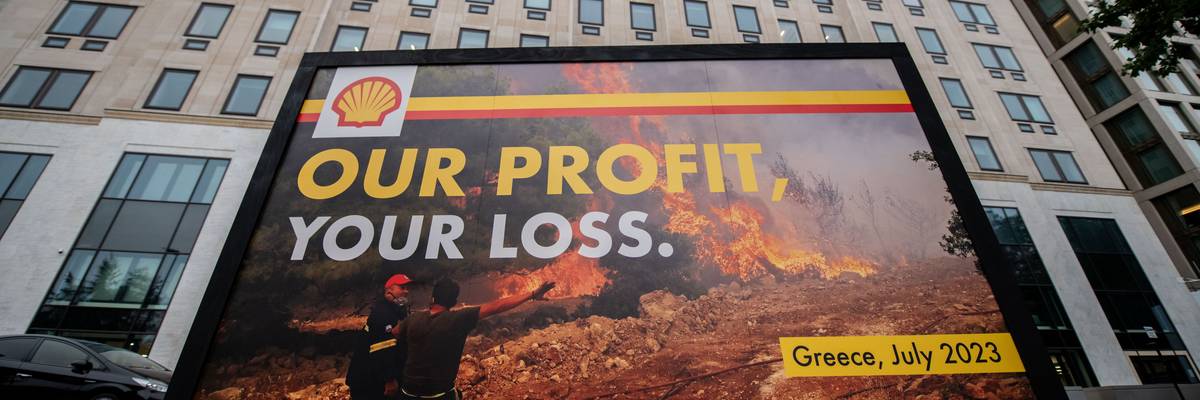
Just five fossil fuel giants—BP, Shell, ExxonMobil, Chevron, and TotalEnergies—are set to use nearly an eighth of the world's dwindling carbon budget by 2050 as they continue to increase oil and gas production, driving up planet-warming emissions that are fueling catastrophic extreme weather worldwide.
According to an analysis released Tuesday by Global Witness, those five corporations are forecast to produce oil and gas that—when burned—will emit roughly 47 billion tonnes of carbon dioxide.
"This is equivalent to almost one-eighth of the remaining global carbon budget for staying below 1.5°C," the group noted, referring to the warming target set by the Paris climate accord.
Scientists have estimated that rich nations must completely cut off oil and gas production by 2034 to give the world a 50% chance of limiting warming to 1.5°C by the end of the century.
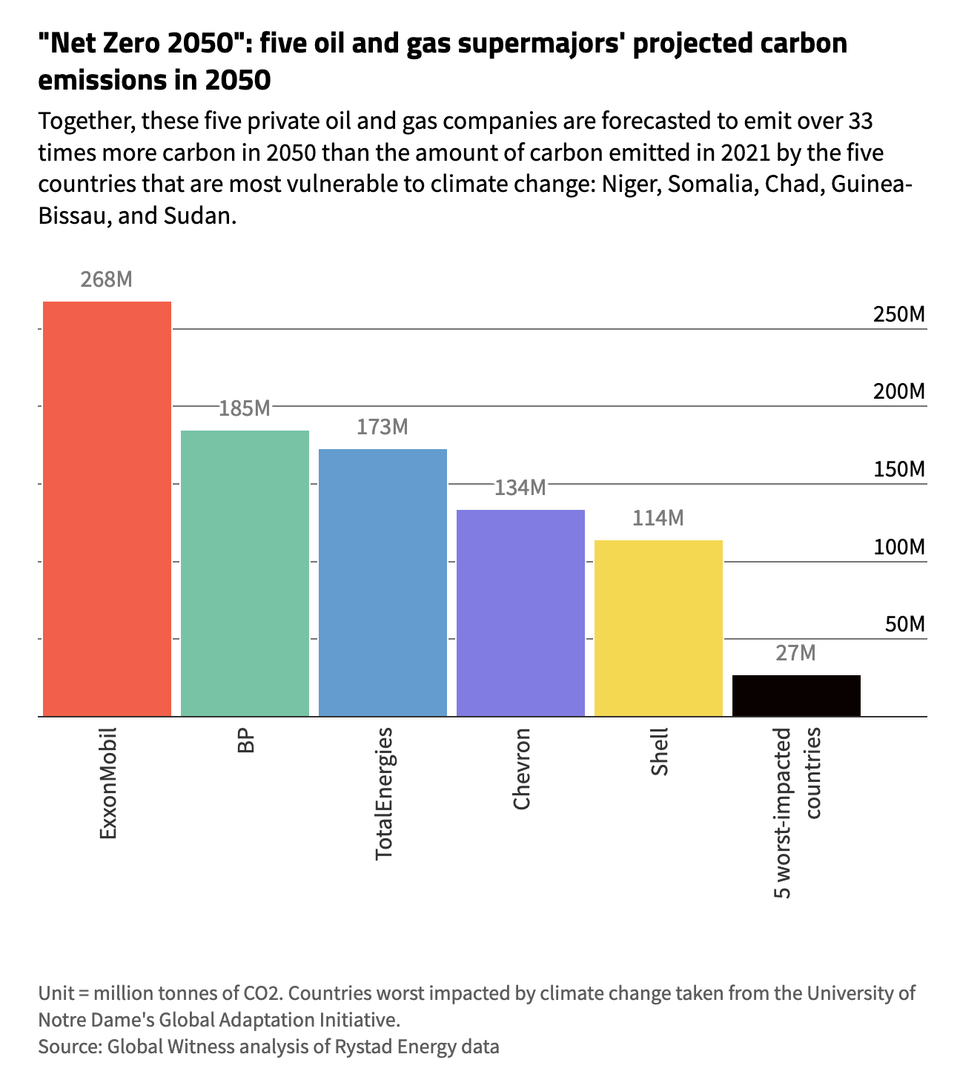
Citing data from the energy business intelligence agency Rystad, Global Witness noted that "in 2050 alone, these five major private western oil and gas companies are estimated to still produce oil and gas, which when burnt, equates to nearly 900 million tonnes of CO2."
"To balance out some of their emissions, many of these companies claim they will use methods designed to reduce emissions, such as carbon capture and storage technologies, according to Net Zero Tracker," the group added. "However, carbon capture and storage remains unproven at scale and highly controversial. This puts the world on a dangerous trajectory of significantly overshooting climate targets."
Global greenhouse gas emissions are currently at an all-time high as world leaders take little concrete action to rein in the primary source of those emissions—fossil fuels.
The new analysis by Global Witness comes as world leaders are preparing to convene for COP28 at the end of November, a summit that will follow months of devastating heatwaves, wildfires, flooding, and other fossil fuel-driven extreme weather across the planet.
"This analysis shows that the world’s top five private oil and gas companies, which already bear a huge responsibility for climate change, are not doing enough to cut emissions now or in the future," Global Witness said Tuesday. "Instead, they are on a dangerous path of foregoing drastic action now and continuing with climate-wrecking emissions."
In recent months, Shell and BP—both of which knew about the connection between fossil fuels and climate change long before they publicly acknowledged it—have walked back pledges to curb oil and gas production and weakened their emission-reduction goals.
Meanwhile, both companies have continued rewarding investors with dividend hikes and stock buybacks.
"It's time to bring in a permanent polluters' tax to hold BP and other fossil fuel companies to account for the damage they continue to wreak," Dorothy Guerrero, head of policy and advocacy at the U.K.-based group Global Justice Now, said earlier this month after BP reported $2.6 billion in second-quarter profits and announced another $1.5 billion in share buybacks.
"Leaving this industry with the power to profit without consequence is not only morally abhorrent—it's plainly ludicrous in the face of a climate catastrophe that threatens us all," Guerrero added.
Just five fossil fuel giants—BP, Shell, ExxonMobil, Chevron, and TotalEnergies—are set to use nearly an eighth of the world's dwindling carbon budget by 2050 as they continue to increase oil and gas production, driving up planet-warming emissions that are fueling catastrophic extreme weather worldwide.
According to an analysis released Tuesday by Global Witness, those five corporations are forecast to produce oil and gas that—when burned—will emit roughly 47 billion tonnes of carbon dioxide.
"This is equivalent to almost one-eighth of the remaining global carbon budget for staying below 1.5°C," the group noted, referring to the warming target set by the Paris climate accord.
Scientists have estimated that rich nations must completely cut off oil and gas production by 2034 to give the world a 50% chance of limiting warming to 1.5°C by the end of the century.
Citing data from the energy business intelligence agency Rystad, Global Witness noted that "in 2050 alone, these five major private western oil and gas companies are estimated to still produce oil and gas, which when burnt, equates to nearly 900 million tonnes of CO2."
"To balance out some of their emissions, many of these companies claim they will use methods designed to reduce emissions, such as carbon capture and storage technologies, according to Net Zero Tracker," the group added. "However, carbon capture and storage remains unproven at scale and highly controversial. This puts the world on a dangerous trajectory of significantly overshooting climate targets."
Global greenhouse gas emissions are currently at an all-time high as world leaders take little concrete action to rein in the primary source of those emissions—fossil fuels.
The new analysis by Global Witness comes as world leaders are preparing to convene for COP28 at the end of November, a summit that will follow months of devastating heatwaves, wildfires, flooding, and other fossil fuel-driven extreme weather across the planet.
"This analysis shows that the world’s top five private oil and gas companies, which already bear a huge responsibility for climate change, are not doing enough to cut emissions now or in the future," Global Witness said Tuesday. "Instead, they are on a dangerous path of foregoing drastic action now and continuing with climate-wrecking emissions."
In recent months, Shell and BP—both of which knew about the connection between fossil fuels and climate change long before they publicly acknowledged it—have walked back pledges to curb oil and gas production and weakened their emission-reduction goals.
Meanwhile, both companies have continued rewarding investors with dividend hikes and stock buybacks.
"It's time to bring in a permanent polluters' tax to hold BP and other fossil fuel companies to account for the damage they continue to wreak," Dorothy Guerrero, head of policy and advocacy at the U.K.-based group Global Justice Now, said earlier this month after BP reported $2.6 billion in second-quarter profits and announced another $1.5 billion in share buybacks.
"Leaving this industry with the power to profit without consequence is not only morally abhorrent—it's plainly ludicrous in the face of a climate catastrophe that threatens us all," Guerrero added.
Just five fossil fuel giants—BP, Shell, ExxonMobil, Chevron, and TotalEnergies—are set to use nearly an eighth of the world's dwindling carbon budget by 2050 as they continue to increase oil and gas production, driving up planet-warming emissions that are fueling catastrophic extreme weather worldwide.
According to an analysis released Tuesday by Global Witness, those five corporations are forecast to produce oil and gas that—when burned—will emit roughly 47 billion tonnes of carbon dioxide.
"This is equivalent to almost one-eighth of the remaining global carbon budget for staying below 1.5°C," the group noted, referring to the warming target set by the Paris climate accord.
Scientists have estimated that rich nations must completely cut off oil and gas production by 2034 to give the world a 50% chance of limiting warming to 1.5°C by the end of the century.
Citing data from the energy business intelligence agency Rystad, Global Witness noted that "in 2050 alone, these five major private western oil and gas companies are estimated to still produce oil and gas, which when burnt, equates to nearly 900 million tonnes of CO2."
"To balance out some of their emissions, many of these companies claim they will use methods designed to reduce emissions, such as carbon capture and storage technologies, according to Net Zero Tracker," the group added. "However, carbon capture and storage remains unproven at scale and highly controversial. This puts the world on a dangerous trajectory of significantly overshooting climate targets."
Global greenhouse gas emissions are currently at an all-time high as world leaders take little concrete action to rein in the primary source of those emissions—fossil fuels.
The new analysis by Global Witness comes as world leaders are preparing to convene for COP28 at the end of November, a summit that will follow months of devastating heatwaves, wildfires, flooding, and other fossil fuel-driven extreme weather across the planet.
"This analysis shows that the world’s top five private oil and gas companies, which already bear a huge responsibility for climate change, are not doing enough to cut emissions now or in the future," Global Witness said Tuesday. "Instead, they are on a dangerous path of foregoing drastic action now and continuing with climate-wrecking emissions."
In recent months, Shell and BP—both of which knew about the connection between fossil fuels and climate change long before they publicly acknowledged it—have walked back pledges to curb oil and gas production and weakened their emission-reduction goals.
Meanwhile, both companies have continued rewarding investors with dividend hikes and stock buybacks.
"It's time to bring in a permanent polluters' tax to hold BP and other fossil fuel companies to account for the damage they continue to wreak," Dorothy Guerrero, head of policy and advocacy at the U.K.-based group Global Justice Now, said earlier this month after BP reported $2.6 billion in second-quarter profits and announced another $1.5 billion in share buybacks.
"Leaving this industry with the power to profit without consequence is not only morally abhorrent—it's plainly ludicrous in the face of a climate catastrophe that threatens us all," Guerrero added.

