SUBSCRIBE TO OUR FREE NEWSLETTER
Daily news & progressive opinion—funded by the people, not the corporations—delivered straight to your inbox.
5
#000000
#FFFFFF
To donate by check, phone, or other method, see our More Ways to Give page.
Daily news & progressive opinion—funded by the people, not the corporations—delivered straight to your inbox.
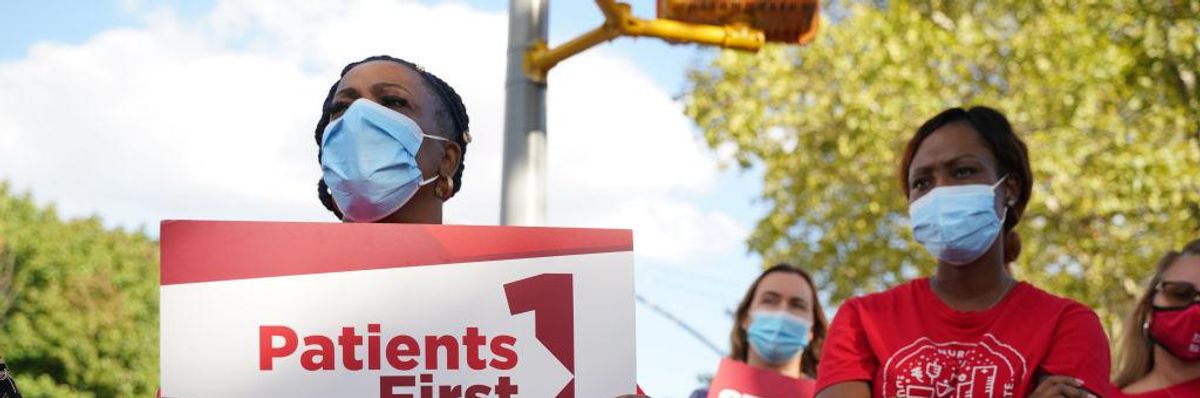
Nurses at Brooklyn VA Medical Center and veterans hold a rally to protest staffing shortage after PACT Act, on August 31, 2022.
"We are truly struggling," said one member of the union which says frontlines caregivers are at a breaking point while patient safety is at risk.
An estimated 16,000 unionized nurses from private hospitals across the New York City metropolitan area announced strike authorizations on Friday as current contracts are set to expire and the region continues to experience a "tridemic" health crisis that includes Covid-19, flu, and the respiratory illness known as RSV.
The New York State Nurses Association (NYSNA) issued ten-day notices on Friday for strikes to begin on January 9 if contract agreements are not reached at eight hospitals, including NewYork-Presbyterian, Montefiore, Mount Sinai Hospital, Mount Sinai Morningside and West, Maimonides, BronxCare, Richmond University Medical Center, and Flushing Hospital Medical Center.
"Somebody needs to understand that we are struggling. This is not going to be sustainable for much longer."
Nurses at each of the hospitals voted separately on whether their union members would go on strike as they called for better caregiver-to-patient ratios, increased benefits, and a sustainable and fair solution to chronic staffing shortages.
In a statement, the NYSNA said the notices "give hospitals time to plan care for patients while nurses are on strike. But the best way for management to protect patients is to listen to nurses and settle fair contracts that protect patient care in the next 10 days."
"We are truly struggling," Michelle Gonzalez, a registered nurse and NYSNA member, told local NBC affiliate News 4 outside a hospital in Yonkers on Friday. "We have been telling the institution that there is not enough of us, that we can not split ourselves into two people—if we could, we would easily have done that already."
"This is about our communities," added Vanessa Weldon, another nurse and member of the union. "This is about providing the best patient care to our community."
Weldon said the message to management "is that we need a fair contract." According to Gonzalez, the strike authorizations at the various hospitals are about making sure the voices of nurses are being heard.
"Somebody has to hear us," she said. "Somebody needs to understand that we are struggling. This is not going to be sustainable for much longer and we're only continuing to lose more healthcare workers" if action is not taking to improve working conditions and benefits for the nursing staff.
Ahead of the vote and Friday's announcement, NYSNA president Nancy Hagans, BSN, RN, said the union does not take the strike threat "lightly."
"Striking is always a last resort," Hagans said. "But we are prepared to strike if our bosses give us no other option. Nurses have been to hell and back, risking our lives to save our patients throughout the Covid-19 pandemic, sometimes without the PPE we needed to keep ourselves safe, and too often without enough staff for safe patient care."
"Instead of supporting us and acknowledging our work," she added, "hospital executives have been fighting against Covid nurse heroes. They've left us with no other choice but to move forward with voting to authorize a strike for better patient care."
Dear Common Dreams reader, It’s been nearly 30 years since I co-founded Common Dreams with my late wife, Lina Newhouser. We had the radical notion that journalism should serve the public good, not corporate profits. It was clear to us from the outset what it would take to build such a project. No paid advertisements. No corporate sponsors. No millionaire publisher telling us what to think or do. Many people said we wouldn't last a year, but we proved those doubters wrong. Together with a tremendous team of journalists and dedicated staff, we built an independent media outlet free from the constraints of profits and corporate control. Our mission has always been simple: To inform. To inspire. To ignite change for the common good. Building Common Dreams was not easy. Our survival was never guaranteed. When you take on the most powerful forces—Wall Street greed, fossil fuel industry destruction, Big Tech lobbyists, and uber-rich oligarchs who have spent billions upon billions rigging the economy and democracy in their favor—the only bulwark you have is supporters who believe in your work. But here’s the urgent message from me today. It's never been this bad out there. And it's never been this hard to keep us going. At the very moment Common Dreams is most needed, the threats we face are intensifying. We need your support now more than ever. We don't accept corporate advertising and never will. We don't have a paywall because we don't think people should be blocked from critical news based on their ability to pay. Everything we do is funded by the donations of readers like you. When everyone does the little they can afford, we are strong. But if that support retreats or dries up, so do we. Will you donate now to make sure Common Dreams not only survives but thrives? —Craig Brown, Co-founder |
An estimated 16,000 unionized nurses from private hospitals across the New York City metropolitan area announced strike authorizations on Friday as current contracts are set to expire and the region continues to experience a "tridemic" health crisis that includes Covid-19, flu, and the respiratory illness known as RSV.
The New York State Nurses Association (NYSNA) issued ten-day notices on Friday for strikes to begin on January 9 if contract agreements are not reached at eight hospitals, including NewYork-Presbyterian, Montefiore, Mount Sinai Hospital, Mount Sinai Morningside and West, Maimonides, BronxCare, Richmond University Medical Center, and Flushing Hospital Medical Center.
"Somebody needs to understand that we are struggling. This is not going to be sustainable for much longer."
Nurses at each of the hospitals voted separately on whether their union members would go on strike as they called for better caregiver-to-patient ratios, increased benefits, and a sustainable and fair solution to chronic staffing shortages.
In a statement, the NYSNA said the notices "give hospitals time to plan care for patients while nurses are on strike. But the best way for management to protect patients is to listen to nurses and settle fair contracts that protect patient care in the next 10 days."
"We are truly struggling," Michelle Gonzalez, a registered nurse and NYSNA member, told local NBC affiliate News 4 outside a hospital in Yonkers on Friday. "We have been telling the institution that there is not enough of us, that we can not split ourselves into two people—if we could, we would easily have done that already."
"This is about our communities," added Vanessa Weldon, another nurse and member of the union. "This is about providing the best patient care to our community."
Weldon said the message to management "is that we need a fair contract." According to Gonzalez, the strike authorizations at the various hospitals are about making sure the voices of nurses are being heard.
"Somebody has to hear us," she said. "Somebody needs to understand that we are struggling. This is not going to be sustainable for much longer and we're only continuing to lose more healthcare workers" if action is not taking to improve working conditions and benefits for the nursing staff.
Ahead of the vote and Friday's announcement, NYSNA president Nancy Hagans, BSN, RN, said the union does not take the strike threat "lightly."
"Striking is always a last resort," Hagans said. "But we are prepared to strike if our bosses give us no other option. Nurses have been to hell and back, risking our lives to save our patients throughout the Covid-19 pandemic, sometimes without the PPE we needed to keep ourselves safe, and too often without enough staff for safe patient care."
"Instead of supporting us and acknowledging our work," she added, "hospital executives have been fighting against Covid nurse heroes. They've left us with no other choice but to move forward with voting to authorize a strike for better patient care."
An estimated 16,000 unionized nurses from private hospitals across the New York City metropolitan area announced strike authorizations on Friday as current contracts are set to expire and the region continues to experience a "tridemic" health crisis that includes Covid-19, flu, and the respiratory illness known as RSV.
The New York State Nurses Association (NYSNA) issued ten-day notices on Friday for strikes to begin on January 9 if contract agreements are not reached at eight hospitals, including NewYork-Presbyterian, Montefiore, Mount Sinai Hospital, Mount Sinai Morningside and West, Maimonides, BronxCare, Richmond University Medical Center, and Flushing Hospital Medical Center.
"Somebody needs to understand that we are struggling. This is not going to be sustainable for much longer."
Nurses at each of the hospitals voted separately on whether their union members would go on strike as they called for better caregiver-to-patient ratios, increased benefits, and a sustainable and fair solution to chronic staffing shortages.
In a statement, the NYSNA said the notices "give hospitals time to plan care for patients while nurses are on strike. But the best way for management to protect patients is to listen to nurses and settle fair contracts that protect patient care in the next 10 days."
"We are truly struggling," Michelle Gonzalez, a registered nurse and NYSNA member, told local NBC affiliate News 4 outside a hospital in Yonkers on Friday. "We have been telling the institution that there is not enough of us, that we can not split ourselves into two people—if we could, we would easily have done that already."
"This is about our communities," added Vanessa Weldon, another nurse and member of the union. "This is about providing the best patient care to our community."
Weldon said the message to management "is that we need a fair contract." According to Gonzalez, the strike authorizations at the various hospitals are about making sure the voices of nurses are being heard.
"Somebody has to hear us," she said. "Somebody needs to understand that we are struggling. This is not going to be sustainable for much longer and we're only continuing to lose more healthcare workers" if action is not taking to improve working conditions and benefits for the nursing staff.
Ahead of the vote and Friday's announcement, NYSNA president Nancy Hagans, BSN, RN, said the union does not take the strike threat "lightly."
"Striking is always a last resort," Hagans said. "But we are prepared to strike if our bosses give us no other option. Nurses have been to hell and back, risking our lives to save our patients throughout the Covid-19 pandemic, sometimes without the PPE we needed to keep ourselves safe, and too often without enough staff for safe patient care."
"Instead of supporting us and acknowledging our work," she added, "hospital executives have been fighting against Covid nurse heroes. They've left us with no other choice but to move forward with voting to authorize a strike for better patient care."