SUBSCRIBE TO OUR FREE NEWSLETTER
Daily news & progressive opinion—funded by the people, not the corporations—delivered straight to your inbox.
5
#000000
#FFFFFF
To donate by check, phone, or other method, see our More Ways to Give page.
Daily news & progressive opinion—funded by the people, not the corporations—delivered straight to your inbox.
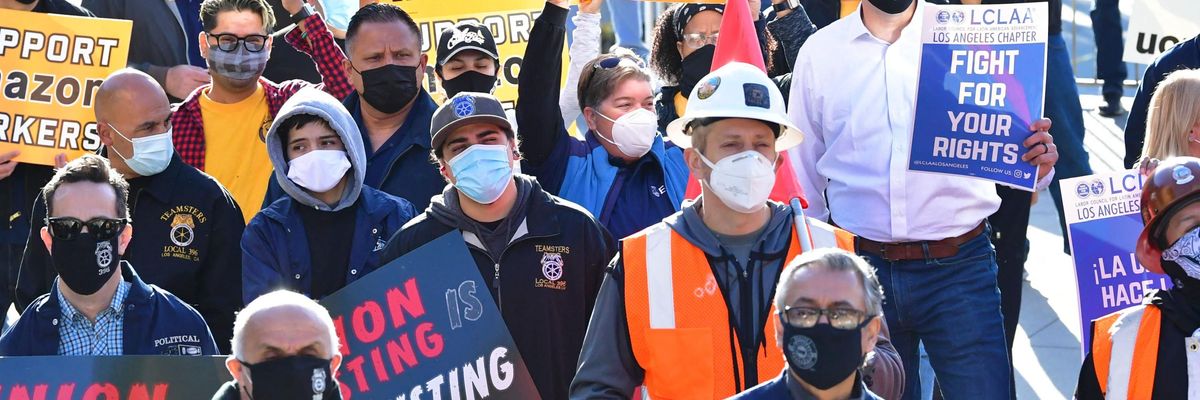
Union leaders are joined by community group representatives, elected officials, and social activists for a rally in support of unionization efforts by Amazon workers in Alabama on March 21, 2021 in Los Angeles, California. (Photo: Frederic J. Brown/AFP via Getty Images)
Amid a continued high-profile push for workers' rights at U.S. companies including Starbucks and Amazon, polling released Tuesday showed that Americans' approval of labor unions is the highest it's been in nearly six decades and has risen substantially since a low point in the 2010s.
Gallup's annual Work and Education Survey, conducted between August 1-23, found that 71% of Americans now approve of labor unions.
Support for workers' rights has steadily risen in recent years as the public has watched a fired Amazon employee lead his former colleagues to a historic union victory in April and Starbucks baristas at more than 200 stores vote to unionize despite facing aggressive--and illegal--retaliation by the coffee chain.
In 2021, 68% of people said they supported labor unions, and 64% reported the same before the coronavirus pandemic marked a shift in many American workplaces.
"The fact is, too many employers still get away with vicious union busting and silencing the voices of their workers. To change this, we must channel support for unions into votes for pro-worker candidates up and down the ballot."
Companies like Trader Joe's faced pressure to provide hazard pay to frontline workers when the pandemic began, and workers at Amazon staged walkouts in April 2020 to demand better coronavirus protections.
Since the pandemic began, 10,000 unionized John Deere workers have pushed the company to offer a new contract with a 10% wage increase while Smalls has drawn national attention to the union push at Amazon, wearing a jacket emblazoned with the words "Eat the Rich" as he met President Joe Biden at the White House and bluntly telling a Senate committee the U.S. economic system "is broken."
The Gallup poll, released less than a week before Labor Day, found that support for unions is now the highest it's been since 1965 and has jumped by 23 points in just 13 years, following the Great Recession.
The survey follows polling that showed Alabama residents overwhelmingly backed an effort to unionize by Amazon warehouse employees in the city of Bessemer and a survey taken in February showing that seven in 10 Starbucks customers supported the unionization push at the company.
As the push to unionize has spread across some of the country's largest companies, the National Labor Relations Board (NLRB) reported in July a 56% increase in union petitions filed in the first six months of 2022.
Restaurant workers in Austin, Texas have formed an independent union with the goal of organizing the nation's entire food services industry and since Starbucks employees in Buffalo, New York became the first U.S. workers at the chain to unionize, employees at more than 300 stores in 36 states have filed for union elections with the NLRB.
That momentum has kept up despite "relentless efforts from corporate billionaires to silence workers," said Liz Shuler, president of the American Federation of Labor and Congress of Industrial Organizations (AFL-CIO).
"Working people recognize the need for a collective voice and it shows," tweeted Shuler. "We are stronger in a union!"
Charles Idelson, communications director for National Nurses United, noted that the rise in support for unions follows "five decades of far right, corporate assaults" on workers' rights and growing inequality between average employees and the wealthiest Americans.
The Gallup poll, said Lee Saunders, president of the American Federation of State, County, and Municipal Employees (AFSCME), shows that "the overwhelming majority of Americans understands what unions bring to the table: higher wages, safer working conditions, lifesaving benefits, job security, and dignity and respect."
Saunders urged Americans to demonstrate their enthusiasm for workers' rights on Election Day to ensure pro-worker legislation is passed at the local, state, and federal level.
"The fact is, too many employers still get away with vicious union busting and silencing the voices of their workers," said Saunders. "To change this, we must channel support for unions into votes for pro-worker candidates up and down the ballot."
This country and this world are at a monumental crossroads. US voters have an opportunity to beat back the forces of fascism and confront the billionaires who are rigging the economy, our media system, and our democracy, making it increasingly impossible for ordinary people to get by. We’re not just talking about the election. We’re talking about what must be done once these fascist elements are vanquished from power. We need a bolder set of solutions than what either major party has so far been willing to offer and a working-class movement ready to fight like hell for it. Trump didn't emerge from nowhere. The conditions that fueled MAGA authoritarianism were created by decades of radical neoliberal economic policies and a corrupt political system dominated by corporate interests. They slashed taxes on the super-rich, promising that the benefits would trickle down. They said giveaways to the corporate titans would make life more affordable for the rest of us. It was all bullshit. And when a bitter, betrayed populace searches for someone to blame, right-wing demagogues have little trouble finding scapegoats. People know when they're being lied to, but you won't hear any of this from the corporate media. Only independent journalism—powered and funded by people who believe in building a better world—can deliver truly trustworthy daily news. If you share our vision, please contribute whatever you can to sustain our work. |
Amid a continued high-profile push for workers' rights at U.S. companies including Starbucks and Amazon, polling released Tuesday showed that Americans' approval of labor unions is the highest it's been in nearly six decades and has risen substantially since a low point in the 2010s.
Gallup's annual Work and Education Survey, conducted between August 1-23, found that 71% of Americans now approve of labor unions.
Support for workers' rights has steadily risen in recent years as the public has watched a fired Amazon employee lead his former colleagues to a historic union victory in April and Starbucks baristas at more than 200 stores vote to unionize despite facing aggressive--and illegal--retaliation by the coffee chain.
In 2021, 68% of people said they supported labor unions, and 64% reported the same before the coronavirus pandemic marked a shift in many American workplaces.
"The fact is, too many employers still get away with vicious union busting and silencing the voices of their workers. To change this, we must channel support for unions into votes for pro-worker candidates up and down the ballot."
Companies like Trader Joe's faced pressure to provide hazard pay to frontline workers when the pandemic began, and workers at Amazon staged walkouts in April 2020 to demand better coronavirus protections.
Since the pandemic began, 10,000 unionized John Deere workers have pushed the company to offer a new contract with a 10% wage increase while Smalls has drawn national attention to the union push at Amazon, wearing a jacket emblazoned with the words "Eat the Rich" as he met President Joe Biden at the White House and bluntly telling a Senate committee the U.S. economic system "is broken."
The Gallup poll, released less than a week before Labor Day, found that support for unions is now the highest it's been since 1965 and has jumped by 23 points in just 13 years, following the Great Recession.
The survey follows polling that showed Alabama residents overwhelmingly backed an effort to unionize by Amazon warehouse employees in the city of Bessemer and a survey taken in February showing that seven in 10 Starbucks customers supported the unionization push at the company.
As the push to unionize has spread across some of the country's largest companies, the National Labor Relations Board (NLRB) reported in July a 56% increase in union petitions filed in the first six months of 2022.
Restaurant workers in Austin, Texas have formed an independent union with the goal of organizing the nation's entire food services industry and since Starbucks employees in Buffalo, New York became the first U.S. workers at the chain to unionize, employees at more than 300 stores in 36 states have filed for union elections with the NLRB.
That momentum has kept up despite "relentless efforts from corporate billionaires to silence workers," said Liz Shuler, president of the American Federation of Labor and Congress of Industrial Organizations (AFL-CIO).
"Working people recognize the need for a collective voice and it shows," tweeted Shuler. "We are stronger in a union!"
Charles Idelson, communications director for National Nurses United, noted that the rise in support for unions follows "five decades of far right, corporate assaults" on workers' rights and growing inequality between average employees and the wealthiest Americans.
The Gallup poll, said Lee Saunders, president of the American Federation of State, County, and Municipal Employees (AFSCME), shows that "the overwhelming majority of Americans understands what unions bring to the table: higher wages, safer working conditions, lifesaving benefits, job security, and dignity and respect."
Saunders urged Americans to demonstrate their enthusiasm for workers' rights on Election Day to ensure pro-worker legislation is passed at the local, state, and federal level.
"The fact is, too many employers still get away with vicious union busting and silencing the voices of their workers," said Saunders. "To change this, we must channel support for unions into votes for pro-worker candidates up and down the ballot."