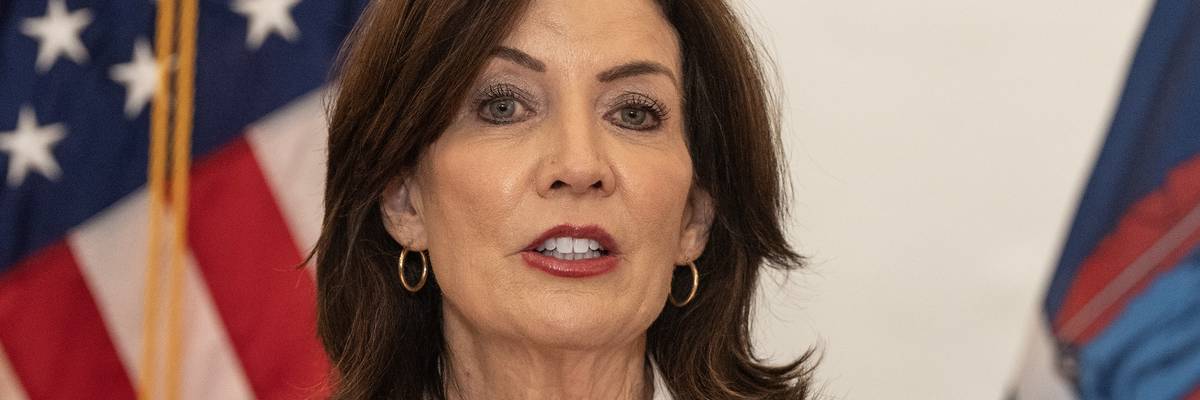
Gov. Kathy Hochul (D-N.Y.) speaks at a press conference on April 24, 2024 in New York City.
'A Real Betrayal': Hochul Condemned for NYC Congestion Pricing Flip-Flop
Climate advocate Bill McKibben called the reversal "the most aggressively anti-environmental stand I can recall a major Democratic governor taking."
"Betrayal."
"A generational setback for climate policy."
"The kind of sabotage by a leader that warrants impeachment."
Those were just some of the ways New Yorkers and climate advocates described Gov. Kathy Hochul's decision to cancel a first-in-the-nation congestion pricing plan for New York City on Wednesday.
Although the move will directly impact a relatively small percentage of U.S. residents' daily lives, critics said the move will stymie progress that could ultimately have been seen across the country—instead dooming communities to continued reliance on vehicles and the planet-heating emissions they cause.
A year after signaling approval for the congestion pricing plan, which was years in the making, the Democratic governor stunned campaigners Wednesday when she released a pre-recorded message announcing that "circumstances have changed" and would not allow the policy to take effect on June 30 as planned.
Under the plan, drivers who entered certain parts of Manhattan would be charged $15, with the projected annual revenue of $1 billion accounting for 50% of the funds needed for the Metropolitan Transportation Authority's (MTA) upgrades to its system.
The MTA's Capital Program is now on hold, according to 6sqft, jeopardizing 23,000 jobs and imperiling the city's ability to improve reliability for working New Yorkers—56% of whom do not own a car—and make subway stations more accessible.
Local groups Riders Alliance and Transportation Alternatives announced plans for an emergency lobby day in Albany on Friday, where they said they would tell Hochul and state lawmakers to say "no to defunding our transit system."
Hochul said she was considering a new tax on businesses to fill in the $1 billion funding gap caused by her decision, but that would require approval by the New York Legislature, whose session ends this week.
The Tri-State Transportation Campaign (TSTC) found in a recent analysis that more than 97% of people who commute from suburbs in New York and New Jersey would not be impacted financially by the congestion pricing plan. Looking at 217 legislative districts across the New York City metropolitan area, the percentage of commuters who would have to pay the $15 toll did not exceed 4%, and was 0-1% in most districts.
"Our members don't ride Escalades to Broadway shows. They use transit," said grassroots civil society group New York Communities for Change.
The TSTC noted that the state Legislature promised the congestion pricing plan to working families who rely on public transportation nearly five years ago.
"We urge the governor to stick to her guns and implement this transformative policy," said the group. "This is the pivotal moment. Please, Gov. Hochul, don't turn your back on the families counting on you to provide cleaner air and faster commutes for everyone."
Third Act founder and author Bill McKibben said Hochul's decision—reportedly encouraged by U.S. House Minority Leader Hakeem Jeffries (D-N.Y.) in an effort to win a Democratic majority in Congress this year—amounts to "a real betrayal."
"This is stupid policy—it's the most aggressively anti-environmental stand I can recall a major Democratic governor taking," wrote McKibben in his newsletter, The Crucial Years. "This kind of system has been a huge success in the European cities that have tried it, like London and Milan; Manhattan (as advocates back to Jimmy Breslin and Norman Mailer have noted) would be an incredibly sweet place with many fewer cars."
Sunrise Movement NYC suggested Hochul's decision was the result of $100,000 in donations to her campaigns from the auto industry, which is hosting a fundraiser for the governor next week with tickets costing $5,000 and up.
"Congestion pricing would save countless lives through reduced traffic across the city, cleaner air, and faster response times by first responders," said the group. "Gov. Hochul cannot usurp congestion pricing unilaterally... We call on the Legislature and the MTA to remain steadfast in the implementation of congestion pricing."
A Dutch study published last year found that although congestion pricing was unpopular when it was first implemented in cities including London, Stockholm, Singapore, and Edinburgh, support grew after the policies went into effect.
"In terms of what's best for the largest number of people, congestion pricing is it, because it brings air quality benefits, it brings lower traffic benefits, and it brings transit improvements to the entire city," Kate Slevin, executive director of the Regional Plan Association in New York, told HuffPost.
Journalist Robinson Meyer said that in terms of the generational climate impact it will have, Hochul's reversal on congestion pricing would ultimately be "worse than the Mountain Valley pipeline, worse than Alaska's Willow project," because of the lost opportunity to bring similar policies to other U.S. cities.
"New York was bushwhacking a trail for everyone else to follow," wrote Meyer. "If congestion policy was a success there, then other American cities could experiment with it in some form... By shuttering the policy in New York, she has poisoned pro-climate urban policies everywhere."
We are at a crossroads
This country and this world are at a monumental crossroads. In a few short weeks, US voters will have an opportunity to beat back the forces of fascism and confront the billionaires who are rigging the economy, our media system, and our democracy, making it increasingly impossible for ordinary people to get by. We’re not just talking about the election. We’re talking about what must be done once these fascist elements are vanquished from power. We need a bolder set of solutions than what either major party has so far been willing to offer and a working-class movement ready to fight like hell for it. Trump didn't emerge from nowhere. The conditions that fueled MAGA authoritarianism were created by decades of radical neoliberal economic policies and a corrupt political system dominated by corporate interests. They slashed taxes on the super-rich, promising that the benefits would trickle down. They said giveaways to the corporate titans would make life more affordable for the rest of us. It was all bullshit. And when a bitter, betrayed populace searches for someone to blame, right-wing demagogues have little trouble finding scapegoats. People know when they're being lied to, but you won't hear any of this from the corporate media. Only independent journalism—powered and funded by people who believe in building a better world—can deliver truly trustworthy daily news. Our Fall Campaign is underway, and we need your help. To power our newsroom through the rest of the year, we need to raise $125,000 by midnight on October 31. So if you share our vision, please contribute whatever you can to sustain our work. |
"Betrayal."
"A generational setback for climate policy."
"The kind of sabotage by a leader that warrants impeachment."
Those were just some of the ways New Yorkers and climate advocates described Gov. Kathy Hochul's decision to cancel a first-in-the-nation congestion pricing plan for New York City on Wednesday.
Although the move will directly impact a relatively small percentage of U.S. residents' daily lives, critics said the move will stymie progress that could ultimately have been seen across the country—instead dooming communities to continued reliance on vehicles and the planet-heating emissions they cause.
A year after signaling approval for the congestion pricing plan, which was years in the making, the Democratic governor stunned campaigners Wednesday when she released a pre-recorded message announcing that "circumstances have changed" and would not allow the policy to take effect on June 30 as planned.
Under the plan, drivers who entered certain parts of Manhattan would be charged $15, with the projected annual revenue of $1 billion accounting for 50% of the funds needed for the Metropolitan Transportation Authority's (MTA) upgrades to its system.
The MTA's Capital Program is now on hold, according to 6sqft, jeopardizing 23,000 jobs and imperiling the city's ability to improve reliability for working New Yorkers—56% of whom do not own a car—and make subway stations more accessible.
Local groups Riders Alliance and Transportation Alternatives announced plans for an emergency lobby day in Albany on Friday, where they said they would tell Hochul and state lawmakers to say "no to defunding our transit system."
Hochul said she was considering a new tax on businesses to fill in the $1 billion funding gap caused by her decision, but that would require approval by the New York Legislature, whose session ends this week.
The Tri-State Transportation Campaign (TSTC) found in a recent analysis that more than 97% of people who commute from suburbs in New York and New Jersey would not be impacted financially by the congestion pricing plan. Looking at 217 legislative districts across the New York City metropolitan area, the percentage of commuters who would have to pay the $15 toll did not exceed 4%, and was 0-1% in most districts.
"Our members don't ride Escalades to Broadway shows. They use transit," said grassroots civil society group New York Communities for Change.
The TSTC noted that the state Legislature promised the congestion pricing plan to working families who rely on public transportation nearly five years ago.
"We urge the governor to stick to her guns and implement this transformative policy," said the group. "This is the pivotal moment. Please, Gov. Hochul, don't turn your back on the families counting on you to provide cleaner air and faster commutes for everyone."
Third Act founder and author Bill McKibben said Hochul's decision—reportedly encouraged by U.S. House Minority Leader Hakeem Jeffries (D-N.Y.) in an effort to win a Democratic majority in Congress this year—amounts to "a real betrayal."
"This is stupid policy—it's the most aggressively anti-environmental stand I can recall a major Democratic governor taking," wrote McKibben in his newsletter, The Crucial Years. "This kind of system has been a huge success in the European cities that have tried it, like London and Milan; Manhattan (as advocates back to Jimmy Breslin and Norman Mailer have noted) would be an incredibly sweet place with many fewer cars."
Sunrise Movement NYC suggested Hochul's decision was the result of $100,000 in donations to her campaigns from the auto industry, which is hosting a fundraiser for the governor next week with tickets costing $5,000 and up.
"Congestion pricing would save countless lives through reduced traffic across the city, cleaner air, and faster response times by first responders," said the group. "Gov. Hochul cannot usurp congestion pricing unilaterally... We call on the Legislature and the MTA to remain steadfast in the implementation of congestion pricing."
A Dutch study published last year found that although congestion pricing was unpopular when it was first implemented in cities including London, Stockholm, Singapore, and Edinburgh, support grew after the policies went into effect.
"In terms of what's best for the largest number of people, congestion pricing is it, because it brings air quality benefits, it brings lower traffic benefits, and it brings transit improvements to the entire city," Kate Slevin, executive director of the Regional Plan Association in New York, told HuffPost.
Journalist Robinson Meyer said that in terms of the generational climate impact it will have, Hochul's reversal on congestion pricing would ultimately be "worse than the Mountain Valley pipeline, worse than Alaska's Willow project," because of the lost opportunity to bring similar policies to other U.S. cities.
"New York was bushwhacking a trail for everyone else to follow," wrote Meyer. "If congestion policy was a success there, then other American cities could experiment with it in some form... By shuttering the policy in New York, she has poisoned pro-climate urban policies everywhere."
- 'Climate Time Bomb': Infrastructure Law Funds Highways Over Public Transit ›
- NJ Joins Growing List of States Phasing Out New Gasoline-Powered Cars ›
- 'Cleaner Air Is Coming' as London Expands Vehicle Pollution Fee to Entire Metro Area ›
- Opinion | New Yorkers Can’t Afford for Gov Hochul to Keep Delaying Climate Action | Common Dreams ›
"Betrayal."
"A generational setback for climate policy."
"The kind of sabotage by a leader that warrants impeachment."
Those were just some of the ways New Yorkers and climate advocates described Gov. Kathy Hochul's decision to cancel a first-in-the-nation congestion pricing plan for New York City on Wednesday.
Although the move will directly impact a relatively small percentage of U.S. residents' daily lives, critics said the move will stymie progress that could ultimately have been seen across the country—instead dooming communities to continued reliance on vehicles and the planet-heating emissions they cause.
A year after signaling approval for the congestion pricing plan, which was years in the making, the Democratic governor stunned campaigners Wednesday when she released a pre-recorded message announcing that "circumstances have changed" and would not allow the policy to take effect on June 30 as planned.
Under the plan, drivers who entered certain parts of Manhattan would be charged $15, with the projected annual revenue of $1 billion accounting for 50% of the funds needed for the Metropolitan Transportation Authority's (MTA) upgrades to its system.
The MTA's Capital Program is now on hold, according to 6sqft, jeopardizing 23,000 jobs and imperiling the city's ability to improve reliability for working New Yorkers—56% of whom do not own a car—and make subway stations more accessible.
Local groups Riders Alliance and Transportation Alternatives announced plans for an emergency lobby day in Albany on Friday, where they said they would tell Hochul and state lawmakers to say "no to defunding our transit system."
Hochul said she was considering a new tax on businesses to fill in the $1 billion funding gap caused by her decision, but that would require approval by the New York Legislature, whose session ends this week.
The Tri-State Transportation Campaign (TSTC) found in a recent analysis that more than 97% of people who commute from suburbs in New York and New Jersey would not be impacted financially by the congestion pricing plan. Looking at 217 legislative districts across the New York City metropolitan area, the percentage of commuters who would have to pay the $15 toll did not exceed 4%, and was 0-1% in most districts.
"Our members don't ride Escalades to Broadway shows. They use transit," said grassroots civil society group New York Communities for Change.
The TSTC noted that the state Legislature promised the congestion pricing plan to working families who rely on public transportation nearly five years ago.
"We urge the governor to stick to her guns and implement this transformative policy," said the group. "This is the pivotal moment. Please, Gov. Hochul, don't turn your back on the families counting on you to provide cleaner air and faster commutes for everyone."
Third Act founder and author Bill McKibben said Hochul's decision—reportedly encouraged by U.S. House Minority Leader Hakeem Jeffries (D-N.Y.) in an effort to win a Democratic majority in Congress this year—amounts to "a real betrayal."
"This is stupid policy—it's the most aggressively anti-environmental stand I can recall a major Democratic governor taking," wrote McKibben in his newsletter, The Crucial Years. "This kind of system has been a huge success in the European cities that have tried it, like London and Milan; Manhattan (as advocates back to Jimmy Breslin and Norman Mailer have noted) would be an incredibly sweet place with many fewer cars."
Sunrise Movement NYC suggested Hochul's decision was the result of $100,000 in donations to her campaigns from the auto industry, which is hosting a fundraiser for the governor next week with tickets costing $5,000 and up.
"Congestion pricing would save countless lives through reduced traffic across the city, cleaner air, and faster response times by first responders," said the group. "Gov. Hochul cannot usurp congestion pricing unilaterally... We call on the Legislature and the MTA to remain steadfast in the implementation of congestion pricing."
A Dutch study published last year found that although congestion pricing was unpopular when it was first implemented in cities including London, Stockholm, Singapore, and Edinburgh, support grew after the policies went into effect.
"In terms of what's best for the largest number of people, congestion pricing is it, because it brings air quality benefits, it brings lower traffic benefits, and it brings transit improvements to the entire city," Kate Slevin, executive director of the Regional Plan Association in New York, told HuffPost.
Journalist Robinson Meyer said that in terms of the generational climate impact it will have, Hochul's reversal on congestion pricing would ultimately be "worse than the Mountain Valley pipeline, worse than Alaska's Willow project," because of the lost opportunity to bring similar policies to other U.S. cities.
"New York was bushwhacking a trail for everyone else to follow," wrote Meyer. "If congestion policy was a success there, then other American cities could experiment with it in some form... By shuttering the policy in New York, she has poisoned pro-climate urban policies everywhere."
- 'Climate Time Bomb': Infrastructure Law Funds Highways Over Public Transit ›
- NJ Joins Growing List of States Phasing Out New Gasoline-Powered Cars ›
- 'Cleaner Air Is Coming' as London Expands Vehicle Pollution Fee to Entire Metro Area ›
- Opinion | New Yorkers Can’t Afford for Gov Hochul to Keep Delaying Climate Action | Common Dreams ›