SUBSCRIBE TO OUR FREE NEWSLETTER
Daily news & progressive opinion—funded by the people, not the corporations—delivered straight to your inbox.
5
#000000
#FFFFFF
To donate by check, phone, or other method, see our More Ways to Give page.
Daily news & progressive opinion—funded by the people, not the corporations—delivered straight to your inbox.
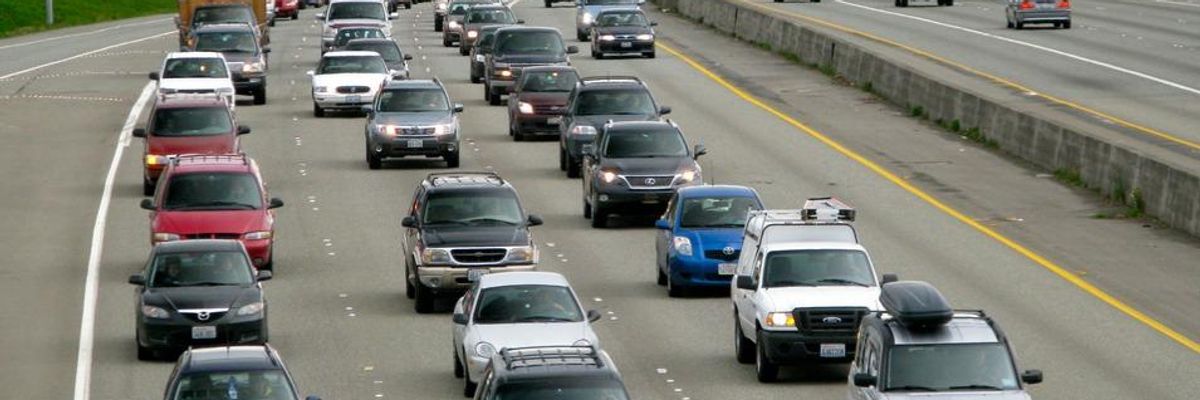
Rush hour traffic is seen on a highway.
"If we want to tackle congestion and the climate crisis, instead of offering platitudes, the next transportation bill needs to offer clean mobility options, like transit, car share, active modes, and electrification," said one analyst.
The law that the Biden administration has heralded as "a once-in-a-generation investment in America's infrastructure" that would help to "build a clean energy economy" has led to an explosion in state-level spending on highway expansion, leading one transportation advocacy group to project on Wednesday that the Bipartisan Infrastructure Law will result in more emissions from transport than if it hadn't passed.
The law, officially known as the Infrastructure Investment and Jobs Act (IIJA), gave state transportation officials discretion over how to spend money distributed by the $1.2 trillion package, but Transportation for America warned in a new analysis of 57,000 projects that the law has revealed itself to be a "climate time bomb," with more than half of the funds—about $70 billion—so far spent on resurfacing and expanding highways.
Only about $25 billion of the money dispersed to states has been spent on transit and passenger rail, even as Americans clamor for more public transportation options.
As Inequality.org reported last week, a 2023 nationwide survey found that 71% of respondents believed the U.S. "should be shifting funding from highways to public transit," and 70% said such a shift would be better for people's "health, safety, and economy."
"Considering the billions of federal dollars already spent on highway expansion projects, it's going to take more than self-congratulation over the bill's historic funding to undo the environmental harms."
Just 18% said building more highways and highway lanes would reduce traffic, cutting down on greenhouse gas emissions—of which transportation is already the biggest source globally and in the United States.
Transportation for America found that unless states change course, highway expansions paid for by the IIJA will lead to more than 178 million tons of greenhouse gas emissions by 2040 and will be only slightly offset by emissions-reducing measures in the law.
"While the IIJA could have been a win for the environment, across the country, states have instead used this once-in-a-generation level of funding to expand roadways the same way they've been doing for years," wrote Corrigan Salerno, a policy associate for the group. "Considering the billions of federal dollars already spent on highway expansion projects, it's going to take more than self-congratulation over the bill's historic funding to undo the environmental harms."
The group noted that the Biden administration advised states to prioritize highway repairs over expansion, but states including Texas and California have forged ahead with plans to increase congested roads' capacity for more vehicles.
"So much of the decision making falls to state departments of transportation," Mary Buchanan, research and policy manager at TransitCenter told The Guardian. "There are essentially 50 opportunities to get this right, I guess, or to potentially get it wrong, in terms of how money is being spent."
The analysis was released a day after an Indiana state House committee approved a bill delaying implementation of dedicated bus lanes in Indianapolis to "study the transportation option," with Republicans in favor of the bill saying the state needs to have an "overall conversation about road funding."
One Democratic lawmaker who has advocated for more public transit options in the city "broke into tears," according to local public broadcasting affiliate WFYI, as he called the decision "really, really, really bad public policy."
Indianapolis residents had testified for months against the bill, WFYI reported.
Salerno called on the Biden administration and the U.S. Congress to "explore every means available" to reduce transportation emissions.
"Congress needs to get real—the largest and most growing sector of emissions is transportation," Salerno wrote. "If we want to tackle congestion and the climate crisis, instead of offering platitudes, the next transportation bill needs to offer clean mobility options, like transit, car share, active modes, and electrification—not just the same strategies that got us in this position in the first place."
Dear Common Dreams reader, It’s been nearly 30 years since I co-founded Common Dreams with my late wife, Lina Newhouser. We had the radical notion that journalism should serve the public good, not corporate profits. It was clear to us from the outset what it would take to build such a project. No paid advertisements. No corporate sponsors. No millionaire publisher telling us what to think or do. Many people said we wouldn't last a year, but we proved those doubters wrong. Together with a tremendous team of journalists and dedicated staff, we built an independent media outlet free from the constraints of profits and corporate control. Our mission has always been simple: To inform. To inspire. To ignite change for the common good. Building Common Dreams was not easy. Our survival was never guaranteed. When you take on the most powerful forces—Wall Street greed, fossil fuel industry destruction, Big Tech lobbyists, and uber-rich oligarchs who have spent billions upon billions rigging the economy and democracy in their favor—the only bulwark you have is supporters who believe in your work. But here’s the urgent message from me today. It's never been this bad out there. And it's never been this hard to keep us going. At the very moment Common Dreams is most needed, the threats we face are intensifying. We need your support now more than ever. We don't accept corporate advertising and never will. We don't have a paywall because we don't think people should be blocked from critical news based on their ability to pay. Everything we do is funded by the donations of readers like you. When everyone does the little they can afford, we are strong. But if that support retreats or dries up, so do we. Will you donate now to make sure Common Dreams not only survives but thrives? —Craig Brown, Co-founder |
The law that the Biden administration has heralded as "a once-in-a-generation investment in America's infrastructure" that would help to "build a clean energy economy" has led to an explosion in state-level spending on highway expansion, leading one transportation advocacy group to project on Wednesday that the Bipartisan Infrastructure Law will result in more emissions from transport than if it hadn't passed.
The law, officially known as the Infrastructure Investment and Jobs Act (IIJA), gave state transportation officials discretion over how to spend money distributed by the $1.2 trillion package, but Transportation for America warned in a new analysis of 57,000 projects that the law has revealed itself to be a "climate time bomb," with more than half of the funds—about $70 billion—so far spent on resurfacing and expanding highways.
Only about $25 billion of the money dispersed to states has been spent on transit and passenger rail, even as Americans clamor for more public transportation options.
As Inequality.org reported last week, a 2023 nationwide survey found that 71% of respondents believed the U.S. "should be shifting funding from highways to public transit," and 70% said such a shift would be better for people's "health, safety, and economy."
"Considering the billions of federal dollars already spent on highway expansion projects, it's going to take more than self-congratulation over the bill's historic funding to undo the environmental harms."
Just 18% said building more highways and highway lanes would reduce traffic, cutting down on greenhouse gas emissions—of which transportation is already the biggest source globally and in the United States.
Transportation for America found that unless states change course, highway expansions paid for by the IIJA will lead to more than 178 million tons of greenhouse gas emissions by 2040 and will be only slightly offset by emissions-reducing measures in the law.
"While the IIJA could have been a win for the environment, across the country, states have instead used this once-in-a-generation level of funding to expand roadways the same way they've been doing for years," wrote Corrigan Salerno, a policy associate for the group. "Considering the billions of federal dollars already spent on highway expansion projects, it's going to take more than self-congratulation over the bill's historic funding to undo the environmental harms."
The group noted that the Biden administration advised states to prioritize highway repairs over expansion, but states including Texas and California have forged ahead with plans to increase congested roads' capacity for more vehicles.
"So much of the decision making falls to state departments of transportation," Mary Buchanan, research and policy manager at TransitCenter told The Guardian. "There are essentially 50 opportunities to get this right, I guess, or to potentially get it wrong, in terms of how money is being spent."
The analysis was released a day after an Indiana state House committee approved a bill delaying implementation of dedicated bus lanes in Indianapolis to "study the transportation option," with Republicans in favor of the bill saying the state needs to have an "overall conversation about road funding."
One Democratic lawmaker who has advocated for more public transit options in the city "broke into tears," according to local public broadcasting affiliate WFYI, as he called the decision "really, really, really bad public policy."
Indianapolis residents had testified for months against the bill, WFYI reported.
Salerno called on the Biden administration and the U.S. Congress to "explore every means available" to reduce transportation emissions.
"Congress needs to get real—the largest and most growing sector of emissions is transportation," Salerno wrote. "If we want to tackle congestion and the climate crisis, instead of offering platitudes, the next transportation bill needs to offer clean mobility options, like transit, car share, active modes, and electrification—not just the same strategies that got us in this position in the first place."
The law that the Biden administration has heralded as "a once-in-a-generation investment in America's infrastructure" that would help to "build a clean energy economy" has led to an explosion in state-level spending on highway expansion, leading one transportation advocacy group to project on Wednesday that the Bipartisan Infrastructure Law will result in more emissions from transport than if it hadn't passed.
The law, officially known as the Infrastructure Investment and Jobs Act (IIJA), gave state transportation officials discretion over how to spend money distributed by the $1.2 trillion package, but Transportation for America warned in a new analysis of 57,000 projects that the law has revealed itself to be a "climate time bomb," with more than half of the funds—about $70 billion—so far spent on resurfacing and expanding highways.
Only about $25 billion of the money dispersed to states has been spent on transit and passenger rail, even as Americans clamor for more public transportation options.
As Inequality.org reported last week, a 2023 nationwide survey found that 71% of respondents believed the U.S. "should be shifting funding from highways to public transit," and 70% said such a shift would be better for people's "health, safety, and economy."
"Considering the billions of federal dollars already spent on highway expansion projects, it's going to take more than self-congratulation over the bill's historic funding to undo the environmental harms."
Just 18% said building more highways and highway lanes would reduce traffic, cutting down on greenhouse gas emissions—of which transportation is already the biggest source globally and in the United States.
Transportation for America found that unless states change course, highway expansions paid for by the IIJA will lead to more than 178 million tons of greenhouse gas emissions by 2040 and will be only slightly offset by emissions-reducing measures in the law.
"While the IIJA could have been a win for the environment, across the country, states have instead used this once-in-a-generation level of funding to expand roadways the same way they've been doing for years," wrote Corrigan Salerno, a policy associate for the group. "Considering the billions of federal dollars already spent on highway expansion projects, it's going to take more than self-congratulation over the bill's historic funding to undo the environmental harms."
The group noted that the Biden administration advised states to prioritize highway repairs over expansion, but states including Texas and California have forged ahead with plans to increase congested roads' capacity for more vehicles.
"So much of the decision making falls to state departments of transportation," Mary Buchanan, research and policy manager at TransitCenter told The Guardian. "There are essentially 50 opportunities to get this right, I guess, or to potentially get it wrong, in terms of how money is being spent."
The analysis was released a day after an Indiana state House committee approved a bill delaying implementation of dedicated bus lanes in Indianapolis to "study the transportation option," with Republicans in favor of the bill saying the state needs to have an "overall conversation about road funding."
One Democratic lawmaker who has advocated for more public transit options in the city "broke into tears," according to local public broadcasting affiliate WFYI, as he called the decision "really, really, really bad public policy."
Indianapolis residents had testified for months against the bill, WFYI reported.
Salerno called on the Biden administration and the U.S. Congress to "explore every means available" to reduce transportation emissions.
"Congress needs to get real—the largest and most growing sector of emissions is transportation," Salerno wrote. "If we want to tackle congestion and the climate crisis, instead of offering platitudes, the next transportation bill needs to offer clean mobility options, like transit, car share, active modes, and electrification—not just the same strategies that got us in this position in the first place."