SUBSCRIBE TO OUR FREE NEWSLETTER
Daily news & progressive opinion—funded by the people, not the corporations—delivered straight to your inbox.
5
#000000
#FFFFFF
To donate by check, phone, or other method, see our More Ways to Give page.
Daily news & progressive opinion—funded by the people, not the corporations—delivered straight to your inbox.
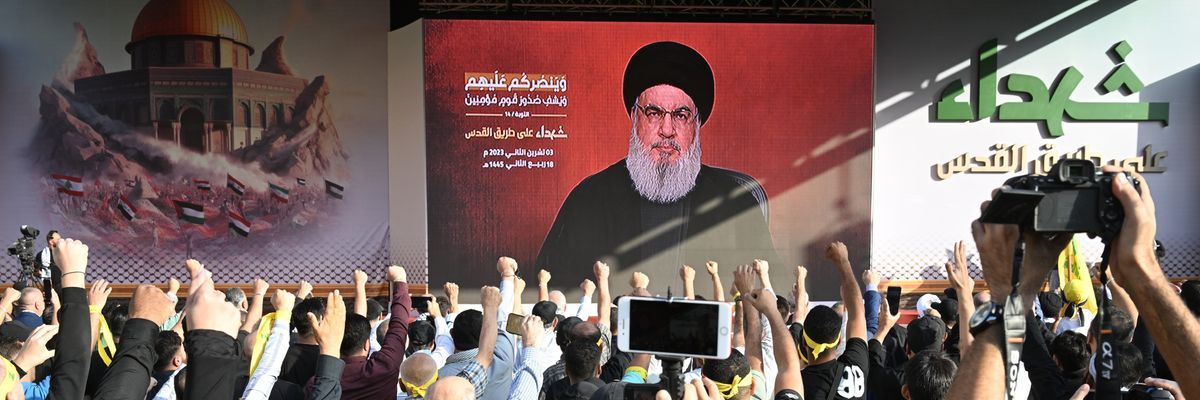
People gather to watch a speech by Hezbollah Secretary-General Hassan Nasrallah in Beirut on November 3, 2023.
The Hezbollah leader stressed that "the only way" to peace "is by stopping the aggression in Gaza and the West Bank" and "not escalation" or "all-out war."
Hezbollah Secretary-General Hassan Nasrallah on Thursday accused Israel of having "violated all red lines" by killing at least 37 people and injuring thousands more in surprise bombings of pagers, walkie-talkies, and other devices across Lebanon, calling the audacious attack "an act of war" that will not go unpunished.
In a televised speech during which Israeli warplanes flew over the Lebanese capital of Beirut, Nasrallah condemned the attack as "a major terrorist operation, an act of genocide, and a massacre," adding that it "amounts to a declaration of war."
"The enemy used a civilian method used by a large segment of society and did so again on Wednesday by blowing up wireless devices without caring who was carrying them," the chief of the Iran-backed political and paramilitary group said.
Numerous figures including United Nations Secretary-General António Guterres decried the weaponization of civilian objects.
"There is no doubt that we have been exposed to a major security and humanitarian blow, unprecedented in the history of the resistance in Lebanon," Nasrallah conceded.
⚡️⭕️[ENGLISH] Hezbollah secretary general Sayed Hassan Nasrallah speech commenting on Israel's Cyber Terror Operation live stream https://t.co/011jOGgYpp
— Middle East Observer (@ME_Observer_) September 19, 2024
Lebanon's Ministry of Health said that in addition to killing at least 37 people—including two children, ages 9 and 11—the bombings, which occurred in two waves on Tuesday and Wednesday, wounded around 3,500 others, 287 of them critically.
While Israel has not claimed responsibility for the attacks, media reports cited Israeli and U.S. officials who attributed the bombings to Israeli military and intelligence operatives.
Nasrallah said that Hezbollah has received "messages through official and unofficial channels saying that the aim of the strike was to stop supporting Gaza."
"Our answer is, in the name of the martyrs and the wounded, that the Lebanon front will not stop until the aggression against Gaza stops, regardless of the sacrifices," he added.
Hezbollah—whose arsenal and military capabilities dwarf those of the Lebanese armed forces or Hamas—launched limited but destructive attacks on northern Israel the day after the October 7 assault on Israel led by its Palestinian ally Hamas. Since then, Hezbollah and Israel have traded cross-border fire that has killed dozens of people and displaced tens of thousands more.
On Wednesday, Israeli Defense Minister Yoav Gallantsaid Israel's war—which has killed or wounded more than 146,000 Palestinians in the besieged enclave and is the subject of an International Court of Justice genocide case—has entered a "new phase" focused on Lebanon.
"The center of gravity is shifting to the north through the diversion of forces and resources," said Gallant, who along with Israeli Prime Minister Benjamin Netanyahu and multiple Hamas leaders faces the prospect of a possible International Criminal Court arrest warrant.
The Israeli remote attack has fueled fears of a wider war and prompted warnings against further escalation.
On Wednesday, Jordan's Foreign Ministry accused Israel of bringing the region to the "brink of war," which would likely involve Iran, whose leaders have yet to publicly retaliate for the July assassination of Hamas political leader Ismail Haniyeh in Tehran. Israel also assassinated Hamas deputy political chief Saleh Arouri in a drone strike in Beirut earlier this year.
Some critics contended that Israel is seeking a wider war. Ronen Bergman, an Israeli expert on targeted assassinations, told Britain's Channel 4 News Wednesday that if his country is behind the Lebanon operation, it is "trying to signal to Hezbollah" that it "is ready for escalation."
Addressing the prospect of a regional war, Nasrallah said during his speech that "the only way" to peace "is by stopping the aggression in Gaza and the West Bank."
"Not escalation," he added. "Not all-out war."
Dear Common Dreams reader, It’s been nearly 30 years since I co-founded Common Dreams with my late wife, Lina Newhouser. We had the radical notion that journalism should serve the public good, not corporate profits. It was clear to us from the outset what it would take to build such a project. No paid advertisements. No corporate sponsors. No millionaire publisher telling us what to think or do. Many people said we wouldn't last a year, but we proved those doubters wrong. Together with a tremendous team of journalists and dedicated staff, we built an independent media outlet free from the constraints of profits and corporate control. Our mission has always been simple: To inform. To inspire. To ignite change for the common good. Building Common Dreams was not easy. Our survival was never guaranteed. When you take on the most powerful forces—Wall Street greed, fossil fuel industry destruction, Big Tech lobbyists, and uber-rich oligarchs who have spent billions upon billions rigging the economy and democracy in their favor—the only bulwark you have is supporters who believe in your work. But here’s the urgent message from me today. It's never been this bad out there. And it's never been this hard to keep us going. At the very moment Common Dreams is most needed, the threats we face are intensifying. We need your support now more than ever. We don't accept corporate advertising and never will. We don't have a paywall because we don't think people should be blocked from critical news based on their ability to pay. Everything we do is funded by the donations of readers like you. When everyone does the little they can afford, we are strong. But if that support retreats or dries up, so do we. Will you donate now to make sure Common Dreams not only survives but thrives? —Craig Brown, Co-founder |
Hezbollah Secretary-General Hassan Nasrallah on Thursday accused Israel of having "violated all red lines" by killing at least 37 people and injuring thousands more in surprise bombings of pagers, walkie-talkies, and other devices across Lebanon, calling the audacious attack "an act of war" that will not go unpunished.
In a televised speech during which Israeli warplanes flew over the Lebanese capital of Beirut, Nasrallah condemned the attack as "a major terrorist operation, an act of genocide, and a massacre," adding that it "amounts to a declaration of war."
"The enemy used a civilian method used by a large segment of society and did so again on Wednesday by blowing up wireless devices without caring who was carrying them," the chief of the Iran-backed political and paramilitary group said.
Numerous figures including United Nations Secretary-General António Guterres decried the weaponization of civilian objects.
"There is no doubt that we have been exposed to a major security and humanitarian blow, unprecedented in the history of the resistance in Lebanon," Nasrallah conceded.
⚡️⭕️[ENGLISH] Hezbollah secretary general Sayed Hassan Nasrallah speech commenting on Israel's Cyber Terror Operation live stream https://t.co/011jOGgYpp
— Middle East Observer (@ME_Observer_) September 19, 2024
Lebanon's Ministry of Health said that in addition to killing at least 37 people—including two children, ages 9 and 11—the bombings, which occurred in two waves on Tuesday and Wednesday, wounded around 3,500 others, 287 of them critically.
While Israel has not claimed responsibility for the attacks, media reports cited Israeli and U.S. officials who attributed the bombings to Israeli military and intelligence operatives.
Nasrallah said that Hezbollah has received "messages through official and unofficial channels saying that the aim of the strike was to stop supporting Gaza."
"Our answer is, in the name of the martyrs and the wounded, that the Lebanon front will not stop until the aggression against Gaza stops, regardless of the sacrifices," he added.
Hezbollah—whose arsenal and military capabilities dwarf those of the Lebanese armed forces or Hamas—launched limited but destructive attacks on northern Israel the day after the October 7 assault on Israel led by its Palestinian ally Hamas. Since then, Hezbollah and Israel have traded cross-border fire that has killed dozens of people and displaced tens of thousands more.
On Wednesday, Israeli Defense Minister Yoav Gallantsaid Israel's war—which has killed or wounded more than 146,000 Palestinians in the besieged enclave and is the subject of an International Court of Justice genocide case—has entered a "new phase" focused on Lebanon.
"The center of gravity is shifting to the north through the diversion of forces and resources," said Gallant, who along with Israeli Prime Minister Benjamin Netanyahu and multiple Hamas leaders faces the prospect of a possible International Criminal Court arrest warrant.
The Israeli remote attack has fueled fears of a wider war and prompted warnings against further escalation.
On Wednesday, Jordan's Foreign Ministry accused Israel of bringing the region to the "brink of war," which would likely involve Iran, whose leaders have yet to publicly retaliate for the July assassination of Hamas political leader Ismail Haniyeh in Tehran. Israel also assassinated Hamas deputy political chief Saleh Arouri in a drone strike in Beirut earlier this year.
Some critics contended that Israel is seeking a wider war. Ronen Bergman, an Israeli expert on targeted assassinations, told Britain's Channel 4 News Wednesday that if his country is behind the Lebanon operation, it is "trying to signal to Hezbollah" that it "is ready for escalation."
Addressing the prospect of a regional war, Nasrallah said during his speech that "the only way" to peace "is by stopping the aggression in Gaza and the West Bank."
"Not escalation," he added. "Not all-out war."
Hezbollah Secretary-General Hassan Nasrallah on Thursday accused Israel of having "violated all red lines" by killing at least 37 people and injuring thousands more in surprise bombings of pagers, walkie-talkies, and other devices across Lebanon, calling the audacious attack "an act of war" that will not go unpunished.
In a televised speech during which Israeli warplanes flew over the Lebanese capital of Beirut, Nasrallah condemned the attack as "a major terrorist operation, an act of genocide, and a massacre," adding that it "amounts to a declaration of war."
"The enemy used a civilian method used by a large segment of society and did so again on Wednesday by blowing up wireless devices without caring who was carrying them," the chief of the Iran-backed political and paramilitary group said.
Numerous figures including United Nations Secretary-General António Guterres decried the weaponization of civilian objects.
"There is no doubt that we have been exposed to a major security and humanitarian blow, unprecedented in the history of the resistance in Lebanon," Nasrallah conceded.
⚡️⭕️[ENGLISH] Hezbollah secretary general Sayed Hassan Nasrallah speech commenting on Israel's Cyber Terror Operation live stream https://t.co/011jOGgYpp
— Middle East Observer (@ME_Observer_) September 19, 2024
Lebanon's Ministry of Health said that in addition to killing at least 37 people—including two children, ages 9 and 11—the bombings, which occurred in two waves on Tuesday and Wednesday, wounded around 3,500 others, 287 of them critically.
While Israel has not claimed responsibility for the attacks, media reports cited Israeli and U.S. officials who attributed the bombings to Israeli military and intelligence operatives.
Nasrallah said that Hezbollah has received "messages through official and unofficial channels saying that the aim of the strike was to stop supporting Gaza."
"Our answer is, in the name of the martyrs and the wounded, that the Lebanon front will not stop until the aggression against Gaza stops, regardless of the sacrifices," he added.
Hezbollah—whose arsenal and military capabilities dwarf those of the Lebanese armed forces or Hamas—launched limited but destructive attacks on northern Israel the day after the October 7 assault on Israel led by its Palestinian ally Hamas. Since then, Hezbollah and Israel have traded cross-border fire that has killed dozens of people and displaced tens of thousands more.
On Wednesday, Israeli Defense Minister Yoav Gallantsaid Israel's war—which has killed or wounded more than 146,000 Palestinians in the besieged enclave and is the subject of an International Court of Justice genocide case—has entered a "new phase" focused on Lebanon.
"The center of gravity is shifting to the north through the diversion of forces and resources," said Gallant, who along with Israeli Prime Minister Benjamin Netanyahu and multiple Hamas leaders faces the prospect of a possible International Criminal Court arrest warrant.
The Israeli remote attack has fueled fears of a wider war and prompted warnings against further escalation.
On Wednesday, Jordan's Foreign Ministry accused Israel of bringing the region to the "brink of war," which would likely involve Iran, whose leaders have yet to publicly retaliate for the July assassination of Hamas political leader Ismail Haniyeh in Tehran. Israel also assassinated Hamas deputy political chief Saleh Arouri in a drone strike in Beirut earlier this year.
Some critics contended that Israel is seeking a wider war. Ronen Bergman, an Israeli expert on targeted assassinations, told Britain's Channel 4 News Wednesday that if his country is behind the Lebanon operation, it is "trying to signal to Hezbollah" that it "is ready for escalation."
Addressing the prospect of a regional war, Nasrallah said during his speech that "the only way" to peace "is by stopping the aggression in Gaza and the West Bank."
"Not escalation," he added. "Not all-out war."