SUBSCRIBE TO OUR FREE NEWSLETTER
Daily news & progressive opinion—funded by the people, not the corporations—delivered straight to your inbox.
5
#000000
#FFFFFF
To donate by check, phone, or other method, see our More Ways to Give page.
Daily news & progressive opinion—funded by the people, not the corporations—delivered straight to your inbox.
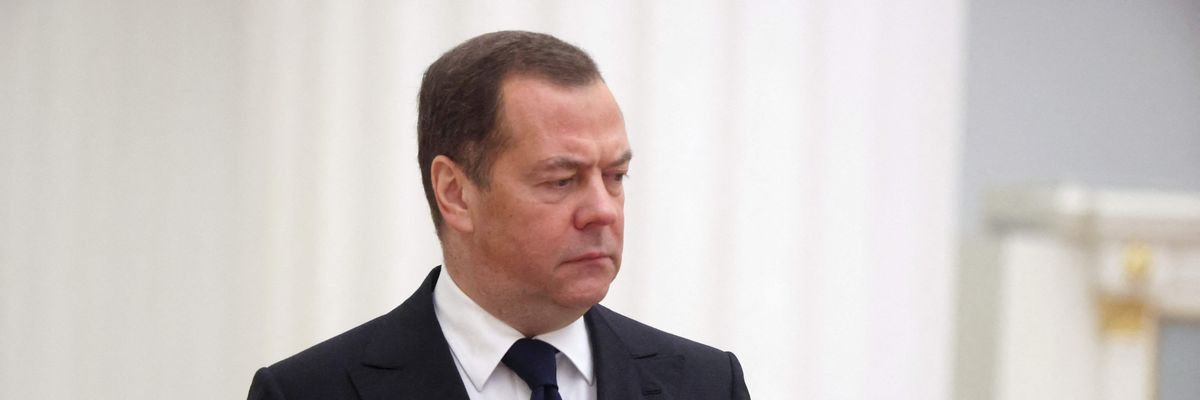
Dmitry Medvedev, deputy chairman of Russia's security council, arrives for a meeting at the Kremlin on November 18, 2022.
"Russia's attempt to cover for its illegal behavior by threatening nuclear war must be condemned," said one peace group. "We can't respond to the use of nuclear weapons, we need to eliminate them now."
Former Russian President Dmitry Medvedev, an ally of current Kremlin leader Vladimir Putin, warned the North Atlantic Treaty Organization on Thursday that a Russian loss in Ukraine could lead to nuclear war.
"The defeat of a nuclear power in a conventional war may trigger a nuclear war," Medvedev, deputy chairman of Russia's security council, said in a post on the Telegram messaging app. "Nuclear powers have never lost major conflicts on which their fate depends."
In response, the International Campaign to Abolish Nuclear Weapons (ICAN) tweeted, "Nuclear threats are unacceptable and banned" under the United Nations Treaty on the Prohibition of Nuclear Weapons. Russia, the United States, China, France, and the United Kingdom—home to more than 12,000 nuclear warheads combined—have expressed opposition to the treaty, which entered into force in January 2021 when it was ratified by 50 governments.
Despite issuing a joint statement last January—prior to Russia's invasion of Ukraine—affirming that "nuclear war cannot be won and must never be fought" and reaffirming that they plan to adhere to non-proliferation, disarmament, and arms control agreements and pledges, the five permanent members of the U.N. Security Council continue to enlarge or modernize their nuclear arsenals. For the first time since the 1980s, the global nuclear stockpile, 90% of which is controlled by Moscow and Washington, is projected to grow in the coming years, and the risk of weapons capable of annihilating life on Earth being used is rising.
"Russia's attempt to cover for its illegal behavior by threatening nuclear war must be condemned," ICAN added. "We can't respond to the use of nuclear weapons, we need to eliminate them now."
This is not the first time that Russian officials have threatened to use nuclear weapons since attacking Ukraine last February. Medvedev, who served as president from 2008 to 2012, "has repeatedly raised the threat of a nuclear apocalypse," Reuters reported Thursday, "but his admission now of the possibility of Russia's defeat indicates the level of Moscow's concern over increased Western weapons deliveries to Ukraine."
According to the news outlet, "Medvedev said NATO and other defense leaders, due to meet at Ramstein Air Base in Germany on Friday to talk about strategy and support for the West's attempt to defeat Russia in Ukraine, should think about the risks of their policy."
When asked if Medvedev's statement reflected an attempt to escalate the war, Kremlin spokesman Dmitry Peskov said: "No, it absolutely does not mean that."
Peskov argued that Medvedev's remarks follow Russia's nuclear doctrine, which permits a nuclear strike after "aggression against the Russian Federation with conventional weapons when the very existence of the state is threatened."
As Reuters noted, Putin has portrayed Russia's so-called "special military operation" in Ukraine as "an existential battle with an aggressive and arrogant West, and has said that Russia will use all available means to protect itself and its people."
In October, U.S. President Joe Biden warned that Russia's assault on Ukraine has brought the world closer to "Armageddon" than at any point since the Cuban Missile Crisis. Just days later, however, his administration released a Nuclear Posture Review that nonproliferation advocates said increases the likelihood of catastrophe, in part because it leaves intact the option of a nuclear first strike. The U.S. remains the only country to have used nuclear weapons in war, decimating the Japanese cities of Hiroshima and Nagasaki with atomic bombs in August 1945.
On Thursday, Max Abrahms, associate professor of political science at Northeastern University, rebuked NATO for ignoring Moscow's warnings against further arming Ukraine.
Instead of heeding those calls, Abrahms noted, Western elites are "saying the opposite—that only by sending more and more weapons into Ukraine can World War III be averted because Putin is just like Hitler and appeasement begets Russian escalation."
Experts have long sounded the alarm about the ongoing war in Europe, saying that it could spiral into a direct conflict between Moscow and NATO, both of which are teeming with nuclear weapons. Nevertheless, the U.S.-led military alliance has continued to prioritize weapons shipments over diplomacy.
Abrahms' criticism comes as the White House is expected to announce Friday that the U.S. will provide Ukraine with another huge military package consisting of artillery, ammunition, and dozens of Bradley and Stryker armored vehicles. According to Politico, the $2.5 billion package excludes the U.S. Army's 60-ton M1 Abrams tanks due to maintenance and logistical issues, not because sending them would intensify the war. Congress has so far authorized more than $23 billion in military aid to Ukraine.
U.S. Secretary of Defense Lloyd Austin admitted last April that the U.S. wants "to see Russia weakened," suggesting that Washington is willing to prolong the war in Ukraine as long as it helps destabilize Moscow.
Peace advocates, by contrast, have consistently called for the U.S. to help negotiate a swift diplomatic resolution to the deadly conflict before it descends into a global nuclear cataclysm.
Dear Common Dreams reader, It’s been nearly 30 years since I co-founded Common Dreams with my late wife, Lina Newhouser. We had the radical notion that journalism should serve the public good, not corporate profits. It was clear to us from the outset what it would take to build such a project. No paid advertisements. No corporate sponsors. No millionaire publisher telling us what to think or do. Many people said we wouldn't last a year, but we proved those doubters wrong. Together with a tremendous team of journalists and dedicated staff, we built an independent media outlet free from the constraints of profits and corporate control. Our mission has always been simple: To inform. To inspire. To ignite change for the common good. Building Common Dreams was not easy. Our survival was never guaranteed. When you take on the most powerful forces—Wall Street greed, fossil fuel industry destruction, Big Tech lobbyists, and uber-rich oligarchs who have spent billions upon billions rigging the economy and democracy in their favor—the only bulwark you have is supporters who believe in your work. But here’s the urgent message from me today. It's never been this bad out there. And it's never been this hard to keep us going. At the very moment Common Dreams is most needed, the threats we face are intensifying. We need your support now more than ever. We don't accept corporate advertising and never will. We don't have a paywall because we don't think people should be blocked from critical news based on their ability to pay. Everything we do is funded by the donations of readers like you. When everyone does the little they can afford, we are strong. But if that support retreats or dries up, so do we. Will you donate now to make sure Common Dreams not only survives but thrives? —Craig Brown, Co-founder |
Former Russian President Dmitry Medvedev, an ally of current Kremlin leader Vladimir Putin, warned the North Atlantic Treaty Organization on Thursday that a Russian loss in Ukraine could lead to nuclear war.
"The defeat of a nuclear power in a conventional war may trigger a nuclear war," Medvedev, deputy chairman of Russia's security council, said in a post on the Telegram messaging app. "Nuclear powers have never lost major conflicts on which their fate depends."
In response, the International Campaign to Abolish Nuclear Weapons (ICAN) tweeted, "Nuclear threats are unacceptable and banned" under the United Nations Treaty on the Prohibition of Nuclear Weapons. Russia, the United States, China, France, and the United Kingdom—home to more than 12,000 nuclear warheads combined—have expressed opposition to the treaty, which entered into force in January 2021 when it was ratified by 50 governments.
Despite issuing a joint statement last January—prior to Russia's invasion of Ukraine—affirming that "nuclear war cannot be won and must never be fought" and reaffirming that they plan to adhere to non-proliferation, disarmament, and arms control agreements and pledges, the five permanent members of the U.N. Security Council continue to enlarge or modernize their nuclear arsenals. For the first time since the 1980s, the global nuclear stockpile, 90% of which is controlled by Moscow and Washington, is projected to grow in the coming years, and the risk of weapons capable of annihilating life on Earth being used is rising.
"Russia's attempt to cover for its illegal behavior by threatening nuclear war must be condemned," ICAN added. "We can't respond to the use of nuclear weapons, we need to eliminate them now."
This is not the first time that Russian officials have threatened to use nuclear weapons since attacking Ukraine last February. Medvedev, who served as president from 2008 to 2012, "has repeatedly raised the threat of a nuclear apocalypse," Reuters reported Thursday, "but his admission now of the possibility of Russia's defeat indicates the level of Moscow's concern over increased Western weapons deliveries to Ukraine."
According to the news outlet, "Medvedev said NATO and other defense leaders, due to meet at Ramstein Air Base in Germany on Friday to talk about strategy and support for the West's attempt to defeat Russia in Ukraine, should think about the risks of their policy."
When asked if Medvedev's statement reflected an attempt to escalate the war, Kremlin spokesman Dmitry Peskov said: "No, it absolutely does not mean that."
Peskov argued that Medvedev's remarks follow Russia's nuclear doctrine, which permits a nuclear strike after "aggression against the Russian Federation with conventional weapons when the very existence of the state is threatened."
As Reuters noted, Putin has portrayed Russia's so-called "special military operation" in Ukraine as "an existential battle with an aggressive and arrogant West, and has said that Russia will use all available means to protect itself and its people."
In October, U.S. President Joe Biden warned that Russia's assault on Ukraine has brought the world closer to "Armageddon" than at any point since the Cuban Missile Crisis. Just days later, however, his administration released a Nuclear Posture Review that nonproliferation advocates said increases the likelihood of catastrophe, in part because it leaves intact the option of a nuclear first strike. The U.S. remains the only country to have used nuclear weapons in war, decimating the Japanese cities of Hiroshima and Nagasaki with atomic bombs in August 1945.
On Thursday, Max Abrahms, associate professor of political science at Northeastern University, rebuked NATO for ignoring Moscow's warnings against further arming Ukraine.
Instead of heeding those calls, Abrahms noted, Western elites are "saying the opposite—that only by sending more and more weapons into Ukraine can World War III be averted because Putin is just like Hitler and appeasement begets Russian escalation."
Experts have long sounded the alarm about the ongoing war in Europe, saying that it could spiral into a direct conflict between Moscow and NATO, both of which are teeming with nuclear weapons. Nevertheless, the U.S.-led military alliance has continued to prioritize weapons shipments over diplomacy.
Abrahms' criticism comes as the White House is expected to announce Friday that the U.S. will provide Ukraine with another huge military package consisting of artillery, ammunition, and dozens of Bradley and Stryker armored vehicles. According to Politico, the $2.5 billion package excludes the U.S. Army's 60-ton M1 Abrams tanks due to maintenance and logistical issues, not because sending them would intensify the war. Congress has so far authorized more than $23 billion in military aid to Ukraine.
U.S. Secretary of Defense Lloyd Austin admitted last April that the U.S. wants "to see Russia weakened," suggesting that Washington is willing to prolong the war in Ukraine as long as it helps destabilize Moscow.
Peace advocates, by contrast, have consistently called for the U.S. to help negotiate a swift diplomatic resolution to the deadly conflict before it descends into a global nuclear cataclysm.
Former Russian President Dmitry Medvedev, an ally of current Kremlin leader Vladimir Putin, warned the North Atlantic Treaty Organization on Thursday that a Russian loss in Ukraine could lead to nuclear war.
"The defeat of a nuclear power in a conventional war may trigger a nuclear war," Medvedev, deputy chairman of Russia's security council, said in a post on the Telegram messaging app. "Nuclear powers have never lost major conflicts on which their fate depends."
In response, the International Campaign to Abolish Nuclear Weapons (ICAN) tweeted, "Nuclear threats are unacceptable and banned" under the United Nations Treaty on the Prohibition of Nuclear Weapons. Russia, the United States, China, France, and the United Kingdom—home to more than 12,000 nuclear warheads combined—have expressed opposition to the treaty, which entered into force in January 2021 when it was ratified by 50 governments.
Despite issuing a joint statement last January—prior to Russia's invasion of Ukraine—affirming that "nuclear war cannot be won and must never be fought" and reaffirming that they plan to adhere to non-proliferation, disarmament, and arms control agreements and pledges, the five permanent members of the U.N. Security Council continue to enlarge or modernize their nuclear arsenals. For the first time since the 1980s, the global nuclear stockpile, 90% of which is controlled by Moscow and Washington, is projected to grow in the coming years, and the risk of weapons capable of annihilating life on Earth being used is rising.
"Russia's attempt to cover for its illegal behavior by threatening nuclear war must be condemned," ICAN added. "We can't respond to the use of nuclear weapons, we need to eliminate them now."
This is not the first time that Russian officials have threatened to use nuclear weapons since attacking Ukraine last February. Medvedev, who served as president from 2008 to 2012, "has repeatedly raised the threat of a nuclear apocalypse," Reuters reported Thursday, "but his admission now of the possibility of Russia's defeat indicates the level of Moscow's concern over increased Western weapons deliveries to Ukraine."
According to the news outlet, "Medvedev said NATO and other defense leaders, due to meet at Ramstein Air Base in Germany on Friday to talk about strategy and support for the West's attempt to defeat Russia in Ukraine, should think about the risks of their policy."
When asked if Medvedev's statement reflected an attempt to escalate the war, Kremlin spokesman Dmitry Peskov said: "No, it absolutely does not mean that."
Peskov argued that Medvedev's remarks follow Russia's nuclear doctrine, which permits a nuclear strike after "aggression against the Russian Federation with conventional weapons when the very existence of the state is threatened."
As Reuters noted, Putin has portrayed Russia's so-called "special military operation" in Ukraine as "an existential battle with an aggressive and arrogant West, and has said that Russia will use all available means to protect itself and its people."
In October, U.S. President Joe Biden warned that Russia's assault on Ukraine has brought the world closer to "Armageddon" than at any point since the Cuban Missile Crisis. Just days later, however, his administration released a Nuclear Posture Review that nonproliferation advocates said increases the likelihood of catastrophe, in part because it leaves intact the option of a nuclear first strike. The U.S. remains the only country to have used nuclear weapons in war, decimating the Japanese cities of Hiroshima and Nagasaki with atomic bombs in August 1945.
On Thursday, Max Abrahms, associate professor of political science at Northeastern University, rebuked NATO for ignoring Moscow's warnings against further arming Ukraine.
Instead of heeding those calls, Abrahms noted, Western elites are "saying the opposite—that only by sending more and more weapons into Ukraine can World War III be averted because Putin is just like Hitler and appeasement begets Russian escalation."
Experts have long sounded the alarm about the ongoing war in Europe, saying that it could spiral into a direct conflict between Moscow and NATO, both of which are teeming with nuclear weapons. Nevertheless, the U.S.-led military alliance has continued to prioritize weapons shipments over diplomacy.
Abrahms' criticism comes as the White House is expected to announce Friday that the U.S. will provide Ukraine with another huge military package consisting of artillery, ammunition, and dozens of Bradley and Stryker armored vehicles. According to Politico, the $2.5 billion package excludes the U.S. Army's 60-ton M1 Abrams tanks due to maintenance and logistical issues, not because sending them would intensify the war. Congress has so far authorized more than $23 billion in military aid to Ukraine.
U.S. Secretary of Defense Lloyd Austin admitted last April that the U.S. wants "to see Russia weakened," suggesting that Washington is willing to prolong the war in Ukraine as long as it helps destabilize Moscow.
Peace advocates, by contrast, have consistently called for the U.S. to help negotiate a swift diplomatic resolution to the deadly conflict before it descends into a global nuclear cataclysm.