SUBSCRIBE TO OUR FREE NEWSLETTER
Daily news & progressive opinion—funded by the people, not the corporations—delivered straight to your inbox.
5
#000000
#FFFFFF
To donate by check, phone, or other method, see our More Ways to Give page.
Daily news & progressive opinion—funded by the people, not the corporations—delivered straight to your inbox.
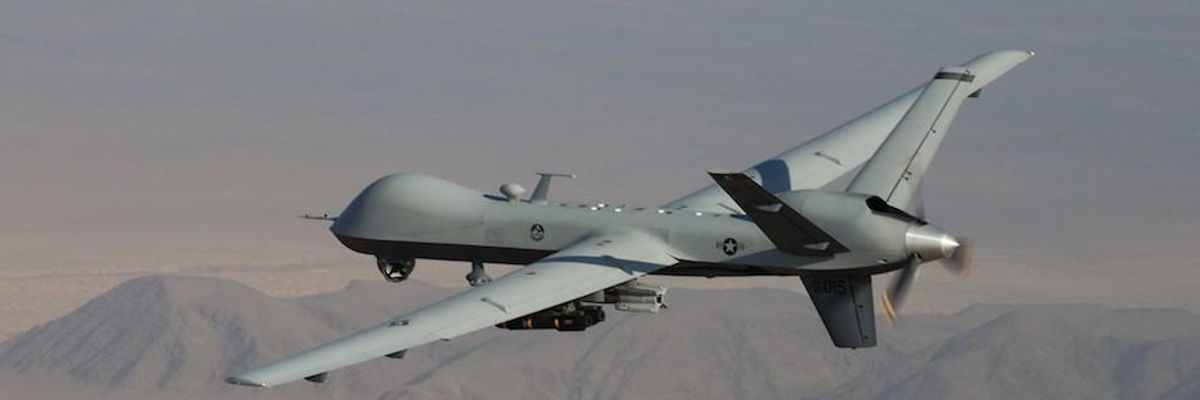
An MQ-9 Reaper drone flies a combat mission.
"As long as the U.S. and Russia both have nukes—not to mention regular signaling/threats of use—relatively minor incidents like this can easily escalate," asserted one disarament expert.
Fears of an escalation between nuclear superpowers Russia and the United States mounted Tuesday after a U.S. Air Force Reaper drone went down in international waters in the Black Sea during an encounter with a Russian fighter jet, with both sides giving varying accounts of the incident.
According to U.S. European Command (EUCOM):
Two Russian Su-27 aircraft conducted an unsafe and unprofessional intercept with a U.S. Air Force intelligence, surveillance, and reconnaissance unmanned MQ-9 aircraft that was operating within international airspace over the Black Sea today. At approximately 7:03 am (CET), one of the Russian Su-27 aircraft struck the propeller of the MQ-9, causing U.S. forces to have to bring the MQ-9 down in international waters. Several times before the collision, the Su-27s dumped fuel on and flew in front of the MQ-9 in a reckless, environmentally unsound, and unprofessional manner. This incident demonstrates a lack of competence in addition to being unsafe and unprofessional.
"This incident follows a pattern of dangerous actions by Russian pilots while interacting with U.S. and allied aircraft over international airspace, including over the Black Sea," EUCOM added. "These aggressive actions by Russian aircrew are dangerous and could lead to miscalculation and unintended escalation. "
U.S. Air Force Gen. James B. Hecker said in a statement that "U.S. and allied aircraft will continue to operate in international airspace and we call on the Russians to conduct themselves professionally and safely."
The Russian Ministry of Defense issued a statement on the incident claiming that the U.S. drone had its transponders turned off and denying that Russian aircraft came into contact with the MQ-9. The ministry said the U.S. aircraft "violated the boundaries" of an area demarcated by Moscow "for the purpose of conducting a special military operation"—an invasion—in Ukraine, and that the drone "went into uncontrolled flight with a loss of altitude and collided with the water surface" as "a result of sharp maneuvering."
An unnamed U.S. Air Force official told The War Zone that American officials do not believe the Russians deliberately tried to bring down the drone, but that the alleged collision "seems to be simple incompetence."
War Zone reporters Howard Altman and Joseph Trevithick wrote that "today's incident does, of course, come amid long-standing concerns about the potential for the conflict in Ukraine to spill out more broadly in the region."
"Russian officials, including President Vladimir Putin, routinely issue nebulous threats to retaliate against the United States, other members of NATO, and other countries over military aid and other support for Ukraine," the pair added. "How either side will react to the loss of the MQ-9 remains to be seen."
Dear Common Dreams reader, It’s been nearly 30 years since I co-founded Common Dreams with my late wife, Lina Newhouser. We had the radical notion that journalism should serve the public good, not corporate profits. It was clear to us from the outset what it would take to build such a project. No paid advertisements. No corporate sponsors. No millionaire publisher telling us what to think or do. Many people said we wouldn't last a year, but we proved those doubters wrong. Together with a tremendous team of journalists and dedicated staff, we built an independent media outlet free from the constraints of profits and corporate control. Our mission has always been simple: To inform. To inspire. To ignite change for the common good. Building Common Dreams was not easy. Our survival was never guaranteed. When you take on the most powerful forces—Wall Street greed, fossil fuel industry destruction, Big Tech lobbyists, and uber-rich oligarchs who have spent billions upon billions rigging the economy and democracy in their favor—the only bulwark you have is supporters who believe in your work. But here’s the urgent message from me today. It's never been this bad out there. And it's never been this hard to keep us going. At the very moment Common Dreams is most needed, the threats we face are intensifying. We need your support now more than ever. We don't accept corporate advertising and never will. We don't have a paywall because we don't think people should be blocked from critical news based on their ability to pay. Everything we do is funded by the donations of readers like you. When everyone does the little they can afford, we are strong. But if that support retreats or dries up, so do we. Will you donate now to make sure Common Dreams not only survives but thrives? —Craig Brown, Co-founder |
Fears of an escalation between nuclear superpowers Russia and the United States mounted Tuesday after a U.S. Air Force Reaper drone went down in international waters in the Black Sea during an encounter with a Russian fighter jet, with both sides giving varying accounts of the incident.
According to U.S. European Command (EUCOM):
Two Russian Su-27 aircraft conducted an unsafe and unprofessional intercept with a U.S. Air Force intelligence, surveillance, and reconnaissance unmanned MQ-9 aircraft that was operating within international airspace over the Black Sea today. At approximately 7:03 am (CET), one of the Russian Su-27 aircraft struck the propeller of the MQ-9, causing U.S. forces to have to bring the MQ-9 down in international waters. Several times before the collision, the Su-27s dumped fuel on and flew in front of the MQ-9 in a reckless, environmentally unsound, and unprofessional manner. This incident demonstrates a lack of competence in addition to being unsafe and unprofessional.
"This incident follows a pattern of dangerous actions by Russian pilots while interacting with U.S. and allied aircraft over international airspace, including over the Black Sea," EUCOM added. "These aggressive actions by Russian aircrew are dangerous and could lead to miscalculation and unintended escalation. "
U.S. Air Force Gen. James B. Hecker said in a statement that "U.S. and allied aircraft will continue to operate in international airspace and we call on the Russians to conduct themselves professionally and safely."
The Russian Ministry of Defense issued a statement on the incident claiming that the U.S. drone had its transponders turned off and denying that Russian aircraft came into contact with the MQ-9. The ministry said the U.S. aircraft "violated the boundaries" of an area demarcated by Moscow "for the purpose of conducting a special military operation"—an invasion—in Ukraine, and that the drone "went into uncontrolled flight with a loss of altitude and collided with the water surface" as "a result of sharp maneuvering."
An unnamed U.S. Air Force official told The War Zone that American officials do not believe the Russians deliberately tried to bring down the drone, but that the alleged collision "seems to be simple incompetence."
War Zone reporters Howard Altman and Joseph Trevithick wrote that "today's incident does, of course, come amid long-standing concerns about the potential for the conflict in Ukraine to spill out more broadly in the region."
"Russian officials, including President Vladimir Putin, routinely issue nebulous threats to retaliate against the United States, other members of NATO, and other countries over military aid and other support for Ukraine," the pair added. "How either side will react to the loss of the MQ-9 remains to be seen."
Fears of an escalation between nuclear superpowers Russia and the United States mounted Tuesday after a U.S. Air Force Reaper drone went down in international waters in the Black Sea during an encounter with a Russian fighter jet, with both sides giving varying accounts of the incident.
According to U.S. European Command (EUCOM):
Two Russian Su-27 aircraft conducted an unsafe and unprofessional intercept with a U.S. Air Force intelligence, surveillance, and reconnaissance unmanned MQ-9 aircraft that was operating within international airspace over the Black Sea today. At approximately 7:03 am (CET), one of the Russian Su-27 aircraft struck the propeller of the MQ-9, causing U.S. forces to have to bring the MQ-9 down in international waters. Several times before the collision, the Su-27s dumped fuel on and flew in front of the MQ-9 in a reckless, environmentally unsound, and unprofessional manner. This incident demonstrates a lack of competence in addition to being unsafe and unprofessional.
"This incident follows a pattern of dangerous actions by Russian pilots while interacting with U.S. and allied aircraft over international airspace, including over the Black Sea," EUCOM added. "These aggressive actions by Russian aircrew are dangerous and could lead to miscalculation and unintended escalation. "
U.S. Air Force Gen. James B. Hecker said in a statement that "U.S. and allied aircraft will continue to operate in international airspace and we call on the Russians to conduct themselves professionally and safely."
The Russian Ministry of Defense issued a statement on the incident claiming that the U.S. drone had its transponders turned off and denying that Russian aircraft came into contact with the MQ-9. The ministry said the U.S. aircraft "violated the boundaries" of an area demarcated by Moscow "for the purpose of conducting a special military operation"—an invasion—in Ukraine, and that the drone "went into uncontrolled flight with a loss of altitude and collided with the water surface" as "a result of sharp maneuvering."
An unnamed U.S. Air Force official told The War Zone that American officials do not believe the Russians deliberately tried to bring down the drone, but that the alleged collision "seems to be simple incompetence."
War Zone reporters Howard Altman and Joseph Trevithick wrote that "today's incident does, of course, come amid long-standing concerns about the potential for the conflict in Ukraine to spill out more broadly in the region."
"Russian officials, including President Vladimir Putin, routinely issue nebulous threats to retaliate against the United States, other members of NATO, and other countries over military aid and other support for Ukraine," the pair added. "How either side will react to the loss of the MQ-9 remains to be seen."