SUBSCRIBE TO OUR FREE NEWSLETTER
Daily news & progressive opinion—funded by the people, not the corporations—delivered straight to your inbox.
5
#000000
#FFFFFF
To donate by check, phone, or other method, see our More Ways to Give page.
Daily news & progressive opinion—funded by the people, not the corporations—delivered straight to your inbox.
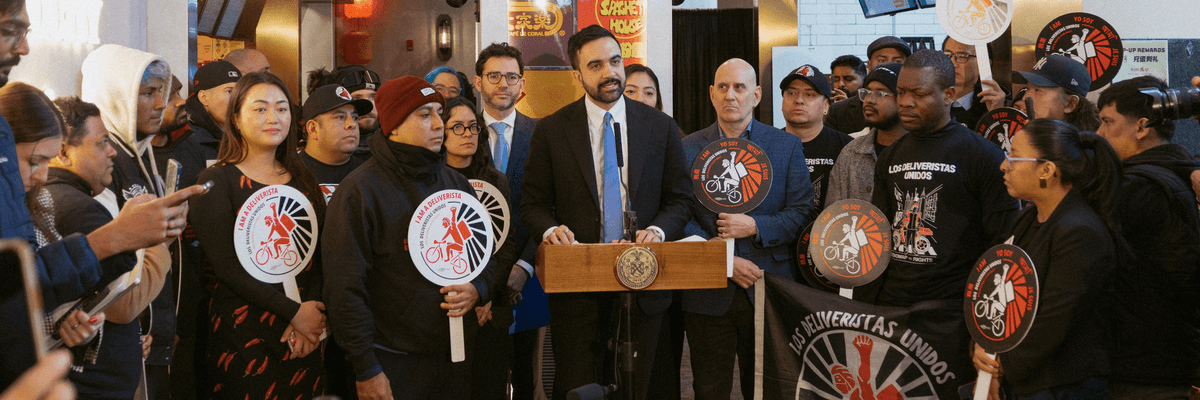
New York City Mayor Zohran Mamdani stands with delivery app drivers in Queens on January 30, 2026.
"It's time we have a politics that puts them at the heart of what it is that we're pursuing and not as part of the appendix."
As he has done numerous times before, New York City Mayor Zohran Mamdani on Thursday rejected the notion that democratic socialism has limited appeal outside of progressive urban centers by asserting that his worker-centered policies are aimed at uplifting the nation's biggest demographic cohort—working people and their families.
Mamdani appeared on "CBS Mornings" and was asked what grade he'd give himself after 100 days leading the world's most important city.
"You know, I'll always leave it to New Yorkers to give me the grade but I will say that I'm proud of what the team has accomplished over the 100 days," Mamdani told "CBS Mornings" hosts Gayle King and Vladimir Duthiers. "I mean, we saw $1.2 billion secured in a partnership with Gov. [Kathy] Hochul to deliver universal childcare in our city."
"We held bad landlords accountable for $32 millon, fixed 6,070 apartments," he added. "We filled 102,000 potholes and we did all of this while also returning $9.3 million back to workers and small businesses that have been ripped off by megacorporations."
Duthiers asked whether "a democratic socialist platform can translate into something that's electorally viable in a statewide election or a national election given that, according to Gallup, many older and rural voters still have issues with the term, with the label, socialist."
Mamdani replied: "You know, what I find is that New Yorkers ask me less about how I describe my politics and more about whether my politics includes them, and I think what we can see is that a democratic socialist politics is one that should be judged on its delivery, like any ideology. And what we're showing in this city is we can we can pursue the big things like universal childcare and do the pothole politics at the same time."
"I think that this is a politics that can flourish anywhere," he added, "because frankly there is only one majority in this country that's the working class and it's time we have a politics that puts them at the heart of what it is that we're pursuing and not as part of the appendix."
Turning to the illegal US-Israeli war of choice against Iran, Mamdani lamented that "we're talking about spending close to $30 billion to kill thousands of people an ocean away while we're told that we don't have even an ounce of that money to help working-class Americans across this country."
According to a Marist poll published earlier this month, 48% of New Yorkers approved of Mamdani's overall performance, while 30% disapproved and 23% are unsure. A majority of respondents—55%—"have either a very favorable or somewhat favorable view of the mayor, and 33% have either a somewhat unfavorable or very unfavorable opinion."
A majority of respondents also said the city is heading in the right direction under Mamdani, while nearly three-quarters believe the mayor is "working hard," and 58% "have a great deal or a good amount of trust in Mayor Mamdani to make decisions that are in the best interest of New York City."
Previous polling has also shown that Mamdani's economic policies are popular across the country.
Responding to Mamdani's "CBS Mornings" appearance, the Center for Economic and Policy Research (CEPR) shared its newly published "Majority Agenda," a “roadmap” to passing policies that most Americans see as major priorities to improve their lives.
"The Majority Agenda is a collection of policy briefs on important issues where Americans generally have broad agreement across the political landscape," CEPR explained. "The project organizes these reports into three main areas: good jobs, strong infrastructure, and fair play."
"We're not as divided as some media and politicians want us to believe," CEPR contended.
Dear Common Dreams reader, It’s been nearly 30 years since I co-founded Common Dreams with my late wife, Lina Newhouser. We had the radical notion that journalism should serve the public good, not corporate profits. It was clear to us from the outset what it would take to build such a project. No paid advertisements. No corporate sponsors. No millionaire publisher telling us what to think or do. Many people said we wouldn't last a year, but we proved those doubters wrong. Together with a tremendous team of journalists and dedicated staff, we built an independent media outlet free from the constraints of profits and corporate control. Our mission has always been simple: To inform. To inspire. To ignite change for the common good. Building Common Dreams was not easy. Our survival was never guaranteed. When you take on the most powerful forces—Wall Street greed, fossil fuel industry destruction, Big Tech lobbyists, and uber-rich oligarchs who have spent billions upon billions rigging the economy and democracy in their favor—the only bulwark you have is supporters who believe in your work. But here’s the urgent message from me today. It's never been this bad out there. And it's never been this hard to keep us going. At the very moment Common Dreams is most needed, the threats we face are intensifying. We need your support now more than ever. We don't accept corporate advertising and never will. We don't have a paywall because we don't think people should be blocked from critical news based on their ability to pay. Everything we do is funded by the donations of readers like you. When everyone does the little they can afford, we are strong. But if that support retreats or dries up, so do we. Will you donate now to make sure Common Dreams not only survives but thrives? —Craig Brown, Co-founder |
As he has done numerous times before, New York City Mayor Zohran Mamdani on Thursday rejected the notion that democratic socialism has limited appeal outside of progressive urban centers by asserting that his worker-centered policies are aimed at uplifting the nation's biggest demographic cohort—working people and their families.
Mamdani appeared on "CBS Mornings" and was asked what grade he'd give himself after 100 days leading the world's most important city.
"You know, I'll always leave it to New Yorkers to give me the grade but I will say that I'm proud of what the team has accomplished over the 100 days," Mamdani told "CBS Mornings" hosts Gayle King and Vladimir Duthiers. "I mean, we saw $1.2 billion secured in a partnership with Gov. [Kathy] Hochul to deliver universal childcare in our city."
"We held bad landlords accountable for $32 millon, fixed 6,070 apartments," he added. "We filled 102,000 potholes and we did all of this while also returning $9.3 million back to workers and small businesses that have been ripped off by megacorporations."
Duthiers asked whether "a democratic socialist platform can translate into something that's electorally viable in a statewide election or a national election given that, according to Gallup, many older and rural voters still have issues with the term, with the label, socialist."
Mamdani replied: "You know, what I find is that New Yorkers ask me less about how I describe my politics and more about whether my politics includes them, and I think what we can see is that a democratic socialist politics is one that should be judged on its delivery, like any ideology. And what we're showing in this city is we can we can pursue the big things like universal childcare and do the pothole politics at the same time."
"I think that this is a politics that can flourish anywhere," he added, "because frankly there is only one majority in this country that's the working class and it's time we have a politics that puts them at the heart of what it is that we're pursuing and not as part of the appendix."
Turning to the illegal US-Israeli war of choice against Iran, Mamdani lamented that "we're talking about spending close to $30 billion to kill thousands of people an ocean away while we're told that we don't have even an ounce of that money to help working-class Americans across this country."
According to a Marist poll published earlier this month, 48% of New Yorkers approved of Mamdani's overall performance, while 30% disapproved and 23% are unsure. A majority of respondents—55%—"have either a very favorable or somewhat favorable view of the mayor, and 33% have either a somewhat unfavorable or very unfavorable opinion."
A majority of respondents also said the city is heading in the right direction under Mamdani, while nearly three-quarters believe the mayor is "working hard," and 58% "have a great deal or a good amount of trust in Mayor Mamdani to make decisions that are in the best interest of New York City."
Previous polling has also shown that Mamdani's economic policies are popular across the country.
Responding to Mamdani's "CBS Mornings" appearance, the Center for Economic and Policy Research (CEPR) shared its newly published "Majority Agenda," a “roadmap” to passing policies that most Americans see as major priorities to improve their lives.
"The Majority Agenda is a collection of policy briefs on important issues where Americans generally have broad agreement across the political landscape," CEPR explained. "The project organizes these reports into three main areas: good jobs, strong infrastructure, and fair play."
"We're not as divided as some media and politicians want us to believe," CEPR contended.
As he has done numerous times before, New York City Mayor Zohran Mamdani on Thursday rejected the notion that democratic socialism has limited appeal outside of progressive urban centers by asserting that his worker-centered policies are aimed at uplifting the nation's biggest demographic cohort—working people and their families.
Mamdani appeared on "CBS Mornings" and was asked what grade he'd give himself after 100 days leading the world's most important city.
"You know, I'll always leave it to New Yorkers to give me the grade but I will say that I'm proud of what the team has accomplished over the 100 days," Mamdani told "CBS Mornings" hosts Gayle King and Vladimir Duthiers. "I mean, we saw $1.2 billion secured in a partnership with Gov. [Kathy] Hochul to deliver universal childcare in our city."
"We held bad landlords accountable for $32 millon, fixed 6,070 apartments," he added. "We filled 102,000 potholes and we did all of this while also returning $9.3 million back to workers and small businesses that have been ripped off by megacorporations."
Duthiers asked whether "a democratic socialist platform can translate into something that's electorally viable in a statewide election or a national election given that, according to Gallup, many older and rural voters still have issues with the term, with the label, socialist."
Mamdani replied: "You know, what I find is that New Yorkers ask me less about how I describe my politics and more about whether my politics includes them, and I think what we can see is that a democratic socialist politics is one that should be judged on its delivery, like any ideology. And what we're showing in this city is we can we can pursue the big things like universal childcare and do the pothole politics at the same time."
"I think that this is a politics that can flourish anywhere," he added, "because frankly there is only one majority in this country that's the working class and it's time we have a politics that puts them at the heart of what it is that we're pursuing and not as part of the appendix."
Turning to the illegal US-Israeli war of choice against Iran, Mamdani lamented that "we're talking about spending close to $30 billion to kill thousands of people an ocean away while we're told that we don't have even an ounce of that money to help working-class Americans across this country."
According to a Marist poll published earlier this month, 48% of New Yorkers approved of Mamdani's overall performance, while 30% disapproved and 23% are unsure. A majority of respondents—55%—"have either a very favorable or somewhat favorable view of the mayor, and 33% have either a somewhat unfavorable or very unfavorable opinion."
A majority of respondents also said the city is heading in the right direction under Mamdani, while nearly three-quarters believe the mayor is "working hard," and 58% "have a great deal or a good amount of trust in Mayor Mamdani to make decisions that are in the best interest of New York City."
Previous polling has also shown that Mamdani's economic policies are popular across the country.
Responding to Mamdani's "CBS Mornings" appearance, the Center for Economic and Policy Research (CEPR) shared its newly published "Majority Agenda," a “roadmap” to passing policies that most Americans see as major priorities to improve their lives.
"The Majority Agenda is a collection of policy briefs on important issues where Americans generally have broad agreement across the political landscape," CEPR explained. "The project organizes these reports into three main areas: good jobs, strong infrastructure, and fair play."
"We're not as divided as some media and politicians want us to believe," CEPR contended.