SUBSCRIBE TO OUR FREE NEWSLETTER
Daily news & progressive opinion—funded by the people, not the corporations—delivered straight to your inbox.
5
#000000
#FFFFFF
To donate by check, phone, or other method, see our More Ways to Give page.
Daily news & progressive opinion—funded by the people, not the corporations—delivered straight to your inbox.
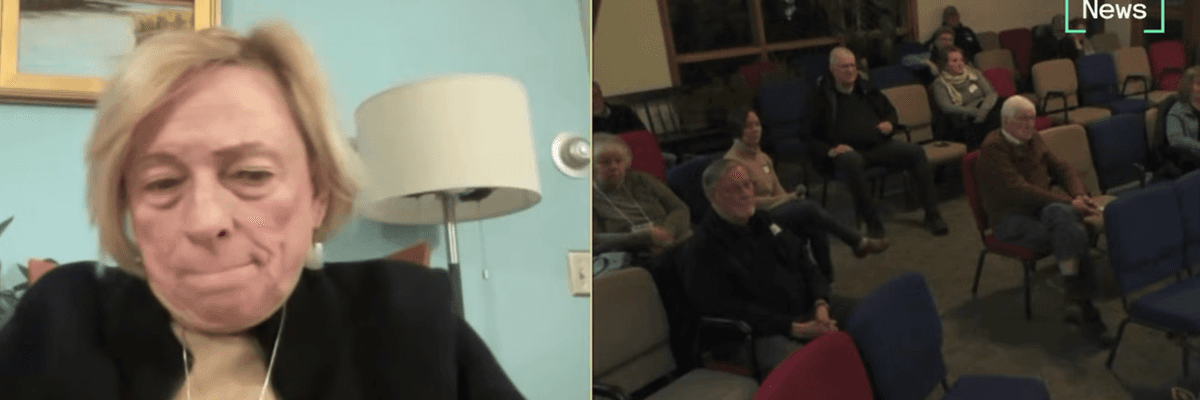
Democratic Maine Gov. Janet Mills addresses a meeting of the Hancock County Democrats on March 19, 2026 in Hancock County, Maine.
One voter told the Maine governor, who is running for US Senate, that she is wondering "why you would fight on behalf of us on the national level if you couldn't do it on the state level."
Most of the national news surrounding the Maine Democratic Senate primary has zeroed in on candidate Graham Platner's record—a tattoo he got while serving in the Marines and posts he wrote several years ago on Reddit.
But a video recording obtained by Drop Site News of a local Democratic group's Zoom meeting last week with Platner's main opponent, Gov. Janet Mills, brought to light discussions Maine voters are having not about the first-time candidate's controversies—which have done little to damage his campaign, according to numerous polls—but about the record of the governor who's run the state for the last six years.
For 30 minutes on March 19, members of the Hancock County Democrats grilled Mills about her history of vetoing significant pieces of legislation and opposing measures broadly supported by Mainers.
⚡️Leaked Video: Janet Mills Attack Ad Against Graham Platner Backfires With Maine Democrats
A Zoom recording with Gov. Janet Mills captures unfiltered voter reactions to the governor’s recent attack ad against her U.S. Senate primary opponent, Graham Platner.
Story by… pic.twitter.com/xF6bmqDsAf
— Drop Site (@DropSiteNews) March 23, 2026
A former Democratic state representative, Mark Worth, asked Mills early in the question-and-answer session about her "record on tribal sovereignty, labor, and gun safety bills, such as your veto of the red flag law"—an apparent reference to Mills' opposition to the red flag law that was passed by referendum in 2025, with 62% supporting the measure to make it easier for law enforcement to take away someone's firearm if they pose a threat to themself or others.
Mills instead supported the state's "yellow flag law," which requires police to take a person into custody and obtain an assessment by a mental health professional before a gun can be taken away.
Nearly two dozen states and the District of Columbia have red flag laws, also known as extreme risk protection orders, and they are supported by 77% of Americans, including a majority of gun owners and Republicans, according to an APM Research Lab/Guns & America/Call To Mind poll from 2019.
Mills responded to the question by defending gun control legislation that has passed in Maine during her tenure—including a ban on ghost guns and expanded background checks—but did not mention the broadly popular red flag law that she opposed.
She said that she had sought to find "common ground" between gun control advocates and gun owners—even though the referendum was supported by nearly two-thirds of voters, including many gun owners—one of whom was Platner, a combat veteran.
The governor has also been criticized for vetoing a bill that would have barred the state from seizing tribal lands, and has angered the state's labor movement several times, including when she vetoed an offshore wind development bill due to her opposition to an amendment requiring collective bargaining agreements, and another measure that would have allowed farmworkers to unionize.
At the meeting this month, a voter named Diana Morenda introduced herself as a "three-time cancer veteran" and asked about two other vetoes by the governor—those of LD 765, which aimed to prohibit "unsupported price increases" of prescription drugs, and LD 1117, which would have prohibited excessive rises in the price of generic prescription drugs.
With the vetoes, Morenda told Mills, she "essentially destroyed any chance that your constituents would have had to combat excessive pricing, kind of siding with Big Pharma."
"You can understand why I... and many others in Hancock County, we might be wondering out loud why you would fight on behalf of us on the national level if you couldn't do it on the state level," said Morenda.
Mills responded similarly as she had to the earlier question, naming other moves she's taken to increase access to prescription drugs and price transparency and telling the voter, "Whoever gave you those two numbers didn't give you the rest of the bills that we did pass."
The controversies surrounding Platner's campaign came up during the meeting, with Worth telling Mills her recent attack ad against Platner was "divisive and odious," and another voter accusing the governor of "using underhanded means" against her opponent.
The ad included several women looking at posts Platner wrote in 2013 disparaging sexual assault survivors. Platner has addressed his old online comments several times, saying his views have evolved since he wrote them.
One voter disclosed that he is a friend of Platner's before asking Mills: "Do you believe in a Maine and a country where a person can be redeemed? Where they can change and become a better version of themself?"
Mills deflected the question, claiming that her concern is not "whether he's reformed or thinks better," but electability.
"The issue is who can beat Susan Collins," said Mills, referring to the state's Republican senator.
The governor has persistently claimed that she has the greatest chance of beating Collins in November, contrary to several polls.
The voter addressed those claims in his question.
"You say electability is what you're looking for here," he said. "And if you truly do believe that and you've read the polls—which I imagine you have—that isn't the case."
Dear Common Dreams reader, It’s been nearly 30 years since I co-founded Common Dreams with my late wife, Lina Newhouser. We had the radical notion that journalism should serve the public good, not corporate profits. It was clear to us from the outset what it would take to build such a project. No paid advertisements. No corporate sponsors. No millionaire publisher telling us what to think or do. Many people said we wouldn't last a year, but we proved those doubters wrong. Together with a tremendous team of journalists and dedicated staff, we built an independent media outlet free from the constraints of profits and corporate control. Our mission has always been simple: To inform. To inspire. To ignite change for the common good. Building Common Dreams was not easy. Our survival was never guaranteed. When you take on the most powerful forces—Wall Street greed, fossil fuel industry destruction, Big Tech lobbyists, and uber-rich oligarchs who have spent billions upon billions rigging the economy and democracy in their favor—the only bulwark you have is supporters who believe in your work. But here’s the urgent message from me today. It's never been this bad out there. And it's never been this hard to keep us going. At the very moment Common Dreams is most needed, the threats we face are intensifying. We need your support now more than ever. We don't accept corporate advertising and never will. We don't have a paywall because we don't think people should be blocked from critical news based on their ability to pay. Everything we do is funded by the donations of readers like you. When everyone does the little they can afford, we are strong. But if that support retreats or dries up, so do we. Will you donate now to make sure Common Dreams not only survives but thrives? —Craig Brown, Co-founder |
Most of the national news surrounding the Maine Democratic Senate primary has zeroed in on candidate Graham Platner's record—a tattoo he got while serving in the Marines and posts he wrote several years ago on Reddit.
But a video recording obtained by Drop Site News of a local Democratic group's Zoom meeting last week with Platner's main opponent, Gov. Janet Mills, brought to light discussions Maine voters are having not about the first-time candidate's controversies—which have done little to damage his campaign, according to numerous polls—but about the record of the governor who's run the state for the last six years.
For 30 minutes on March 19, members of the Hancock County Democrats grilled Mills about her history of vetoing significant pieces of legislation and opposing measures broadly supported by Mainers.
⚡️Leaked Video: Janet Mills Attack Ad Against Graham Platner Backfires With Maine Democrats
A Zoom recording with Gov. Janet Mills captures unfiltered voter reactions to the governor’s recent attack ad against her U.S. Senate primary opponent, Graham Platner.
Story by… pic.twitter.com/xF6bmqDsAf
— Drop Site (@DropSiteNews) March 23, 2026
A former Democratic state representative, Mark Worth, asked Mills early in the question-and-answer session about her "record on tribal sovereignty, labor, and gun safety bills, such as your veto of the red flag law"—an apparent reference to Mills' opposition to the red flag law that was passed by referendum in 2025, with 62% supporting the measure to make it easier for law enforcement to take away someone's firearm if they pose a threat to themself or others.
Mills instead supported the state's "yellow flag law," which requires police to take a person into custody and obtain an assessment by a mental health professional before a gun can be taken away.
Nearly two dozen states and the District of Columbia have red flag laws, also known as extreme risk protection orders, and they are supported by 77% of Americans, including a majority of gun owners and Republicans, according to an APM Research Lab/Guns & America/Call To Mind poll from 2019.
Mills responded to the question by defending gun control legislation that has passed in Maine during her tenure—including a ban on ghost guns and expanded background checks—but did not mention the broadly popular red flag law that she opposed.
She said that she had sought to find "common ground" between gun control advocates and gun owners—even though the referendum was supported by nearly two-thirds of voters, including many gun owners—one of whom was Platner, a combat veteran.
The governor has also been criticized for vetoing a bill that would have barred the state from seizing tribal lands, and has angered the state's labor movement several times, including when she vetoed an offshore wind development bill due to her opposition to an amendment requiring collective bargaining agreements, and another measure that would have allowed farmworkers to unionize.
At the meeting this month, a voter named Diana Morenda introduced herself as a "three-time cancer veteran" and asked about two other vetoes by the governor—those of LD 765, which aimed to prohibit "unsupported price increases" of prescription drugs, and LD 1117, which would have prohibited excessive rises in the price of generic prescription drugs.
With the vetoes, Morenda told Mills, she "essentially destroyed any chance that your constituents would have had to combat excessive pricing, kind of siding with Big Pharma."
"You can understand why I... and many others in Hancock County, we might be wondering out loud why you would fight on behalf of us on the national level if you couldn't do it on the state level," said Morenda.
Mills responded similarly as she had to the earlier question, naming other moves she's taken to increase access to prescription drugs and price transparency and telling the voter, "Whoever gave you those two numbers didn't give you the rest of the bills that we did pass."
The controversies surrounding Platner's campaign came up during the meeting, with Worth telling Mills her recent attack ad against Platner was "divisive and odious," and another voter accusing the governor of "using underhanded means" against her opponent.
The ad included several women looking at posts Platner wrote in 2013 disparaging sexual assault survivors. Platner has addressed his old online comments several times, saying his views have evolved since he wrote them.
One voter disclosed that he is a friend of Platner's before asking Mills: "Do you believe in a Maine and a country where a person can be redeemed? Where they can change and become a better version of themself?"
Mills deflected the question, claiming that her concern is not "whether he's reformed or thinks better," but electability.
"The issue is who can beat Susan Collins," said Mills, referring to the state's Republican senator.
The governor has persistently claimed that she has the greatest chance of beating Collins in November, contrary to several polls.
The voter addressed those claims in his question.
"You say electability is what you're looking for here," he said. "And if you truly do believe that and you've read the polls—which I imagine you have—that isn't the case."
Most of the national news surrounding the Maine Democratic Senate primary has zeroed in on candidate Graham Platner's record—a tattoo he got while serving in the Marines and posts he wrote several years ago on Reddit.
But a video recording obtained by Drop Site News of a local Democratic group's Zoom meeting last week with Platner's main opponent, Gov. Janet Mills, brought to light discussions Maine voters are having not about the first-time candidate's controversies—which have done little to damage his campaign, according to numerous polls—but about the record of the governor who's run the state for the last six years.
For 30 minutes on March 19, members of the Hancock County Democrats grilled Mills about her history of vetoing significant pieces of legislation and opposing measures broadly supported by Mainers.
⚡️Leaked Video: Janet Mills Attack Ad Against Graham Platner Backfires With Maine Democrats
A Zoom recording with Gov. Janet Mills captures unfiltered voter reactions to the governor’s recent attack ad against her U.S. Senate primary opponent, Graham Platner.
Story by… pic.twitter.com/xF6bmqDsAf
— Drop Site (@DropSiteNews) March 23, 2026
A former Democratic state representative, Mark Worth, asked Mills early in the question-and-answer session about her "record on tribal sovereignty, labor, and gun safety bills, such as your veto of the red flag law"—an apparent reference to Mills' opposition to the red flag law that was passed by referendum in 2025, with 62% supporting the measure to make it easier for law enforcement to take away someone's firearm if they pose a threat to themself or others.
Mills instead supported the state's "yellow flag law," which requires police to take a person into custody and obtain an assessment by a mental health professional before a gun can be taken away.
Nearly two dozen states and the District of Columbia have red flag laws, also known as extreme risk protection orders, and they are supported by 77% of Americans, including a majority of gun owners and Republicans, according to an APM Research Lab/Guns & America/Call To Mind poll from 2019.
Mills responded to the question by defending gun control legislation that has passed in Maine during her tenure—including a ban on ghost guns and expanded background checks—but did not mention the broadly popular red flag law that she opposed.
She said that she had sought to find "common ground" between gun control advocates and gun owners—even though the referendum was supported by nearly two-thirds of voters, including many gun owners—one of whom was Platner, a combat veteran.
The governor has also been criticized for vetoing a bill that would have barred the state from seizing tribal lands, and has angered the state's labor movement several times, including when she vetoed an offshore wind development bill due to her opposition to an amendment requiring collective bargaining agreements, and another measure that would have allowed farmworkers to unionize.
At the meeting this month, a voter named Diana Morenda introduced herself as a "three-time cancer veteran" and asked about two other vetoes by the governor—those of LD 765, which aimed to prohibit "unsupported price increases" of prescription drugs, and LD 1117, which would have prohibited excessive rises in the price of generic prescription drugs.
With the vetoes, Morenda told Mills, she "essentially destroyed any chance that your constituents would have had to combat excessive pricing, kind of siding with Big Pharma."
"You can understand why I... and many others in Hancock County, we might be wondering out loud why you would fight on behalf of us on the national level if you couldn't do it on the state level," said Morenda.
Mills responded similarly as she had to the earlier question, naming other moves she's taken to increase access to prescription drugs and price transparency and telling the voter, "Whoever gave you those two numbers didn't give you the rest of the bills that we did pass."
The controversies surrounding Platner's campaign came up during the meeting, with Worth telling Mills her recent attack ad against Platner was "divisive and odious," and another voter accusing the governor of "using underhanded means" against her opponent.
The ad included several women looking at posts Platner wrote in 2013 disparaging sexual assault survivors. Platner has addressed his old online comments several times, saying his views have evolved since he wrote them.
One voter disclosed that he is a friend of Platner's before asking Mills: "Do you believe in a Maine and a country where a person can be redeemed? Where they can change and become a better version of themself?"
Mills deflected the question, claiming that her concern is not "whether he's reformed or thinks better," but electability.
"The issue is who can beat Susan Collins," said Mills, referring to the state's Republican senator.
The governor has persistently claimed that she has the greatest chance of beating Collins in November, contrary to several polls.
The voter addressed those claims in his question.
"You say electability is what you're looking for here," he said. "And if you truly do believe that and you've read the polls—which I imagine you have—that isn't the case."