

SUBSCRIBE TO OUR FREE NEWSLETTER
Daily news & progressive opinion—funded by the people, not the corporations—delivered straight to your inbox.
5
#000000
#FFFFFF
To donate by check, phone, or other method, see our More Ways to Give page.
Researchers in Pennsylvania published a series of studies late Tuesday showing that children who live near fracking operations are roughly five to seven times more likely to develop lymphoma than kids whose homes are at least five miles away from drilling sites.
Released by the University of Pittsburgh and the Pennsylvania Department of Health, the studies also found a "strong link" between fracked gas development and "severe exacerbations, emergency department visits, and hospitalizations for asthma in people living within 10 miles of one or more wells" producing gas.
While the studies weren't designed to establish a causal connection between fracking and cancer or asthma, they add to the large and growing body of literature indicating that oil and gas operations pose a significant threat to public health.
The publicly funded research out Tuesday suggests there are "no associations" between proximity to fracking activities and childhood leukemia or brain and bone cancers.
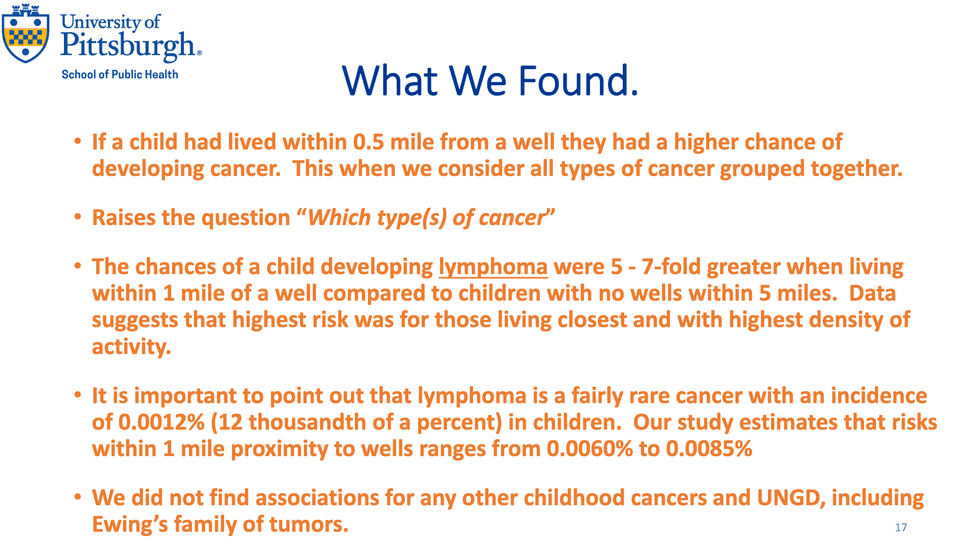
But the results "indicated that children who lived within one mile of a well had approximately five to seven times the chance of developing lymphoma, a relatively rare type of cancer, compared to children who lived in a place with no wells within five miles," the researchers wrote. "Data suggests that those who lived closer, especially in areas with greater intensity of unconventional natural gas development activities, had the highest risk."
"For perspective, the incidence of lymphoma is, on average, 0.0012% in U.S. children under 20 years of age," they added. "Our study estimates that rate would be 0.006% to 0.0084% for children living within one mile of a well."
The studies also examined links between gas development activities and adverse birth outcomes, finding that babies born to mothers who lived close to active fracking wells during the production phase were around an ounce smaller at birth.
"We also found that mothers who lived near active wells were more likely to have babies who were small for gestational age," the researchers wrote in a summary of their results.
Edward Ketyer, president of Physicians for Social Responsibility, told the Associated Press that the findings are a "bombshell" further demonstrating that the "closer you live to fracking activity, the increased risk you have of being sick with a variety of illnesses."
"The biggest question is, why is anybody surprised about that?" asked Ketyer, a retired pediatrician who served on an advisory board for the new research.
The studies were published after around four years of research that drew from the medical histories of thousands of southwestern Pennsylvania residents. In 2021, Pennsylvania produced more shale gas—a product of fracking—than any U.S. state other than Texas.
The Pittsburgh Post-Gazette reported late Tuesday that a community meeting with residents and activists became "intense and at times emotional" as researchers and Pennsylvania Department of Health (DOH) officials presented the results of their studies.
"Parents talked about watching their kids suffer with cancer or asthma, about the lack of state guidance if their water was drinkable and air healthy enough to play outside," the newspaper reported. "DOH executive deputy secretary Kristen Rodack tried to assure them that the studies are just the beginning."
"The DOH said it would be updating its cancer incidence studies, making space on its website for people to submit environmental health complaints, and educating physicians and healthcare providers how to 'identify and treat people with environmental exposures,'" the Post-Gazette added. "It will also work with parents and schools on air quality awareness, and look at the potential for future research."
Climate advocates and medical experts have long demanded a national halt to fracking operations, citing both public health risks and threats to the planet. President Joe Biden pledged to ban new fracking operations on public lands during his 2020 campaign, but he has reneged on that promise.
Matt Nemeth, a member of Sunrise Movement Pittsburgh, wrote in response to the new research that "once again, science confirms fracking is extremely hazardous to human life."
"Politicians and big business [are] still lagging far behind with near unrequited support for this destructive practice," Nemeth added.
In a 2022 roundup of more than 2,000 studies and investigative reports, Physicians for Social Responsibility and Concerned Health Professionals of New York noted that "recent national and global efforts to increase oil and gas production and liquefied natural gas (LNG) exports have dire impacts on public health and the climate."
Sandra Steingraber, co-founder of Concerned Health Professionals of New York, said that "for over 10 years, individual studies have demonstrated impacts in multiple areas, including toxic air pollution, water contamination, radioactive releases, earthquakes, methane emissions, and much more."
During Tuesday's community meeting, Steingraber criticized Pennsylvania health officials for merely pledging to continue monitoring cancer rates near fracking operations.
"JUST STOP DRILLING," she wrote.
Researchers in Pennsylvania published a series of studies late Tuesday showing that children who live near fracking operations are roughly five to seven times more likely to develop lymphoma than kids whose homes are at least five miles away from drilling sites.
Released by the University of Pittsburgh and the Pennsylvania Department of Health, the studies also found a "strong link" between fracked gas development and "severe exacerbations, emergency department visits, and hospitalizations for asthma in people living within 10 miles of one or more wells" producing gas.
While the studies weren't designed to establish a causal connection between fracking and cancer or asthma, they add to the large and growing body of literature indicating that oil and gas operations pose a significant threat to public health.
The publicly funded research out Tuesday suggests there are "no associations" between proximity to fracking activities and childhood leukemia or brain and bone cancers.
But the results "indicated that children who lived within one mile of a well had approximately five to seven times the chance of developing lymphoma, a relatively rare type of cancer, compared to children who lived in a place with no wells within five miles," the researchers wrote. "Data suggests that those who lived closer, especially in areas with greater intensity of unconventional natural gas development activities, had the highest risk."
"For perspective, the incidence of lymphoma is, on average, 0.0012% in U.S. children under 20 years of age," they added. "Our study estimates that rate would be 0.006% to 0.0084% for children living within one mile of a well."
The studies also examined links between gas development activities and adverse birth outcomes, finding that babies born to mothers who lived close to active fracking wells during the production phase were around an ounce smaller at birth.
"We also found that mothers who lived near active wells were more likely to have babies who were small for gestational age," the researchers wrote in a summary of their results.
Edward Ketyer, president of Physicians for Social Responsibility, told the Associated Press that the findings are a "bombshell" further demonstrating that the "closer you live to fracking activity, the increased risk you have of being sick with a variety of illnesses."
"The biggest question is, why is anybody surprised about that?" asked Ketyer, a retired pediatrician who served on an advisory board for the new research.
The studies were published after around four years of research that drew from the medical histories of thousands of southwestern Pennsylvania residents. In 2021, Pennsylvania produced more shale gas—a product of fracking—than any U.S. state other than Texas.
The Pittsburgh Post-Gazette reported late Tuesday that a community meeting with residents and activists became "intense and at times emotional" as researchers and Pennsylvania Department of Health (DOH) officials presented the results of their studies.
"Parents talked about watching their kids suffer with cancer or asthma, about the lack of state guidance if their water was drinkable and air healthy enough to play outside," the newspaper reported. "DOH executive deputy secretary Kristen Rodack tried to assure them that the studies are just the beginning."
"The DOH said it would be updating its cancer incidence studies, making space on its website for people to submit environmental health complaints, and educating physicians and healthcare providers how to 'identify and treat people with environmental exposures,'" the Post-Gazette added. "It will also work with parents and schools on air quality awareness, and look at the potential for future research."
Climate advocates and medical experts have long demanded a national halt to fracking operations, citing both public health risks and threats to the planet. President Joe Biden pledged to ban new fracking operations on public lands during his 2020 campaign, but he has reneged on that promise.
Matt Nemeth, a member of Sunrise Movement Pittsburgh, wrote in response to the new research that "once again, science confirms fracking is extremely hazardous to human life."
"Politicians and big business [are] still lagging far behind with near unrequited support for this destructive practice," Nemeth added.
In a 2022 roundup of more than 2,000 studies and investigative reports, Physicians for Social Responsibility and Concerned Health Professionals of New York noted that "recent national and global efforts to increase oil and gas production and liquefied natural gas (LNG) exports have dire impacts on public health and the climate."
Sandra Steingraber, co-founder of Concerned Health Professionals of New York, said that "for over 10 years, individual studies have demonstrated impacts in multiple areas, including toxic air pollution, water contamination, radioactive releases, earthquakes, methane emissions, and much more."
During Tuesday's community meeting, Steingraber criticized Pennsylvania health officials for merely pledging to continue monitoring cancer rates near fracking operations.
"JUST STOP DRILLING," she wrote.
Researchers in Pennsylvania published a series of studies late Tuesday showing that children who live near fracking operations are roughly five to seven times more likely to develop lymphoma than kids whose homes are at least five miles away from drilling sites.
Released by the University of Pittsburgh and the Pennsylvania Department of Health, the studies also found a "strong link" between fracked gas development and "severe exacerbations, emergency department visits, and hospitalizations for asthma in people living within 10 miles of one or more wells" producing gas.
While the studies weren't designed to establish a causal connection between fracking and cancer or asthma, they add to the large and growing body of literature indicating that oil and gas operations pose a significant threat to public health.
The publicly funded research out Tuesday suggests there are "no associations" between proximity to fracking activities and childhood leukemia or brain and bone cancers.
But the results "indicated that children who lived within one mile of a well had approximately five to seven times the chance of developing lymphoma, a relatively rare type of cancer, compared to children who lived in a place with no wells within five miles," the researchers wrote. "Data suggests that those who lived closer, especially in areas with greater intensity of unconventional natural gas development activities, had the highest risk."
"For perspective, the incidence of lymphoma is, on average, 0.0012% in U.S. children under 20 years of age," they added. "Our study estimates that rate would be 0.006% to 0.0084% for children living within one mile of a well."
The studies also examined links between gas development activities and adverse birth outcomes, finding that babies born to mothers who lived close to active fracking wells during the production phase were around an ounce smaller at birth.
"We also found that mothers who lived near active wells were more likely to have babies who were small for gestational age," the researchers wrote in a summary of their results.
Edward Ketyer, president of Physicians for Social Responsibility, told the Associated Press that the findings are a "bombshell" further demonstrating that the "closer you live to fracking activity, the increased risk you have of being sick with a variety of illnesses."
"The biggest question is, why is anybody surprised about that?" asked Ketyer, a retired pediatrician who served on an advisory board for the new research.
The studies were published after around four years of research that drew from the medical histories of thousands of southwestern Pennsylvania residents. In 2021, Pennsylvania produced more shale gas—a product of fracking—than any U.S. state other than Texas.
The Pittsburgh Post-Gazette reported late Tuesday that a community meeting with residents and activists became "intense and at times emotional" as researchers and Pennsylvania Department of Health (DOH) officials presented the results of their studies.
"Parents talked about watching their kids suffer with cancer or asthma, about the lack of state guidance if their water was drinkable and air healthy enough to play outside," the newspaper reported. "DOH executive deputy secretary Kristen Rodack tried to assure them that the studies are just the beginning."
"The DOH said it would be updating its cancer incidence studies, making space on its website for people to submit environmental health complaints, and educating physicians and healthcare providers how to 'identify and treat people with environmental exposures,'" the Post-Gazette added. "It will also work with parents and schools on air quality awareness, and look at the potential for future research."
Climate advocates and medical experts have long demanded a national halt to fracking operations, citing both public health risks and threats to the planet. President Joe Biden pledged to ban new fracking operations on public lands during his 2020 campaign, but he has reneged on that promise.
Matt Nemeth, a member of Sunrise Movement Pittsburgh, wrote in response to the new research that "once again, science confirms fracking is extremely hazardous to human life."
"Politicians and big business [are] still lagging far behind with near unrequited support for this destructive practice," Nemeth added.
In a 2022 roundup of more than 2,000 studies and investigative reports, Physicians for Social Responsibility and Concerned Health Professionals of New York noted that "recent national and global efforts to increase oil and gas production and liquefied natural gas (LNG) exports have dire impacts on public health and the climate."
Sandra Steingraber, co-founder of Concerned Health Professionals of New York, said that "for over 10 years, individual studies have demonstrated impacts in multiple areas, including toxic air pollution, water contamination, radioactive releases, earthquakes, methane emissions, and much more."
During Tuesday's community meeting, Steingraber criticized Pennsylvania health officials for merely pledging to continue monitoring cancer rates near fracking operations.
"JUST STOP DRILLING," she wrote.

