SUBSCRIBE TO OUR FREE NEWSLETTER
Daily news & progressive opinion—funded by the people, not the corporations—delivered straight to your inbox.
5
#000000
#FFFFFF
To donate by check, phone, or other method, see our More Ways to Give page.
Daily news & progressive opinion—funded by the people, not the corporations—delivered straight to your inbox.
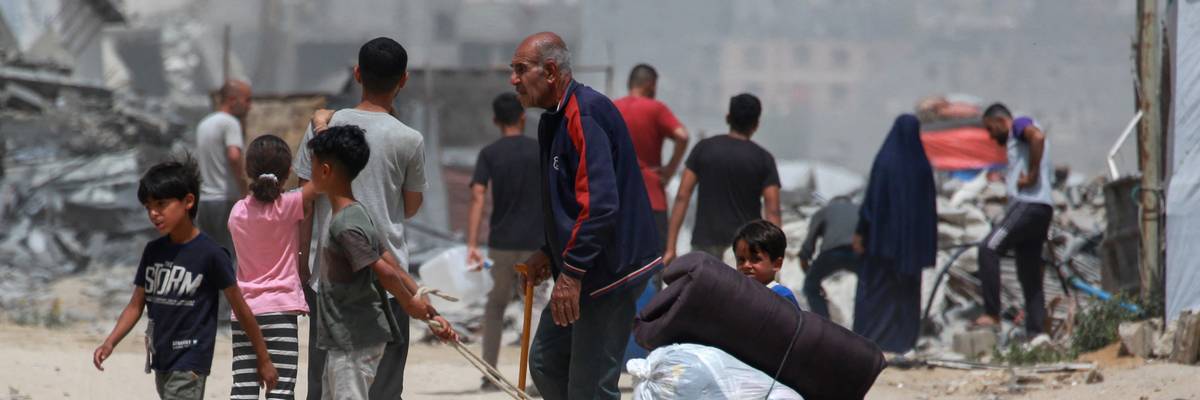
Palestinians in Gaza move with their belongings as they flee the northern cities of Jabalia and Beit Lahia towards Gaza City amid continuous Israeli strikes in the besieged Palestinian territory on May 17, 2025.
"American-led ethnic cleansing should be flatly unacceptable," said one professor.
A plan reportedly under consideration by the Trump administration to send up to one million Gazans to the divided country of Libya was met with criticism on Friday and Saturday, with several observers calling it part of a plan to carry out ethnic cleansing.
On Friday, NBC News reported that the Trump administration has broached the plan with Libya's leadership, though no final agreement has been reached. NBC News' reporting relied on several unnamed sources "with knowledge of the effort."
"This is absolutely categorically an ethnic cleansing and sending people to Libya of all places is unconscionable," wrote investigative journalist James Stout on Bluesky on Friday, in response to the reporting.
An unnamed spokesperson for the Trump administration told NBC News after publication that "these reports are untrue."
As part of the plan, the Trump administration may unfreeze billions of dollars of funds originally meant for Libya that the U.S. froze over ten years ago, the outlet reported.
"A decade and change after U.S. military intervention in Libya under Obama, a direct appeal from the Trump administration to make it a destination for a 21st century Trail of Tears," remarked Olúfẹ́mi O. Táíwò, the Georgetown University assistant professor and philosopher, referencing the forced displacement of indigenous people in the United States in the 19th Century.
Gregg Carlstrom, a Middle East correspondent for the The Economist, called the NBC News' reporting "insanity."
"Skeptical that there's a serious 'plan' here (rather than just spitballing). But the underlying premise is correct: the Trump administration has spent months approaching various countries to see if it could bribe them into helping out with the ethnic cleansing of Gaza," Carlstrom wrote in a post on X on Saturday.
NBC News also reported that the Trump administration has discussed multiple locations for resettling Palestinians in Gaza, and that the administration is considering Syria as a potential location.
In February, Trump floated a plan to "take over" Gaza and mused about permanently displacing Palestinians in Gaza. International law prohibits the forced deportation and transfer of civilians.
Israel has carried out a brutal military campaign on the Gaza Strip following a Hamas attack on Israel on October 7, 2023.
Observers pointed out that Libya is itself experiencing instability.
"This would be an expensive nightmare to practically implement, Libya is an active war zone with a current [population] of only 7 million and in no shape to absorb refugees, and American-led ethnic cleansing should be flatly unacceptable," wrote David Burbach, an associate professor at the U.S. Naval War College on Bluesky on Friday
In 2011, a U.S.-backed intervention toppled Libya's then leader, Muammar Gaddafi, which was followed by a six-year civil war between rival political factions. Currently, eastern Libya is controlled by Khalifa Hifter and a United Nations-recognized government lead by Abdul Hamid Dbeibah is in control in the west. While the humanitarian situation in the country has eased in recent years, largely due to a cease-fire implemented in 2020, the country still experiences outbreaks of violence.
The spokesperson for the Trump administration also highlighted instability in Libya in their response to NBC News. "The situation on the ground is untenable for such a plan. Such a plan was not discussed and makes no sense."
Dear Common Dreams reader, It’s been nearly 30 years since I co-founded Common Dreams with my late wife, Lina Newhouser. We had the radical notion that journalism should serve the public good, not corporate profits. It was clear to us from the outset what it would take to build such a project. No paid advertisements. No corporate sponsors. No millionaire publisher telling us what to think or do. Many people said we wouldn't last a year, but we proved those doubters wrong. Together with a tremendous team of journalists and dedicated staff, we built an independent media outlet free from the constraints of profits and corporate control. Our mission has always been simple: To inform. To inspire. To ignite change for the common good. Building Common Dreams was not easy. Our survival was never guaranteed. When you take on the most powerful forces—Wall Street greed, fossil fuel industry destruction, Big Tech lobbyists, and uber-rich oligarchs who have spent billions upon billions rigging the economy and democracy in their favor—the only bulwark you have is supporters who believe in your work. But here’s the urgent message from me today. It's never been this bad out there. And it's never been this hard to keep us going. At the very moment Common Dreams is most needed, the threats we face are intensifying. We need your support now more than ever. We don't accept corporate advertising and never will. We don't have a paywall because we don't think people should be blocked from critical news based on their ability to pay. Everything we do is funded by the donations of readers like you. When everyone does the little they can afford, we are strong. But if that support retreats or dries up, so do we. Will you donate now to make sure Common Dreams not only survives but thrives? —Craig Brown, Co-founder |
A plan reportedly under consideration by the Trump administration to send up to one million Gazans to the divided country of Libya was met with criticism on Friday and Saturday, with several observers calling it part of a plan to carry out ethnic cleansing.
On Friday, NBC News reported that the Trump administration has broached the plan with Libya's leadership, though no final agreement has been reached. NBC News' reporting relied on several unnamed sources "with knowledge of the effort."
"This is absolutely categorically an ethnic cleansing and sending people to Libya of all places is unconscionable," wrote investigative journalist James Stout on Bluesky on Friday, in response to the reporting.
An unnamed spokesperson for the Trump administration told NBC News after publication that "these reports are untrue."
As part of the plan, the Trump administration may unfreeze billions of dollars of funds originally meant for Libya that the U.S. froze over ten years ago, the outlet reported.
"A decade and change after U.S. military intervention in Libya under Obama, a direct appeal from the Trump administration to make it a destination for a 21st century Trail of Tears," remarked Olúfẹ́mi O. Táíwò, the Georgetown University assistant professor and philosopher, referencing the forced displacement of indigenous people in the United States in the 19th Century.
Gregg Carlstrom, a Middle East correspondent for the The Economist, called the NBC News' reporting "insanity."
"Skeptical that there's a serious 'plan' here (rather than just spitballing). But the underlying premise is correct: the Trump administration has spent months approaching various countries to see if it could bribe them into helping out with the ethnic cleansing of Gaza," Carlstrom wrote in a post on X on Saturday.
NBC News also reported that the Trump administration has discussed multiple locations for resettling Palestinians in Gaza, and that the administration is considering Syria as a potential location.
In February, Trump floated a plan to "take over" Gaza and mused about permanently displacing Palestinians in Gaza. International law prohibits the forced deportation and transfer of civilians.
Israel has carried out a brutal military campaign on the Gaza Strip following a Hamas attack on Israel on October 7, 2023.
Observers pointed out that Libya is itself experiencing instability.
"This would be an expensive nightmare to practically implement, Libya is an active war zone with a current [population] of only 7 million and in no shape to absorb refugees, and American-led ethnic cleansing should be flatly unacceptable," wrote David Burbach, an associate professor at the U.S. Naval War College on Bluesky on Friday
In 2011, a U.S.-backed intervention toppled Libya's then leader, Muammar Gaddafi, which was followed by a six-year civil war between rival political factions. Currently, eastern Libya is controlled by Khalifa Hifter and a United Nations-recognized government lead by Abdul Hamid Dbeibah is in control in the west. While the humanitarian situation in the country has eased in recent years, largely due to a cease-fire implemented in 2020, the country still experiences outbreaks of violence.
The spokesperson for the Trump administration also highlighted instability in Libya in their response to NBC News. "The situation on the ground is untenable for such a plan. Such a plan was not discussed and makes no sense."
A plan reportedly under consideration by the Trump administration to send up to one million Gazans to the divided country of Libya was met with criticism on Friday and Saturday, with several observers calling it part of a plan to carry out ethnic cleansing.
On Friday, NBC News reported that the Trump administration has broached the plan with Libya's leadership, though no final agreement has been reached. NBC News' reporting relied on several unnamed sources "with knowledge of the effort."
"This is absolutely categorically an ethnic cleansing and sending people to Libya of all places is unconscionable," wrote investigative journalist James Stout on Bluesky on Friday, in response to the reporting.
An unnamed spokesperson for the Trump administration told NBC News after publication that "these reports are untrue."
As part of the plan, the Trump administration may unfreeze billions of dollars of funds originally meant for Libya that the U.S. froze over ten years ago, the outlet reported.
"A decade and change after U.S. military intervention in Libya under Obama, a direct appeal from the Trump administration to make it a destination for a 21st century Trail of Tears," remarked Olúfẹ́mi O. Táíwò, the Georgetown University assistant professor and philosopher, referencing the forced displacement of indigenous people in the United States in the 19th Century.
Gregg Carlstrom, a Middle East correspondent for the The Economist, called the NBC News' reporting "insanity."
"Skeptical that there's a serious 'plan' here (rather than just spitballing). But the underlying premise is correct: the Trump administration has spent months approaching various countries to see if it could bribe them into helping out with the ethnic cleansing of Gaza," Carlstrom wrote in a post on X on Saturday.
NBC News also reported that the Trump administration has discussed multiple locations for resettling Palestinians in Gaza, and that the administration is considering Syria as a potential location.
In February, Trump floated a plan to "take over" Gaza and mused about permanently displacing Palestinians in Gaza. International law prohibits the forced deportation and transfer of civilians.
Israel has carried out a brutal military campaign on the Gaza Strip following a Hamas attack on Israel on October 7, 2023.
Observers pointed out that Libya is itself experiencing instability.
"This would be an expensive nightmare to practically implement, Libya is an active war zone with a current [population] of only 7 million and in no shape to absorb refugees, and American-led ethnic cleansing should be flatly unacceptable," wrote David Burbach, an associate professor at the U.S. Naval War College on Bluesky on Friday
In 2011, a U.S.-backed intervention toppled Libya's then leader, Muammar Gaddafi, which was followed by a six-year civil war between rival political factions. Currently, eastern Libya is controlled by Khalifa Hifter and a United Nations-recognized government lead by Abdul Hamid Dbeibah is in control in the west. While the humanitarian situation in the country has eased in recent years, largely due to a cease-fire implemented in 2020, the country still experiences outbreaks of violence.
The spokesperson for the Trump administration also highlighted instability in Libya in their response to NBC News. "The situation on the ground is untenable for such a plan. Such a plan was not discussed and makes no sense."