

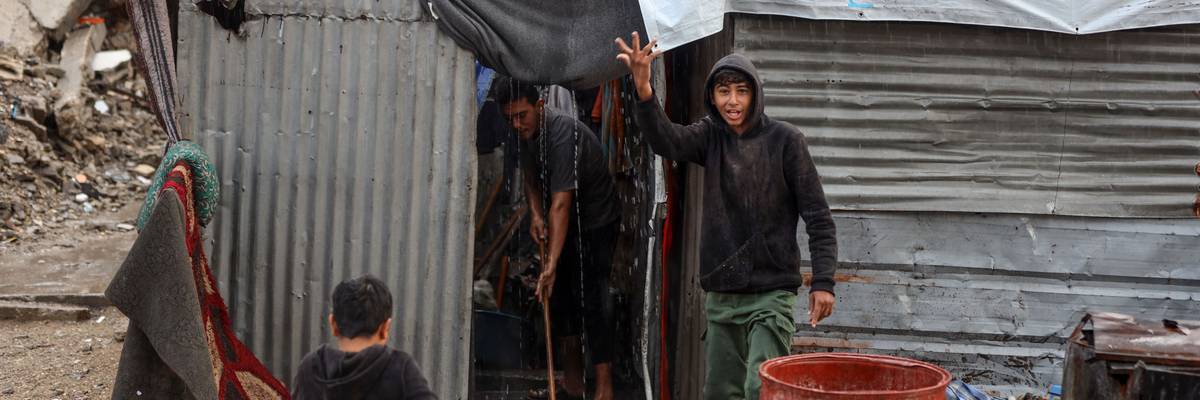
Young Palestinian men create channels in the sand to direct the rain at a makeshift camp housing displaced Palestinians in Gaza City, Palestine, on November 25, 2025.
Human Rights Group Warns US Gaza Plan Will Impose 'Unlawful Collective Imprisonment' of Palestinians as New Details Emerge
“The design of these proposed cities mirrors the historical model of ghettos,” said the Euro-Mediterranean Human Rights Monitor, which said the US plans to cram 25,000 people into areas smaller than a square kilometer.
A prominent international human rights organization is warning that the United States' plan for postwar Gaza will impose "unlawful collective imprisonment" on the Palestinian civilians who have survived two years of genocide.
In November, several news outlets reported on the Trump administration's plan to carve Gaza in two: a so-called “green zone” controlled by Israel and a “red zone” controlled by the militant group Hamas.
The US would construct what it called “Alternative Safe Communities” for Palestinians to live in the Israeli-controlled portion of Gaza, which is over half of the territory under the current "ceasefire" agreement.
The New York Times described these communities as "compounds" of 20,000 to 25,000 people, where Israeli officials reportedly argued they should not be allowed to leave.
The initial reporting raised fears that the US and Israel were constructing what would amount to a "concentration camp," where Palestinians would be forced to live in squalid conditions without freedom of movement.
On Wednesday, the Euro-Mediterranean Human Rights Monitor released new details on how Palestinians, currently facing mass displacement from their homes in the portion of the strip not occupied by Israel, would be corralled into the green zone under the US proposal.
The Geneva-based group issued a stark warning about the plan, which it said carried "grave risks, including the effective displacement of Palestinians from their homes and the transformation of large parts of Gaza into closed military zones under the direct control of the Israeli army."
“Entry and exit would be permitted only through security screening, effectively converting these sites into overcrowded detention camps that impose severe restrictions on residents’ freedom of movement and daily life."
Euro-Med's report explains that the transfer of Palestinians would be carried out using "various pressure tactics."
"This is done by creating a coercive environment in the red zone and making access to relative protection and basic services conditional on relocating to designated areas within the green zone, following extensive security screening and vetting," the report says. "This removes any genuine element of consent and places the process squarely within the scope of forced displacement prohibited under international humanitarian law."
It also provides new details on the conditions Palestinians would be subject to once they've arrived: "The plan includes the establishment of 'cities' of prefabricated container homes (caravans) in the green zone, each housing around 25,000 people within an area of no more than one square kilometer and enclosed by walls and checkpoints."
This means these Palestinian cantons would be over three times as densely populated as the Tel Aviv District, the most crowded in Israel, which has about 8,130 people per square kilometer.
"Entry and exit would be permitted only through security screening, effectively converting these sites into overcrowded detention camps that impose severe restrictions on residents’ freedom of movement and daily life," the report continues.
This is not the first proposal to use the promise of safety to lure Palestinians into an enclosed space without the right to leave.
Earlier this year, following US President Donald Trump's call for the people of Palestine to be forcibly removed from the Gaza Strip, Israeli Defense Minister Israel Katz proposed the creation of a massive “humanitarian city” built on the ruins of Rafah that would be used as part of an “emigration plan” for hundreds of thousands of displaced people.
Under that plan, Palestinians would have been given “security screenings” and once inside would not be allowed to leave. Humanitarian organizations, including those inside Israel, roundly condemned the plan as essentially a “concentration camp.”
Euro-Med said that the design laid out in the new US plan "mirrors the historical model of ghettos, in which colonial and racist regimes confined specific groups to sealed areas surrounded by walls and guard posts, with movement and resources controlled externally, as seen in Europe during World War II and in other colonial contexts."
We are at a crossroads
This country and this world are at a monumental crossroads. In a few short weeks, US voters will have an opportunity to beat back the forces of fascism and confront the billionaires who are rigging the economy, our media system, and our democracy, making it increasingly impossible for ordinary people to get by. We’re not just talking about the election. We’re talking about what must be done once these fascist elements are vanquished from power. We need a bolder set of solutions than what either major party has so far been willing to offer and a working-class movement ready to fight like hell for it. Trump didn't emerge from nowhere. The conditions that fueled MAGA authoritarianism were created by decades of radical neoliberal economic policies and a corrupt political system dominated by corporate interests. They slashed taxes on the super-rich, promising that the benefits would trickle down. They said giveaways to the corporate titans would make life more affordable for the rest of us. It was all bullshit. And when a bitter, betrayed populace searches for someone to blame, right-wing demagogues have little trouble finding scapegoats. People know when they're being lied to, but you won't hear any of this from the corporate media. Only independent journalism—powered and funded by people who believe in building a better world—can deliver truly trustworthy daily news. Our Fall Campaign is underway, and we need your help. To power our newsroom through the rest of the year, we need to raise $125,000 by midnight on October 31. So if you share our vision, please contribute whatever you can to sustain our work. |
A prominent international human rights organization is warning that the United States' plan for postwar Gaza will impose "unlawful collective imprisonment" on the Palestinian civilians who have survived two years of genocide.
In November, several news outlets reported on the Trump administration's plan to carve Gaza in two: a so-called “green zone” controlled by Israel and a “red zone” controlled by the militant group Hamas.
The US would construct what it called “Alternative Safe Communities” for Palestinians to live in the Israeli-controlled portion of Gaza, which is over half of the territory under the current "ceasefire" agreement.
The New York Times described these communities as "compounds" of 20,000 to 25,000 people, where Israeli officials reportedly argued they should not be allowed to leave.
The initial reporting raised fears that the US and Israel were constructing what would amount to a "concentration camp," where Palestinians would be forced to live in squalid conditions without freedom of movement.
On Wednesday, the Euro-Mediterranean Human Rights Monitor released new details on how Palestinians, currently facing mass displacement from their homes in the portion of the strip not occupied by Israel, would be corralled into the green zone under the US proposal.
The Geneva-based group issued a stark warning about the plan, which it said carried "grave risks, including the effective displacement of Palestinians from their homes and the transformation of large parts of Gaza into closed military zones under the direct control of the Israeli army."
“Entry and exit would be permitted only through security screening, effectively converting these sites into overcrowded detention camps that impose severe restrictions on residents’ freedom of movement and daily life."
Euro-Med's report explains that the transfer of Palestinians would be carried out using "various pressure tactics."
"This is done by creating a coercive environment in the red zone and making access to relative protection and basic services conditional on relocating to designated areas within the green zone, following extensive security screening and vetting," the report says. "This removes any genuine element of consent and places the process squarely within the scope of forced displacement prohibited under international humanitarian law."
It also provides new details on the conditions Palestinians would be subject to once they've arrived: "The plan includes the establishment of 'cities' of prefabricated container homes (caravans) in the green zone, each housing around 25,000 people within an area of no more than one square kilometer and enclosed by walls and checkpoints."
This means these Palestinian cantons would be over three times as densely populated as the Tel Aviv District, the most crowded in Israel, which has about 8,130 people per square kilometer.
"Entry and exit would be permitted only through security screening, effectively converting these sites into overcrowded detention camps that impose severe restrictions on residents’ freedom of movement and daily life," the report continues.
This is not the first proposal to use the promise of safety to lure Palestinians into an enclosed space without the right to leave.
Earlier this year, following US President Donald Trump's call for the people of Palestine to be forcibly removed from the Gaza Strip, Israeli Defense Minister Israel Katz proposed the creation of a massive “humanitarian city” built on the ruins of Rafah that would be used as part of an “emigration plan” for hundreds of thousands of displaced people.
Under that plan, Palestinians would have been given “security screenings” and once inside would not be allowed to leave. Humanitarian organizations, including those inside Israel, roundly condemned the plan as essentially a “concentration camp.”
Euro-Med said that the design laid out in the new US plan "mirrors the historical model of ghettos, in which colonial and racist regimes confined specific groups to sealed areas surrounded by walls and guard posts, with movement and resources controlled externally, as seen in Europe during World War II and in other colonial contexts."
A prominent international human rights organization is warning that the United States' plan for postwar Gaza will impose "unlawful collective imprisonment" on the Palestinian civilians who have survived two years of genocide.
In November, several news outlets reported on the Trump administration's plan to carve Gaza in two: a so-called “green zone” controlled by Israel and a “red zone” controlled by the militant group Hamas.
The US would construct what it called “Alternative Safe Communities” for Palestinians to live in the Israeli-controlled portion of Gaza, which is over half of the territory under the current "ceasefire" agreement.
The New York Times described these communities as "compounds" of 20,000 to 25,000 people, where Israeli officials reportedly argued they should not be allowed to leave.
The initial reporting raised fears that the US and Israel were constructing what would amount to a "concentration camp," where Palestinians would be forced to live in squalid conditions without freedom of movement.
On Wednesday, the Euro-Mediterranean Human Rights Monitor released new details on how Palestinians, currently facing mass displacement from their homes in the portion of the strip not occupied by Israel, would be corralled into the green zone under the US proposal.
The Geneva-based group issued a stark warning about the plan, which it said carried "grave risks, including the effective displacement of Palestinians from their homes and the transformation of large parts of Gaza into closed military zones under the direct control of the Israeli army."
“Entry and exit would be permitted only through security screening, effectively converting these sites into overcrowded detention camps that impose severe restrictions on residents’ freedom of movement and daily life."
Euro-Med's report explains that the transfer of Palestinians would be carried out using "various pressure tactics."
"This is done by creating a coercive environment in the red zone and making access to relative protection and basic services conditional on relocating to designated areas within the green zone, following extensive security screening and vetting," the report says. "This removes any genuine element of consent and places the process squarely within the scope of forced displacement prohibited under international humanitarian law."
It also provides new details on the conditions Palestinians would be subject to once they've arrived: "The plan includes the establishment of 'cities' of prefabricated container homes (caravans) in the green zone, each housing around 25,000 people within an area of no more than one square kilometer and enclosed by walls and checkpoints."
This means these Palestinian cantons would be over three times as densely populated as the Tel Aviv District, the most crowded in Israel, which has about 8,130 people per square kilometer.
"Entry and exit would be permitted only through security screening, effectively converting these sites into overcrowded detention camps that impose severe restrictions on residents’ freedom of movement and daily life," the report continues.
This is not the first proposal to use the promise of safety to lure Palestinians into an enclosed space without the right to leave.
Earlier this year, following US President Donald Trump's call for the people of Palestine to be forcibly removed from the Gaza Strip, Israeli Defense Minister Israel Katz proposed the creation of a massive “humanitarian city” built on the ruins of Rafah that would be used as part of an “emigration plan” for hundreds of thousands of displaced people.
Under that plan, Palestinians would have been given “security screenings” and once inside would not be allowed to leave. Humanitarian organizations, including those inside Israel, roundly condemned the plan as essentially a “concentration camp.”
Euro-Med said that the design laid out in the new US plan "mirrors the historical model of ghettos, in which colonial and racist regimes confined specific groups to sealed areas surrounded by walls and guard posts, with movement and resources controlled externally, as seen in Europe during World War II and in other colonial contexts."