5
#000000
#FFFFFF
To donate by check, phone, or other method, see our More Ways to Give page.
Daily news & progressive opinion—funded by the people, not the corporations—delivered straight to your inbox.
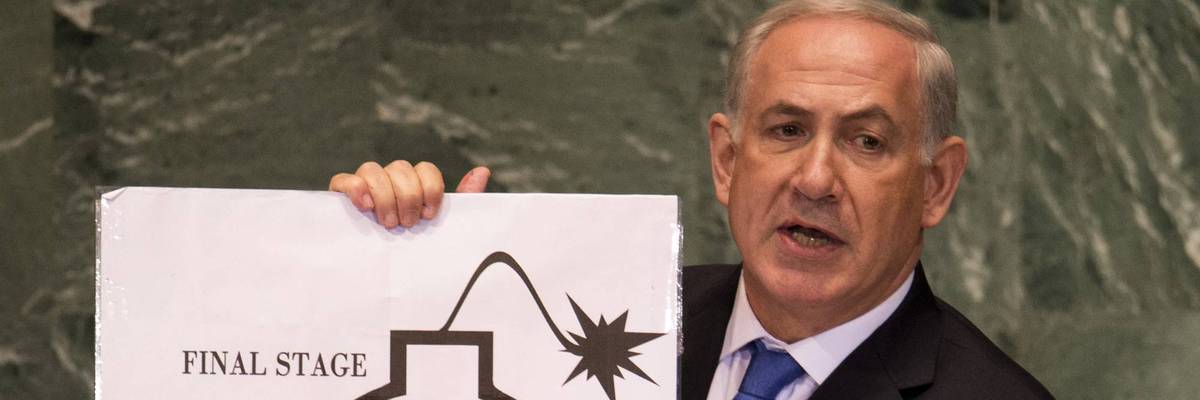
Israeli Prime Minister Benjamin Netanyahu points to a diagram of a nuclear bomb during a United Nations General Assembly meeting on September 27, 2012 in New York.
"Washington’s silence on the program is indefensible amid the war in Iran and the acute threat of military escalation, they argue. And they are right," said one arms control expert.
More than two dozen Democratic lawmakers in the US House of Representatives are urging the Trump administration to break its official silence on Israel's nuclear weapons program, whose existence is almost universally acknowledged even as its origins and status remain shrouded in secrecy.
In a letter to US Secretary of State Marco Rubio on Monday, the group of House Democrats led by Rep. Joaquin Castro of Texas wrote that "Congress has a constitutional responsibility to be fully informed about the nuclear balance in the Middle East, the risk of escalation by any party to this conflict, and the administration's planning and contingencies for such scenarios," particularly as it wages war on Iran in partnership with the Israeli government.
"The risks of miscalculation, escalation, and nuclear use in this environment are not theoretical," the lawmakers wrote. "A policy of official ambiguity about the nuclear capabilities of one party to this conflict makes coherent nonproliferation policy in the Middle East impossible, for Iran, for Saudi Arabia, and for every other state in the region making decisions based on their perceptions of the capabilities of their neighbors."
The House Democrats pressed Rubio to provide detailed information the US possesses about Israel's nuclear weapons program, including the country's current fissile material capability, nuclear doctrine, and "any indications of Israel planning to use or deploy nuclear weapons during the recent Iran conflict or during other conflicts."
Israeli leaders have for decades maintained a posture of deliberate ambiguity regarding their country's nuclear weapons capacity, even as some officials have at times tacitly acknowledged the nation's nukes—including by suggesting they could be dropped on Gaza—and falsely claimed that Iran was on the verge of creating a nuclear weapon.
Israel is believed to have begun producing nuclear weapons in the 1960s, helped in part by uranium that US intelligence agencies suspected was obtained from a factory in the United States.
Analysts estimate that Israel currently has between 90 and 300 nuclear warheads, according to the Stockholm International Peace Research Institute (SIPRI).
"The United States’ indulgence of Israeli nuclear weapons has not escaped international attention, and the evident hypocrisy has undermined US nonproliferation policy," Victor Gilinsky, a former commissioner of the US Nuclear Regulatory Commission, and Leonard Weiss, a visiting scholar at Stanford University’s Center for International Security and Cooperation, wrote in a March op-ed for the Bulletin of the Atomic Scientists.
"The US government’s public position continues to be that it does not know anything about Israeli nuclear weapons, and this will apparently continue until Israel releases the United States’ gag," Gilinsky and Weiss continued. "This policy is allegedly enforced by a secret federal bulletin that threatens disciplinary actions for any US official who publicly acknowledges Israel’s nuclear weapons."
Experts and anti-war campaigners applauded the group of House Democrats for demanding an end to the US government's official silence on Israel's nuclear weapons program.
"Washington’s silence on the program is indefensible amid the war in Iran and the acute threat of military escalation, they argue. And they are right," said Daryl Kimball, director of the Arms Control Association.
The advocacy group Win Without War thanked Castro and his colleagues for "breaking DC’s 'taboo' over the Israeli government's nuclear weapons—especially concerning as US and Israeli leaders wage a disastrous war of choice in the Middle East."
Dear Common Dreams reader, It’s been nearly 30 years since I co-founded Common Dreams with my late wife, Lina Newhouser. We had the radical notion that journalism should serve the public good, not corporate profits. It was clear to us from the outset what it would take to build such a project. No paid advertisements. No corporate sponsors. No millionaire publisher telling us what to think or do. Many people said we wouldn't last a year, but we proved those doubters wrong. Together with a tremendous team of journalists and dedicated staff, we built an independent media outlet free from the constraints of profits and corporate control. Our mission has always been simple: To inform. To inspire. To ignite change for the common good. Building Common Dreams was not easy. Our survival was never guaranteed. When you take on the most powerful forces—Wall Street greed, fossil fuel industry destruction, Big Tech lobbyists, and uber-rich oligarchs who have spent billions upon billions rigging the economy and democracy in their favor—the only bulwark you have is supporters who believe in your work. But here’s the urgent message from me today. It's never been this bad out there. And it's never been this hard to keep us going. At the very moment Common Dreams is most needed, the threats we face are intensifying. We need your support now more than ever. We don't accept corporate advertising and never will. We don't have a paywall because we don't think people should be blocked from critical news based on their ability to pay. Everything we do is funded by the donations of readers like you. When everyone does the little they can afford, we are strong. But if that support retreats or dries up, so do we. Will you donate now to make sure Common Dreams not only survives but thrives? —Craig Brown, Co-founder |
More than two dozen Democratic lawmakers in the US House of Representatives are urging the Trump administration to break its official silence on Israel's nuclear weapons program, whose existence is almost universally acknowledged even as its origins and status remain shrouded in secrecy.
In a letter to US Secretary of State Marco Rubio on Monday, the group of House Democrats led by Rep. Joaquin Castro of Texas wrote that "Congress has a constitutional responsibility to be fully informed about the nuclear balance in the Middle East, the risk of escalation by any party to this conflict, and the administration's planning and contingencies for such scenarios," particularly as it wages war on Iran in partnership with the Israeli government.
"The risks of miscalculation, escalation, and nuclear use in this environment are not theoretical," the lawmakers wrote. "A policy of official ambiguity about the nuclear capabilities of one party to this conflict makes coherent nonproliferation policy in the Middle East impossible, for Iran, for Saudi Arabia, and for every other state in the region making decisions based on their perceptions of the capabilities of their neighbors."
The House Democrats pressed Rubio to provide detailed information the US possesses about Israel's nuclear weapons program, including the country's current fissile material capability, nuclear doctrine, and "any indications of Israel planning to use or deploy nuclear weapons during the recent Iran conflict or during other conflicts."
Israeli leaders have for decades maintained a posture of deliberate ambiguity regarding their country's nuclear weapons capacity, even as some officials have at times tacitly acknowledged the nation's nukes—including by suggesting they could be dropped on Gaza—and falsely claimed that Iran was on the verge of creating a nuclear weapon.
Israel is believed to have begun producing nuclear weapons in the 1960s, helped in part by uranium that US intelligence agencies suspected was obtained from a factory in the United States.
Analysts estimate that Israel currently has between 90 and 300 nuclear warheads, according to the Stockholm International Peace Research Institute (SIPRI).
"The United States’ indulgence of Israeli nuclear weapons has not escaped international attention, and the evident hypocrisy has undermined US nonproliferation policy," Victor Gilinsky, a former commissioner of the US Nuclear Regulatory Commission, and Leonard Weiss, a visiting scholar at Stanford University’s Center for International Security and Cooperation, wrote in a March op-ed for the Bulletin of the Atomic Scientists.
"The US government’s public position continues to be that it does not know anything about Israeli nuclear weapons, and this will apparently continue until Israel releases the United States’ gag," Gilinsky and Weiss continued. "This policy is allegedly enforced by a secret federal bulletin that threatens disciplinary actions for any US official who publicly acknowledges Israel’s nuclear weapons."
Experts and anti-war campaigners applauded the group of House Democrats for demanding an end to the US government's official silence on Israel's nuclear weapons program.
"Washington’s silence on the program is indefensible amid the war in Iran and the acute threat of military escalation, they argue. And they are right," said Daryl Kimball, director of the Arms Control Association.
The advocacy group Win Without War thanked Castro and his colleagues for "breaking DC’s 'taboo' over the Israeli government's nuclear weapons—especially concerning as US and Israeli leaders wage a disastrous war of choice in the Middle East."
More than two dozen Democratic lawmakers in the US House of Representatives are urging the Trump administration to break its official silence on Israel's nuclear weapons program, whose existence is almost universally acknowledged even as its origins and status remain shrouded in secrecy.
In a letter to US Secretary of State Marco Rubio on Monday, the group of House Democrats led by Rep. Joaquin Castro of Texas wrote that "Congress has a constitutional responsibility to be fully informed about the nuclear balance in the Middle East, the risk of escalation by any party to this conflict, and the administration's planning and contingencies for such scenarios," particularly as it wages war on Iran in partnership with the Israeli government.
"The risks of miscalculation, escalation, and nuclear use in this environment are not theoretical," the lawmakers wrote. "A policy of official ambiguity about the nuclear capabilities of one party to this conflict makes coherent nonproliferation policy in the Middle East impossible, for Iran, for Saudi Arabia, and for every other state in the region making decisions based on their perceptions of the capabilities of their neighbors."
The House Democrats pressed Rubio to provide detailed information the US possesses about Israel's nuclear weapons program, including the country's current fissile material capability, nuclear doctrine, and "any indications of Israel planning to use or deploy nuclear weapons during the recent Iran conflict or during other conflicts."
Israeli leaders have for decades maintained a posture of deliberate ambiguity regarding their country's nuclear weapons capacity, even as some officials have at times tacitly acknowledged the nation's nukes—including by suggesting they could be dropped on Gaza—and falsely claimed that Iran was on the verge of creating a nuclear weapon.
Israel is believed to have begun producing nuclear weapons in the 1960s, helped in part by uranium that US intelligence agencies suspected was obtained from a factory in the United States.
Analysts estimate that Israel currently has between 90 and 300 nuclear warheads, according to the Stockholm International Peace Research Institute (SIPRI).
"The United States’ indulgence of Israeli nuclear weapons has not escaped international attention, and the evident hypocrisy has undermined US nonproliferation policy," Victor Gilinsky, a former commissioner of the US Nuclear Regulatory Commission, and Leonard Weiss, a visiting scholar at Stanford University’s Center for International Security and Cooperation, wrote in a March op-ed for the Bulletin of the Atomic Scientists.
"The US government’s public position continues to be that it does not know anything about Israeli nuclear weapons, and this will apparently continue until Israel releases the United States’ gag," Gilinsky and Weiss continued. "This policy is allegedly enforced by a secret federal bulletin that threatens disciplinary actions for any US official who publicly acknowledges Israel’s nuclear weapons."
Experts and anti-war campaigners applauded the group of House Democrats for demanding an end to the US government's official silence on Israel's nuclear weapons program.
"Washington’s silence on the program is indefensible amid the war in Iran and the acute threat of military escalation, they argue. And they are right," said Daryl Kimball, director of the Arms Control Association.
The advocacy group Win Without War thanked Castro and his colleagues for "breaking DC’s 'taboo' over the Israeli government's nuclear weapons—especially concerning as US and Israeli leaders wage a disastrous war of choice in the Middle East."