SUBSCRIBE TO OUR FREE NEWSLETTER
Daily news & progressive opinion—funded by the people, not the corporations—delivered straight to your inbox.
5
#000000
#FFFFFF
To donate by check, phone, or other method, see our More Ways to Give page.
Daily news & progressive opinion—funded by the people, not the corporations—delivered straight to your inbox.

18-month-old Mayar El Arca is being treated at Nasser Hospital in Khan Younis, Gaza on May 17, 2025.
"The limited entry of aid into Gaza cannot be mistaken for meaningful progress," said one humanitarian expert.
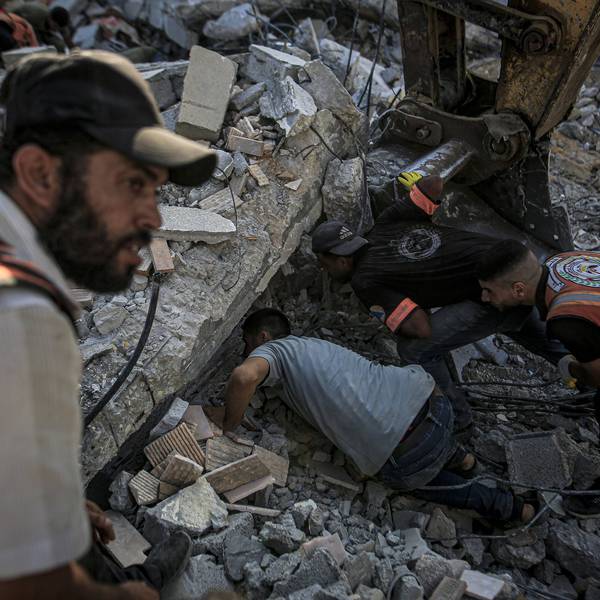
The United Nations estimated that the Netanyahu government's continued starvation of more than 2 million Palestinians could kill up to 14,000 infants in the next two days without a serious influx of aid.
News outlets have reported since Monday that Prime Minister Benjamin Netanyahu allowed five aid trucks carrying baby food and other nutritional aid into the besieged enclave—but humanitarian experts and workers have decried the arrival of the aid as "a trickle among a sea of need."
Tom Fletcher, under-secretary-general for humanitarian affairs for the United Nations, said the tiny amount of aid was a "drop in the ocean" in a bombarded enclave where food security experts announced earlier this month that nearly a quarter of a million people are facing "extreme deprivation of food" and the entire population has "very high" levels of acute malnutrition and excess mortality.
While many medical workers have been killed in Israeli bombings, Fletcher told the BBC's Radio 4 "Today" program that teams have assessed that 14,000 infants are likely to die within 48 hours if food aid can't reach them. The small amount of trucks allowed in through the Karem Abu Salem crossing Monday—a fraction of the 600 per day that provided food, medications, water, and other aid to Palestinians during the recent cease-fire—have yet to actually reach civilians.
On Tuesday, 100 more U.N. trucks were given clearance to enter Gaza. Fletcher said humanitarian workers fear potential looting of aid trucks due to the chaotic, desperate situation faced by Palestinians.
The current blockade began March 2, and international humanitarian groups operating in Gaza have exhausted their reserves of food aid over the past 79 days.
"For over 70 days Israel has been starving the people of Gaza, depriving them of food, water, medicine, and essential supplies while escalating its cruel and indiscriminate bombing campaign," said Wassem Mushtaha, Gaza response lead for Oxfam. "Two million people are on the brink of famine, and they are not just starving, but also traumatized, sick, and displaced from their homes."
"The limited entry of aid into Gaza cannot be mistaken for meaningful progress, especially alongside the expansion of Israel's brutal bombing campaign across the Gaza Strip," said Mushtaha. "It is not a turning point, but at best a narrow concession that seems to reflect mounting international pressure."
The continued blockade on effectively all humanitarian aid prompted the United Kingdom, Canada, and France to issue a joint statement Monday saying that "the level of human suffering in Gaza is intolerable" and threatening "targeted sanctions."
On Tuesday, U.K. Foreign Secretary David Lammy told Parliament that the government had suspended trade negotiations over Netanyahu's blockade and plan to expand military operations across Gaza.
French Foreign Minister Jean-Noël Barrot said Tuesday that the country also supports a review of the European Union's trade relationship with Gaza.
"The blind violence and the blockade of humanitarian aid by the Israeli government have turned the enclave into a death trap, not to say a cemetery," Barrot said. "This must stop... It is an absolute violation of all the rules of international law."
The European leaders' comments were a departure from many Western governments' insistence since 2023 that Israel is operating in self-defense and that it is targeting Hamas in retaliation for the group's attack on October 7, 2023. Humanitarian groups, rights experts, and progressive lawmakers have called on Western governments to end their support for Israel, which faces a genocide case at the International Court of Justice.
Bushra Khalidi, Oxfam's policy lead in the occupied Palestinian territory and Gaza, said Tuesday that "what is urgently needed is for all crossings to be opened to allow a full and proper humanitarian response that allows real access, with safe corridors and respect for international humanitarian law."
"A token convoy does not equal progress, only sustained, accountable access through every crossing will end the impunity that keeps aid from flowing," said Khalidi. "We must also see an end to the relentless bombing and attacks on Palestinian people, with an urgent and permanent cease-fire, alongside justice and accountability for all."
Dear Common Dreams reader, It’s been nearly 30 years since I co-founded Common Dreams with my late wife, Lina Newhouser. We had the radical notion that journalism should serve the public good, not corporate profits. It was clear to us from the outset what it would take to build such a project. No paid advertisements. No corporate sponsors. No millionaire publisher telling us what to think or do. Many people said we wouldn't last a year, but we proved those doubters wrong. Together with a tremendous team of journalists and dedicated staff, we built an independent media outlet free from the constraints of profits and corporate control. Our mission has always been simple: To inform. To inspire. To ignite change for the common good. Building Common Dreams was not easy. Our survival was never guaranteed. When you take on the most powerful forces—Wall Street greed, fossil fuel industry destruction, Big Tech lobbyists, and uber-rich oligarchs who have spent billions upon billions rigging the economy and democracy in their favor—the only bulwark you have is supporters who believe in your work. But here’s the urgent message from me today. It's never been this bad out there. And it's never been this hard to keep us going. At the very moment Common Dreams is most needed, the threats we face are intensifying. We need your support now more than ever. We don't accept corporate advertising and never will. We don't have a paywall because we don't think people should be blocked from critical news based on their ability to pay. Everything we do is funded by the donations of readers like you. When everyone does the little they can afford, we are strong. But if that support retreats or dries up, so do we. Will you donate now to make sure Common Dreams not only survives but thrives? —Craig Brown, Co-founder |
The United Nations estimated that the Netanyahu government's continued starvation of more than 2 million Palestinians could kill up to 14,000 infants in the next two days without a serious influx of aid.
News outlets have reported since Monday that Prime Minister Benjamin Netanyahu allowed five aid trucks carrying baby food and other nutritional aid into the besieged enclave—but humanitarian experts and workers have decried the arrival of the aid as "a trickle among a sea of need."
Tom Fletcher, under-secretary-general for humanitarian affairs for the United Nations, said the tiny amount of aid was a "drop in the ocean" in a bombarded enclave where food security experts announced earlier this month that nearly a quarter of a million people are facing "extreme deprivation of food" and the entire population has "very high" levels of acute malnutrition and excess mortality.
While many medical workers have been killed in Israeli bombings, Fletcher told the BBC's Radio 4 "Today" program that teams have assessed that 14,000 infants are likely to die within 48 hours if food aid can't reach them. The small amount of trucks allowed in through the Karem Abu Salem crossing Monday—a fraction of the 600 per day that provided food, medications, water, and other aid to Palestinians during the recent cease-fire—have yet to actually reach civilians.
On Tuesday, 100 more U.N. trucks were given clearance to enter Gaza. Fletcher said humanitarian workers fear potential looting of aid trucks due to the chaotic, desperate situation faced by Palestinians.
The current blockade began March 2, and international humanitarian groups operating in Gaza have exhausted their reserves of food aid over the past 79 days.
"For over 70 days Israel has been starving the people of Gaza, depriving them of food, water, medicine, and essential supplies while escalating its cruel and indiscriminate bombing campaign," said Wassem Mushtaha, Gaza response lead for Oxfam. "Two million people are on the brink of famine, and they are not just starving, but also traumatized, sick, and displaced from their homes."
"The limited entry of aid into Gaza cannot be mistaken for meaningful progress, especially alongside the expansion of Israel's brutal bombing campaign across the Gaza Strip," said Mushtaha. "It is not a turning point, but at best a narrow concession that seems to reflect mounting international pressure."
The continued blockade on effectively all humanitarian aid prompted the United Kingdom, Canada, and France to issue a joint statement Monday saying that "the level of human suffering in Gaza is intolerable" and threatening "targeted sanctions."
On Tuesday, U.K. Foreign Secretary David Lammy told Parliament that the government had suspended trade negotiations over Netanyahu's blockade and plan to expand military operations across Gaza.
French Foreign Minister Jean-Noël Barrot said Tuesday that the country also supports a review of the European Union's trade relationship with Gaza.
"The blind violence and the blockade of humanitarian aid by the Israeli government have turned the enclave into a death trap, not to say a cemetery," Barrot said. "This must stop... It is an absolute violation of all the rules of international law."
The European leaders' comments were a departure from many Western governments' insistence since 2023 that Israel is operating in self-defense and that it is targeting Hamas in retaliation for the group's attack on October 7, 2023. Humanitarian groups, rights experts, and progressive lawmakers have called on Western governments to end their support for Israel, which faces a genocide case at the International Court of Justice.
Bushra Khalidi, Oxfam's policy lead in the occupied Palestinian territory and Gaza, said Tuesday that "what is urgently needed is for all crossings to be opened to allow a full and proper humanitarian response that allows real access, with safe corridors and respect for international humanitarian law."
"A token convoy does not equal progress, only sustained, accountable access through every crossing will end the impunity that keeps aid from flowing," said Khalidi. "We must also see an end to the relentless bombing and attacks on Palestinian people, with an urgent and permanent cease-fire, alongside justice and accountability for all."
The United Nations estimated that the Netanyahu government's continued starvation of more than 2 million Palestinians could kill up to 14,000 infants in the next two days without a serious influx of aid.
News outlets have reported since Monday that Prime Minister Benjamin Netanyahu allowed five aid trucks carrying baby food and other nutritional aid into the besieged enclave—but humanitarian experts and workers have decried the arrival of the aid as "a trickle among a sea of need."
Tom Fletcher, under-secretary-general for humanitarian affairs for the United Nations, said the tiny amount of aid was a "drop in the ocean" in a bombarded enclave where food security experts announced earlier this month that nearly a quarter of a million people are facing "extreme deprivation of food" and the entire population has "very high" levels of acute malnutrition and excess mortality.
While many medical workers have been killed in Israeli bombings, Fletcher told the BBC's Radio 4 "Today" program that teams have assessed that 14,000 infants are likely to die within 48 hours if food aid can't reach them. The small amount of trucks allowed in through the Karem Abu Salem crossing Monday—a fraction of the 600 per day that provided food, medications, water, and other aid to Palestinians during the recent cease-fire—have yet to actually reach civilians.
On Tuesday, 100 more U.N. trucks were given clearance to enter Gaza. Fletcher said humanitarian workers fear potential looting of aid trucks due to the chaotic, desperate situation faced by Palestinians.
The current blockade began March 2, and international humanitarian groups operating in Gaza have exhausted their reserves of food aid over the past 79 days.
"For over 70 days Israel has been starving the people of Gaza, depriving them of food, water, medicine, and essential supplies while escalating its cruel and indiscriminate bombing campaign," said Wassem Mushtaha, Gaza response lead for Oxfam. "Two million people are on the brink of famine, and they are not just starving, but also traumatized, sick, and displaced from their homes."
"The limited entry of aid into Gaza cannot be mistaken for meaningful progress, especially alongside the expansion of Israel's brutal bombing campaign across the Gaza Strip," said Mushtaha. "It is not a turning point, but at best a narrow concession that seems to reflect mounting international pressure."
The continued blockade on effectively all humanitarian aid prompted the United Kingdom, Canada, and France to issue a joint statement Monday saying that "the level of human suffering in Gaza is intolerable" and threatening "targeted sanctions."
On Tuesday, U.K. Foreign Secretary David Lammy told Parliament that the government had suspended trade negotiations over Netanyahu's blockade and plan to expand military operations across Gaza.
French Foreign Minister Jean-Noël Barrot said Tuesday that the country also supports a review of the European Union's trade relationship with Gaza.
"The blind violence and the blockade of humanitarian aid by the Israeli government have turned the enclave into a death trap, not to say a cemetery," Barrot said. "This must stop... It is an absolute violation of all the rules of international law."
The European leaders' comments were a departure from many Western governments' insistence since 2023 that Israel is operating in self-defense and that it is targeting Hamas in retaliation for the group's attack on October 7, 2023. Humanitarian groups, rights experts, and progressive lawmakers have called on Western governments to end their support for Israel, which faces a genocide case at the International Court of Justice.
Bushra Khalidi, Oxfam's policy lead in the occupied Palestinian territory and Gaza, said Tuesday that "what is urgently needed is for all crossings to be opened to allow a full and proper humanitarian response that allows real access, with safe corridors and respect for international humanitarian law."
"A token convoy does not equal progress, only sustained, accountable access through every crossing will end the impunity that keeps aid from flowing," said Khalidi. "We must also see an end to the relentless bombing and attacks on Palestinian people, with an urgent and permanent cease-fire, alongside justice and accountability for all."