5
#000000
#FFFFFF
To donate by check, phone, or other method, see our More Ways to Give page.
Daily news & progressive opinion—funded by the people, not the corporations—delivered straight to your inbox.
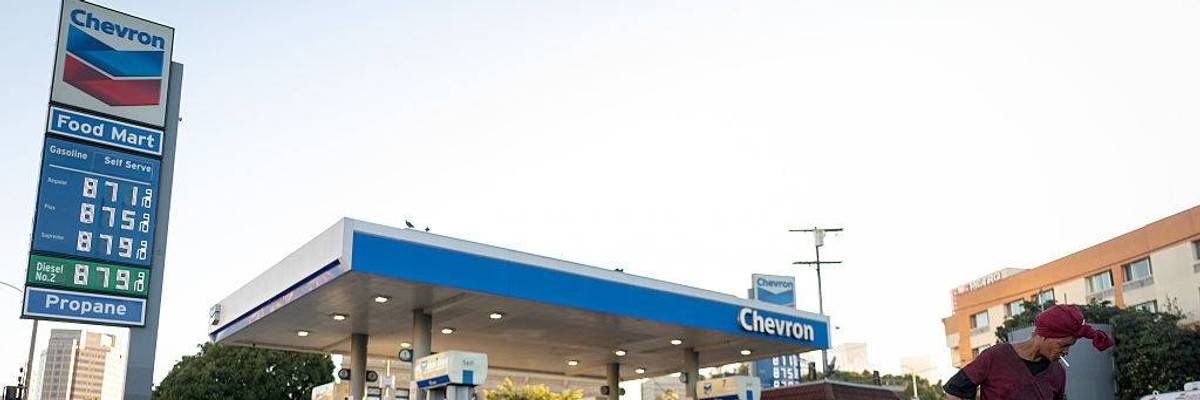
A woman near a gas station on Thursday, March 19, 2026 in Los Angeles, CA.
"Every single one of this administration's policies is doing what it can to raise prices," said one critic.
The Organization for Economic Cooperation and Development on Thursday released a report projecting that President Donald Trump's unconstitutional war with Iran will sharply increase inflation in the US this year.
According to OECD, the disruption in energy markets caused by the war means that "inflation pressures will persist for longer," with inflation in G20 nations "now expected to be higher in 2026 than previously projected."
OECD projects that inflation in the US, which was previously seen coming in at 2.6% in 2026, will instead rise to 4.2% this year thanks in large part to the war, which has spiked prices for oil, gasoline, diesel fuel, and fertilizer.
The report also warns that these numbers could get even worse if the Iran conflict drags on and the Strait of Hormuz remains shut for a prolonged period.
"Further disruptions to trade in the Persian Gulf could also have negative effects on a broader range of products in global supply chains," OECD writes. "For example, ongoing constraints to fertilizer supply could increase global food prices, with potentially serious impacts on household finances and inflation expectations. Furthermore, reduced supply of sulphur, helium or aluminium could impede production in a range of industries."
More ominously, the report finds that "prolonged disruptions to energy supply and growth, or lower-than-expected returns from net AI investment, or rising losses in private capital markets, could all trigger more widespread risk repricing in financial markets," with the result being a higher risk of default across "multiple credit products" and an evaporation of economic liquidity.
Asa Johansson, director of policy studies at OECD, said in an interview with The Wall Street Journal that the organization's forecast is "highly uncertain" at this point because "we don’t know the breadth and the duration of this energy shock" caused by the war.
Tahra Hoops, director of economic analysis at Chamber of Progress, expressed astonishment at the Trump administration's economic mismanagement in launching the Iran war, which came at a time when polling has consistently shown that affordability is the top concern for US voters.
"Every single one of this administration's policies is doing what it can to raise prices," wrote Hoops, "for a political goal that they have yet to coherently articulate, let alone have any chance at achieving."
Phillips O'Brien, professor of strategic studies at the University of St. Andrews, argued that the OECD's inflation forecast was yet another nail in the Republican Party's chances of retaining control of Congress this year.
"It’s going to be so much fun watching the GOP run on 'affordability' in 2026," O'Brien wrote.
Dear Common Dreams reader, The U.S. is on a fast track to authoritarianism like nothing I've ever seen. Meanwhile, corporate news outlets are utterly capitulating to Trump, twisting their coverage to avoid drawing his ire while lining up to stuff cash in his pockets. That's why I believe that Common Dreams is doing the best and most consequential reporting that we've ever done. Our small but mighty team is a progressive reporting powerhouse, covering the news every day that the corporate media never will. Our mission has always been simple: To inform. To inspire. And to ignite change for the common good. Now here's the key piece that I want all our readers to understand: None of this would be possible without your financial support. That's not just some fundraising cliche. It's the absolute and literal truth. We don't accept corporate advertising and never will. We don't have a paywall because we don't think people should be blocked from critical news based on their ability to pay. Everything we do is funded by the donations of readers like you. Will you donate now to help power the nonprofit, independent reporting of Common Dreams? Thank you for being a vital member of our community. Together, we can keep independent journalism alive when it’s needed most. - Craig Brown, Co-founder |
The Organization for Economic Cooperation and Development on Thursday released a report projecting that President Donald Trump's unconstitutional war with Iran will sharply increase inflation in the US this year.
According to OECD, the disruption in energy markets caused by the war means that "inflation pressures will persist for longer," with inflation in G20 nations "now expected to be higher in 2026 than previously projected."
OECD projects that inflation in the US, which was previously seen coming in at 2.6% in 2026, will instead rise to 4.2% this year thanks in large part to the war, which has spiked prices for oil, gasoline, diesel fuel, and fertilizer.
The report also warns that these numbers could get even worse if the Iran conflict drags on and the Strait of Hormuz remains shut for a prolonged period.
"Further disruptions to trade in the Persian Gulf could also have negative effects on a broader range of products in global supply chains," OECD writes. "For example, ongoing constraints to fertilizer supply could increase global food prices, with potentially serious impacts on household finances and inflation expectations. Furthermore, reduced supply of sulphur, helium or aluminium could impede production in a range of industries."
More ominously, the report finds that "prolonged disruptions to energy supply and growth, or lower-than-expected returns from net AI investment, or rising losses in private capital markets, could all trigger more widespread risk repricing in financial markets," with the result being a higher risk of default across "multiple credit products" and an evaporation of economic liquidity.
Asa Johansson, director of policy studies at OECD, said in an interview with The Wall Street Journal that the organization's forecast is "highly uncertain" at this point because "we don’t know the breadth and the duration of this energy shock" caused by the war.
Tahra Hoops, director of economic analysis at Chamber of Progress, expressed astonishment at the Trump administration's economic mismanagement in launching the Iran war, which came at a time when polling has consistently shown that affordability is the top concern for US voters.
"Every single one of this administration's policies is doing what it can to raise prices," wrote Hoops, "for a political goal that they have yet to coherently articulate, let alone have any chance at achieving."
Phillips O'Brien, professor of strategic studies at the University of St. Andrews, argued that the OECD's inflation forecast was yet another nail in the Republican Party's chances of retaining control of Congress this year.
"It’s going to be so much fun watching the GOP run on 'affordability' in 2026," O'Brien wrote.
The Organization for Economic Cooperation and Development on Thursday released a report projecting that President Donald Trump's unconstitutional war with Iran will sharply increase inflation in the US this year.
According to OECD, the disruption in energy markets caused by the war means that "inflation pressures will persist for longer," with inflation in G20 nations "now expected to be higher in 2026 than previously projected."
OECD projects that inflation in the US, which was previously seen coming in at 2.6% in 2026, will instead rise to 4.2% this year thanks in large part to the war, which has spiked prices for oil, gasoline, diesel fuel, and fertilizer.
The report also warns that these numbers could get even worse if the Iran conflict drags on and the Strait of Hormuz remains shut for a prolonged period.
"Further disruptions to trade in the Persian Gulf could also have negative effects on a broader range of products in global supply chains," OECD writes. "For example, ongoing constraints to fertilizer supply could increase global food prices, with potentially serious impacts on household finances and inflation expectations. Furthermore, reduced supply of sulphur, helium or aluminium could impede production in a range of industries."
More ominously, the report finds that "prolonged disruptions to energy supply and growth, or lower-than-expected returns from net AI investment, or rising losses in private capital markets, could all trigger more widespread risk repricing in financial markets," with the result being a higher risk of default across "multiple credit products" and an evaporation of economic liquidity.
Asa Johansson, director of policy studies at OECD, said in an interview with The Wall Street Journal that the organization's forecast is "highly uncertain" at this point because "we don’t know the breadth and the duration of this energy shock" caused by the war.
Tahra Hoops, director of economic analysis at Chamber of Progress, expressed astonishment at the Trump administration's economic mismanagement in launching the Iran war, which came at a time when polling has consistently shown that affordability is the top concern for US voters.
"Every single one of this administration's policies is doing what it can to raise prices," wrote Hoops, "for a political goal that they have yet to coherently articulate, let alone have any chance at achieving."
Phillips O'Brien, professor of strategic studies at the University of St. Andrews, argued that the OECD's inflation forecast was yet another nail in the Republican Party's chances of retaining control of Congress this year.
"It’s going to be so much fun watching the GOP run on 'affordability' in 2026," O'Brien wrote.