SUBSCRIBE TO OUR FREE NEWSLETTER
Daily news & progressive opinion—funded by the people, not the corporations—delivered straight to your inbox.
5
#000000
#FFFFFF
To donate by check, phone, or other method, see our More Ways to Give page.
Daily news & progressive opinion—funded by the people, not the corporations—delivered straight to your inbox.
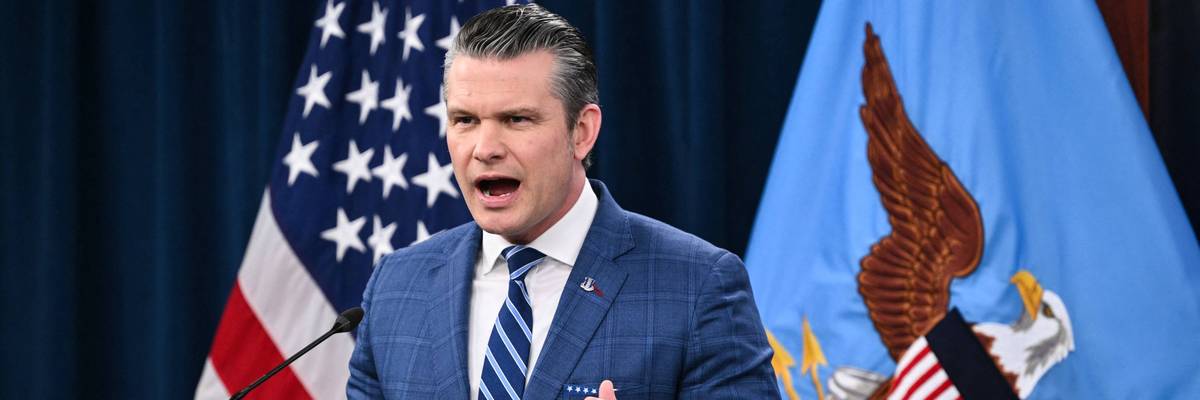
Pentagon Secretary Pete Hegseth speaks during a press briefing on April 8, 2026.
Pentagon Secretary Pete Hegseth said Wednesday that President Donald Trump's genocidal threats against Iran were not a bluff, telling reporters in the wake of a two-week ceasefire deal that US forces were fully prepared to unleash an illegal and devastating assault on Iranian infrastructure.
"Had Iran refused our terms, the next targets would have been their power plants, their bridges, and oil and energy infrastructure—targets they could not defend and could not realistically rebuild," Hegseth told reporters during a characteristically belligerent press briefing. "We were locked and loaded... President Trump had the power to cripple Iran's entire economy in minutes."
Hegseth: If Iran refused our terms, the next targets would have been their power plants, their bridges and oil and energy infrastructure—we were locked and loaded. They couldn't defend against it. President Trump chose mercy because Iran accepted the ceasefire under overwhelming… pic.twitter.com/QMklWNM8PH
— Acyn (@Acyn) April 8, 2026
Hegseth—who, like Trump, is facing articles of impeachment in the US House—went on to say that American forces aren't "going anywhere" and are "prepared to restart" the bombing of Iran "at a moment's notice," echoing the president and underscoring the fragility of the newly announced ceasefire.
"The United States military has the ability to strike [Iran] with impunity," the Pentagon secretary declared, asserting that the president's threats forced Iran to the negotiating table—a narrative that Iranian leaders rejected in their statement on the ceasefire deal.
"The enemy, in its cowardly, illegal, and criminal war against the Iranian nation, has suffered an undeniable, historical, and crushing defeat," Iran's Supreme National Security Council said in a statement. "We congratulate all the people of Iran on this victory and emphasize that until the details of this victory are finalized, there remains a need for the steadfastness and prudence of officials and the maintenance of unity and solidarity among the Iranian people."
The Trump administration's past and continued threats to attack Iran's infrastructure—even if they aren't ultimately carried out—are violations of international law, Yale Law School professor Oona Hathaway said Wednesday, pointing to the Geneva Conventions.
"Threats of use of force also violate the United Nations Charter," said Hathaway, a former special counsel at the Pentagon. "Moreover, the threat to commit mass war crimes raises questions as to whether the US is fighting the war consistent with its legal obligations. It gives insight into intent that may be relevant to war crimes investigations."
In a statement issued shortly before the two-week ceasefire was announced, a broad coalition of more than 200 organizations and experts reminded "those engaged in military operations of their obligation to refuse any patently unlawful orders."
"Anyone who orders, carries out, or is otherwise complicit in, President Trump’s abhorrent threats must be held accountable," the groups said.
Dear Common Dreams reader, It’s been nearly 30 years since I co-founded Common Dreams with my late wife, Lina Newhouser. We had the radical notion that journalism should serve the public good, not corporate profits. It was clear to us from the outset what it would take to build such a project. No paid advertisements. No corporate sponsors. No millionaire publisher telling us what to think or do. Many people said we wouldn't last a year, but we proved those doubters wrong. Together with a tremendous team of journalists and dedicated staff, we built an independent media outlet free from the constraints of profits and corporate control. Our mission has always been simple: To inform. To inspire. To ignite change for the common good. Building Common Dreams was not easy. Our survival was never guaranteed. When you take on the most powerful forces—Wall Street greed, fossil fuel industry destruction, Big Tech lobbyists, and uber-rich oligarchs who have spent billions upon billions rigging the economy and democracy in their favor—the only bulwark you have is supporters who believe in your work. But here’s the urgent message from me today. It's never been this bad out there. And it's never been this hard to keep us going. At the very moment Common Dreams is most needed, the threats we face are intensifying. We need your support now more than ever. We don't accept corporate advertising and never will. We don't have a paywall because we don't think people should be blocked from critical news based on their ability to pay. Everything we do is funded by the donations of readers like you. When everyone does the little they can afford, we are strong. But if that support retreats or dries up, so do we. Will you donate now to make sure Common Dreams not only survives but thrives? —Craig Brown, Co-founder |
Pentagon Secretary Pete Hegseth said Wednesday that President Donald Trump's genocidal threats against Iran were not a bluff, telling reporters in the wake of a two-week ceasefire deal that US forces were fully prepared to unleash an illegal and devastating assault on Iranian infrastructure.
"Had Iran refused our terms, the next targets would have been their power plants, their bridges, and oil and energy infrastructure—targets they could not defend and could not realistically rebuild," Hegseth told reporters during a characteristically belligerent press briefing. "We were locked and loaded... President Trump had the power to cripple Iran's entire economy in minutes."
Hegseth: If Iran refused our terms, the next targets would have been their power plants, their bridges and oil and energy infrastructure—we were locked and loaded. They couldn't defend against it. President Trump chose mercy because Iran accepted the ceasefire under overwhelming… pic.twitter.com/QMklWNM8PH
— Acyn (@Acyn) April 8, 2026
Hegseth—who, like Trump, is facing articles of impeachment in the US House—went on to say that American forces aren't "going anywhere" and are "prepared to restart" the bombing of Iran "at a moment's notice," echoing the president and underscoring the fragility of the newly announced ceasefire.
"The United States military has the ability to strike [Iran] with impunity," the Pentagon secretary declared, asserting that the president's threats forced Iran to the negotiating table—a narrative that Iranian leaders rejected in their statement on the ceasefire deal.
"The enemy, in its cowardly, illegal, and criminal war against the Iranian nation, has suffered an undeniable, historical, and crushing defeat," Iran's Supreme National Security Council said in a statement. "We congratulate all the people of Iran on this victory and emphasize that until the details of this victory are finalized, there remains a need for the steadfastness and prudence of officials and the maintenance of unity and solidarity among the Iranian people."
The Trump administration's past and continued threats to attack Iran's infrastructure—even if they aren't ultimately carried out—are violations of international law, Yale Law School professor Oona Hathaway said Wednesday, pointing to the Geneva Conventions.
"Threats of use of force also violate the United Nations Charter," said Hathaway, a former special counsel at the Pentagon. "Moreover, the threat to commit mass war crimes raises questions as to whether the US is fighting the war consistent with its legal obligations. It gives insight into intent that may be relevant to war crimes investigations."
In a statement issued shortly before the two-week ceasefire was announced, a broad coalition of more than 200 organizations and experts reminded "those engaged in military operations of their obligation to refuse any patently unlawful orders."
"Anyone who orders, carries out, or is otherwise complicit in, President Trump’s abhorrent threats must be held accountable," the groups said.
Pentagon Secretary Pete Hegseth said Wednesday that President Donald Trump's genocidal threats against Iran were not a bluff, telling reporters in the wake of a two-week ceasefire deal that US forces were fully prepared to unleash an illegal and devastating assault on Iranian infrastructure.
"Had Iran refused our terms, the next targets would have been their power plants, their bridges, and oil and energy infrastructure—targets they could not defend and could not realistically rebuild," Hegseth told reporters during a characteristically belligerent press briefing. "We were locked and loaded... President Trump had the power to cripple Iran's entire economy in minutes."
Hegseth: If Iran refused our terms, the next targets would have been their power plants, their bridges and oil and energy infrastructure—we were locked and loaded. They couldn't defend against it. President Trump chose mercy because Iran accepted the ceasefire under overwhelming… pic.twitter.com/QMklWNM8PH
— Acyn (@Acyn) April 8, 2026
Hegseth—who, like Trump, is facing articles of impeachment in the US House—went on to say that American forces aren't "going anywhere" and are "prepared to restart" the bombing of Iran "at a moment's notice," echoing the president and underscoring the fragility of the newly announced ceasefire.
"The United States military has the ability to strike [Iran] with impunity," the Pentagon secretary declared, asserting that the president's threats forced Iran to the negotiating table—a narrative that Iranian leaders rejected in their statement on the ceasefire deal.
"The enemy, in its cowardly, illegal, and criminal war against the Iranian nation, has suffered an undeniable, historical, and crushing defeat," Iran's Supreme National Security Council said in a statement. "We congratulate all the people of Iran on this victory and emphasize that until the details of this victory are finalized, there remains a need for the steadfastness and prudence of officials and the maintenance of unity and solidarity among the Iranian people."
The Trump administration's past and continued threats to attack Iran's infrastructure—even if they aren't ultimately carried out—are violations of international law, Yale Law School professor Oona Hathaway said Wednesday, pointing to the Geneva Conventions.
"Threats of use of force also violate the United Nations Charter," said Hathaway, a former special counsel at the Pentagon. "Moreover, the threat to commit mass war crimes raises questions as to whether the US is fighting the war consistent with its legal obligations. It gives insight into intent that may be relevant to war crimes investigations."
In a statement issued shortly before the two-week ceasefire was announced, a broad coalition of more than 200 organizations and experts reminded "those engaged in military operations of their obligation to refuse any patently unlawful orders."
"Anyone who orders, carries out, or is otherwise complicit in, President Trump’s abhorrent threats must be held accountable," the groups said.