SUBSCRIBE TO OUR FREE NEWSLETTER
Daily news & progressive opinion—funded by the people, not the corporations—delivered straight to your inbox.
5
#000000
#FFFFFF
To donate by check, phone, or other method, see our More Ways to Give page.
Daily news & progressive opinion—funded by the people, not the corporations—delivered straight to your inbox.
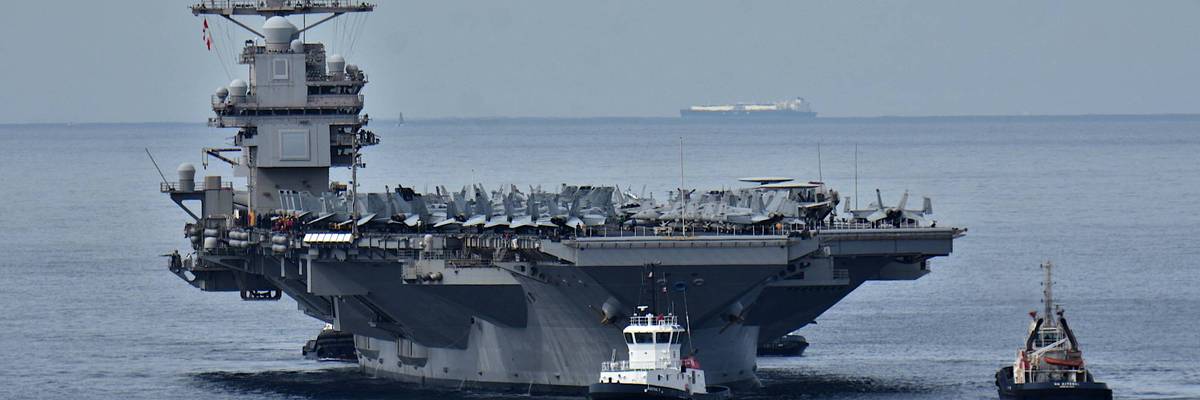
The aircraft carrier USS Gerald R. Ford arrives in Marseille, France on August 4, 2025.
Analyst Mouin Rabbani said the deployment comes as “Netanyahu is seeking to... inject poison pills into the negotiations in order to ensure that they fail and thereby set the stage for a new armed conflict with Iran.”
President Donald Trump further escalated his threats to attack Iran on Thursday by deploying another massive aircraft carrier to the Middle East.
According to Axios, Trump decided to send the USS Gerald Ford to the region shortly after his Wednesday talk with Israeli Prime Minister Benjamin Netanyahu, the seventh such meeting in just over a year since he returned to the presidency.
The Ford, America’s largest aircraft carrier, will take approximately 3-4 weeks to reach the Persian Gulf from Venezuela, where it was used as part of Trump’s operation to overthrow President Nicolás Maduro in January. It will join the USS Abraham Lincoln, which was sent to the region earlier this month.
Trump has said he wants to finalize a new nuclear deal with Iran by next month after ripping up the old one during his first term, and has threatened war if one is not reached.
Iranian President Masud Pezeshkian has said Iran is open to making a deal to limit its capabilities to develop nuclear weapons in the future and to allow weapons inspectors to ensure compliance with the deal.
“We are not seeking nuclear weapons, and we are ready for any kind of verification,” Pezeshkian said on Wednesday.
However, its leaders have said they are not willing to negotiate on their broader ballistic missile program, which they view as the only deterrent against attacks by Israel and the US.
Netanyahu, who met with Trump for nearly two and a half hours on Wednesday, has pushed the president to pursue maximalist demands that Iran is unlikely to accept.
"I said that any agreement must include... not just the nuclear issue, but also the ballistic missiles and the Iranian proxies in the region," Netanyahu said.
Middle East analyst Mouin Rabbani said in an interview Thursday with Democracy Now that "what Netanyahu is seeking to do with this visit is to inject poison pills into the negotiations in order to ensure that they fail and thereby set the stage for a new armed conflict with Iran."
So far, this appears not to have worked, as Trump has said he is willing to negotiate on the narrower issue of nuclear weapons.
But, according to Rabbani, "it's really impossible to take any statement he says either seriously or literally because his subsequent actions could either be a very accurate reflection of what he said or the precise opposite."
"Trump seems to think that a deal limited to the nuclear issue may be preferable to going to war to tackle everything else," said Christian Emery, an associate professor of international politics at the University College London. "Yet opponents of US military action, which include all of Washington’s Middle Eastern allies except Israel, should still be worried."
"It is far from clear whether Iran will offer the kind of nuclear deal Trump would find acceptable, and Trump himself does not seem to know what else to do other than double down on military threats," Emery said. "That alone may scupper the talks."
"The danger here... is that Washington, encouraged by Israel, is looking at Iran as a substantially weakened power," Rabbani said. "It has taken note of the widespread unrest in Iran last month. And coming straight off the successful abduction of the Venezuelan president, they may believe that it's just going to be one and done and that there can be a limited clean conflict with Iran."
“But of course, Iran is a very different kettle of fish than Venezuela,” he continued. “Iran has already indicated that should there be a new armed conflict, it will observe neither strategic patience nor restraint or proportionality as it has in previous realms.”
Dear Common Dreams reader, It’s been nearly 30 years since I co-founded Common Dreams with my late wife, Lina Newhouser. We had the radical notion that journalism should serve the public good, not corporate profits. It was clear to us from the outset what it would take to build such a project. No paid advertisements. No corporate sponsors. No millionaire publisher telling us what to think or do. Many people said we wouldn't last a year, but we proved those doubters wrong. Together with a tremendous team of journalists and dedicated staff, we built an independent media outlet free from the constraints of profits and corporate control. Our mission has always been simple: To inform. To inspire. To ignite change for the common good. Building Common Dreams was not easy. Our survival was never guaranteed. When you take on the most powerful forces—Wall Street greed, fossil fuel industry destruction, Big Tech lobbyists, and uber-rich oligarchs who have spent billions upon billions rigging the economy and democracy in their favor—the only bulwark you have is supporters who believe in your work. But here’s the urgent message from me today. It's never been this bad out there. And it's never been this hard to keep us going. At the very moment Common Dreams is most needed, the threats we face are intensifying. We need your support now more than ever. We don't accept corporate advertising and never will. We don't have a paywall because we don't think people should be blocked from critical news based on their ability to pay. Everything we do is funded by the donations of readers like you. When everyone does the little they can afford, we are strong. But if that support retreats or dries up, so do we. Will you donate now to make sure Common Dreams not only survives but thrives? —Craig Brown, Co-founder |
President Donald Trump further escalated his threats to attack Iran on Thursday by deploying another massive aircraft carrier to the Middle East.
According to Axios, Trump decided to send the USS Gerald Ford to the region shortly after his Wednesday talk with Israeli Prime Minister Benjamin Netanyahu, the seventh such meeting in just over a year since he returned to the presidency.
The Ford, America’s largest aircraft carrier, will take approximately 3-4 weeks to reach the Persian Gulf from Venezuela, where it was used as part of Trump’s operation to overthrow President Nicolás Maduro in January. It will join the USS Abraham Lincoln, which was sent to the region earlier this month.
Trump has said he wants to finalize a new nuclear deal with Iran by next month after ripping up the old one during his first term, and has threatened war if one is not reached.
Iranian President Masud Pezeshkian has said Iran is open to making a deal to limit its capabilities to develop nuclear weapons in the future and to allow weapons inspectors to ensure compliance with the deal.
“We are not seeking nuclear weapons, and we are ready for any kind of verification,” Pezeshkian said on Wednesday.
However, its leaders have said they are not willing to negotiate on their broader ballistic missile program, which they view as the only deterrent against attacks by Israel and the US.
Netanyahu, who met with Trump for nearly two and a half hours on Wednesday, has pushed the president to pursue maximalist demands that Iran is unlikely to accept.
"I said that any agreement must include... not just the nuclear issue, but also the ballistic missiles and the Iranian proxies in the region," Netanyahu said.
Middle East analyst Mouin Rabbani said in an interview Thursday with Democracy Now that "what Netanyahu is seeking to do with this visit is to inject poison pills into the negotiations in order to ensure that they fail and thereby set the stage for a new armed conflict with Iran."
So far, this appears not to have worked, as Trump has said he is willing to negotiate on the narrower issue of nuclear weapons.
But, according to Rabbani, "it's really impossible to take any statement he says either seriously or literally because his subsequent actions could either be a very accurate reflection of what he said or the precise opposite."
"Trump seems to think that a deal limited to the nuclear issue may be preferable to going to war to tackle everything else," said Christian Emery, an associate professor of international politics at the University College London. "Yet opponents of US military action, which include all of Washington’s Middle Eastern allies except Israel, should still be worried."
"It is far from clear whether Iran will offer the kind of nuclear deal Trump would find acceptable, and Trump himself does not seem to know what else to do other than double down on military threats," Emery said. "That alone may scupper the talks."
"The danger here... is that Washington, encouraged by Israel, is looking at Iran as a substantially weakened power," Rabbani said. "It has taken note of the widespread unrest in Iran last month. And coming straight off the successful abduction of the Venezuelan president, they may believe that it's just going to be one and done and that there can be a limited clean conflict with Iran."
“But of course, Iran is a very different kettle of fish than Venezuela,” he continued. “Iran has already indicated that should there be a new armed conflict, it will observe neither strategic patience nor restraint or proportionality as it has in previous realms.”
President Donald Trump further escalated his threats to attack Iran on Thursday by deploying another massive aircraft carrier to the Middle East.
According to Axios, Trump decided to send the USS Gerald Ford to the region shortly after his Wednesday talk with Israeli Prime Minister Benjamin Netanyahu, the seventh such meeting in just over a year since he returned to the presidency.
The Ford, America’s largest aircraft carrier, will take approximately 3-4 weeks to reach the Persian Gulf from Venezuela, where it was used as part of Trump’s operation to overthrow President Nicolás Maduro in January. It will join the USS Abraham Lincoln, which was sent to the region earlier this month.
Trump has said he wants to finalize a new nuclear deal with Iran by next month after ripping up the old one during his first term, and has threatened war if one is not reached.
Iranian President Masud Pezeshkian has said Iran is open to making a deal to limit its capabilities to develop nuclear weapons in the future and to allow weapons inspectors to ensure compliance with the deal.
“We are not seeking nuclear weapons, and we are ready for any kind of verification,” Pezeshkian said on Wednesday.
However, its leaders have said they are not willing to negotiate on their broader ballistic missile program, which they view as the only deterrent against attacks by Israel and the US.
Netanyahu, who met with Trump for nearly two and a half hours on Wednesday, has pushed the president to pursue maximalist demands that Iran is unlikely to accept.
"I said that any agreement must include... not just the nuclear issue, but also the ballistic missiles and the Iranian proxies in the region," Netanyahu said.
Middle East analyst Mouin Rabbani said in an interview Thursday with Democracy Now that "what Netanyahu is seeking to do with this visit is to inject poison pills into the negotiations in order to ensure that they fail and thereby set the stage for a new armed conflict with Iran."
So far, this appears not to have worked, as Trump has said he is willing to negotiate on the narrower issue of nuclear weapons.
But, according to Rabbani, "it's really impossible to take any statement he says either seriously or literally because his subsequent actions could either be a very accurate reflection of what he said or the precise opposite."
"Trump seems to think that a deal limited to the nuclear issue may be preferable to going to war to tackle everything else," said Christian Emery, an associate professor of international politics at the University College London. "Yet opponents of US military action, which include all of Washington’s Middle Eastern allies except Israel, should still be worried."
"It is far from clear whether Iran will offer the kind of nuclear deal Trump would find acceptable, and Trump himself does not seem to know what else to do other than double down on military threats," Emery said. "That alone may scupper the talks."
"The danger here... is that Washington, encouraged by Israel, is looking at Iran as a substantially weakened power," Rabbani said. "It has taken note of the widespread unrest in Iran last month. And coming straight off the successful abduction of the Venezuelan president, they may believe that it's just going to be one and done and that there can be a limited clean conflict with Iran."
“But of course, Iran is a very different kettle of fish than Venezuela,” he continued. “Iran has already indicated that should there be a new armed conflict, it will observe neither strategic patience nor restraint or proportionality as it has in previous realms.”