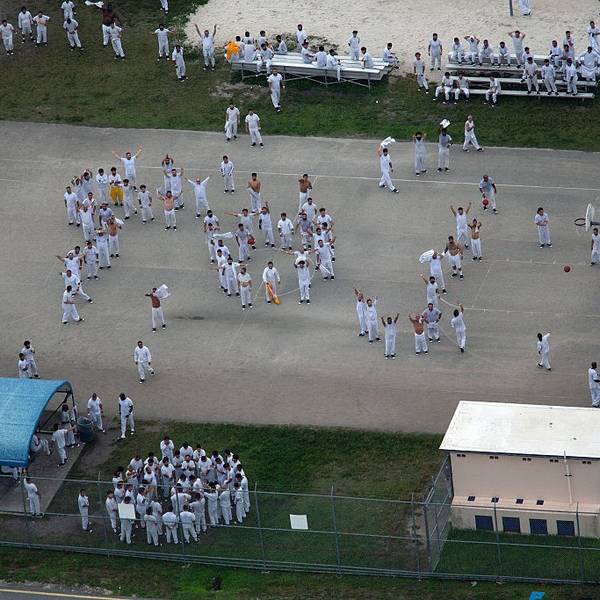
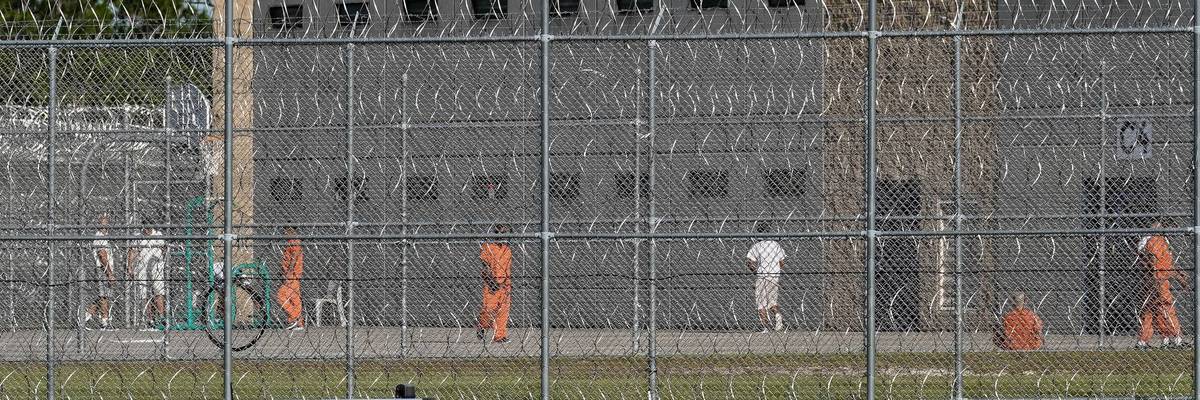
Detainees are seen in a yard at the Folkston Immigration and Customs Enforcement Processing Center on September 9, 2025, in Folkston, Georgia.
(Photo by Elijah Nouvelage/AFP/Getty Images)
Accusing Trump of ‘Reckless Violations of the Law,’ Judge Orders Bond Hearings for Detained Immigrants
The White House's repeated claims that it is arresting the "worst of the worst" violent criminals "merely mirrors the severity and ill-natured conduct by the government," wrote US District Judge Sunshine Sykes.
Feb 19, 2026
In a ruling that accused the Trump administration of "shameless" conduct in its mass deportation campaign and at one point suggested the phrase "worst of the worst"—frequently used by the Department of Homeland Security to describe immigrants it's arrested—better describes the actions of agency officials, a federal judge on Wednesday vacated an administrative board's decision that's been used to detain thousands of people without providing bond hearings.
Ruling in a class action lawsuit filed by several immigrant rights groups, US District Judge Sunshine Sykes in the Central District of California threw out a decision by the Board of Immigration Appeals, part of the US Department of Justice (DOJ), which endorsed the administration's policy of denying bond hearings to immigrants with no criminal records who have been swept up in President Donald Trump's mass detention campaign.
Immigration judges employed by the DOJ have used the board's interpretation of the law to mandate the detention of thousands of immigrants.
Historically, people who have no criminal record—like many of the people arrested by federal immigration agents during Trump's second term—are eligible to request a bond hearing before an immigration judge while their cases move through the court system, unless they were detained while trying to cross the US border.
The White House last year reversed decades of precedent by denying bond hearings to people who were in the US for years prior to their arrest.
The administration has continued denying bond hearings even after similar rulings by Sykes last year.
Sykes noted in her Wednesday ruling that immigrants across the country have filed habeas corpus petitions in federal courts to seek their release. According to the Associated Press, more than 20,000 habeas corpus cases have been filed since Trump was inaugurated in January 2025.
The judge accused the administration of wasting "valuable time and resources" and wrote, "not only does detention without due process deprive members of the bond eligible class of their liberty, economic stability, and fundamental dignity, but it also harms their families, communities, and the fabric of this very nation."
Sykes' ruling "is more sweeping than decisions by hundreds of other US judges holding the policy is unlawful and ordering detainees to be freed or given bond hearings," according to Reuters.
Niels Frenzen, a law professor at University of Southern California who represented plaintiffs in the class action case, said in a statement, "We hope that DHS and the immigration courts will now comply with the court's orders to provide bond hearings to the thousands of noncitizens who have been arrested."
In addition to condemning the administration's continued denial of bond hearings, Sykes excoriated the White House for perpetrating "terror" against citizens and immigrants.
"Americans have expressed deep concerns over unlawful, wanton acts by the executive branch," wrote Sykes. "It is not the 'worst of the worst' that are swept into the nationwide and reckless violations of the law by the executive branch. In the past weeks, the government detained Adrian Conejo Arias and his five-year-old son without a valid warrant. Beyond its terror against noncitizens, the executive branch has extended its violence on its own citizens, killing two American citizens—Renée Good and Alex Pretti—in Minnesota. The threats posed by the executive branch cannot be viewed in isolation."
The judge added that "worst of the worst" is an "inaccurate description of most of those affected by DHS and [US Immigration and Customs Enforcement's] operations."
"Perhaps in utilizing this extreme language DHS seeks to justify the magnitude and scope of its operations against non-criminal noncitizens. Maybe that phrase merely mirrors the severity and ill-natured conduct by the government," she wrote.
Press releases from DHS describing convicted criminals who have been arrested by federal agents "might contain an inkling of
truth," Sykes added, but "they ignore a greater, more dire reality."
An Urgent Message From Our Co-Founder
Dear Common Dreams reader, The U.S. is on a fast track to authoritarianism like nothing I've ever seen. Meanwhile, corporate news outlets are utterly capitulating to Trump, twisting their coverage to avoid drawing his ire while lining up to stuff cash in his pockets. That's why I believe that Common Dreams is doing the best and most consequential reporting that we've ever done. Our small but mighty team is a progressive reporting powerhouse, covering the news every day that the corporate media never will. Our mission has always been simple: To inform. To inspire. And to ignite change for the common good. Now here's the key piece that I want all our readers to understand: None of this would be possible without your financial support. That's not just some fundraising cliche. It's the absolute and literal truth. We don't accept corporate advertising and never will. We don't have a paywall because we don't think people should be blocked from critical news based on their ability to pay. Everything we do is funded by the donations of readers like you. Will you donate now to help power the nonprofit, independent reporting of Common Dreams? Thank you for being a vital member of our community. Together, we can keep independent journalism alive when it’s needed most. - Craig Brown, Co-founder |
Our work is licensed under Creative Commons (CC BY-NC-ND 3.0). Feel free to republish and share widely.
In a ruling that accused the Trump administration of "shameless" conduct in its mass deportation campaign and at one point suggested the phrase "worst of the worst"—frequently used by the Department of Homeland Security to describe immigrants it's arrested—better describes the actions of agency officials, a federal judge on Wednesday vacated an administrative board's decision that's been used to detain thousands of people without providing bond hearings.
Ruling in a class action lawsuit filed by several immigrant rights groups, US District Judge Sunshine Sykes in the Central District of California threw out a decision by the Board of Immigration Appeals, part of the US Department of Justice (DOJ), which endorsed the administration's policy of denying bond hearings to immigrants with no criminal records who have been swept up in President Donald Trump's mass detention campaign.
Immigration judges employed by the DOJ have used the board's interpretation of the law to mandate the detention of thousands of immigrants.
Historically, people who have no criminal record—like many of the people arrested by federal immigration agents during Trump's second term—are eligible to request a bond hearing before an immigration judge while their cases move through the court system, unless they were detained while trying to cross the US border.
The White House last year reversed decades of precedent by denying bond hearings to people who were in the US for years prior to their arrest.
The administration has continued denying bond hearings even after similar rulings by Sykes last year.
Sykes noted in her Wednesday ruling that immigrants across the country have filed habeas corpus petitions in federal courts to seek their release. According to the Associated Press, more than 20,000 habeas corpus cases have been filed since Trump was inaugurated in January 2025.
The judge accused the administration of wasting "valuable time and resources" and wrote, "not only does detention without due process deprive members of the bond eligible class of their liberty, economic stability, and fundamental dignity, but it also harms their families, communities, and the fabric of this very nation."
Sykes' ruling "is more sweeping than decisions by hundreds of other US judges holding the policy is unlawful and ordering detainees to be freed or given bond hearings," according to Reuters.
Niels Frenzen, a law professor at University of Southern California who represented plaintiffs in the class action case, said in a statement, "We hope that DHS and the immigration courts will now comply with the court's orders to provide bond hearings to the thousands of noncitizens who have been arrested."
In addition to condemning the administration's continued denial of bond hearings, Sykes excoriated the White House for perpetrating "terror" against citizens and immigrants.
"Americans have expressed deep concerns over unlawful, wanton acts by the executive branch," wrote Sykes. "It is not the 'worst of the worst' that are swept into the nationwide and reckless violations of the law by the executive branch. In the past weeks, the government detained Adrian Conejo Arias and his five-year-old son without a valid warrant. Beyond its terror against noncitizens, the executive branch has extended its violence on its own citizens, killing two American citizens—Renée Good and Alex Pretti—in Minnesota. The threats posed by the executive branch cannot be viewed in isolation."
The judge added that "worst of the worst" is an "inaccurate description of most of those affected by DHS and [US Immigration and Customs Enforcement's] operations."
"Perhaps in utilizing this extreme language DHS seeks to justify the magnitude and scope of its operations against non-criminal noncitizens. Maybe that phrase merely mirrors the severity and ill-natured conduct by the government," she wrote.
Press releases from DHS describing convicted criminals who have been arrested by federal agents "might contain an inkling of
truth," Sykes added, but "they ignore a greater, more dire reality."
In a ruling that accused the Trump administration of "shameless" conduct in its mass deportation campaign and at one point suggested the phrase "worst of the worst"—frequently used by the Department of Homeland Security to describe immigrants it's arrested—better describes the actions of agency officials, a federal judge on Wednesday vacated an administrative board's decision that's been used to detain thousands of people without providing bond hearings.
Ruling in a class action lawsuit filed by several immigrant rights groups, US District Judge Sunshine Sykes in the Central District of California threw out a decision by the Board of Immigration Appeals, part of the US Department of Justice (DOJ), which endorsed the administration's policy of denying bond hearings to immigrants with no criminal records who have been swept up in President Donald Trump's mass detention campaign.
Immigration judges employed by the DOJ have used the board's interpretation of the law to mandate the detention of thousands of immigrants.
Historically, people who have no criminal record—like many of the people arrested by federal immigration agents during Trump's second term—are eligible to request a bond hearing before an immigration judge while their cases move through the court system, unless they were detained while trying to cross the US border.
The White House last year reversed decades of precedent by denying bond hearings to people who were in the US for years prior to their arrest.
The administration has continued denying bond hearings even after similar rulings by Sykes last year.
Sykes noted in her Wednesday ruling that immigrants across the country have filed habeas corpus petitions in federal courts to seek their release. According to the Associated Press, more than 20,000 habeas corpus cases have been filed since Trump was inaugurated in January 2025.
The judge accused the administration of wasting "valuable time and resources" and wrote, "not only does detention without due process deprive members of the bond eligible class of their liberty, economic stability, and fundamental dignity, but it also harms their families, communities, and the fabric of this very nation."
Sykes' ruling "is more sweeping than decisions by hundreds of other US judges holding the policy is unlawful and ordering detainees to be freed or given bond hearings," according to Reuters.
Niels Frenzen, a law professor at University of Southern California who represented plaintiffs in the class action case, said in a statement, "We hope that DHS and the immigration courts will now comply with the court's orders to provide bond hearings to the thousands of noncitizens who have been arrested."
In addition to condemning the administration's continued denial of bond hearings, Sykes excoriated the White House for perpetrating "terror" against citizens and immigrants.
"Americans have expressed deep concerns over unlawful, wanton acts by the executive branch," wrote Sykes. "It is not the 'worst of the worst' that are swept into the nationwide and reckless violations of the law by the executive branch. In the past weeks, the government detained Adrian Conejo Arias and his five-year-old son without a valid warrant. Beyond its terror against noncitizens, the executive branch has extended its violence on its own citizens, killing two American citizens—Renée Good and Alex Pretti—in Minnesota. The threats posed by the executive branch cannot be viewed in isolation."
The judge added that "worst of the worst" is an "inaccurate description of most of those affected by DHS and [US Immigration and Customs Enforcement's] operations."
"Perhaps in utilizing this extreme language DHS seeks to justify the magnitude and scope of its operations against non-criminal noncitizens. Maybe that phrase merely mirrors the severity and ill-natured conduct by the government," she wrote.
Press releases from DHS describing convicted criminals who have been arrested by federal agents "might contain an inkling of
truth," Sykes added, but "they ignore a greater, more dire reality."
We've had enough. The 1% own and operate the corporate media. They are doing everything they can to defend the status quo, squash dissent and protect the wealthy and the powerful. The Common Dreams media model is different. We cover the news that matters to the 99%. Our mission? To inform. To inspire. To ignite change for the common good. How? Nonprofit. Independent. Reader-supported. Free to read. Free to republish. Free to share. With no advertising. No paywalls. No selling of your data. Thousands of small donations fund our newsroom and allow us to continue publishing. Can you chip in? We can't do it without you. Thank you.