

SUBSCRIBE TO OUR FREE NEWSLETTER
Daily news & progressive opinion—funded by the people, not the corporations—delivered straight to your inbox.
5
#000000
#FFFFFF
To donate by check, phone, or other method, see our More Ways to Give page.
Daily news & progressive opinion—funded by the people, not the corporations—delivered straight to your inbox.
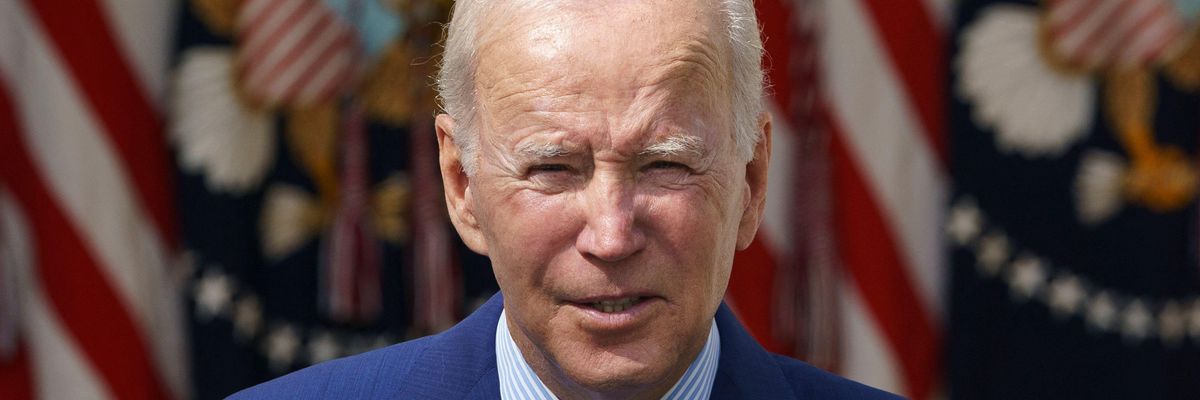
U.S. President Joe Biden speaks about the tentative railway labor agreement in the Rose Garden of the White House in Washington, D.C. on September 15, 2022. (Photo: Mandel Ngan/AFP via Getty Images)
Warning that the looming U.S. railroad strike "would devastate our economy," President Joe Biden angered labor advocates on Monday after he implored Congress to take legislative action to force union members to keep working under a contract that many of them have rejected, mainly due to its denial of paid sick days.
"Paid sick leave is both a basic part of fair employment practices and an absolutely essential part of national public health policy."
"I am calling on Congress to pass legislation immediately to adopt the tentative agreement between railroad workers and operators--without any modifications or delay--to avert a potentially crippling national rail shutdown," Biden said in a statement.
Under the Railway Labor Act of 1926--which critics have long slammed as anti-worker--Congress can pass a joint resolution that would force employees to stay on the job. By signing such a measure, labor advocates say, Biden would be betraying his claim, reiterated in Monday's statement, to be a "pro-labor president."
Progressive political commentator Krystal Ball responded to the president's statement by tweeting that "Biden is siding with corporate rail bosses over the rank-and-file workers who voted against this agreement."
Labor reporter Jonah Furman went even further in his criticism, accusing Biden of a "full sellout."
In his statement, Biden noted that "this agreement was approved by labor and management negotiators in September" and that the deal "provides a historic 24% pay raise for rail workers" as well as "improved healthcare benefits."
However, while most unions representing rail workers did reach agreements with their employers, the two largest--the International Association of Sheet Metal, Air, Rail, and Transportation Workers-Transportation Division (SMART-TD) and the Brotherhood of Locomotive Engineers and Trainmen (BLET)--did not accept the proposal, which critics said did not address workers' key demands on work rules and conditions.
The main sticking point involves paid sick leave. U.S. rail workers get none, and the deal being pushed by railroad companies and Biden would keep it that way. Congress could impose the industry-backed agreement without paid sick days, or it could heed unions' call for the addition of such compensated time off. Lawmakers could also extend a "cooling-off" period, allowing negotiations to continue while workers remain on the job.
Tony Caldwell, president of the Brotherhood of Maintenance of Way Employees--which rejected the proposed deal--told The Washington Post that "during [the] pandemic, our members suffered the most. The pandemic spread through our membership like wildfire. We lost members to sickness and death. They aren't happy with the deal because it didn't address their main issue: sick leave."
Dr. Eric Reinhart, an expert on public health policy, tweeted Monday that "railroad workers still get zero paid sick leave. Increased risk of exposure to infectious illness is part of many jobs. Paid sick leave is both a basic part of fair employment practices and an absolutely essential part of national public health policy."
An analysis published last week by the watchdog group Accountable.US showed that BNSF--a subsidiary of multibillionaire Warren Buffett's Berkshire Hathaway, which operates one of North America's largest railroad networks--saw a net income increase of 4% to $4.4 billion during the first three quarters of 2022. Railroad giant Union Pacific also enjoyed an 11% profit increase over the same period, during which it spent nearly $8 billion on stock buybacks.
"The corporate greed never ends," U.S. Sen. Bernie Sanders (I-Vt.) wrote Sunday. "Last year, the rail industry made a record-breaking $20 billion in profits after cutting their workforce by 30% over the last six years. Meanwhile, rail workers have ZERO guaranteed paid sick days. Congress must stand with rail workers."
Dear Common Dreams reader, It’s been nearly 30 years since I co-founded Common Dreams with my late wife, Lina Newhouser. We had the radical notion that journalism should serve the public good, not corporate profits. It was clear to us from the outset what it would take to build such a project. No paid advertisements. No corporate sponsors. No millionaire publisher telling us what to think or do. Many people said we wouldn't last a year, but we proved those doubters wrong. Together with a tremendous team of journalists and dedicated staff, we built an independent media outlet free from the constraints of profits and corporate control. Our mission has always been simple: To inform. To inspire. To ignite change for the common good. Building Common Dreams was not easy. Our survival was never guaranteed. When you take on the most powerful forces—Wall Street greed, fossil fuel industry destruction, Big Tech lobbyists, and uber-rich oligarchs who have spent billions upon billions rigging the economy and democracy in their favor—the only bulwark you have is supporters who believe in your work. But here’s the urgent message from me today. It's never been this bad out there. And it's never been this hard to keep us going. At the very moment Common Dreams is most needed, the threats we face are intensifying. We need your support now more than ever. We don't accept corporate advertising and never will. We don't have a paywall because we don't think people should be blocked from critical news based on their ability to pay. Everything we do is funded by the donations of readers like you. When everyone does the little they can afford, we are strong. But if that support retreats or dries up, so do we. Will you donate now to make sure Common Dreams not only survives but thrives? —Craig Brown, Co-founder |
Warning that the looming U.S. railroad strike "would devastate our economy," President Joe Biden angered labor advocates on Monday after he implored Congress to take legislative action to force union members to keep working under a contract that many of them have rejected, mainly due to its denial of paid sick days.
"Paid sick leave is both a basic part of fair employment practices and an absolutely essential part of national public health policy."
"I am calling on Congress to pass legislation immediately to adopt the tentative agreement between railroad workers and operators--without any modifications or delay--to avert a potentially crippling national rail shutdown," Biden said in a statement.
Under the Railway Labor Act of 1926--which critics have long slammed as anti-worker--Congress can pass a joint resolution that would force employees to stay on the job. By signing such a measure, labor advocates say, Biden would be betraying his claim, reiterated in Monday's statement, to be a "pro-labor president."
Progressive political commentator Krystal Ball responded to the president's statement by tweeting that "Biden is siding with corporate rail bosses over the rank-and-file workers who voted against this agreement."
Labor reporter Jonah Furman went even further in his criticism, accusing Biden of a "full sellout."
In his statement, Biden noted that "this agreement was approved by labor and management negotiators in September" and that the deal "provides a historic 24% pay raise for rail workers" as well as "improved healthcare benefits."
However, while most unions representing rail workers did reach agreements with their employers, the two largest--the International Association of Sheet Metal, Air, Rail, and Transportation Workers-Transportation Division (SMART-TD) and the Brotherhood of Locomotive Engineers and Trainmen (BLET)--did not accept the proposal, which critics said did not address workers' key demands on work rules and conditions.
The main sticking point involves paid sick leave. U.S. rail workers get none, and the deal being pushed by railroad companies and Biden would keep it that way. Congress could impose the industry-backed agreement without paid sick days, or it could heed unions' call for the addition of such compensated time off. Lawmakers could also extend a "cooling-off" period, allowing negotiations to continue while workers remain on the job.
Tony Caldwell, president of the Brotherhood of Maintenance of Way Employees--which rejected the proposed deal--told The Washington Post that "during [the] pandemic, our members suffered the most. The pandemic spread through our membership like wildfire. We lost members to sickness and death. They aren't happy with the deal because it didn't address their main issue: sick leave."
Dr. Eric Reinhart, an expert on public health policy, tweeted Monday that "railroad workers still get zero paid sick leave. Increased risk of exposure to infectious illness is part of many jobs. Paid sick leave is both a basic part of fair employment practices and an absolutely essential part of national public health policy."
An analysis published last week by the watchdog group Accountable.US showed that BNSF--a subsidiary of multibillionaire Warren Buffett's Berkshire Hathaway, which operates one of North America's largest railroad networks--saw a net income increase of 4% to $4.4 billion during the first three quarters of 2022. Railroad giant Union Pacific also enjoyed an 11% profit increase over the same period, during which it spent nearly $8 billion on stock buybacks.
"The corporate greed never ends," U.S. Sen. Bernie Sanders (I-Vt.) wrote Sunday. "Last year, the rail industry made a record-breaking $20 billion in profits after cutting their workforce by 30% over the last six years. Meanwhile, rail workers have ZERO guaranteed paid sick days. Congress must stand with rail workers."
Warning that the looming U.S. railroad strike "would devastate our economy," President Joe Biden angered labor advocates on Monday after he implored Congress to take legislative action to force union members to keep working under a contract that many of them have rejected, mainly due to its denial of paid sick days.
"Paid sick leave is both a basic part of fair employment practices and an absolutely essential part of national public health policy."
"I am calling on Congress to pass legislation immediately to adopt the tentative agreement between railroad workers and operators--without any modifications or delay--to avert a potentially crippling national rail shutdown," Biden said in a statement.
Under the Railway Labor Act of 1926--which critics have long slammed as anti-worker--Congress can pass a joint resolution that would force employees to stay on the job. By signing such a measure, labor advocates say, Biden would be betraying his claim, reiterated in Monday's statement, to be a "pro-labor president."
Progressive political commentator Krystal Ball responded to the president's statement by tweeting that "Biden is siding with corporate rail bosses over the rank-and-file workers who voted against this agreement."
Labor reporter Jonah Furman went even further in his criticism, accusing Biden of a "full sellout."
In his statement, Biden noted that "this agreement was approved by labor and management negotiators in September" and that the deal "provides a historic 24% pay raise for rail workers" as well as "improved healthcare benefits."
However, while most unions representing rail workers did reach agreements with their employers, the two largest--the International Association of Sheet Metal, Air, Rail, and Transportation Workers-Transportation Division (SMART-TD) and the Brotherhood of Locomotive Engineers and Trainmen (BLET)--did not accept the proposal, which critics said did not address workers' key demands on work rules and conditions.
The main sticking point involves paid sick leave. U.S. rail workers get none, and the deal being pushed by railroad companies and Biden would keep it that way. Congress could impose the industry-backed agreement without paid sick days, or it could heed unions' call for the addition of such compensated time off. Lawmakers could also extend a "cooling-off" period, allowing negotiations to continue while workers remain on the job.
Tony Caldwell, president of the Brotherhood of Maintenance of Way Employees--which rejected the proposed deal--told The Washington Post that "during [the] pandemic, our members suffered the most. The pandemic spread through our membership like wildfire. We lost members to sickness and death. They aren't happy with the deal because it didn't address their main issue: sick leave."
Dr. Eric Reinhart, an expert on public health policy, tweeted Monday that "railroad workers still get zero paid sick leave. Increased risk of exposure to infectious illness is part of many jobs. Paid sick leave is both a basic part of fair employment practices and an absolutely essential part of national public health policy."
An analysis published last week by the watchdog group Accountable.US showed that BNSF--a subsidiary of multibillionaire Warren Buffett's Berkshire Hathaway, which operates one of North America's largest railroad networks--saw a net income increase of 4% to $4.4 billion during the first three quarters of 2022. Railroad giant Union Pacific also enjoyed an 11% profit increase over the same period, during which it spent nearly $8 billion on stock buybacks.
"The corporate greed never ends," U.S. Sen. Bernie Sanders (I-Vt.) wrote Sunday. "Last year, the rail industry made a record-breaking $20 billion in profits after cutting their workforce by 30% over the last six years. Meanwhile, rail workers have ZERO guaranteed paid sick days. Congress must stand with rail workers."

