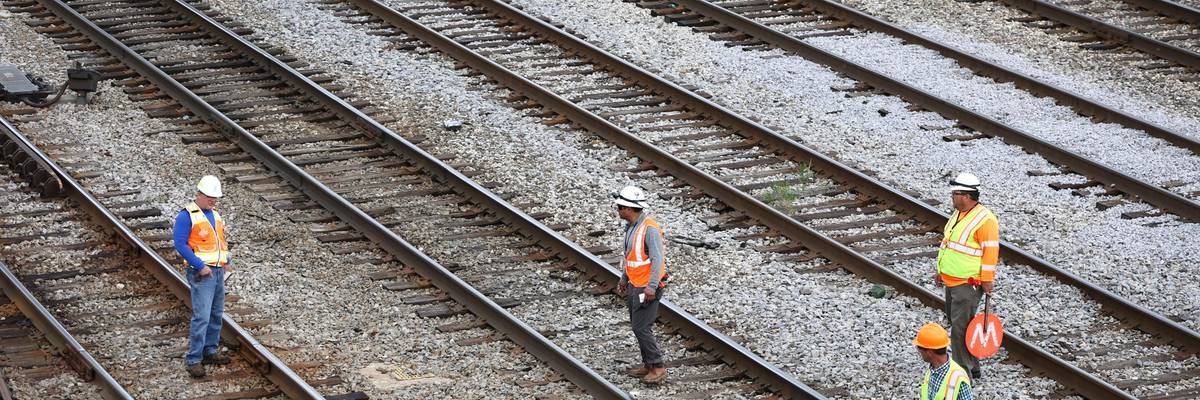
Workers service the tracks at the Metra/BNSF railroad yard on September 13, 2022 in Chicago, Illinois. (Photo: Scott Olson/Getty Images)
Despite Record Profits, Rail Companies Reject Union's Demand for Paid Sick Leave
Paid sick leave "has become a norm in this society," said one labor organizer--one that rail carriers "can very easily afford."
A statement from the United States' major freight rail companies left railroad workers feeling increasingly "disenfranchised and undervalued," according to one labor organizer, as the National Carriers' Conference Committee rejected a proposal from the third largest rail workers union which called for just seven days of paid sick leave per year.
While claiming "the health, safety, and wellbeing of rail employees is a top priority for all railroads," the NCCC said it would not accept the proposal from the Brotherhood of Maintenance of Way Employees Division (BMWED), which was introduced last week.
"They'd still be making record profits if they agreed to provide railroad workers paid sick leave."
The BMWED had demanded the addition of paid sick days--modeled on a system used for federal workers in which employees accrue one hour of paid sick time for every 30 hours worked--last week as its members voted against a proposed contract that was developed with the help of White House officials. That contract included unpaid days off for medical care, but no paid sick days.
Clark Ballew, a spokesperson for the BMWED, noted that having reported more than $10 billion in stock buybacks and dividends in the first six months of 2022, rail companies "can very easily afford" to provide workers with paid leave when they are sick, as they did during the coronavirus pandemic hit before vaccines were available to employees.
"It is not unreasonable... and they'd still be making record profits if they agreed to provide railroad workers paid sick leave," Ballew told the Associated Press, adding that paid sick leave for employees "has become a norm in this society."
Ballew posited that if the two sides can't agree on a contract and Congress has to step in to avoid a strike, lawmakers may impose the proposed deal that excludes paid leave--a possibility that may be keeping the carriers from agreeing to BMWED's terms.
The rail carriers said Wednesday that while workers lack standard paid sick leave, "comprehensive paid sickness benefits" kick in for long-term illnesses after four days of absence, but unions have suggested the companies are capable of providing employees with both long-term disability benefits and comprehensive paid sick leave, as other workers throughout the economy have.
"It's totally asinine," Peter Kennedy, director of strategic coordination and research for BMWED, told CNN of the NCCC's rejection of the union's proposal. "Members are very upset."
Rail worker unions agreed not to call a strike until workers from across the industry, represented by 12 unions, have voted on the tentative deal reached last month.
A work stoppage could begin as early as November 19. The last nationwide railroad shutdown took place in 1992 after just one union rejected a contract and called a strike.
On Sunday, BMWED Local 0695 in Baltimore is reportedly planning to picket at M&T Bank Stadium during a Baltimore Ravens football game "to get information out to the public" ahead of next month's deadline for a contract.
This week, the CEO of the National Association of Chemical Distributors warned in an opinion piece at Supply Chain Dive that a work stoppage could have "dire economic ramifications" for supply chains across sectors and lambasted rail companies for refusing to bend regarding the demand for paid sick leave.
"Without adequate benefits, there is no incentive for current workers to stay or for new workers to fill positions essential for safe and reliable freight rail service for customers," wrote Eric R. Byer. "A fragile and volatile supply chain requires a strong rail network. Now is not the time to deny reasonable benefits for a labor community that has been decimated by losses in recent years... It's time for the freight rail industry to right this wrong and get rail back on track."
Byer's op-ed was evidence of the "capitalist class splitting in real time," tweeted Labor Notes reporter Jonah Furman.
"The rail monopolists have gone so far in destroying the industry for destructive profit-seeking that their customers, big chemical distributors, are siding with the workers in reforming the freight railroad labor system," he said.
We are at a crossroads
This country and this world are at a monumental crossroads. In a few short weeks, US voters will have an opportunity to beat back the forces of fascism and confront the billionaires who are rigging the economy, our media system, and our democracy, making it increasingly impossible for ordinary people to get by. We’re not just talking about the election. We’re talking about what must be done once these fascist elements are vanquished from power. We need a bolder set of solutions than what either major party has so far been willing to offer and a working-class movement ready to fight like hell for it. Trump didn't emerge from nowhere. The conditions that fueled MAGA authoritarianism were created by decades of radical neoliberal economic policies and a corrupt political system dominated by corporate interests. They slashed taxes on the super-rich, promising that the benefits would trickle down. They said giveaways to the corporate titans would make life more affordable for the rest of us. It was all bullshit. And when a bitter, betrayed populace searches for someone to blame, right-wing demagogues have little trouble finding scapegoats. People know when they're being lied to, but you won't hear any of this from the corporate media. Only independent journalism—powered and funded by people who believe in building a better world—can deliver truly trustworthy daily news. Our Fall Campaign is underway, and we need your help. To power our newsroom through the rest of the year, we need to raise $125,000 by midnight on October 31. So if you share our vision, please contribute whatever you can to sustain our work. |
A statement from the United States' major freight rail companies left railroad workers feeling increasingly "disenfranchised and undervalued," according to one labor organizer, as the National Carriers' Conference Committee rejected a proposal from the third largest rail workers union which called for just seven days of paid sick leave per year.
While claiming "the health, safety, and wellbeing of rail employees is a top priority for all railroads," the NCCC said it would not accept the proposal from the Brotherhood of Maintenance of Way Employees Division (BMWED), which was introduced last week.
"They'd still be making record profits if they agreed to provide railroad workers paid sick leave."
The BMWED had demanded the addition of paid sick days--modeled on a system used for federal workers in which employees accrue one hour of paid sick time for every 30 hours worked--last week as its members voted against a proposed contract that was developed with the help of White House officials. That contract included unpaid days off for medical care, but no paid sick days.
Clark Ballew, a spokesperson for the BMWED, noted that having reported more than $10 billion in stock buybacks and dividends in the first six months of 2022, rail companies "can very easily afford" to provide workers with paid leave when they are sick, as they did during the coronavirus pandemic hit before vaccines were available to employees.
"It is not unreasonable... and they'd still be making record profits if they agreed to provide railroad workers paid sick leave," Ballew told the Associated Press, adding that paid sick leave for employees "has become a norm in this society."
Ballew posited that if the two sides can't agree on a contract and Congress has to step in to avoid a strike, lawmakers may impose the proposed deal that excludes paid leave--a possibility that may be keeping the carriers from agreeing to BMWED's terms.
The rail carriers said Wednesday that while workers lack standard paid sick leave, "comprehensive paid sickness benefits" kick in for long-term illnesses after four days of absence, but unions have suggested the companies are capable of providing employees with both long-term disability benefits and comprehensive paid sick leave, as other workers throughout the economy have.
"It's totally asinine," Peter Kennedy, director of strategic coordination and research for BMWED, told CNN of the NCCC's rejection of the union's proposal. "Members are very upset."
Rail worker unions agreed not to call a strike until workers from across the industry, represented by 12 unions, have voted on the tentative deal reached last month.
A work stoppage could begin as early as November 19. The last nationwide railroad shutdown took place in 1992 after just one union rejected a contract and called a strike.
On Sunday, BMWED Local 0695 in Baltimore is reportedly planning to picket at M&T Bank Stadium during a Baltimore Ravens football game "to get information out to the public" ahead of next month's deadline for a contract.
This week, the CEO of the National Association of Chemical Distributors warned in an opinion piece at Supply Chain Dive that a work stoppage could have "dire economic ramifications" for supply chains across sectors and lambasted rail companies for refusing to bend regarding the demand for paid sick leave.
"Without adequate benefits, there is no incentive for current workers to stay or for new workers to fill positions essential for safe and reliable freight rail service for customers," wrote Eric R. Byer. "A fragile and volatile supply chain requires a strong rail network. Now is not the time to deny reasonable benefits for a labor community that has been decimated by losses in recent years... It's time for the freight rail industry to right this wrong and get rail back on track."
Byer's op-ed was evidence of the "capitalist class splitting in real time," tweeted Labor Notes reporter Jonah Furman.
"The rail monopolists have gone so far in destroying the industry for destructive profit-seeking that their customers, big chemical distributors, are siding with the workers in reforming the freight railroad labor system," he said.
A statement from the United States' major freight rail companies left railroad workers feeling increasingly "disenfranchised and undervalued," according to one labor organizer, as the National Carriers' Conference Committee rejected a proposal from the third largest rail workers union which called for just seven days of paid sick leave per year.
While claiming "the health, safety, and wellbeing of rail employees is a top priority for all railroads," the NCCC said it would not accept the proposal from the Brotherhood of Maintenance of Way Employees Division (BMWED), which was introduced last week.
"They'd still be making record profits if they agreed to provide railroad workers paid sick leave."
The BMWED had demanded the addition of paid sick days--modeled on a system used for federal workers in which employees accrue one hour of paid sick time for every 30 hours worked--last week as its members voted against a proposed contract that was developed with the help of White House officials. That contract included unpaid days off for medical care, but no paid sick days.
Clark Ballew, a spokesperson for the BMWED, noted that having reported more than $10 billion in stock buybacks and dividends in the first six months of 2022, rail companies "can very easily afford" to provide workers with paid leave when they are sick, as they did during the coronavirus pandemic hit before vaccines were available to employees.
"It is not unreasonable... and they'd still be making record profits if they agreed to provide railroad workers paid sick leave," Ballew told the Associated Press, adding that paid sick leave for employees "has become a norm in this society."
Ballew posited that if the two sides can't agree on a contract and Congress has to step in to avoid a strike, lawmakers may impose the proposed deal that excludes paid leave--a possibility that may be keeping the carriers from agreeing to BMWED's terms.
The rail carriers said Wednesday that while workers lack standard paid sick leave, "comprehensive paid sickness benefits" kick in for long-term illnesses after four days of absence, but unions have suggested the companies are capable of providing employees with both long-term disability benefits and comprehensive paid sick leave, as other workers throughout the economy have.
"It's totally asinine," Peter Kennedy, director of strategic coordination and research for BMWED, told CNN of the NCCC's rejection of the union's proposal. "Members are very upset."
Rail worker unions agreed not to call a strike until workers from across the industry, represented by 12 unions, have voted on the tentative deal reached last month.
A work stoppage could begin as early as November 19. The last nationwide railroad shutdown took place in 1992 after just one union rejected a contract and called a strike.
On Sunday, BMWED Local 0695 in Baltimore is reportedly planning to picket at M&T Bank Stadium during a Baltimore Ravens football game "to get information out to the public" ahead of next month's deadline for a contract.
This week, the CEO of the National Association of Chemical Distributors warned in an opinion piece at Supply Chain Dive that a work stoppage could have "dire economic ramifications" for supply chains across sectors and lambasted rail companies for refusing to bend regarding the demand for paid sick leave.
"Without adequate benefits, there is no incentive for current workers to stay or for new workers to fill positions essential for safe and reliable freight rail service for customers," wrote Eric R. Byer. "A fragile and volatile supply chain requires a strong rail network. Now is not the time to deny reasonable benefits for a labor community that has been decimated by losses in recent years... It's time for the freight rail industry to right this wrong and get rail back on track."
Byer's op-ed was evidence of the "capitalist class splitting in real time," tweeted Labor Notes reporter Jonah Furman.
"The rail monopolists have gone so far in destroying the industry for destructive profit-seeking that their customers, big chemical distributors, are siding with the workers in reforming the freight railroad labor system," he said.