SUBSCRIBE TO OUR FREE NEWSLETTER
Daily news & progressive opinion—funded by the people, not the corporations—delivered straight to your inbox.
5
#000000
#FFFFFF
To donate by check, phone, or other method, see our More Ways to Give page.
Daily news & progressive opinion—funded by the people, not the corporations—delivered straight to your inbox.
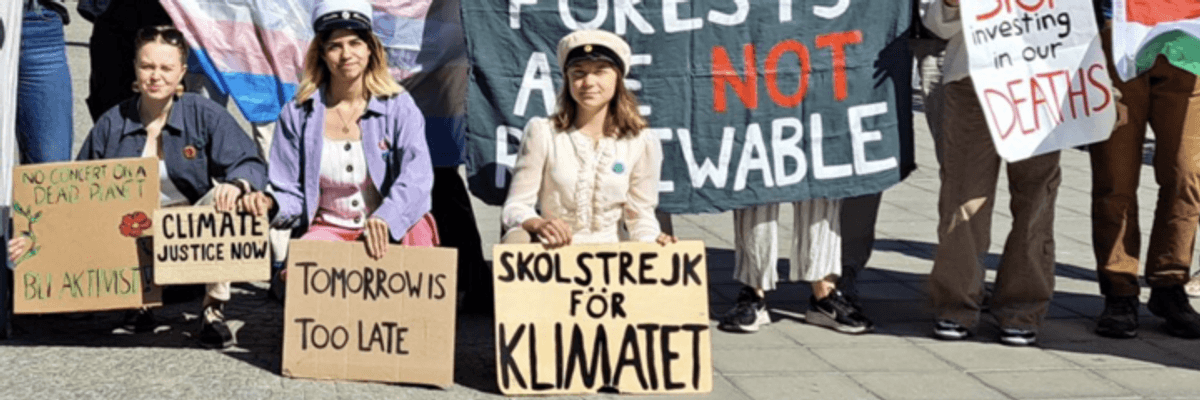
Greta Thunberg participates in her last school strike on Friday, June 9, 2023.
"When I started striking in 2018 I could never have expected that it would lead to anything," Thunberg tweeted in a reflection on the Fridays For Future movement on the day of her graduation.
Swedish climate activist Greta Thunberg—who launched a global movement when she began skipping school to protest in front of the Swedish parliament nearly five years ago–carried out her last school strike on Friday.
"School strike week 251," Thunberg tweeted. "Today, I graduate from school, which means I'll no longer be able to school strike for the climate."
Thunberg, who is now 20, first made headlines at the age of 15 when she refused to attend school during the three-week lead-up to September Swedish elections in an effort to persuade politicians to take action on the climate crisis.
Instead, she sat outside the Swedish parliament with a sign reading, "School strike for climate," in Swedish.
"We young people don't have the vote, but school is obligatory," Thunberg told The Local at the time. "So this [is] a way to get our voices heard."
"There are probably many of us who graduate who now wonder what kind of future it is that we are stepping into, even though we did not cause this crisis."
On the day of her final school strike, Thunberg took the opportunity to reflect on the movement she helped galvanize.
"When I started striking in 2018 I could never have expected that it would lead to anything," she tweeted. "After striking every day for three weeks, we were a small group of children who decided to continue doing this every Friday. And we did, which is how Fridays For Future was formed."
The movement went global "quite suddenly," Thunberg recalled.
"During 2019, millions of youth striked from school for the climate, flooding the streets in over 180 countries," she said.
Fridays For Future found a different way to protest during the coronavirus lockdowns by launching a #digitalclimatestrike.
"In a crisis we change our behavior and adapt to the new circumstances for the greater good of society," Thunberg wrote at the time.
However, one group that hasn't changed their behavior are the world leaders Thunberg has famously excoriated in a number of high-profile speeches. A study released Thursday found that greenhouse gas emissions rose to record levels in the last decade despite the promises of the Paris agreement.
"Much has changed since we started, and yet we have much further to go," Thunberg tweeted Friday. "We are still moving in the wrong direction, where those in power are allowed to sacrifice marginalized and affected people and the planet in the name of greed, profit, and economic growth."
Thunberg has spoken up for frontline communities recently. In January, she was detained while protesting the destruction of a German village to pave the way for a coal mine expansion, and in February, she joined with Norwegian Sami activists in opposing the placement of wind turbines on Indigenous land.
While graduation is typically a joyful occasion, Thunberg reflected on how the climate crisis has altered her generation's vision of the future.
"There are probably many of us who graduate who now wonder what kind of future it is that we are stepping into, even though we did not cause this crisis," she wrote.
Whatever Thunberg's future contains, climate activism will continue to be part of it.
"We who can speak up have a duty to do so. In order to change everything, we need everyone. I'll continue to protest on Fridays, even though it's not technically 'school striking,'" she promised.
"We simply have no other option than to do everything we possibly can," Thunberg concluded. "The fight has only just begun."
Dear Common Dreams reader, It’s been nearly 30 years since I co-founded Common Dreams with my late wife, Lina Newhouser. We had the radical notion that journalism should serve the public good, not corporate profits. It was clear to us from the outset what it would take to build such a project. No paid advertisements. No corporate sponsors. No millionaire publisher telling us what to think or do. Many people said we wouldn't last a year, but we proved those doubters wrong. Together with a tremendous team of journalists and dedicated staff, we built an independent media outlet free from the constraints of profits and corporate control. Our mission has always been simple: To inform. To inspire. To ignite change for the common good. Building Common Dreams was not easy. Our survival was never guaranteed. When you take on the most powerful forces—Wall Street greed, fossil fuel industry destruction, Big Tech lobbyists, and uber-rich oligarchs who have spent billions upon billions rigging the economy and democracy in their favor—the only bulwark you have is supporters who believe in your work. But here’s the urgent message from me today. It's never been this bad out there. And it's never been this hard to keep us going. At the very moment Common Dreams is most needed, the threats we face are intensifying. We need your support now more than ever. We don't accept corporate advertising and never will. We don't have a paywall because we don't think people should be blocked from critical news based on their ability to pay. Everything we do is funded by the donations of readers like you. When everyone does the little they can afford, we are strong. But if that support retreats or dries up, so do we. Will you donate now to make sure Common Dreams not only survives but thrives? —Craig Brown, Co-founder |
Swedish climate activist Greta Thunberg—who launched a global movement when she began skipping school to protest in front of the Swedish parliament nearly five years ago–carried out her last school strike on Friday.
"School strike week 251," Thunberg tweeted. "Today, I graduate from school, which means I'll no longer be able to school strike for the climate."
Thunberg, who is now 20, first made headlines at the age of 15 when she refused to attend school during the three-week lead-up to September Swedish elections in an effort to persuade politicians to take action on the climate crisis.
Instead, she sat outside the Swedish parliament with a sign reading, "School strike for climate," in Swedish.
"We young people don't have the vote, but school is obligatory," Thunberg told The Local at the time. "So this [is] a way to get our voices heard."
"There are probably many of us who graduate who now wonder what kind of future it is that we are stepping into, even though we did not cause this crisis."
On the day of her final school strike, Thunberg took the opportunity to reflect on the movement she helped galvanize.
"When I started striking in 2018 I could never have expected that it would lead to anything," she tweeted. "After striking every day for three weeks, we were a small group of children who decided to continue doing this every Friday. And we did, which is how Fridays For Future was formed."
The movement went global "quite suddenly," Thunberg recalled.
"During 2019, millions of youth striked from school for the climate, flooding the streets in over 180 countries," she said.
Fridays For Future found a different way to protest during the coronavirus lockdowns by launching a #digitalclimatestrike.
"In a crisis we change our behavior and adapt to the new circumstances for the greater good of society," Thunberg wrote at the time.
However, one group that hasn't changed their behavior are the world leaders Thunberg has famously excoriated in a number of high-profile speeches. A study released Thursday found that greenhouse gas emissions rose to record levels in the last decade despite the promises of the Paris agreement.
"Much has changed since we started, and yet we have much further to go," Thunberg tweeted Friday. "We are still moving in the wrong direction, where those in power are allowed to sacrifice marginalized and affected people and the planet in the name of greed, profit, and economic growth."
Thunberg has spoken up for frontline communities recently. In January, she was detained while protesting the destruction of a German village to pave the way for a coal mine expansion, and in February, she joined with Norwegian Sami activists in opposing the placement of wind turbines on Indigenous land.
While graduation is typically a joyful occasion, Thunberg reflected on how the climate crisis has altered her generation's vision of the future.
"There are probably many of us who graduate who now wonder what kind of future it is that we are stepping into, even though we did not cause this crisis," she wrote.
Whatever Thunberg's future contains, climate activism will continue to be part of it.
"We who can speak up have a duty to do so. In order to change everything, we need everyone. I'll continue to protest on Fridays, even though it's not technically 'school striking,'" she promised.
"We simply have no other option than to do everything we possibly can," Thunberg concluded. "The fight has only just begun."
Swedish climate activist Greta Thunberg—who launched a global movement when she began skipping school to protest in front of the Swedish parliament nearly five years ago–carried out her last school strike on Friday.
"School strike week 251," Thunberg tweeted. "Today, I graduate from school, which means I'll no longer be able to school strike for the climate."
Thunberg, who is now 20, first made headlines at the age of 15 when she refused to attend school during the three-week lead-up to September Swedish elections in an effort to persuade politicians to take action on the climate crisis.
Instead, she sat outside the Swedish parliament with a sign reading, "School strike for climate," in Swedish.
"We young people don't have the vote, but school is obligatory," Thunberg told The Local at the time. "So this [is] a way to get our voices heard."
"There are probably many of us who graduate who now wonder what kind of future it is that we are stepping into, even though we did not cause this crisis."
On the day of her final school strike, Thunberg took the opportunity to reflect on the movement she helped galvanize.
"When I started striking in 2018 I could never have expected that it would lead to anything," she tweeted. "After striking every day for three weeks, we were a small group of children who decided to continue doing this every Friday. And we did, which is how Fridays For Future was formed."
The movement went global "quite suddenly," Thunberg recalled.
"During 2019, millions of youth striked from school for the climate, flooding the streets in over 180 countries," she said.
Fridays For Future found a different way to protest during the coronavirus lockdowns by launching a #digitalclimatestrike.
"In a crisis we change our behavior and adapt to the new circumstances for the greater good of society," Thunberg wrote at the time.
However, one group that hasn't changed their behavior are the world leaders Thunberg has famously excoriated in a number of high-profile speeches. A study released Thursday found that greenhouse gas emissions rose to record levels in the last decade despite the promises of the Paris agreement.
"Much has changed since we started, and yet we have much further to go," Thunberg tweeted Friday. "We are still moving in the wrong direction, where those in power are allowed to sacrifice marginalized and affected people and the planet in the name of greed, profit, and economic growth."
Thunberg has spoken up for frontline communities recently. In January, she was detained while protesting the destruction of a German village to pave the way for a coal mine expansion, and in February, she joined with Norwegian Sami activists in opposing the placement of wind turbines on Indigenous land.
While graduation is typically a joyful occasion, Thunberg reflected on how the climate crisis has altered her generation's vision of the future.
"There are probably many of us who graduate who now wonder what kind of future it is that we are stepping into, even though we did not cause this crisis," she wrote.
Whatever Thunberg's future contains, climate activism will continue to be part of it.
"We who can speak up have a duty to do so. In order to change everything, we need everyone. I'll continue to protest on Fridays, even though it's not technically 'school striking,'" she promised.
"We simply have no other option than to do everything we possibly can," Thunberg concluded. "The fight has only just begun."