SUBSCRIBE TO OUR FREE NEWSLETTER
Daily news & progressive opinion—funded by the people, not the corporations—delivered straight to your inbox.
5
#000000
#FFFFFF
To donate by check, phone, or other method, see our More Ways to Give page.
Daily news & progressive opinion—funded by the people, not the corporations—delivered straight to your inbox.
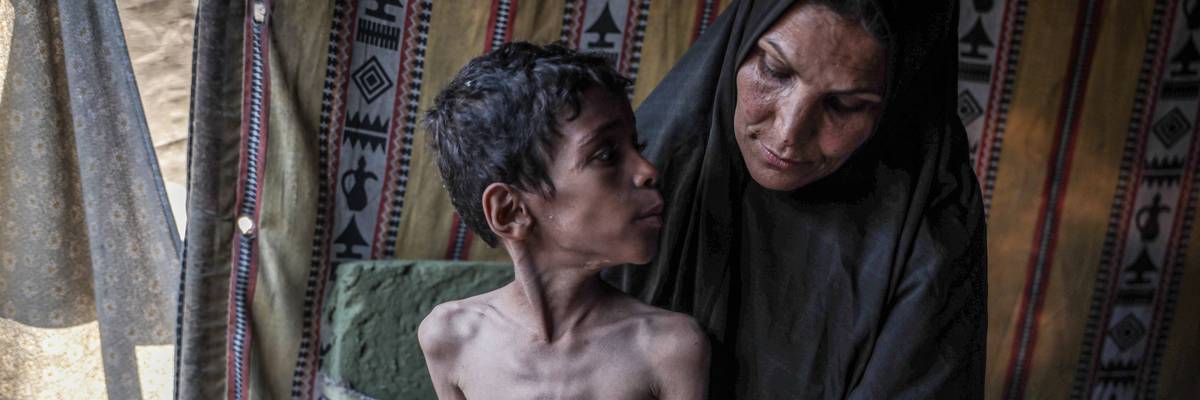
Ten-year-old Palestinian Mohammed Ahmed Masoud al-Susi struggles with malnutrition due to Israel's attacks on the Gaza Strip and restrictions on aid entry, in Gaza City on April 30, 2026.
"Every six months, we might get a food parcel once. It's barely enough," said one mother. "We are forced to eat whatever is in front of us."
A ceasefire was declared between Israel and Hamas seven months ago, but just as the deal has not stopped the killing of hundreds of Palestinians in Gaza, it has failed to alleviate the acute malnutrition crisis that was created when Israel began blocking almost all humanitarian aid in October 2023.
The international aid group Doctors Without Borders, also known by its French name, Médecins Sans Frontières (MSF), on Wednesday accused Israel of imposing a "manufactured malnutrition crisis" that is proving particularly devastating for pregnant and breastfeeding women, newborns, and infants.
At four clinics operated by MSF in Gaza between late 2024 and early 2026, medical teams found higher levels of miscarriage among mothers who experienced malnutrition.
The group also analyzed data on 201 mothers of newborns who required treatment in neonatal intensive care units at Nasser Hospital in Khan Younis and Al-Helou Hospital in Gaza City between June 2025 and this past January. More than half of the mothers had been affected by malnutrition at some point in their pregnancy.
Ninety percent of the babies had been born prematurely and 84% had low birth weight.
"Neonatal mortality was twice as high among infants born to mothers affected by malnutrition compared to those born to mothers without malnutrition," said MSF.
Samar Abu Mustafa, a displaced mother from Abasan al-Kabira, said she was diagnosed with malnutrition while pregnant with her 3-month-old baby.
"I don't know how I will provide diapers and milk, nor how I will provide food for my other daughters. There is no income and no support," said Abu Mustafa. "There is nothing apart from food parcels from the World Food Program and community kitchens. Every six months, we might get a food parcel once. It's barely enough. It is all rice and lentils. We are forced to eat whatever is in front of us."
"For a long time, we haven't eaten anything nutritious and the baby does not get enough milk from me, so I am forced to provide formula, but I don’t have money for it," she said. "I have just one remaining can of milk."
Mercè Rocaspana, MSF's medical referent for emergencies, emphasized that malnutrition in the exclave was "almost nonexistent" before Israel began bombarding Gaza and blocking humanitarian aid—an action Israeli and US officials persistently claimed Israel was not taking before the ceasefire was reached, even as the number of deaths from starvation climbed to nearly 500.
“The malnutrition crisis is entirely manufactured,” said Rocaspana. "For two and a half years, the systematic blockade of humanitarian aid and commercial goods, on top of insecurity, have severely restricted access to food and clean water. Healthcare facilities have been forced out of service and living conditions have profoundly deteriorated. As a result, vulnerable groups of people are at heightened risk of malnutrition.”
Before the war, there were no dedicated therapeutic medical feeding units in Gaza's hospitals, but MSF teams admitted more than 500 infants under six months of age to outpatient feeding programs between October 2024-December 2025—programs that the bombardment has made impossible for many families to complete.
"Of those admitted, 91% were at risk of poor growth and development. By December, 200 infants were no longer in the program—only 48% of them were cured, while 7% died, another 7% were referred to a program for older children, and a staggering 32% defaulted due in part to insecurity and displacement."
The 20-point ceasefire agreement stipulated that at least 600 aid trucks must enter Gaza daily and that border crossings must be reopened, but as Common Dreams reported in April, five leading aid groups gave "humanitarian aid access" a failing grade in a scorecard rating conditions in Gaza six months after the deal was reached.
Israel was still restricting deliveries, and food items sold in Gaza were anywhere from 3% to 233% more expensive than they were before the war started.
Al Jazeera's Hind Khoury reported Thursday that only 150 aid trucks are being allowed in daily.
Last week, the United Nations Office for the Coordination of Humanitarian Affairs said that while there's been a 72% increase in the amount of humanitarian aid reaching Palestinians in Gaza since the ceasefire was brokered, 11% of coordinated humanitarian missions are still being denied.
"Many lives have been saved in Gaza because of scaled up humanitarian effort since the ceasefire. But much more to do: We need to sustain access, protection of civilians, neutrality, and partnership," said Tom Fletcher, UN under-secretary general for humanitarian affairs.
Gaza: Six months into the ceasefire, hunger continues to shape daily life and malnutrition levels remain high.@WFP is on the ground supporting those most in need, but aid alone is not enough for full recovery. pic.twitter.com/gABZySEjFI
— United Nations (@UN) May 6, 2026
Sahar Nafez Salem, who lives with her children in a tent in Khan Younis, told MSF that her family has been relying on a charity kitchen to eat.
"We eat lunch from it and save some for dinner," she said. "We try to manage getting lunch for our poor children every Friday, so we can bring them joy, but all week long, almost everything is from charity kitchens... The last time I received aid was during Ramadan... There is rice and lentils... Other things, like vegetables, are expensive. We can't get them all the time. So sometimes we go without vegetables for months."
Dear Common Dreams reader, It’s been nearly 30 years since I co-founded Common Dreams with my late wife, Lina Newhouser. We had the radical notion that journalism should serve the public good, not corporate profits. It was clear to us from the outset what it would take to build such a project. No paid advertisements. No corporate sponsors. No millionaire publisher telling us what to think or do. Many people said we wouldn't last a year, but we proved those doubters wrong. Together with a tremendous team of journalists and dedicated staff, we built an independent media outlet free from the constraints of profits and corporate control. Our mission has always been simple: To inform. To inspire. To ignite change for the common good. Building Common Dreams was not easy. Our survival was never guaranteed. When you take on the most powerful forces—Wall Street greed, fossil fuel industry destruction, Big Tech lobbyists, and uber-rich oligarchs who have spent billions upon billions rigging the economy and democracy in their favor—the only bulwark you have is supporters who believe in your work. But here’s the urgent message from me today. It's never been this bad out there. And it's never been this hard to keep us going. At the very moment Common Dreams is most needed, the threats we face are intensifying. We need your support now more than ever. We don't accept corporate advertising and never will. We don't have a paywall because we don't think people should be blocked from critical news based on their ability to pay. Everything we do is funded by the donations of readers like you. When everyone does the little they can afford, we are strong. But if that support retreats or dries up, so do we. Will you donate now to make sure Common Dreams not only survives but thrives? —Craig Brown, Co-founder |
A ceasefire was declared between Israel and Hamas seven months ago, but just as the deal has not stopped the killing of hundreds of Palestinians in Gaza, it has failed to alleviate the acute malnutrition crisis that was created when Israel began blocking almost all humanitarian aid in October 2023.
The international aid group Doctors Without Borders, also known by its French name, Médecins Sans Frontières (MSF), on Wednesday accused Israel of imposing a "manufactured malnutrition crisis" that is proving particularly devastating for pregnant and breastfeeding women, newborns, and infants.
At four clinics operated by MSF in Gaza between late 2024 and early 2026, medical teams found higher levels of miscarriage among mothers who experienced malnutrition.
The group also analyzed data on 201 mothers of newborns who required treatment in neonatal intensive care units at Nasser Hospital in Khan Younis and Al-Helou Hospital in Gaza City between June 2025 and this past January. More than half of the mothers had been affected by malnutrition at some point in their pregnancy.
Ninety percent of the babies had been born prematurely and 84% had low birth weight.
"Neonatal mortality was twice as high among infants born to mothers affected by malnutrition compared to those born to mothers without malnutrition," said MSF.
Samar Abu Mustafa, a displaced mother from Abasan al-Kabira, said she was diagnosed with malnutrition while pregnant with her 3-month-old baby.
"I don't know how I will provide diapers and milk, nor how I will provide food for my other daughters. There is no income and no support," said Abu Mustafa. "There is nothing apart from food parcels from the World Food Program and community kitchens. Every six months, we might get a food parcel once. It's barely enough. It is all rice and lentils. We are forced to eat whatever is in front of us."
"For a long time, we haven't eaten anything nutritious and the baby does not get enough milk from me, so I am forced to provide formula, but I don’t have money for it," she said. "I have just one remaining can of milk."
Mercè Rocaspana, MSF's medical referent for emergencies, emphasized that malnutrition in the exclave was "almost nonexistent" before Israel began bombarding Gaza and blocking humanitarian aid—an action Israeli and US officials persistently claimed Israel was not taking before the ceasefire was reached, even as the number of deaths from starvation climbed to nearly 500.
“The malnutrition crisis is entirely manufactured,” said Rocaspana. "For two and a half years, the systematic blockade of humanitarian aid and commercial goods, on top of insecurity, have severely restricted access to food and clean water. Healthcare facilities have been forced out of service and living conditions have profoundly deteriorated. As a result, vulnerable groups of people are at heightened risk of malnutrition.”
Before the war, there were no dedicated therapeutic medical feeding units in Gaza's hospitals, but MSF teams admitted more than 500 infants under six months of age to outpatient feeding programs between October 2024-December 2025—programs that the bombardment has made impossible for many families to complete.
"Of those admitted, 91% were at risk of poor growth and development. By December, 200 infants were no longer in the program—only 48% of them were cured, while 7% died, another 7% were referred to a program for older children, and a staggering 32% defaulted due in part to insecurity and displacement."
The 20-point ceasefire agreement stipulated that at least 600 aid trucks must enter Gaza daily and that border crossings must be reopened, but as Common Dreams reported in April, five leading aid groups gave "humanitarian aid access" a failing grade in a scorecard rating conditions in Gaza six months after the deal was reached.
Israel was still restricting deliveries, and food items sold in Gaza were anywhere from 3% to 233% more expensive than they were before the war started.
Al Jazeera's Hind Khoury reported Thursday that only 150 aid trucks are being allowed in daily.
Last week, the United Nations Office for the Coordination of Humanitarian Affairs said that while there's been a 72% increase in the amount of humanitarian aid reaching Palestinians in Gaza since the ceasefire was brokered, 11% of coordinated humanitarian missions are still being denied.
"Many lives have been saved in Gaza because of scaled up humanitarian effort since the ceasefire. But much more to do: We need to sustain access, protection of civilians, neutrality, and partnership," said Tom Fletcher, UN under-secretary general for humanitarian affairs.
Gaza: Six months into the ceasefire, hunger continues to shape daily life and malnutrition levels remain high.@WFP is on the ground supporting those most in need, but aid alone is not enough for full recovery. pic.twitter.com/gABZySEjFI
— United Nations (@UN) May 6, 2026
Sahar Nafez Salem, who lives with her children in a tent in Khan Younis, told MSF that her family has been relying on a charity kitchen to eat.
"We eat lunch from it and save some for dinner," she said. "We try to manage getting lunch for our poor children every Friday, so we can bring them joy, but all week long, almost everything is from charity kitchens... The last time I received aid was during Ramadan... There is rice and lentils... Other things, like vegetables, are expensive. We can't get them all the time. So sometimes we go without vegetables for months."
A ceasefire was declared between Israel and Hamas seven months ago, but just as the deal has not stopped the killing of hundreds of Palestinians in Gaza, it has failed to alleviate the acute malnutrition crisis that was created when Israel began blocking almost all humanitarian aid in October 2023.
The international aid group Doctors Without Borders, also known by its French name, Médecins Sans Frontières (MSF), on Wednesday accused Israel of imposing a "manufactured malnutrition crisis" that is proving particularly devastating for pregnant and breastfeeding women, newborns, and infants.
At four clinics operated by MSF in Gaza between late 2024 and early 2026, medical teams found higher levels of miscarriage among mothers who experienced malnutrition.
The group also analyzed data on 201 mothers of newborns who required treatment in neonatal intensive care units at Nasser Hospital in Khan Younis and Al-Helou Hospital in Gaza City between June 2025 and this past January. More than half of the mothers had been affected by malnutrition at some point in their pregnancy.
Ninety percent of the babies had been born prematurely and 84% had low birth weight.
"Neonatal mortality was twice as high among infants born to mothers affected by malnutrition compared to those born to mothers without malnutrition," said MSF.
Samar Abu Mustafa, a displaced mother from Abasan al-Kabira, said she was diagnosed with malnutrition while pregnant with her 3-month-old baby.
"I don't know how I will provide diapers and milk, nor how I will provide food for my other daughters. There is no income and no support," said Abu Mustafa. "There is nothing apart from food parcels from the World Food Program and community kitchens. Every six months, we might get a food parcel once. It's barely enough. It is all rice and lentils. We are forced to eat whatever is in front of us."
"For a long time, we haven't eaten anything nutritious and the baby does not get enough milk from me, so I am forced to provide formula, but I don’t have money for it," she said. "I have just one remaining can of milk."
Mercè Rocaspana, MSF's medical referent for emergencies, emphasized that malnutrition in the exclave was "almost nonexistent" before Israel began bombarding Gaza and blocking humanitarian aid—an action Israeli and US officials persistently claimed Israel was not taking before the ceasefire was reached, even as the number of deaths from starvation climbed to nearly 500.
“The malnutrition crisis is entirely manufactured,” said Rocaspana. "For two and a half years, the systematic blockade of humanitarian aid and commercial goods, on top of insecurity, have severely restricted access to food and clean water. Healthcare facilities have been forced out of service and living conditions have profoundly deteriorated. As a result, vulnerable groups of people are at heightened risk of malnutrition.”
Before the war, there were no dedicated therapeutic medical feeding units in Gaza's hospitals, but MSF teams admitted more than 500 infants under six months of age to outpatient feeding programs between October 2024-December 2025—programs that the bombardment has made impossible for many families to complete.
"Of those admitted, 91% were at risk of poor growth and development. By December, 200 infants were no longer in the program—only 48% of them were cured, while 7% died, another 7% were referred to a program for older children, and a staggering 32% defaulted due in part to insecurity and displacement."
The 20-point ceasefire agreement stipulated that at least 600 aid trucks must enter Gaza daily and that border crossings must be reopened, but as Common Dreams reported in April, five leading aid groups gave "humanitarian aid access" a failing grade in a scorecard rating conditions in Gaza six months after the deal was reached.
Israel was still restricting deliveries, and food items sold in Gaza were anywhere from 3% to 233% more expensive than they were before the war started.
Al Jazeera's Hind Khoury reported Thursday that only 150 aid trucks are being allowed in daily.
Last week, the United Nations Office for the Coordination of Humanitarian Affairs said that while there's been a 72% increase in the amount of humanitarian aid reaching Palestinians in Gaza since the ceasefire was brokered, 11% of coordinated humanitarian missions are still being denied.
"Many lives have been saved in Gaza because of scaled up humanitarian effort since the ceasefire. But much more to do: We need to sustain access, protection of civilians, neutrality, and partnership," said Tom Fletcher, UN under-secretary general for humanitarian affairs.
Gaza: Six months into the ceasefire, hunger continues to shape daily life and malnutrition levels remain high.@WFP is on the ground supporting those most in need, but aid alone is not enough for full recovery. pic.twitter.com/gABZySEjFI
— United Nations (@UN) May 6, 2026
Sahar Nafez Salem, who lives with her children in a tent in Khan Younis, told MSF that her family has been relying on a charity kitchen to eat.
"We eat lunch from it and save some for dinner," she said. "We try to manage getting lunch for our poor children every Friday, so we can bring them joy, but all week long, almost everything is from charity kitchens... The last time I received aid was during Ramadan... There is rice and lentils... Other things, like vegetables, are expensive. We can't get them all the time. So sometimes we go without vegetables for months."