SUBSCRIBE TO OUR FREE NEWSLETTER
Daily news & progressive opinion—funded by the people, not the corporations—delivered straight to your inbox.
5
#000000
#FFFFFF
To donate by check, phone, or other method, see our More Ways to Give page.
Daily news & progressive opinion—funded by the people, not the corporations—delivered straight to your inbox.
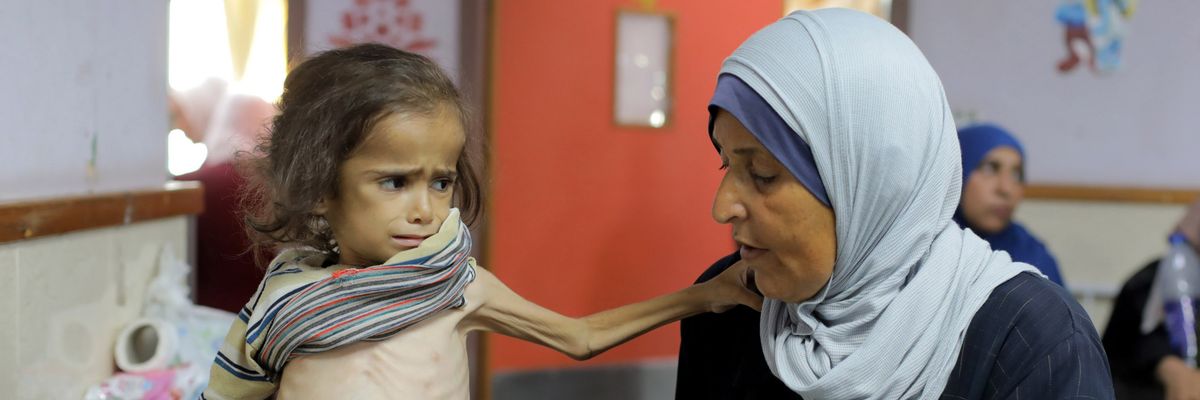
A Palestinian child suffering from malnutrition receives treatment with limited facilities at the Al-Aqsa Martyrs Hospital in Deir al-Balah, Gaza on June 1, 2024.
"Nothing changed," said journalist Bisan Owda. "The Israeli army is still committing the same massacres using starvation in the north and the south."
Humanitarian officials at the United Nations warned Wednesday evening that with Israel continuing to block aid deliveries across Gaza, thousands of children are among those facing acute malnutrition as extreme summer heat exacerbates suffering in the besieged enclave.
The Site Management Working Group for the U.N. Office for the Coordination of Humanitarian Affairs (OCHA) released its latest report on the humanitarian situation in Gaza, noting that aid deliveries in recent days have done little to improve the condition of a population that has been under attack by the U.S.-backed Israeli military—and facing an illegal blockade—for more than eight months.
OCHA said its workers have seen "visible signs of wasting among children"—the most dangerous form of malnutrition, which causes a child to be too thin for their height and results from rapid weight loss.
"No nutrition screenings have been conducted to assess the scale of malnutrition and treat identified cases due to limited capacity," reported OCHA.
Last week, the World Health Organization reported that more than 8,000 children have been diagnosed with and treated for acute malnutrition, including 1,600 with severe wasting.
Health officials have counted at least 32 deaths from malnutrition in Gaza, including 28 among children under the age of five. At least 37,431 Palestinians have been reported killed in the enclave since October, but with hospitals, emergency services, and communications systems largely inoperable due to relentless attacks by the Israel Defense Forces (IDF), the official death tolls from starvation and other causes are likely significant undercounts.
OCHA reported that at displacement sites like Deir el-Balah, Khan Younis, and Al Mawasi, where hundreds of thousands of internally displaced people are "living in overcrowded makeshift shelters and tents" with no protection from extreme heat, medical facilities are operating for only a few hours per day and have shortages of medicines.
"Unaffordable transportation and the lack of ambulance services hamper access to partially functioning hospitals, with reports of emergency deliveries taking place in tents with no medical support at late hours during the night," the agency reported.
At Al Jazeera on Thursday, correspondent Hani Mahmoud provided a dispatch from Deir el-Balah, where reporters entered Al-Aqsa Hospital—the only remaining hospital with any functionality in central Gaza:
We spoke to medical staff who described the outbreak of diseases as "alien." The diseases are spreading among displaced people due to their poor living conditions, contaminated water, lack of sanitation and hygiene, and the rising heat. The Israeli military destroyed the vast majority of Gaza's sanitation facilities. It's easy to walk along any of the roads here and see sewage. This is all aggravating the spread of diseases, particularly infectious diseases among women, children, and those who have health complications. Inside Al-Aqsa Hospital, there is unanimous agreement that it is not a hospital any more. It's not suitable for medical services, it's not suitable to save lives.
Pediatric surgeon Jamal Mari, who has been working at one of Deir el-Balah's destroyed hospitals, Al-Ahli, on a medical aid mission from Australia, told Al Jazeera he encountered a facility with "zero supplies," and was barred from bringing any of his own medical equipment to provide care.
"Whatever disposables we have, we keep reusing and reusing them, which is not safe at all," said Mari. "They've got five rooms which they say are operating theaters, but honestly they're just little cubicles re-fashioned and done as theaters... I don't understand how they're managing."
Deir el-Balah was the site of overnight Israeli air strikes on Thursday, as was the Nuseirat refuguee camp. At least three people were killed and more than a dozen were injured, while the IDF increased its attacks on the southern city of Rafah, where more than 900,000 people have already fled since Israel launched a full-scale attack in May.
The U.N. Relief and Works Agency for Palestine Refugees in the Near East (UNRWA) reported on Wednesday that since October 7, when the IDF began its bombardment of Gaza in retaliation for a Hamas-led attack on southern Israel, 67% of water sanitation facilities and infrastructure have been destroyed or damaged.
In addition to starvation, UNRWA said, "as infectious diseases continue to spread and temperatures rise, the lack of hygiene and dehydration pose a severe threat to the health of people across Gaza."
OCHA's report on Wednesday noted that "access constraints continue to severely undermine the delivery of essential humanitarian assistance and services across Gaza, including the delivery of food and nutrition assistance, medical care, protection and shelter support, and water, sanitation, and hygiene (WASH) services to hundreds of thousands of people."
Between June 1-18, Israeli authorities facilitated 46% of humanitarian assistance missions to northern Gaza. But more than half were either impeded, denied access, or canceled.
Planned transfers of hygiene kits, water deliveries, and waste removals were among the missions that were denied access, and dozens of humanitarian missions were also canceled and impeded in southern Gaza over the same time period.
Carl Skau, deputy executive director of the World Food Program, described the sabotage of the agency's aid efforts.
"Staff spend five to eight hours waiting at checkpoints every day," he said. "Missiles hit our premises, despite being deconflicted."
On social media, Palestinian journalist Bisan Owda posted a video on Wednesday saying that although some aid deliveries have been granted access by Israeli authorities in recent days, Palestinians are still "starving to death."
"Nothing changed," said Owda. "The Israeli army is still committing the same massacres using starvation in the north and the south, because simply, the air drops are not enough... They are trying to kill the people of Gaza by starvation."
Dear Common Dreams reader, It’s been nearly 30 years since I co-founded Common Dreams with my late wife, Lina Newhouser. We had the radical notion that journalism should serve the public good, not corporate profits. It was clear to us from the outset what it would take to build such a project. No paid advertisements. No corporate sponsors. No millionaire publisher telling us what to think or do. Many people said we wouldn't last a year, but we proved those doubters wrong. Together with a tremendous team of journalists and dedicated staff, we built an independent media outlet free from the constraints of profits and corporate control. Our mission has always been simple: To inform. To inspire. To ignite change for the common good. Building Common Dreams was not easy. Our survival was never guaranteed. When you take on the most powerful forces—Wall Street greed, fossil fuel industry destruction, Big Tech lobbyists, and uber-rich oligarchs who have spent billions upon billions rigging the economy and democracy in their favor—the only bulwark you have is supporters who believe in your work. But here’s the urgent message from me today. It's never been this bad out there. And it's never been this hard to keep us going. At the very moment Common Dreams is most needed, the threats we face are intensifying. We need your support now more than ever. We don't accept corporate advertising and never will. We don't have a paywall because we don't think people should be blocked from critical news based on their ability to pay. Everything we do is funded by the donations of readers like you. When everyone does the little they can afford, we are strong. But if that support retreats or dries up, so do we. Will you donate now to make sure Common Dreams not only survives but thrives? —Craig Brown, Co-founder |
Humanitarian officials at the United Nations warned Wednesday evening that with Israel continuing to block aid deliveries across Gaza, thousands of children are among those facing acute malnutrition as extreme summer heat exacerbates suffering in the besieged enclave.
The Site Management Working Group for the U.N. Office for the Coordination of Humanitarian Affairs (OCHA) released its latest report on the humanitarian situation in Gaza, noting that aid deliveries in recent days have done little to improve the condition of a population that has been under attack by the U.S.-backed Israeli military—and facing an illegal blockade—for more than eight months.
OCHA said its workers have seen "visible signs of wasting among children"—the most dangerous form of malnutrition, which causes a child to be too thin for their height and results from rapid weight loss.
"No nutrition screenings have been conducted to assess the scale of malnutrition and treat identified cases due to limited capacity," reported OCHA.
Last week, the World Health Organization reported that more than 8,000 children have been diagnosed with and treated for acute malnutrition, including 1,600 with severe wasting.
Health officials have counted at least 32 deaths from malnutrition in Gaza, including 28 among children under the age of five. At least 37,431 Palestinians have been reported killed in the enclave since October, but with hospitals, emergency services, and communications systems largely inoperable due to relentless attacks by the Israel Defense Forces (IDF), the official death tolls from starvation and other causes are likely significant undercounts.
OCHA reported that at displacement sites like Deir el-Balah, Khan Younis, and Al Mawasi, where hundreds of thousands of internally displaced people are "living in overcrowded makeshift shelters and tents" with no protection from extreme heat, medical facilities are operating for only a few hours per day and have shortages of medicines.
"Unaffordable transportation and the lack of ambulance services hamper access to partially functioning hospitals, with reports of emergency deliveries taking place in tents with no medical support at late hours during the night," the agency reported.
At Al Jazeera on Thursday, correspondent Hani Mahmoud provided a dispatch from Deir el-Balah, where reporters entered Al-Aqsa Hospital—the only remaining hospital with any functionality in central Gaza:
We spoke to medical staff who described the outbreak of diseases as "alien." The diseases are spreading among displaced people due to their poor living conditions, contaminated water, lack of sanitation and hygiene, and the rising heat. The Israeli military destroyed the vast majority of Gaza's sanitation facilities. It's easy to walk along any of the roads here and see sewage. This is all aggravating the spread of diseases, particularly infectious diseases among women, children, and those who have health complications. Inside Al-Aqsa Hospital, there is unanimous agreement that it is not a hospital any more. It's not suitable for medical services, it's not suitable to save lives.
Pediatric surgeon Jamal Mari, who has been working at one of Deir el-Balah's destroyed hospitals, Al-Ahli, on a medical aid mission from Australia, told Al Jazeera he encountered a facility with "zero supplies," and was barred from bringing any of his own medical equipment to provide care.
"Whatever disposables we have, we keep reusing and reusing them, which is not safe at all," said Mari. "They've got five rooms which they say are operating theaters, but honestly they're just little cubicles re-fashioned and done as theaters... I don't understand how they're managing."
Deir el-Balah was the site of overnight Israeli air strikes on Thursday, as was the Nuseirat refuguee camp. At least three people were killed and more than a dozen were injured, while the IDF increased its attacks on the southern city of Rafah, where more than 900,000 people have already fled since Israel launched a full-scale attack in May.
The U.N. Relief and Works Agency for Palestine Refugees in the Near East (UNRWA) reported on Wednesday that since October 7, when the IDF began its bombardment of Gaza in retaliation for a Hamas-led attack on southern Israel, 67% of water sanitation facilities and infrastructure have been destroyed or damaged.
In addition to starvation, UNRWA said, "as infectious diseases continue to spread and temperatures rise, the lack of hygiene and dehydration pose a severe threat to the health of people across Gaza."
OCHA's report on Wednesday noted that "access constraints continue to severely undermine the delivery of essential humanitarian assistance and services across Gaza, including the delivery of food and nutrition assistance, medical care, protection and shelter support, and water, sanitation, and hygiene (WASH) services to hundreds of thousands of people."
Between June 1-18, Israeli authorities facilitated 46% of humanitarian assistance missions to northern Gaza. But more than half were either impeded, denied access, or canceled.
Planned transfers of hygiene kits, water deliveries, and waste removals were among the missions that were denied access, and dozens of humanitarian missions were also canceled and impeded in southern Gaza over the same time period.
Carl Skau, deputy executive director of the World Food Program, described the sabotage of the agency's aid efforts.
"Staff spend five to eight hours waiting at checkpoints every day," he said. "Missiles hit our premises, despite being deconflicted."
On social media, Palestinian journalist Bisan Owda posted a video on Wednesday saying that although some aid deliveries have been granted access by Israeli authorities in recent days, Palestinians are still "starving to death."
"Nothing changed," said Owda. "The Israeli army is still committing the same massacres using starvation in the north and the south, because simply, the air drops are not enough... They are trying to kill the people of Gaza by starvation."
Humanitarian officials at the United Nations warned Wednesday evening that with Israel continuing to block aid deliveries across Gaza, thousands of children are among those facing acute malnutrition as extreme summer heat exacerbates suffering in the besieged enclave.
The Site Management Working Group for the U.N. Office for the Coordination of Humanitarian Affairs (OCHA) released its latest report on the humanitarian situation in Gaza, noting that aid deliveries in recent days have done little to improve the condition of a population that has been under attack by the U.S.-backed Israeli military—and facing an illegal blockade—for more than eight months.
OCHA said its workers have seen "visible signs of wasting among children"—the most dangerous form of malnutrition, which causes a child to be too thin for their height and results from rapid weight loss.
"No nutrition screenings have been conducted to assess the scale of malnutrition and treat identified cases due to limited capacity," reported OCHA.
Last week, the World Health Organization reported that more than 8,000 children have been diagnosed with and treated for acute malnutrition, including 1,600 with severe wasting.
Health officials have counted at least 32 deaths from malnutrition in Gaza, including 28 among children under the age of five. At least 37,431 Palestinians have been reported killed in the enclave since October, but with hospitals, emergency services, and communications systems largely inoperable due to relentless attacks by the Israel Defense Forces (IDF), the official death tolls from starvation and other causes are likely significant undercounts.
OCHA reported that at displacement sites like Deir el-Balah, Khan Younis, and Al Mawasi, where hundreds of thousands of internally displaced people are "living in overcrowded makeshift shelters and tents" with no protection from extreme heat, medical facilities are operating for only a few hours per day and have shortages of medicines.
"Unaffordable transportation and the lack of ambulance services hamper access to partially functioning hospitals, with reports of emergency deliveries taking place in tents with no medical support at late hours during the night," the agency reported.
At Al Jazeera on Thursday, correspondent Hani Mahmoud provided a dispatch from Deir el-Balah, where reporters entered Al-Aqsa Hospital—the only remaining hospital with any functionality in central Gaza:
We spoke to medical staff who described the outbreak of diseases as "alien." The diseases are spreading among displaced people due to their poor living conditions, contaminated water, lack of sanitation and hygiene, and the rising heat. The Israeli military destroyed the vast majority of Gaza's sanitation facilities. It's easy to walk along any of the roads here and see sewage. This is all aggravating the spread of diseases, particularly infectious diseases among women, children, and those who have health complications. Inside Al-Aqsa Hospital, there is unanimous agreement that it is not a hospital any more. It's not suitable for medical services, it's not suitable to save lives.
Pediatric surgeon Jamal Mari, who has been working at one of Deir el-Balah's destroyed hospitals, Al-Ahli, on a medical aid mission from Australia, told Al Jazeera he encountered a facility with "zero supplies," and was barred from bringing any of his own medical equipment to provide care.
"Whatever disposables we have, we keep reusing and reusing them, which is not safe at all," said Mari. "They've got five rooms which they say are operating theaters, but honestly they're just little cubicles re-fashioned and done as theaters... I don't understand how they're managing."
Deir el-Balah was the site of overnight Israeli air strikes on Thursday, as was the Nuseirat refuguee camp. At least three people were killed and more than a dozen were injured, while the IDF increased its attacks on the southern city of Rafah, where more than 900,000 people have already fled since Israel launched a full-scale attack in May.
The U.N. Relief and Works Agency for Palestine Refugees in the Near East (UNRWA) reported on Wednesday that since October 7, when the IDF began its bombardment of Gaza in retaliation for a Hamas-led attack on southern Israel, 67% of water sanitation facilities and infrastructure have been destroyed or damaged.
In addition to starvation, UNRWA said, "as infectious diseases continue to spread and temperatures rise, the lack of hygiene and dehydration pose a severe threat to the health of people across Gaza."
OCHA's report on Wednesday noted that "access constraints continue to severely undermine the delivery of essential humanitarian assistance and services across Gaza, including the delivery of food and nutrition assistance, medical care, protection and shelter support, and water, sanitation, and hygiene (WASH) services to hundreds of thousands of people."
Between June 1-18, Israeli authorities facilitated 46% of humanitarian assistance missions to northern Gaza. But more than half were either impeded, denied access, or canceled.
Planned transfers of hygiene kits, water deliveries, and waste removals were among the missions that were denied access, and dozens of humanitarian missions were also canceled and impeded in southern Gaza over the same time period.
Carl Skau, deputy executive director of the World Food Program, described the sabotage of the agency's aid efforts.
"Staff spend five to eight hours waiting at checkpoints every day," he said. "Missiles hit our premises, despite being deconflicted."
On social media, Palestinian journalist Bisan Owda posted a video on Wednesday saying that although some aid deliveries have been granted access by Israeli authorities in recent days, Palestinians are still "starving to death."
"Nothing changed," said Owda. "The Israeli army is still committing the same massacres using starvation in the north and the south, because simply, the air drops are not enough... They are trying to kill the people of Gaza by starvation."