

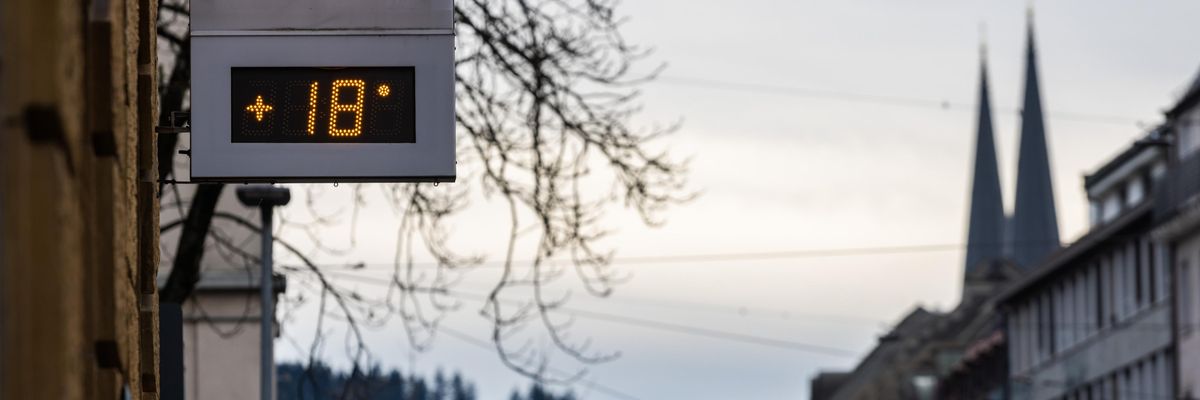
A thermometer at a pharmacy in Freiburg, Baden-Württemberg Germany shows an air temperature of 18°C (64°F) on December 31, 2022.
'Absolute Madness': Record-Shattering Heat Dome Hits Europe
It's "the most extreme event ever seen in European climatology," said one climatologist. "Nothing stands close to this."
As Europe closed the books on its warmest year ever recorded, an exceptionally potent winter heat dome descended on much of the continent over the holiday weekend, with thousands of daily and monthly high-temperature records shattered from Spain to Russia.
"The intensity and extent of warmth in Europe right now is hard to comprehend," meteorologist Scott Duncan told The Times of London. "There are too many records to count. Literally thousands. Overnight minimum temperatures are like summer."
The Times reported:
Bilbao in northern Spain reached 24.9°C, the hottest temperature recorded for the city in January and more akin to a summer's day than the start of the year. Records were broken throughout Germany, including Dresden in the east where it was 13.5°C. Temperatures in Switzerland were at 20°C. The Czech Republic recorded a January national record of 19.6°C at the town of Javornik.
The Washington Post noted that at least seven countries—Belarus, the Czech Republic, Denmark, Latvia, Lithuania, the Netherlands, and Poland—recorded their warmest January temperatures ever.
Poland's Institute of Meteorology and Water Management (IMGW) said Sunday that "the average daily temperature for Słubice was 15.3°C for the last day, and 15°C in Warsaw and Wrocław."
"This means that we have a one-day thermal summer in the middle of winter," IMGW added. "The thermal anomaly is over 15°C. This is an unprecedented situation in our climate."
Climatologist Maximiliano Herrera, who specializes in extreme weather, called the temperatures "totally insane" and "absolute madness."
It's "the most extreme event ever seen in European climatology,” Herrera told the Post. "Nothing stands close to this."
As the Post noted:
This exceptional wintertime warmth comes on the heels of the warmest 2022 in many parts of Europe, including in the U.K., Germany, and Switzerland. Extreme heat visited Europe in waves throughout the year and was intensified by a historically severe summer drought. The combination helped push the United Kingdom to 104°F (40°C) for the first time on record in July.
Climatologists said that while weather conditions caused the heat dome currently over Europe, there is a proven link between the continued burning of fossil fuels and rising global temperatures.
"The record-breaking across Europe over the new year was made more likely to happen by human-caused climate change," Imperial College of London climate scientist Friederike Otto told The Times, "just as climate change is now making every heatwave more likely and hotter."
We are at a crossroads
This country and this world are at a monumental crossroads. In a few short weeks, US voters will have an opportunity to beat back the forces of fascism and confront the billionaires who are rigging the economy, our media system, and our democracy, making it increasingly impossible for ordinary people to get by. We’re not just talking about the election. We’re talking about what must be done once these fascist elements are vanquished from power. We need a bolder set of solutions than what either major party has so far been willing to offer and a working-class movement ready to fight like hell for it. Trump didn't emerge from nowhere. The conditions that fueled MAGA authoritarianism were created by decades of radical neoliberal economic policies and a corrupt political system dominated by corporate interests. They slashed taxes on the super-rich, promising that the benefits would trickle down. They said giveaways to the corporate titans would make life more affordable for the rest of us. It was all bullshit. And when a bitter, betrayed populace searches for someone to blame, right-wing demagogues have little trouble finding scapegoats. People know when they're being lied to, but you won't hear any of this from the corporate media. Only independent journalism—powered and funded by people who believe in building a better world—can deliver truly trustworthy daily news. Our Fall Campaign is underway, and we need your help. To power our newsroom through the rest of the year, we need to raise $125,000 by midnight on October 31. So if you share our vision, please contribute whatever you can to sustain our work. |
As Europe closed the books on its warmest year ever recorded, an exceptionally potent winter heat dome descended on much of the continent over the holiday weekend, with thousands of daily and monthly high-temperature records shattered from Spain to Russia.
"The intensity and extent of warmth in Europe right now is hard to comprehend," meteorologist Scott Duncan told The Times of London. "There are too many records to count. Literally thousands. Overnight minimum temperatures are like summer."
The Times reported:
Bilbao in northern Spain reached 24.9°C, the hottest temperature recorded for the city in January and more akin to a summer's day than the start of the year. Records were broken throughout Germany, including Dresden in the east where it was 13.5°C. Temperatures in Switzerland were at 20°C. The Czech Republic recorded a January national record of 19.6°C at the town of Javornik.
The Washington Post noted that at least seven countries—Belarus, the Czech Republic, Denmark, Latvia, Lithuania, the Netherlands, and Poland—recorded their warmest January temperatures ever.
Poland's Institute of Meteorology and Water Management (IMGW) said Sunday that "the average daily temperature for Słubice was 15.3°C for the last day, and 15°C in Warsaw and Wrocław."
"This means that we have a one-day thermal summer in the middle of winter," IMGW added. "The thermal anomaly is over 15°C. This is an unprecedented situation in our climate."
Climatologist Maximiliano Herrera, who specializes in extreme weather, called the temperatures "totally insane" and "absolute madness."
It's "the most extreme event ever seen in European climatology,” Herrera told the Post. "Nothing stands close to this."
As the Post noted:
This exceptional wintertime warmth comes on the heels of the warmest 2022 in many parts of Europe, including in the U.K., Germany, and Switzerland. Extreme heat visited Europe in waves throughout the year and was intensified by a historically severe summer drought. The combination helped push the United Kingdom to 104°F (40°C) for the first time on record in July.
Climatologists said that while weather conditions caused the heat dome currently over Europe, there is a proven link between the continued burning of fossil fuels and rising global temperatures.
"The record-breaking across Europe over the new year was made more likely to happen by human-caused climate change," Imperial College of London climate scientist Friederike Otto told The Times, "just as climate change is now making every heatwave more likely and hotter."
- 2022 Will Be Remembered for Its Brutal Climate Change Impacts ›
- UK Saw Hottest Year on Record in 2022 as Climate Chaos Grows in Europe ›
- Oxford Study Warns Extreme Heat and Drought to Hit 90% of World Population ›
- In EU Climate Proposal, 'A Dark Hole Where an End to Fossil Fuels Should Be' ›
As Europe closed the books on its warmest year ever recorded, an exceptionally potent winter heat dome descended on much of the continent over the holiday weekend, with thousands of daily and monthly high-temperature records shattered from Spain to Russia.
"The intensity and extent of warmth in Europe right now is hard to comprehend," meteorologist Scott Duncan told The Times of London. "There are too many records to count. Literally thousands. Overnight minimum temperatures are like summer."
The Times reported:
Bilbao in northern Spain reached 24.9°C, the hottest temperature recorded for the city in January and more akin to a summer's day than the start of the year. Records were broken throughout Germany, including Dresden in the east where it was 13.5°C. Temperatures in Switzerland were at 20°C. The Czech Republic recorded a January national record of 19.6°C at the town of Javornik.
The Washington Post noted that at least seven countries—Belarus, the Czech Republic, Denmark, Latvia, Lithuania, the Netherlands, and Poland—recorded their warmest January temperatures ever.
Poland's Institute of Meteorology and Water Management (IMGW) said Sunday that "the average daily temperature for Słubice was 15.3°C for the last day, and 15°C in Warsaw and Wrocław."
"This means that we have a one-day thermal summer in the middle of winter," IMGW added. "The thermal anomaly is over 15°C. This is an unprecedented situation in our climate."
Climatologist Maximiliano Herrera, who specializes in extreme weather, called the temperatures "totally insane" and "absolute madness."
It's "the most extreme event ever seen in European climatology,” Herrera told the Post. "Nothing stands close to this."
As the Post noted:
This exceptional wintertime warmth comes on the heels of the warmest 2022 in many parts of Europe, including in the U.K., Germany, and Switzerland. Extreme heat visited Europe in waves throughout the year and was intensified by a historically severe summer drought. The combination helped push the United Kingdom to 104°F (40°C) for the first time on record in July.
Climatologists said that while weather conditions caused the heat dome currently over Europe, there is a proven link between the continued burning of fossil fuels and rising global temperatures.
"The record-breaking across Europe over the new year was made more likely to happen by human-caused climate change," Imperial College of London climate scientist Friederike Otto told The Times, "just as climate change is now making every heatwave more likely and hotter."
- 2022 Will Be Remembered for Its Brutal Climate Change Impacts ›
- UK Saw Hottest Year on Record in 2022 as Climate Chaos Grows in Europe ›
- Oxford Study Warns Extreme Heat and Drought to Hit 90% of World Population ›
- In EU Climate Proposal, 'A Dark Hole Where an End to Fossil Fuels Should Be' ›