SUBSCRIBE TO OUR FREE NEWSLETTER
Daily news & progressive opinion—funded by the people, not the corporations—delivered straight to your inbox.
5
#000000
#FFFFFF
To donate by check, phone, or other method, see our More Ways to Give page.
Daily news & progressive opinion—funded by the people, not the corporations—delivered straight to your inbox.
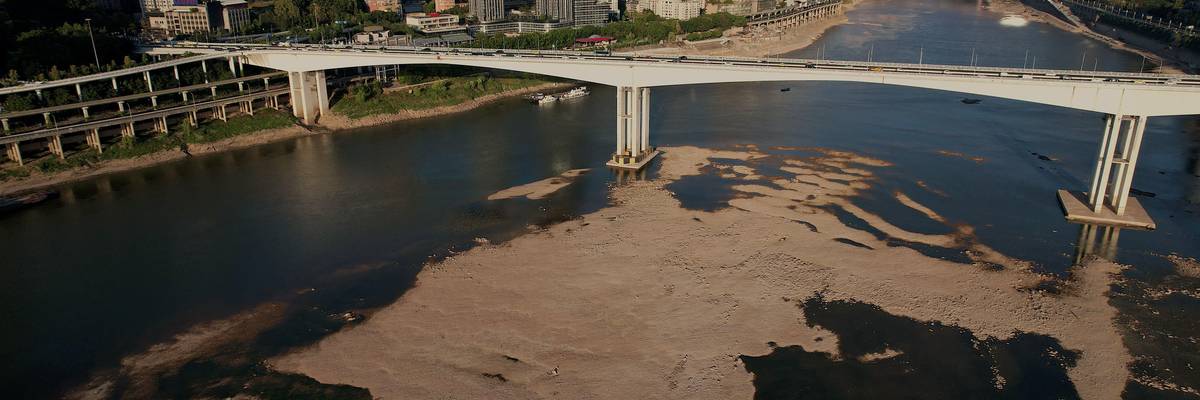
An aerial picture taken on August 24, 2022 shows the riverbed of the Jialing River, a tributary of the Yangtze River, in China's southwestern city of Chongqing.
The frequency of compound drought-heatwave events is "projected to increase by tenfold globally under the highest emissions scenario."
As interlinked extreme heat and drought events grow in intensity and frequency amid the ruling class' ongoing failure to adequately slash planet-heating fossil fuel pollution, over 90% of the global population is projected to suffer the consequences in the coming decades, according to peer-reviewed research published Thursday in Nature Sustainability.
Compound drought-heatwave (CDHW) events are "one of the worst climatic stressors for global sustainable development," states the paper, but their "physical mechanisms" and "impacts on socio-ecosystem productivity remain poorly understood."
"Using simulations from a large climate-hydrology model," nine scholars—working at universities in China, the United States, the United Kingdom, and Japan—found that "the frequency of extreme CDHWs is projected to increase by tenfold globally under the highest emissions scenario, along with a disproportionate negative impact on vegetation and socio-economic productivity by the late 21st century."
According to the study: "Terrestrial water storage and temperature are negatively coupled, probably driven by similar atmospheric conditions (for example, water vapor deficit and energy demand). Limits on water availability are likely to play a more important role in constraining the terrestrial carbon sink than temperature extremes."
Put plainly, drought and extreme heat are intertwined. Increasingly arid and hot conditions are undermining the capacity of land-based ecosystems to absorb carbon dioxide, with a lack of water considered even more consequential than higher temperatures.
Not only are CDHWs hurting the ability of biodiverse regions to absorb a key greenhouse gas but these increasingly intense and frequent events also threaten to exacerbate socioeconomic inequalities.
The study estimates that even under the lowest emission scenario, "over 90% of the global population and gross domestic product could be exposed to increasing CDHW risks in the future, with more severe impacts in poorer and more rural areas."
Lead author Jiabo Yin, an associate professor of hydrology at Wuhan University and visiting researcher at Oxford University, explained in a statement that quantifying "the response of ecosystem productivity to heat and water stressors at the global scale" shows that the joint threats of dangerously hot temperatures and drought pose substantially greater risks to society and the environment when assessed together rather than independently.
The effects of rising temperatures and declining terrestrial water storage combine to weaken the capacity of "carbon sinks" to absorb heat-trapping emissions and release oxygen, Yin noted.
Co-author Lousie Slater, associate professor of physical geography at the University of Oxford, said that "understanding compounding hazards in a warming Earth is essential for the implementation of the U.N. Sustainable Development Goals (SDGs), in particular SDG13 that aims to combat climate change and its impacts."
"By combining atmospheric dynamics and hydrology, we explore the role of water and energy budgets in causing these extremes," said Slater.
The new research, which is aimed at "assessing and mitigating adverse effects of compound hazards on ecosystems and human well-being," comes in the wake of record-breaking extreme heat and historic droughts around the world in 2022.
The life-threatening impacts of the global climate emergency have only continued to reverberate in 2023, underscoring the need to expedite the clean energy transition, among other necessary transformations.
Dear Common Dreams reader, It’s been nearly 30 years since I co-founded Common Dreams with my late wife, Lina Newhouser. We had the radical notion that journalism should serve the public good, not corporate profits. It was clear to us from the outset what it would take to build such a project. No paid advertisements. No corporate sponsors. No millionaire publisher telling us what to think or do. Many people said we wouldn't last a year, but we proved those doubters wrong. Together with a tremendous team of journalists and dedicated staff, we built an independent media outlet free from the constraints of profits and corporate control. Our mission has always been simple: To inform. To inspire. To ignite change for the common good. Building Common Dreams was not easy. Our survival was never guaranteed. When you take on the most powerful forces—Wall Street greed, fossil fuel industry destruction, Big Tech lobbyists, and uber-rich oligarchs who have spent billions upon billions rigging the economy and democracy in their favor—the only bulwark you have is supporters who believe in your work. But here’s the urgent message from me today. It's never been this bad out there. And it's never been this hard to keep us going. At the very moment Common Dreams is most needed, the threats we face are intensifying. We need your support now more than ever. We don't accept corporate advertising and never will. We don't have a paywall because we don't think people should be blocked from critical news based on their ability to pay. Everything we do is funded by the donations of readers like you. When everyone does the little they can afford, we are strong. But if that support retreats or dries up, so do we. Will you donate now to make sure Common Dreams not only survives but thrives? —Craig Brown, Co-founder |
As interlinked extreme heat and drought events grow in intensity and frequency amid the ruling class' ongoing failure to adequately slash planet-heating fossil fuel pollution, over 90% of the global population is projected to suffer the consequences in the coming decades, according to peer-reviewed research published Thursday in Nature Sustainability.
Compound drought-heatwave (CDHW) events are "one of the worst climatic stressors for global sustainable development," states the paper, but their "physical mechanisms" and "impacts on socio-ecosystem productivity remain poorly understood."
"Using simulations from a large climate-hydrology model," nine scholars—working at universities in China, the United States, the United Kingdom, and Japan—found that "the frequency of extreme CDHWs is projected to increase by tenfold globally under the highest emissions scenario, along with a disproportionate negative impact on vegetation and socio-economic productivity by the late 21st century."
According to the study: "Terrestrial water storage and temperature are negatively coupled, probably driven by similar atmospheric conditions (for example, water vapor deficit and energy demand). Limits on water availability are likely to play a more important role in constraining the terrestrial carbon sink than temperature extremes."
Put plainly, drought and extreme heat are intertwined. Increasingly arid and hot conditions are undermining the capacity of land-based ecosystems to absorb carbon dioxide, with a lack of water considered even more consequential than higher temperatures.
Not only are CDHWs hurting the ability of biodiverse regions to absorb a key greenhouse gas but these increasingly intense and frequent events also threaten to exacerbate socioeconomic inequalities.
The study estimates that even under the lowest emission scenario, "over 90% of the global population and gross domestic product could be exposed to increasing CDHW risks in the future, with more severe impacts in poorer and more rural areas."
Lead author Jiabo Yin, an associate professor of hydrology at Wuhan University and visiting researcher at Oxford University, explained in a statement that quantifying "the response of ecosystem productivity to heat and water stressors at the global scale" shows that the joint threats of dangerously hot temperatures and drought pose substantially greater risks to society and the environment when assessed together rather than independently.
The effects of rising temperatures and declining terrestrial water storage combine to weaken the capacity of "carbon sinks" to absorb heat-trapping emissions and release oxygen, Yin noted.
Co-author Lousie Slater, associate professor of physical geography at the University of Oxford, said that "understanding compounding hazards in a warming Earth is essential for the implementation of the U.N. Sustainable Development Goals (SDGs), in particular SDG13 that aims to combat climate change and its impacts."
"By combining atmospheric dynamics and hydrology, we explore the role of water and energy budgets in causing these extremes," said Slater.
The new research, which is aimed at "assessing and mitigating adverse effects of compound hazards on ecosystems and human well-being," comes in the wake of record-breaking extreme heat and historic droughts around the world in 2022.
The life-threatening impacts of the global climate emergency have only continued to reverberate in 2023, underscoring the need to expedite the clean energy transition, among other necessary transformations.
As interlinked extreme heat and drought events grow in intensity and frequency amid the ruling class' ongoing failure to adequately slash planet-heating fossil fuel pollution, over 90% of the global population is projected to suffer the consequences in the coming decades, according to peer-reviewed research published Thursday in Nature Sustainability.
Compound drought-heatwave (CDHW) events are "one of the worst climatic stressors for global sustainable development," states the paper, but their "physical mechanisms" and "impacts on socio-ecosystem productivity remain poorly understood."
"Using simulations from a large climate-hydrology model," nine scholars—working at universities in China, the United States, the United Kingdom, and Japan—found that "the frequency of extreme CDHWs is projected to increase by tenfold globally under the highest emissions scenario, along with a disproportionate negative impact on vegetation and socio-economic productivity by the late 21st century."
According to the study: "Terrestrial water storage and temperature are negatively coupled, probably driven by similar atmospheric conditions (for example, water vapor deficit and energy demand). Limits on water availability are likely to play a more important role in constraining the terrestrial carbon sink than temperature extremes."
Put plainly, drought and extreme heat are intertwined. Increasingly arid and hot conditions are undermining the capacity of land-based ecosystems to absorb carbon dioxide, with a lack of water considered even more consequential than higher temperatures.
Not only are CDHWs hurting the ability of biodiverse regions to absorb a key greenhouse gas but these increasingly intense and frequent events also threaten to exacerbate socioeconomic inequalities.
The study estimates that even under the lowest emission scenario, "over 90% of the global population and gross domestic product could be exposed to increasing CDHW risks in the future, with more severe impacts in poorer and more rural areas."
Lead author Jiabo Yin, an associate professor of hydrology at Wuhan University and visiting researcher at Oxford University, explained in a statement that quantifying "the response of ecosystem productivity to heat and water stressors at the global scale" shows that the joint threats of dangerously hot temperatures and drought pose substantially greater risks to society and the environment when assessed together rather than independently.
The effects of rising temperatures and declining terrestrial water storage combine to weaken the capacity of "carbon sinks" to absorb heat-trapping emissions and release oxygen, Yin noted.
Co-author Lousie Slater, associate professor of physical geography at the University of Oxford, said that "understanding compounding hazards in a warming Earth is essential for the implementation of the U.N. Sustainable Development Goals (SDGs), in particular SDG13 that aims to combat climate change and its impacts."
"By combining atmospheric dynamics and hydrology, we explore the role of water and energy budgets in causing these extremes," said Slater.
The new research, which is aimed at "assessing and mitigating adverse effects of compound hazards on ecosystems and human well-being," comes in the wake of record-breaking extreme heat and historic droughts around the world in 2022.
The life-threatening impacts of the global climate emergency have only continued to reverberate in 2023, underscoring the need to expedite the clean energy transition, among other necessary transformations.