SUBSCRIBE TO OUR FREE NEWSLETTER
Daily news & progressive opinion—funded by the people, not the corporations—delivered straight to your inbox.
5
#000000
#FFFFFF
To donate by check, phone, or other method, see our More Ways to Give page.
Daily news & progressive opinion—funded by the people, not the corporations—delivered straight to your inbox.
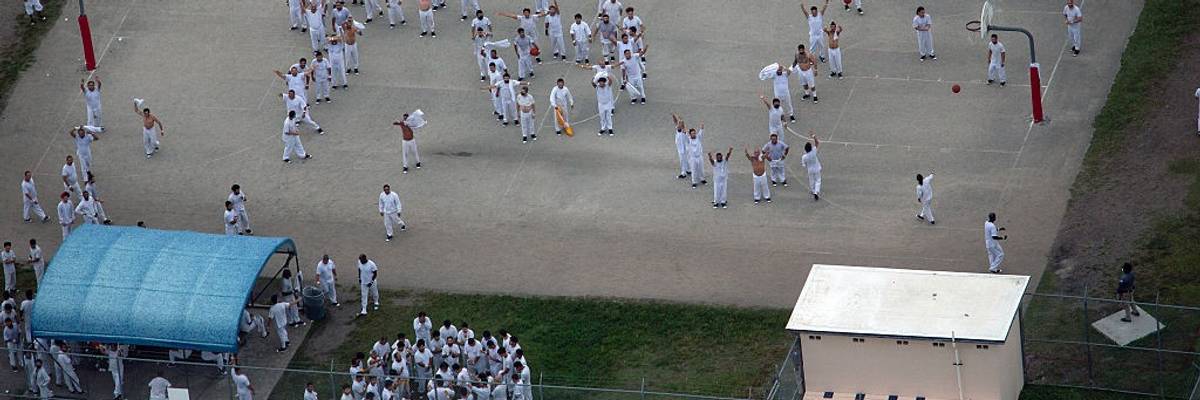
In an aerial view from a helicopter, detainees are seen at Krome Detention Center run by United States Immigration and Customs Enforcement on July 4, 2025 in Miami.
Last year was the deadliest in ICE detention in about two decades, with more than 30 deaths reported in custody. So far this year, at least 18 more detainees had reportedly died in ICE custody.
The US Department of Homeland Security is officially closing its watchdog for immigrant detention abuse, even as reports of excessive force, deadly neglect, and other maltreatment by agency personnel soar under the Trump administration.
Citing an internal email, Huffpost's Dave Jamieson reported Monday that DHS is shutting down its Office of the Immigration Detention Ombudsman (OIDO), which was established by an act of Congress and signed into law by President Donald Trump in 2020 as part the massive federal spending package known as the Consolidated Appropriations Act.
Jamieson added that the communication said that OIDO "is in the process of removing all its public signage and ending its inspection," and that the agency's website was down.
The email attributed OIDO's closure to a lack of federal funding in the Homeland Security appropriations package that ended the recent 76-day shutdown affecting the agency.
Largely pushed through by congressional Democrats, OIDO was designed to be independent from both US Immigration and Customs Enforcement (ICE) and US Customs and Border Protection. The office was given the power to receive detainee complaints, investigate alleged abuse or misconduct, inspect detention facilities, and report systemic problems to DHS leaders and Congress.
OIDO emerged amid widespread abuse of detained migrants during the first Trump administration, including deaths in custody, family separation, overcrowding, and other mistreatment.
Since returning to office for a second term, Trump has overseen the dismantling of the agency, arguing that it hinders immigration enforcement. The administration's effort to dilute OIDO's power have triggered legal action arguing that, since it was created by Congress, the agency cannot be abolished without congressional consent.
DHS detainees—especially those ICE lockups—report abuses including inadequate or delayed medical care; physical attacks and excessive force; sexual abuse and harassment; solitary confinement misuse; overcrowded and unsanitary conditions; intimidation and retaliation following complaints; abuse of pregnant women and children; denial of access to lawyers; denial of family contact; and denial of food, water, hygiene, or medication.
Last year was the deadliest in ICE detention in about two decades, with more than 30 deaths reported in custody. So far this year, at least 18 more detainees had reportedly died in ICE custody.
18 people have died in ICE detention this year—and the administration is illegally "closing" OIDO, the office that is supposed to monitor detention conditions and help detained people needing medical care or suffering abuse.Its portal, myoido.dhs.gov, is offline.
[image or embed]
— Adam Isacson (@adamisacson.com) May 4, 2026 at 3:19 PM
OIDO isn't the only DHS watchdog under attack by the Trump administration. The Office of Civil Rights and Civil Liberties (CRCL) and Office of Citizenship and Immigration Services Ombudsman have also been targeted.
One former CRCL employee who was placed on administrative leave due to funding cuts said in a recent court filing that the agency is unable to conduct “meaningful investigations” into alleged civil rights and civil liberties violations committed by its personnel. As an example, they noted the accusations of excessive force by the ICE agent who fatally shot Minneapolis resident Renee Good last year.
“In my experience, investigations into systemic issues like these required significant staff resources, which CRCL no longer has to devote to these important issues of civil rights and civil liberties,” the official told Federal News Network earlier this year. “Nor does CRCL have the resources to conduct multidisciplinary onsite investigations at detention facilities, the need for which is greater than it has ever been as both the number of detention facilities and number of people detained has skyrocketed."
Dear Common Dreams reader, It’s been nearly 30 years since I co-founded Common Dreams with my late wife, Lina Newhouser. We had the radical notion that journalism should serve the public good, not corporate profits. It was clear to us from the outset what it would take to build such a project. No paid advertisements. No corporate sponsors. No millionaire publisher telling us what to think or do. Many people said we wouldn't last a year, but we proved those doubters wrong. Together with a tremendous team of journalists and dedicated staff, we built an independent media outlet free from the constraints of profits and corporate control. Our mission has always been simple: To inform. To inspire. To ignite change for the common good. Building Common Dreams was not easy. Our survival was never guaranteed. When you take on the most powerful forces—Wall Street greed, fossil fuel industry destruction, Big Tech lobbyists, and uber-rich oligarchs who have spent billions upon billions rigging the economy and democracy in their favor—the only bulwark you have is supporters who believe in your work. But here’s the urgent message from me today. It's never been this bad out there. And it's never been this hard to keep us going. At the very moment Common Dreams is most needed, the threats we face are intensifying. We need your support now more than ever. We don't accept corporate advertising and never will. We don't have a paywall because we don't think people should be blocked from critical news based on their ability to pay. Everything we do is funded by the donations of readers like you. When everyone does the little they can afford, we are strong. But if that support retreats or dries up, so do we. Will you donate now to make sure Common Dreams not only survives but thrives? —Craig Brown, Co-founder |
The US Department of Homeland Security is officially closing its watchdog for immigrant detention abuse, even as reports of excessive force, deadly neglect, and other maltreatment by agency personnel soar under the Trump administration.
Citing an internal email, Huffpost's Dave Jamieson reported Monday that DHS is shutting down its Office of the Immigration Detention Ombudsman (OIDO), which was established by an act of Congress and signed into law by President Donald Trump in 2020 as part the massive federal spending package known as the Consolidated Appropriations Act.
Jamieson added that the communication said that OIDO "is in the process of removing all its public signage and ending its inspection," and that the agency's website was down.
The email attributed OIDO's closure to a lack of federal funding in the Homeland Security appropriations package that ended the recent 76-day shutdown affecting the agency.
Largely pushed through by congressional Democrats, OIDO was designed to be independent from both US Immigration and Customs Enforcement (ICE) and US Customs and Border Protection. The office was given the power to receive detainee complaints, investigate alleged abuse or misconduct, inspect detention facilities, and report systemic problems to DHS leaders and Congress.
OIDO emerged amid widespread abuse of detained migrants during the first Trump administration, including deaths in custody, family separation, overcrowding, and other mistreatment.
Since returning to office for a second term, Trump has overseen the dismantling of the agency, arguing that it hinders immigration enforcement. The administration's effort to dilute OIDO's power have triggered legal action arguing that, since it was created by Congress, the agency cannot be abolished without congressional consent.
DHS detainees—especially those ICE lockups—report abuses including inadequate or delayed medical care; physical attacks and excessive force; sexual abuse and harassment; solitary confinement misuse; overcrowded and unsanitary conditions; intimidation and retaliation following complaints; abuse of pregnant women and children; denial of access to lawyers; denial of family contact; and denial of food, water, hygiene, or medication.
Last year was the deadliest in ICE detention in about two decades, with more than 30 deaths reported in custody. So far this year, at least 18 more detainees had reportedly died in ICE custody.
18 people have died in ICE detention this year—and the administration is illegally "closing" OIDO, the office that is supposed to monitor detention conditions and help detained people needing medical care or suffering abuse.Its portal, myoido.dhs.gov, is offline.
[image or embed]
— Adam Isacson (@adamisacson.com) May 4, 2026 at 3:19 PM
OIDO isn't the only DHS watchdog under attack by the Trump administration. The Office of Civil Rights and Civil Liberties (CRCL) and Office of Citizenship and Immigration Services Ombudsman have also been targeted.
One former CRCL employee who was placed on administrative leave due to funding cuts said in a recent court filing that the agency is unable to conduct “meaningful investigations” into alleged civil rights and civil liberties violations committed by its personnel. As an example, they noted the accusations of excessive force by the ICE agent who fatally shot Minneapolis resident Renee Good last year.
“In my experience, investigations into systemic issues like these required significant staff resources, which CRCL no longer has to devote to these important issues of civil rights and civil liberties,” the official told Federal News Network earlier this year. “Nor does CRCL have the resources to conduct multidisciplinary onsite investigations at detention facilities, the need for which is greater than it has ever been as both the number of detention facilities and number of people detained has skyrocketed."
The US Department of Homeland Security is officially closing its watchdog for immigrant detention abuse, even as reports of excessive force, deadly neglect, and other maltreatment by agency personnel soar under the Trump administration.
Citing an internal email, Huffpost's Dave Jamieson reported Monday that DHS is shutting down its Office of the Immigration Detention Ombudsman (OIDO), which was established by an act of Congress and signed into law by President Donald Trump in 2020 as part the massive federal spending package known as the Consolidated Appropriations Act.
Jamieson added that the communication said that OIDO "is in the process of removing all its public signage and ending its inspection," and that the agency's website was down.
The email attributed OIDO's closure to a lack of federal funding in the Homeland Security appropriations package that ended the recent 76-day shutdown affecting the agency.
Largely pushed through by congressional Democrats, OIDO was designed to be independent from both US Immigration and Customs Enforcement (ICE) and US Customs and Border Protection. The office was given the power to receive detainee complaints, investigate alleged abuse or misconduct, inspect detention facilities, and report systemic problems to DHS leaders and Congress.
OIDO emerged amid widespread abuse of detained migrants during the first Trump administration, including deaths in custody, family separation, overcrowding, and other mistreatment.
Since returning to office for a second term, Trump has overseen the dismantling of the agency, arguing that it hinders immigration enforcement. The administration's effort to dilute OIDO's power have triggered legal action arguing that, since it was created by Congress, the agency cannot be abolished without congressional consent.
DHS detainees—especially those ICE lockups—report abuses including inadequate or delayed medical care; physical attacks and excessive force; sexual abuse and harassment; solitary confinement misuse; overcrowded and unsanitary conditions; intimidation and retaliation following complaints; abuse of pregnant women and children; denial of access to lawyers; denial of family contact; and denial of food, water, hygiene, or medication.
Last year was the deadliest in ICE detention in about two decades, with more than 30 deaths reported in custody. So far this year, at least 18 more detainees had reportedly died in ICE custody.
18 people have died in ICE detention this year—and the administration is illegally "closing" OIDO, the office that is supposed to monitor detention conditions and help detained people needing medical care or suffering abuse.Its portal, myoido.dhs.gov, is offline.
[image or embed]
— Adam Isacson (@adamisacson.com) May 4, 2026 at 3:19 PM
OIDO isn't the only DHS watchdog under attack by the Trump administration. The Office of Civil Rights and Civil Liberties (CRCL) and Office of Citizenship and Immigration Services Ombudsman have also been targeted.
One former CRCL employee who was placed on administrative leave due to funding cuts said in a recent court filing that the agency is unable to conduct “meaningful investigations” into alleged civil rights and civil liberties violations committed by its personnel. As an example, they noted the accusations of excessive force by the ICE agent who fatally shot Minneapolis resident Renee Good last year.
“In my experience, investigations into systemic issues like these required significant staff resources, which CRCL no longer has to devote to these important issues of civil rights and civil liberties,” the official told Federal News Network earlier this year. “Nor does CRCL have the resources to conduct multidisciplinary onsite investigations at detention facilities, the need for which is greater than it has ever been as both the number of detention facilities and number of people detained has skyrocketed."