SUBSCRIBE TO OUR FREE NEWSLETTER
Daily news & progressive opinion—funded by the people, not the corporations—delivered straight to your inbox.
5
#000000
#FFFFFF
To donate by check, phone, or other method, see our More Ways to Give page.
Daily news & progressive opinion—funded by the people, not the corporations—delivered straight to your inbox.
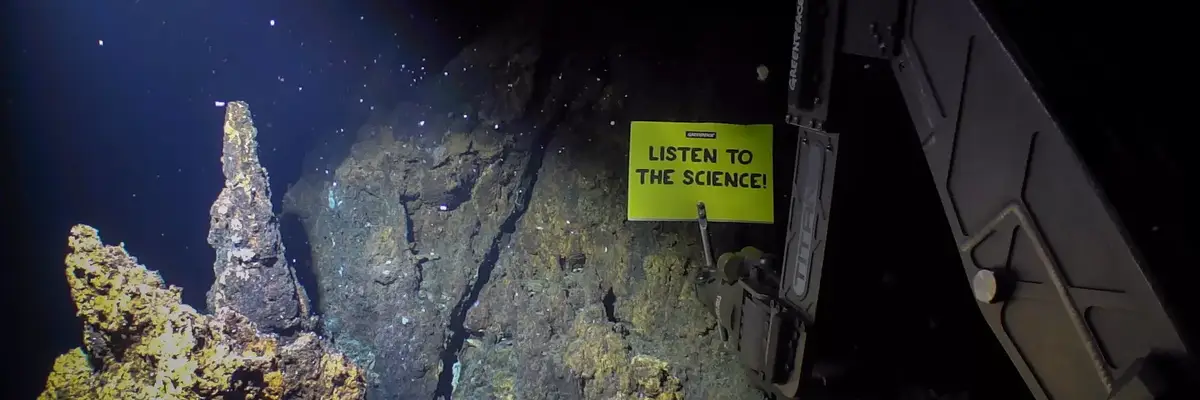
An expedition led by Greenpeace International, Greenpeace Germany, and Greenpeace Nordic deployed an underwater robot and banner reading 'Listen To The Science' to deliver a direct message to global leaders from 2,300 meters below the surface, in the deepest protest ever made.
“By safeguarding these deep-sea ecosystems within a global network of ocean sanctuaries and establishing a moratorium on deep sea mining, we can create a resilient safety net for marine life, and protect the health of our global oceans for generations to come."
Aided by a sophisticated underwater submersible, activists with Greenpeace on Wednesday set a world record for the deepest protest ever by displaying a banner 1.4 miles beneath the surface of the Arctic Ocean to oppose industrial deep-sea mining and urging protection of the world's oceans.
According to the international environmental group, the message "LISTEN TO THE SCIENCE!" was displayed 2,315 meters below sea level using a remotely operated vehicle called ‘ROV Holly.’
Executed during a deep-water survey expedition between Iceland and the island of Svalbard, the robotic hand of the submersible held up the sign in front of a hydrothermal vent field known as Loki’s Castle, which is located along the Arctic Mid-Ocean Ridge that separates the Arctic Ocean's Greenland Sea from the Norwegian Sea.
"This marks the deepest banner protest in history, to speak for ecosystems that have no voice of their own," said Dr. Sandra Schöttner, chief scientist for the Deep Arctic Expedition at Greenpeace International. "World leaders have already promised to protect 30 percent of the oceans, now they must listen to the science and actually do it. We cannot meet our global goals if we also allow industrial exploitation of unexplored and vulnerable ecosystems in the deep sea. It is high time that leaders keep their promises and give the oceans a chance to recover.”
The Arctic Mid Ocean Arctic Ridge—which the group characterized as "one of Earth's least known wildernesses"—goes down to depths of up to 3000 meters. The expedition and historic protest is part of a Greenpeace campaign that is calling for the deep-sea world of hydrothermal vents like Loki's Castle and others, as well as seamounts and the "extraordinary creatures" that live in such ecosystems to be protected with the establishment of a network of marine sanctuaries.
“By safeguarding these deep-sea ecosystems within a global network of ocean sanctuaries and establishing a moratorium on deep sea mining," said Dr. Schöttner, "we can create a resilient safety net for marine life, and protect the health of our global oceans for generations to come."
Efforts to ban deep-sea mining by environmentalists, ocean stewards, and conservationists were stymied in the US with an executive order last year issued by President Donald Trump which seeks to bolster and expand the practice by the mining industry.
Trump was condemned for the move, which Greenpeace at the time called "an insult to multilateralism" due to its sidestepping of a UN-backed process designed to protect the oceans, and "a slap in the face to all the countries and millions of people around the world who oppose this dangerous industry.”
Trump's failures, however, have been counteracted at some level by other nations who have paused or put stronger protections in place when it comes to deep-sea mining. In December, Norway paused controversial plans to issue a fresh round of drilling and mining license beneath undersea areas it controls.
As part of its ongoing campaign to curb the destructive practice, Greenpeace is calling on world leaders to honor existing global climate targets, implement the UN Ocean Treaty to protect 30% of the global ocean by 2030, and establish an immediate moratorium on deep-sea mining.
“There is no version of seabed mining that is sustainable or safe,” Greenpeace Aotearoa campaigner Juressa Lee said last year. “Alongside our allies who want to protect the ocean for future generations, we will continue to say a loud and bold no to miners who want to strip the seafloor for their profit.”
Dear Common Dreams reader, It’s been nearly 30 years since I co-founded Common Dreams with my late wife, Lina Newhouser. We had the radical notion that journalism should serve the public good, not corporate profits. It was clear to us from the outset what it would take to build such a project. No paid advertisements. No corporate sponsors. No millionaire publisher telling us what to think or do. Many people said we wouldn't last a year, but we proved those doubters wrong. Together with a tremendous team of journalists and dedicated staff, we built an independent media outlet free from the constraints of profits and corporate control. Our mission has always been simple: To inform. To inspire. To ignite change for the common good. Building Common Dreams was not easy. Our survival was never guaranteed. When you take on the most powerful forces—Wall Street greed, fossil fuel industry destruction, Big Tech lobbyists, and uber-rich oligarchs who have spent billions upon billions rigging the economy and democracy in their favor—the only bulwark you have is supporters who believe in your work. But here’s the urgent message from me today. It's never been this bad out there. And it's never been this hard to keep us going. At the very moment Common Dreams is most needed, the threats we face are intensifying. We need your support now more than ever. We don't accept corporate advertising and never will. We don't have a paywall because we don't think people should be blocked from critical news based on their ability to pay. Everything we do is funded by the donations of readers like you. When everyone does the little they can afford, we are strong. But if that support retreats or dries up, so do we. Will you donate now to make sure Common Dreams not only survives but thrives? —Craig Brown, Co-founder |
Aided by a sophisticated underwater submersible, activists with Greenpeace on Wednesday set a world record for the deepest protest ever by displaying a banner 1.4 miles beneath the surface of the Arctic Ocean to oppose industrial deep-sea mining and urging protection of the world's oceans.
According to the international environmental group, the message "LISTEN TO THE SCIENCE!" was displayed 2,315 meters below sea level using a remotely operated vehicle called ‘ROV Holly.’
Executed during a deep-water survey expedition between Iceland and the island of Svalbard, the robotic hand of the submersible held up the sign in front of a hydrothermal vent field known as Loki’s Castle, which is located along the Arctic Mid-Ocean Ridge that separates the Arctic Ocean's Greenland Sea from the Norwegian Sea.
"This marks the deepest banner protest in history, to speak for ecosystems that have no voice of their own," said Dr. Sandra Schöttner, chief scientist for the Deep Arctic Expedition at Greenpeace International. "World leaders have already promised to protect 30 percent of the oceans, now they must listen to the science and actually do it. We cannot meet our global goals if we also allow industrial exploitation of unexplored and vulnerable ecosystems in the deep sea. It is high time that leaders keep their promises and give the oceans a chance to recover.”
The Arctic Mid Ocean Arctic Ridge—which the group characterized as "one of Earth's least known wildernesses"—goes down to depths of up to 3000 meters. The expedition and historic protest is part of a Greenpeace campaign that is calling for the deep-sea world of hydrothermal vents like Loki's Castle and others, as well as seamounts and the "extraordinary creatures" that live in such ecosystems to be protected with the establishment of a network of marine sanctuaries.
“By safeguarding these deep-sea ecosystems within a global network of ocean sanctuaries and establishing a moratorium on deep sea mining," said Dr. Schöttner, "we can create a resilient safety net for marine life, and protect the health of our global oceans for generations to come."
Efforts to ban deep-sea mining by environmentalists, ocean stewards, and conservationists were stymied in the US with an executive order last year issued by President Donald Trump which seeks to bolster and expand the practice by the mining industry.
Trump was condemned for the move, which Greenpeace at the time called "an insult to multilateralism" due to its sidestepping of a UN-backed process designed to protect the oceans, and "a slap in the face to all the countries and millions of people around the world who oppose this dangerous industry.”
Trump's failures, however, have been counteracted at some level by other nations who have paused or put stronger protections in place when it comes to deep-sea mining. In December, Norway paused controversial plans to issue a fresh round of drilling and mining license beneath undersea areas it controls.
As part of its ongoing campaign to curb the destructive practice, Greenpeace is calling on world leaders to honor existing global climate targets, implement the UN Ocean Treaty to protect 30% of the global ocean by 2030, and establish an immediate moratorium on deep-sea mining.
“There is no version of seabed mining that is sustainable or safe,” Greenpeace Aotearoa campaigner Juressa Lee said last year. “Alongside our allies who want to protect the ocean for future generations, we will continue to say a loud and bold no to miners who want to strip the seafloor for their profit.”
Aided by a sophisticated underwater submersible, activists with Greenpeace on Wednesday set a world record for the deepest protest ever by displaying a banner 1.4 miles beneath the surface of the Arctic Ocean to oppose industrial deep-sea mining and urging protection of the world's oceans.
According to the international environmental group, the message "LISTEN TO THE SCIENCE!" was displayed 2,315 meters below sea level using a remotely operated vehicle called ‘ROV Holly.’
Executed during a deep-water survey expedition between Iceland and the island of Svalbard, the robotic hand of the submersible held up the sign in front of a hydrothermal vent field known as Loki’s Castle, which is located along the Arctic Mid-Ocean Ridge that separates the Arctic Ocean's Greenland Sea from the Norwegian Sea.
"This marks the deepest banner protest in history, to speak for ecosystems that have no voice of their own," said Dr. Sandra Schöttner, chief scientist for the Deep Arctic Expedition at Greenpeace International. "World leaders have already promised to protect 30 percent of the oceans, now they must listen to the science and actually do it. We cannot meet our global goals if we also allow industrial exploitation of unexplored and vulnerable ecosystems in the deep sea. It is high time that leaders keep their promises and give the oceans a chance to recover.”
The Arctic Mid Ocean Arctic Ridge—which the group characterized as "one of Earth's least known wildernesses"—goes down to depths of up to 3000 meters. The expedition and historic protest is part of a Greenpeace campaign that is calling for the deep-sea world of hydrothermal vents like Loki's Castle and others, as well as seamounts and the "extraordinary creatures" that live in such ecosystems to be protected with the establishment of a network of marine sanctuaries.
“By safeguarding these deep-sea ecosystems within a global network of ocean sanctuaries and establishing a moratorium on deep sea mining," said Dr. Schöttner, "we can create a resilient safety net for marine life, and protect the health of our global oceans for generations to come."
Efforts to ban deep-sea mining by environmentalists, ocean stewards, and conservationists were stymied in the US with an executive order last year issued by President Donald Trump which seeks to bolster and expand the practice by the mining industry.
Trump was condemned for the move, which Greenpeace at the time called "an insult to multilateralism" due to its sidestepping of a UN-backed process designed to protect the oceans, and "a slap in the face to all the countries and millions of people around the world who oppose this dangerous industry.”
Trump's failures, however, have been counteracted at some level by other nations who have paused or put stronger protections in place when it comes to deep-sea mining. In December, Norway paused controversial plans to issue a fresh round of drilling and mining license beneath undersea areas it controls.
As part of its ongoing campaign to curb the destructive practice, Greenpeace is calling on world leaders to honor existing global climate targets, implement the UN Ocean Treaty to protect 30% of the global ocean by 2030, and establish an immediate moratorium on deep-sea mining.
“There is no version of seabed mining that is sustainable or safe,” Greenpeace Aotearoa campaigner Juressa Lee said last year. “Alongside our allies who want to protect the ocean for future generations, we will continue to say a loud and bold no to miners who want to strip the seafloor for their profit.”