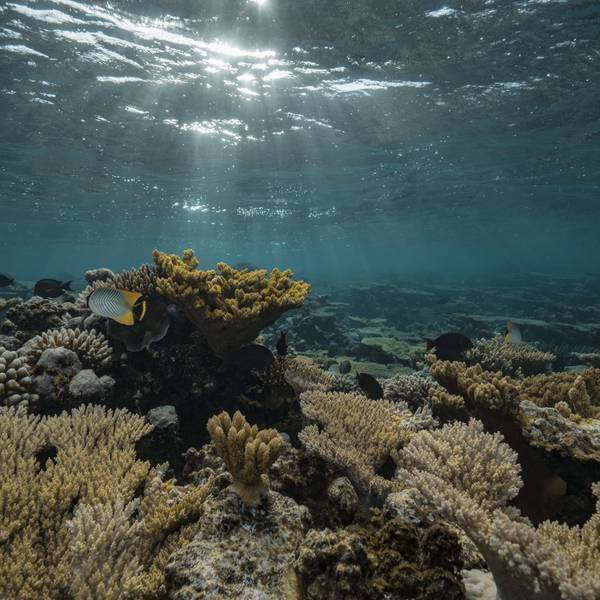
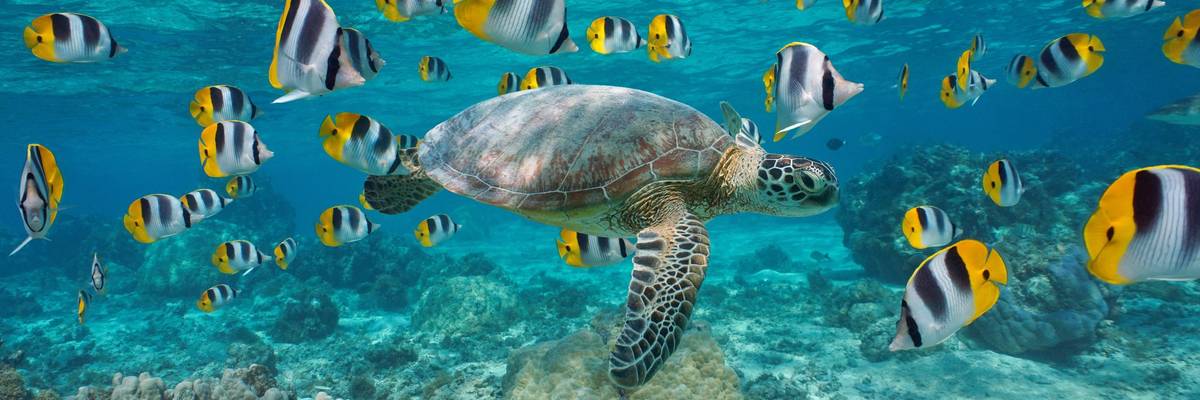
A green sea turtle swims with a school of tropical fish underwater in the Pacific Ocean.
Analyses Expose Ocean Protection Failures Before UN Summit on 'Unprecedented Crisis'
"Conserving 30% of our ocean by 2030 is not just a target—it's a lifeline for communities, food security, biodiversity, and the global economy," said one advocate.
Ahead of the third United Nations summit on oceans, scheduled for next week, multiple analyses have highlighted how humanity is failing to address the multipronged emergency faced by the world's seas.
"The ocean is facing an unprecedented crisis due to climate change, plastic pollution, ecosystem loss, and the overuse of marine resources," Li Junhua, secretary-general for the 2025 United Nations Ocean Conference (UNOC3), told U.N. News.
UNOC3 is co-chaired by Costa Rica and France, and set to be held in the French coastal city of Nice June 9-13. Its theme is "accelerating action and mobilizing all actors to conserve and sustainably use the ocean."
"Only $1.2 billion of finance is flowing to ocean protection and conservation—less than 10% of what is needed."
One of the new analyses—The Ocean Protection Gap: Assessing Progress Toward the 30×30 Target—was commissioned by the Bloomberg Ocean Fund and produced in partnership with nature groups, including WWF International.
The report, released Thursday, focuses on the 30×30 goal from the Kunming-Montreal Global Biodiversity Framework, which is a commitment to conserve at least 30% of the world's land and ocean by 2030. The document warns that right now, "just 8.6% of the ocean is protected, with only 2.7% assessed and deemed effectively protected—a far cry from the 30% target."
Additionally, "only $1.2 billion of finance is flowing to ocean protection and conservation—less than 10% of what is needed," the report notes. It urges governments behind the framework to boost funding, including honoring their pledge to "provide at least $20 billion by 2025 and $30 billion by 2030 in international biodiversity finance to developing countries."
Calling the analysis "a wake-up call," Pepe Clarke, oceans practice leader at WWF, stressed that "we have the science, the tools, and a global agreement, but without bold political leadership and a rapid scaling of ambition, funding, and implementation, the promise of 30×30 will remain unfulfilled. Conserving 30% of our ocean by 2030 is not just a target—it's a lifeline for communities, food security, biodiversity, and the global economy."
🚨In a timely comment piece in @nature.com ahead of #UNOC3, leading ocean scientists make the case for protecting the High Seas from all extraction. @profcallum.bsky.social @ubcoceans.bsky.social @marklynas.bsky.social www.nature.com/articles/d41...
[image or embed]
— Deep Sea Conservation Coalition (@deepseaconserve.bsky.social) June 4, 2025 at 12:07 PM
Another new report, released Thursday by the U.S.-based Earth Insight in partnership with groups from around the world, details "the global expansion of offshore and coastal oil and gas development and its profound threats to marine ecosystems, biodiversity, and the livelihoods of coastal communities—drawing on regional case studies to illustrate these threats."
The analysis found significant overlap between fossil fuel blocks—sites where exploration and production are permitted—and coral, mangroves, sea grass, and allegedly protected areas. It calls for halting oil and gas expansion, retiring blocks not already assigned to investors, ending financial support for coastal and offshore fossil fuel development, investing in renewables, ensuring a just transition, restoring impacted ecosystems, and strengthening legal, financial, and policy frameworks.
Last week, Oceana released another analysis of fishing in France's six Marine Nature Parks in 2024. The conservation group found that over 100 bottom trawling vessels appeared to spend more than 17,000 hours fishing in these "protected" spaces.
"Bottom trawling is one of the most destructive and wasteful practices taking place in our ocean today," said Oceana board member and Sea Around Us Project founder Daniel Pauly in a statement. "These massive, weighted nets bulldoze the ocean floor, destroying everything in their path and remobilizing carbon stored in the seabed. You cannot destroy areas and call them protected. We don't need more bulldozed tracks on the seafloor. We need protected areas that benefit people and nature."
Nicolas Fournier, Oceana's campaign director for marine protection in Europe, urged action by French President Emmanuel Macron.
"This is a problem President Macron can no longer ignore," said Fournier. "France needs to go from words to action—and substantiate its claim of achieving 30×30 by actually protecting its marine treasures from destructive fishing."
As #UNOC3 approaches, it's clear: a #FossilFreeOcean is no longer optional, but a moral and legal imperative. The fight for our oceans is urgent! Read more: bit.ly/3HtViJl
[image or embed]
— Center for International Environmental Law (@ciel.org) June 5, 2025 at 11:02 AM
Greenpeace has also recently called out the "weaknesses" of French marine protections—and then faced what the group condemned as retaliation from the government: Authorities blocked its ship, Arctic Sunrise, from entering the port of Nice.
"Arctic Sunrise had been invited by the French Ministry of Foreign Affairs to participate in the 'One Ocean Science Congress' and in the ocean wonders parade taking place right before the U.N. Ocean Conference," the group explained in a Tuesday statement. "Greenpeace International had intended to deliver the messages of 3 million people calling for a moratorium on deep-sea mining to the politicians attending the conference."
Greenpeace International executive director Mads Christensen denounced the "attempt to silence fair criticism" before UNOC3 as "clearly a political decision" and "utterly unacceptable."
"France wants this to be a moment where they present themselves as saviors of the oceans while they want to silence any criticism of their own failures in national waters. We will not be silenced," Christensen declared. "Greenpeace and the French government share the same objective to get a moratorium on deep-sea mining, which makes the ban of the Arctic Sunrise from Nice even more absurd."
We are at a crossroads
This country and this world are at a monumental crossroads. In a few short weeks, US voters will have an opportunity to beat back the forces of fascism and confront the billionaires who are rigging the economy, our media system, and our democracy, making it increasingly impossible for ordinary people to get by. We’re not just talking about the election. We’re talking about what must be done once these fascist elements are vanquished from power. We need a bolder set of solutions than what either major party has so far been willing to offer and a working-class movement ready to fight like hell for it. Trump didn't emerge from nowhere. The conditions that fueled MAGA authoritarianism were created by decades of radical neoliberal economic policies and a corrupt political system dominated by corporate interests. They slashed taxes on the super-rich, promising that the benefits would trickle down. They said giveaways to the corporate titans would make life more affordable for the rest of us. It was all bullshit. And when a bitter, betrayed populace searches for someone to blame, right-wing demagogues have little trouble finding scapegoats. People know when they're being lied to, but you won't hear any of this from the corporate media. Only independent journalism—powered and funded by people who believe in building a better world—can deliver truly trustworthy daily news. Our Fall Campaign is underway, and we need your help. To power our newsroom through the rest of the year, we need to raise $125,000 by midnight on October 31. So if you share our vision, please contribute whatever you can to sustain our work. |
Ahead of the third United Nations summit on oceans, scheduled for next week, multiple analyses have highlighted how humanity is failing to address the multipronged emergency faced by the world's seas.
"The ocean is facing an unprecedented crisis due to climate change, plastic pollution, ecosystem loss, and the overuse of marine resources," Li Junhua, secretary-general for the 2025 United Nations Ocean Conference (UNOC3), told U.N. News.
UNOC3 is co-chaired by Costa Rica and France, and set to be held in the French coastal city of Nice June 9-13. Its theme is "accelerating action and mobilizing all actors to conserve and sustainably use the ocean."
"Only $1.2 billion of finance is flowing to ocean protection and conservation—less than 10% of what is needed."
One of the new analyses—The Ocean Protection Gap: Assessing Progress Toward the 30×30 Target—was commissioned by the Bloomberg Ocean Fund and produced in partnership with nature groups, including WWF International.
The report, released Thursday, focuses on the 30×30 goal from the Kunming-Montreal Global Biodiversity Framework, which is a commitment to conserve at least 30% of the world's land and ocean by 2030. The document warns that right now, "just 8.6% of the ocean is protected, with only 2.7% assessed and deemed effectively protected—a far cry from the 30% target."
Additionally, "only $1.2 billion of finance is flowing to ocean protection and conservation—less than 10% of what is needed," the report notes. It urges governments behind the framework to boost funding, including honoring their pledge to "provide at least $20 billion by 2025 and $30 billion by 2030 in international biodiversity finance to developing countries."
Calling the analysis "a wake-up call," Pepe Clarke, oceans practice leader at WWF, stressed that "we have the science, the tools, and a global agreement, but without bold political leadership and a rapid scaling of ambition, funding, and implementation, the promise of 30×30 will remain unfulfilled. Conserving 30% of our ocean by 2030 is not just a target—it's a lifeline for communities, food security, biodiversity, and the global economy."
🚨In a timely comment piece in @nature.com ahead of #UNOC3, leading ocean scientists make the case for protecting the High Seas from all extraction. @profcallum.bsky.social @ubcoceans.bsky.social @marklynas.bsky.social www.nature.com/articles/d41...
[image or embed]
— Deep Sea Conservation Coalition (@deepseaconserve.bsky.social) June 4, 2025 at 12:07 PM
Another new report, released Thursday by the U.S.-based Earth Insight in partnership with groups from around the world, details "the global expansion of offshore and coastal oil and gas development and its profound threats to marine ecosystems, biodiversity, and the livelihoods of coastal communities—drawing on regional case studies to illustrate these threats."
The analysis found significant overlap between fossil fuel blocks—sites where exploration and production are permitted—and coral, mangroves, sea grass, and allegedly protected areas. It calls for halting oil and gas expansion, retiring blocks not already assigned to investors, ending financial support for coastal and offshore fossil fuel development, investing in renewables, ensuring a just transition, restoring impacted ecosystems, and strengthening legal, financial, and policy frameworks.
Last week, Oceana released another analysis of fishing in France's six Marine Nature Parks in 2024. The conservation group found that over 100 bottom trawling vessels appeared to spend more than 17,000 hours fishing in these "protected" spaces.
"Bottom trawling is one of the most destructive and wasteful practices taking place in our ocean today," said Oceana board member and Sea Around Us Project founder Daniel Pauly in a statement. "These massive, weighted nets bulldoze the ocean floor, destroying everything in their path and remobilizing carbon stored in the seabed. You cannot destroy areas and call them protected. We don't need more bulldozed tracks on the seafloor. We need protected areas that benefit people and nature."
Nicolas Fournier, Oceana's campaign director for marine protection in Europe, urged action by French President Emmanuel Macron.
"This is a problem President Macron can no longer ignore," said Fournier. "France needs to go from words to action—and substantiate its claim of achieving 30×30 by actually protecting its marine treasures from destructive fishing."
As #UNOC3 approaches, it's clear: a #FossilFreeOcean is no longer optional, but a moral and legal imperative. The fight for our oceans is urgent! Read more: bit.ly/3HtViJl
[image or embed]
— Center for International Environmental Law (@ciel.org) June 5, 2025 at 11:02 AM
Greenpeace has also recently called out the "weaknesses" of French marine protections—and then faced what the group condemned as retaliation from the government: Authorities blocked its ship, Arctic Sunrise, from entering the port of Nice.
"Arctic Sunrise had been invited by the French Ministry of Foreign Affairs to participate in the 'One Ocean Science Congress' and in the ocean wonders parade taking place right before the U.N. Ocean Conference," the group explained in a Tuesday statement. "Greenpeace International had intended to deliver the messages of 3 million people calling for a moratorium on deep-sea mining to the politicians attending the conference."
Greenpeace International executive director Mads Christensen denounced the "attempt to silence fair criticism" before UNOC3 as "clearly a political decision" and "utterly unacceptable."
"France wants this to be a moment where they present themselves as saviors of the oceans while they want to silence any criticism of their own failures in national waters. We will not be silenced," Christensen declared. "Greenpeace and the French government share the same objective to get a moratorium on deep-sea mining, which makes the ban of the Arctic Sunrise from Nice even more absurd."
- The Deep Sea Is Not for Sale—the ISA Must Reject Corporate Pressure ›
- The Ocean, Our Common Future: A Call For Legal Recognition ›
- Ocean Summit Wake-Up Call on Plastics Treaty 'Only Matters If Countries Back It Up With Action' | Common Dreams ›
- Opinion | Corporate Greed and National Interests Torpedoed the UN Plastics Treaty | Common Dreams ›
- Opinion | The Second World Summit for Social Development: Mind the (Equality) Gap | Common Dreams ›
- 2,315 Meters Under the Sea, Greenpeace Stages Deepest Protest in World History | Common Dreams ›
Ahead of the third United Nations summit on oceans, scheduled for next week, multiple analyses have highlighted how humanity is failing to address the multipronged emergency faced by the world's seas.
"The ocean is facing an unprecedented crisis due to climate change, plastic pollution, ecosystem loss, and the overuse of marine resources," Li Junhua, secretary-general for the 2025 United Nations Ocean Conference (UNOC3), told U.N. News.
UNOC3 is co-chaired by Costa Rica and France, and set to be held in the French coastal city of Nice June 9-13. Its theme is "accelerating action and mobilizing all actors to conserve and sustainably use the ocean."
"Only $1.2 billion of finance is flowing to ocean protection and conservation—less than 10% of what is needed."
One of the new analyses—The Ocean Protection Gap: Assessing Progress Toward the 30×30 Target—was commissioned by the Bloomberg Ocean Fund and produced in partnership with nature groups, including WWF International.
The report, released Thursday, focuses on the 30×30 goal from the Kunming-Montreal Global Biodiversity Framework, which is a commitment to conserve at least 30% of the world's land and ocean by 2030. The document warns that right now, "just 8.6% of the ocean is protected, with only 2.7% assessed and deemed effectively protected—a far cry from the 30% target."
Additionally, "only $1.2 billion of finance is flowing to ocean protection and conservation—less than 10% of what is needed," the report notes. It urges governments behind the framework to boost funding, including honoring their pledge to "provide at least $20 billion by 2025 and $30 billion by 2030 in international biodiversity finance to developing countries."
Calling the analysis "a wake-up call," Pepe Clarke, oceans practice leader at WWF, stressed that "we have the science, the tools, and a global agreement, but without bold political leadership and a rapid scaling of ambition, funding, and implementation, the promise of 30×30 will remain unfulfilled. Conserving 30% of our ocean by 2030 is not just a target—it's a lifeline for communities, food security, biodiversity, and the global economy."
🚨In a timely comment piece in @nature.com ahead of #UNOC3, leading ocean scientists make the case for protecting the High Seas from all extraction. @profcallum.bsky.social @ubcoceans.bsky.social @marklynas.bsky.social www.nature.com/articles/d41...
[image or embed]
— Deep Sea Conservation Coalition (@deepseaconserve.bsky.social) June 4, 2025 at 12:07 PM
Another new report, released Thursday by the U.S.-based Earth Insight in partnership with groups from around the world, details "the global expansion of offshore and coastal oil and gas development and its profound threats to marine ecosystems, biodiversity, and the livelihoods of coastal communities—drawing on regional case studies to illustrate these threats."
The analysis found significant overlap between fossil fuel blocks—sites where exploration and production are permitted—and coral, mangroves, sea grass, and allegedly protected areas. It calls for halting oil and gas expansion, retiring blocks not already assigned to investors, ending financial support for coastal and offshore fossil fuel development, investing in renewables, ensuring a just transition, restoring impacted ecosystems, and strengthening legal, financial, and policy frameworks.
Last week, Oceana released another analysis of fishing in France's six Marine Nature Parks in 2024. The conservation group found that over 100 bottom trawling vessels appeared to spend more than 17,000 hours fishing in these "protected" spaces.
"Bottom trawling is one of the most destructive and wasteful practices taking place in our ocean today," said Oceana board member and Sea Around Us Project founder Daniel Pauly in a statement. "These massive, weighted nets bulldoze the ocean floor, destroying everything in their path and remobilizing carbon stored in the seabed. You cannot destroy areas and call them protected. We don't need more bulldozed tracks on the seafloor. We need protected areas that benefit people and nature."
Nicolas Fournier, Oceana's campaign director for marine protection in Europe, urged action by French President Emmanuel Macron.
"This is a problem President Macron can no longer ignore," said Fournier. "France needs to go from words to action—and substantiate its claim of achieving 30×30 by actually protecting its marine treasures from destructive fishing."
As #UNOC3 approaches, it's clear: a #FossilFreeOcean is no longer optional, but a moral and legal imperative. The fight for our oceans is urgent! Read more: bit.ly/3HtViJl
[image or embed]
— Center for International Environmental Law (@ciel.org) June 5, 2025 at 11:02 AM
Greenpeace has also recently called out the "weaknesses" of French marine protections—and then faced what the group condemned as retaliation from the government: Authorities blocked its ship, Arctic Sunrise, from entering the port of Nice.
"Arctic Sunrise had been invited by the French Ministry of Foreign Affairs to participate in the 'One Ocean Science Congress' and in the ocean wonders parade taking place right before the U.N. Ocean Conference," the group explained in a Tuesday statement. "Greenpeace International had intended to deliver the messages of 3 million people calling for a moratorium on deep-sea mining to the politicians attending the conference."
Greenpeace International executive director Mads Christensen denounced the "attempt to silence fair criticism" before UNOC3 as "clearly a political decision" and "utterly unacceptable."
"France wants this to be a moment where they present themselves as saviors of the oceans while they want to silence any criticism of their own failures in national waters. We will not be silenced," Christensen declared. "Greenpeace and the French government share the same objective to get a moratorium on deep-sea mining, which makes the ban of the Arctic Sunrise from Nice even more absurd."
- The Deep Sea Is Not for Sale—the ISA Must Reject Corporate Pressure ›
- The Ocean, Our Common Future: A Call For Legal Recognition ›
- Ocean Summit Wake-Up Call on Plastics Treaty 'Only Matters If Countries Back It Up With Action' | Common Dreams ›
- Opinion | Corporate Greed and National Interests Torpedoed the UN Plastics Treaty | Common Dreams ›
- Opinion | The Second World Summit for Social Development: Mind the (Equality) Gap | Common Dreams ›
- 2,315 Meters Under the Sea, Greenpeace Stages Deepest Protest in World History | Common Dreams ›