SUBSCRIBE TO OUR FREE NEWSLETTER
Daily news & progressive opinion—funded by the people, not the corporations—delivered straight to your inbox.
5
#000000
#FFFFFF
To donate by check, phone, or other method, see our More Ways to Give page.
Daily news & progressive opinion—funded by the people, not the corporations—delivered straight to your inbox.
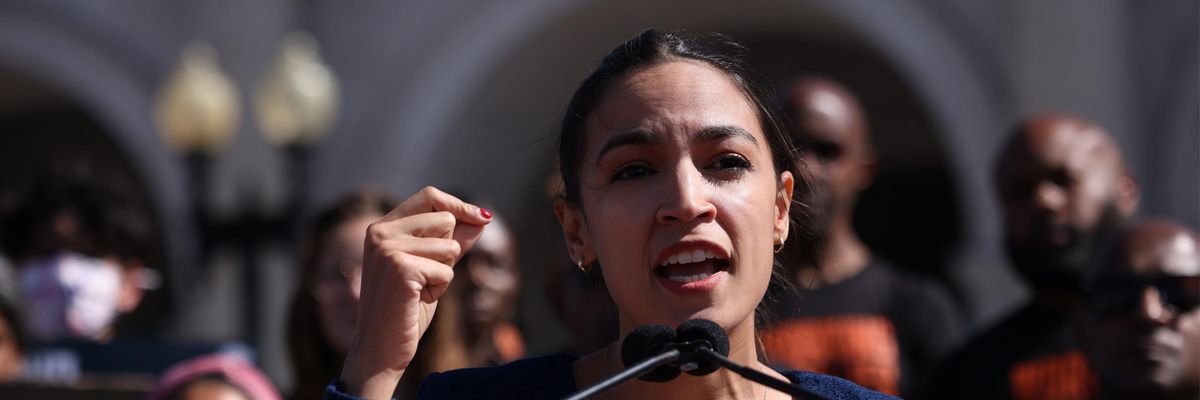
Rep. Alexandria Ocasio-Cortez (D-N.Y.) speaks during an event outside Union Station on June 16, 2021 in Washington, D.C. (Photo: Win McNamee/Getty Images)
Democratic Congresswoman Alexandria Ocasio-Cortez on Thursday condemned the Biden administration for upholding the United States' crippling embargo against Cuba, where people have taken to the streets in recent days to protest food and medicine shortages exacerbated by the decades-old economic restrictions.
"The embargo is absurdly cruel and, like too many other U.S. policies targeting Latin Americans, the cruelty is the point," Ocasio-Cortez (D-N.Y) said in a statement Thursday night. "I outright reject the Biden administration's defense of the embargo. It is never acceptable for us to use cruelty as a point of leverage against every day people."
In late June, just weeks before the protests in Cuba began, the Biden administration joined the Israeli government in voting against a United Nations resolution calling for an end to the longstanding U.S. embargo, which--according to a 2018 U.N. report--has cost the island nation's economy $130 billion since it was imposed in the 1960s. The U.N. General Assembly overwhelmingly approved the nonbinding resolution by a vote of 184-2, with Colombia, Ukraine, and Brazil abstaining.
Last October, the Cuban government estimated that the U.S. embargo cost the country's economy more than $5 billion between April 2019 through March 2020, the month the World Health Organization declared the coronavirus crisis a global pandemic.
In her statement on Thursday, Ocasio-Cortez expressed solidarity with Cubans protesting for better economic conditions and criticized the Cuban government for what she described as "anti-democratic" responses to the recent street demonstrations. But the New York Democrat added that "we also must name the U.S. contribution to Cuban suffering: our 60-year-old embargo."
The Biden administration is currently in the process of reviewing the U.S. policy of economic warfare against Cuba, which the Trump administration intensified by tightening sanctions and declaring the country a "state sponsor of terror"--a designation that inflicted additional damage on the Cuban economy.
President Joe Biden has yet to reverse his predecessor's damaging policy moves toward Cuba, despite growing pressure to do so. During a press conference on Thursday, Biden said he does not intend to ease a policy barring people in the U.S. from sending money to their Cuban relatives on the island.
In recent days, Biden administration officials have downplayed the role of the U.S. embargo in causing acute food and medicine shortages in Cuba, issues that the coronavirus pandemic has made substantially worse. Speaking to reporters earlier this week, U.S. State Department spokesperson Ned Price dismissively referred to the embargo as the "so-called embargo" and refused to say whether the ban on remittances is harming the Cuban economy.
Price went on to claim that current U.S. policy "allows humanitarian goods to reach Cuba," but The Intercept reported last month that U.S.-imposed trade restrictions have contributed to the island nation's struggle "to obtain critical foreign-made medical supplies to treat its own population" and other necessities.
William LeoGrande, professor of government at American University in Washington, D.C., wrote in a column for The Daily Beast on Thursday that the protests in Cuba "should be a decision-forcing event for the Biden administration."
"In the next few weeks, Biden will have to make a fateful choice," wrote LeoGrande. "He can slide Cuba to the back burner of his agenda once again in the hope that the crisis on the island will subside without any U.S. action. Or he can act decisively, announcing a policy aimed at reducing the suffering of the Cuban people by lifting Trump's sanctions--as he promised to do during the presidential campaign."
Dear Common Dreams reader, It’s been nearly 30 years since I co-founded Common Dreams with my late wife, Lina Newhouser. We had the radical notion that journalism should serve the public good, not corporate profits. It was clear to us from the outset what it would take to build such a project. No paid advertisements. No corporate sponsors. No millionaire publisher telling us what to think or do. Many people said we wouldn't last a year, but we proved those doubters wrong. Together with a tremendous team of journalists and dedicated staff, we built an independent media outlet free from the constraints of profits and corporate control. Our mission has always been simple: To inform. To inspire. To ignite change for the common good. Building Common Dreams was not easy. Our survival was never guaranteed. When you take on the most powerful forces—Wall Street greed, fossil fuel industry destruction, Big Tech lobbyists, and uber-rich oligarchs who have spent billions upon billions rigging the economy and democracy in their favor—the only bulwark you have is supporters who believe in your work. But here’s the urgent message from me today. It's never been this bad out there. And it's never been this hard to keep us going. At the very moment Common Dreams is most needed, the threats we face are intensifying. We need your support now more than ever. We don't accept corporate advertising and never will. We don't have a paywall because we don't think people should be blocked from critical news based on their ability to pay. Everything we do is funded by the donations of readers like you. When everyone does the little they can afford, we are strong. But if that support retreats or dries up, so do we. Will you donate now to make sure Common Dreams not only survives but thrives? —Craig Brown, Co-founder |
Democratic Congresswoman Alexandria Ocasio-Cortez on Thursday condemned the Biden administration for upholding the United States' crippling embargo against Cuba, where people have taken to the streets in recent days to protest food and medicine shortages exacerbated by the decades-old economic restrictions.
"The embargo is absurdly cruel and, like too many other U.S. policies targeting Latin Americans, the cruelty is the point," Ocasio-Cortez (D-N.Y) said in a statement Thursday night. "I outright reject the Biden administration's defense of the embargo. It is never acceptable for us to use cruelty as a point of leverage against every day people."
In late June, just weeks before the protests in Cuba began, the Biden administration joined the Israeli government in voting against a United Nations resolution calling for an end to the longstanding U.S. embargo, which--according to a 2018 U.N. report--has cost the island nation's economy $130 billion since it was imposed in the 1960s. The U.N. General Assembly overwhelmingly approved the nonbinding resolution by a vote of 184-2, with Colombia, Ukraine, and Brazil abstaining.
Last October, the Cuban government estimated that the U.S. embargo cost the country's economy more than $5 billion between April 2019 through March 2020, the month the World Health Organization declared the coronavirus crisis a global pandemic.
In her statement on Thursday, Ocasio-Cortez expressed solidarity with Cubans protesting for better economic conditions and criticized the Cuban government for what she described as "anti-democratic" responses to the recent street demonstrations. But the New York Democrat added that "we also must name the U.S. contribution to Cuban suffering: our 60-year-old embargo."
The Biden administration is currently in the process of reviewing the U.S. policy of economic warfare against Cuba, which the Trump administration intensified by tightening sanctions and declaring the country a "state sponsor of terror"--a designation that inflicted additional damage on the Cuban economy.
President Joe Biden has yet to reverse his predecessor's damaging policy moves toward Cuba, despite growing pressure to do so. During a press conference on Thursday, Biden said he does not intend to ease a policy barring people in the U.S. from sending money to their Cuban relatives on the island.
In recent days, Biden administration officials have downplayed the role of the U.S. embargo in causing acute food and medicine shortages in Cuba, issues that the coronavirus pandemic has made substantially worse. Speaking to reporters earlier this week, U.S. State Department spokesperson Ned Price dismissively referred to the embargo as the "so-called embargo" and refused to say whether the ban on remittances is harming the Cuban economy.
Price went on to claim that current U.S. policy "allows humanitarian goods to reach Cuba," but The Intercept reported last month that U.S.-imposed trade restrictions have contributed to the island nation's struggle "to obtain critical foreign-made medical supplies to treat its own population" and other necessities.
William LeoGrande, professor of government at American University in Washington, D.C., wrote in a column for The Daily Beast on Thursday that the protests in Cuba "should be a decision-forcing event for the Biden administration."
"In the next few weeks, Biden will have to make a fateful choice," wrote LeoGrande. "He can slide Cuba to the back burner of his agenda once again in the hope that the crisis on the island will subside without any U.S. action. Or he can act decisively, announcing a policy aimed at reducing the suffering of the Cuban people by lifting Trump's sanctions--as he promised to do during the presidential campaign."
Democratic Congresswoman Alexandria Ocasio-Cortez on Thursday condemned the Biden administration for upholding the United States' crippling embargo against Cuba, where people have taken to the streets in recent days to protest food and medicine shortages exacerbated by the decades-old economic restrictions.
"The embargo is absurdly cruel and, like too many other U.S. policies targeting Latin Americans, the cruelty is the point," Ocasio-Cortez (D-N.Y) said in a statement Thursday night. "I outright reject the Biden administration's defense of the embargo. It is never acceptable for us to use cruelty as a point of leverage against every day people."
In late June, just weeks before the protests in Cuba began, the Biden administration joined the Israeli government in voting against a United Nations resolution calling for an end to the longstanding U.S. embargo, which--according to a 2018 U.N. report--has cost the island nation's economy $130 billion since it was imposed in the 1960s. The U.N. General Assembly overwhelmingly approved the nonbinding resolution by a vote of 184-2, with Colombia, Ukraine, and Brazil abstaining.
Last October, the Cuban government estimated that the U.S. embargo cost the country's economy more than $5 billion between April 2019 through March 2020, the month the World Health Organization declared the coronavirus crisis a global pandemic.
In her statement on Thursday, Ocasio-Cortez expressed solidarity with Cubans protesting for better economic conditions and criticized the Cuban government for what she described as "anti-democratic" responses to the recent street demonstrations. But the New York Democrat added that "we also must name the U.S. contribution to Cuban suffering: our 60-year-old embargo."
The Biden administration is currently in the process of reviewing the U.S. policy of economic warfare against Cuba, which the Trump administration intensified by tightening sanctions and declaring the country a "state sponsor of terror"--a designation that inflicted additional damage on the Cuban economy.
President Joe Biden has yet to reverse his predecessor's damaging policy moves toward Cuba, despite growing pressure to do so. During a press conference on Thursday, Biden said he does not intend to ease a policy barring people in the U.S. from sending money to their Cuban relatives on the island.
In recent days, Biden administration officials have downplayed the role of the U.S. embargo in causing acute food and medicine shortages in Cuba, issues that the coronavirus pandemic has made substantially worse. Speaking to reporters earlier this week, U.S. State Department spokesperson Ned Price dismissively referred to the embargo as the "so-called embargo" and refused to say whether the ban on remittances is harming the Cuban economy.
Price went on to claim that current U.S. policy "allows humanitarian goods to reach Cuba," but The Intercept reported last month that U.S.-imposed trade restrictions have contributed to the island nation's struggle "to obtain critical foreign-made medical supplies to treat its own population" and other necessities.
William LeoGrande, professor of government at American University in Washington, D.C., wrote in a column for The Daily Beast on Thursday that the protests in Cuba "should be a decision-forcing event for the Biden administration."
"In the next few weeks, Biden will have to make a fateful choice," wrote LeoGrande. "He can slide Cuba to the back burner of his agenda once again in the hope that the crisis on the island will subside without any U.S. action. Or he can act decisively, announcing a policy aimed at reducing the suffering of the Cuban people by lifting Trump's sanctions--as he promised to do during the presidential campaign."