SUBSCRIBE TO OUR FREE NEWSLETTER
Daily news & progressive opinion—funded by the people, not the corporations—delivered straight to your inbox.
5
#000000
#FFFFFF
To donate by check, phone, or other method, see our More Ways to Give page.
Daily news & progressive opinion—funded by the people, not the corporations—delivered straight to your inbox.
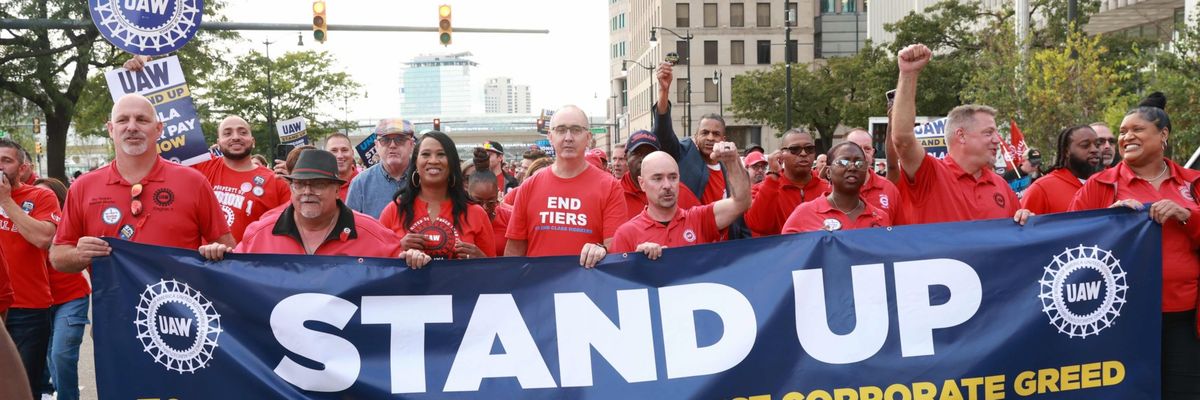
Members of the United Auto Workers union march for better pay and benefits in Detroit on September 17, 2023.
Despite reaping tens of billions of dollars in profits between them over the past five years, General Motors and Ford paid an average combined tax rate of just 1% on total pre-tax income, an analysis published Tuesday by economic justice advocates revealed—as the auto giants claimed they cannot afford striking workers' demands for better pay.
The Americans for Tax Fairness (ATF) analysis—which posits that "the tax system is rigged to benefit multinational corporations over the workers who keep them running"— notes that over the past five years, GM and Ford made a total of $34 billion and $8 billion respectively, but paid an effective federal tax rate of only 1.3% for GM and -0.2% for Ford.
"While some of those tax savings have found their way into rapidly rising compensation packages for the firms' top executives and board members, wages of rank-and-file workers have lagged," the report states. "Average executive pay at GM and Ford grew by 32% over the past five years, while median autoworker pay grew by just 8.8% over the same period, widening the executive-to-worker pay gap to 183-to-1."
"Over that same period, GM and Ford paid out a combined total of $14 billion in dividends (34 times more than they paid in taxes), spent $3.6 billion on stock buybacks (nine times more than they paid in taxes), and lavished $614 million on top company executives (50% more than they paid in taxes)," the publication continues.
The analysis comes five days into a "stand-up strike" by around 13,000 United Auto Workers (UAW) members at GM, Ford, and Stellantis plants. The workers are seeking better pay and benefits.
"General Motors and Ford are refusing to meet UAW's demands, claiming that what workers are asking for is unreasonable," the report states. "An Americans for Tax Fairness analysis of GM and Ford's most recent [Securities and Exchange Commission] filings finds that what is truly unreasonable is how the auto giants get away with paying practically nothing in federal taxes while further enriching their top executives with huge pay packages and their shareholders with dividend payments and stock buybacks."
ATF executive director David Kass argued that "Ford and GM have thrown their priorities into reverse."
"They're overcompensating their already wealthy executives, board members, and shareholders, while shortchanging the workers and nation that made their success possible," Kass continued. "They need to offer serious proposals for sharing the wealth with rank-and-file employees and start paying their fair share of taxes."
"They're overcompensating their already wealthy executives, board members, and shareholders, while shortchanging the workers and nation that made their success possible."
Kass additionally asserted that the National Labor Relations Board "must ensure these corporations treat their workers justly; and in its upcoming budget negotiations, Congress must ensure big corporations like Ford and GM are contributing what they should to America's fiscal health."
Corporate tax dodging is pervasive in most U.S. industries. According to a Government Accountability Office (GAO) analysis commissioned by Sen. Bernie Sanders (I-Vt.) and released in January, more than a third of large, profitable corporations in the United States paid no federal income tax in 2018, the year that the so-called Republican "tax scam" signed into law by then-President Donald Trump took effect.
The GAO report also found that "average effective tax rates—the percentage of income paid after tax breaks—among profitable large corporations fell from 16% in 2014 to 9% in 2018."
Other analyses of more recent data confirms the trend continues. A Center for American Progress study of 2021 investor filings for Fortune 100 companies revealed that 19 of the largest profitable corporations in America "are paying effective tax rates that are in the single digits—or paying nothing at all."
Dear Common Dreams reader, It’s been nearly 30 years since I co-founded Common Dreams with my late wife, Lina Newhouser. We had the radical notion that journalism should serve the public good, not corporate profits. It was clear to us from the outset what it would take to build such a project. No paid advertisements. No corporate sponsors. No millionaire publisher telling us what to think or do. Many people said we wouldn't last a year, but we proved those doubters wrong. Together with a tremendous team of journalists and dedicated staff, we built an independent media outlet free from the constraints of profits and corporate control. Our mission has always been simple: To inform. To inspire. To ignite change for the common good. Building Common Dreams was not easy. Our survival was never guaranteed. When you take on the most powerful forces—Wall Street greed, fossil fuel industry destruction, Big Tech lobbyists, and uber-rich oligarchs who have spent billions upon billions rigging the economy and democracy in their favor—the only bulwark you have is supporters who believe in your work. But here’s the urgent message from me today. It's never been this bad out there. And it's never been this hard to keep us going. At the very moment Common Dreams is most needed, the threats we face are intensifying. We need your support now more than ever. We don't accept corporate advertising and never will. We don't have a paywall because we don't think people should be blocked from critical news based on their ability to pay. Everything we do is funded by the donations of readers like you. When everyone does the little they can afford, we are strong. But if that support retreats or dries up, so do we. Will you donate now to make sure Common Dreams not only survives but thrives? —Craig Brown, Co-founder |
Despite reaping tens of billions of dollars in profits between them over the past five years, General Motors and Ford paid an average combined tax rate of just 1% on total pre-tax income, an analysis published Tuesday by economic justice advocates revealed—as the auto giants claimed they cannot afford striking workers' demands for better pay.
The Americans for Tax Fairness (ATF) analysis—which posits that "the tax system is rigged to benefit multinational corporations over the workers who keep them running"— notes that over the past five years, GM and Ford made a total of $34 billion and $8 billion respectively, but paid an effective federal tax rate of only 1.3% for GM and -0.2% for Ford.
"While some of those tax savings have found their way into rapidly rising compensation packages for the firms' top executives and board members, wages of rank-and-file workers have lagged," the report states. "Average executive pay at GM and Ford grew by 32% over the past five years, while median autoworker pay grew by just 8.8% over the same period, widening the executive-to-worker pay gap to 183-to-1."
"Over that same period, GM and Ford paid out a combined total of $14 billion in dividends (34 times more than they paid in taxes), spent $3.6 billion on stock buybacks (nine times more than they paid in taxes), and lavished $614 million on top company executives (50% more than they paid in taxes)," the publication continues.
The analysis comes five days into a "stand-up strike" by around 13,000 United Auto Workers (UAW) members at GM, Ford, and Stellantis plants. The workers are seeking better pay and benefits.
"General Motors and Ford are refusing to meet UAW's demands, claiming that what workers are asking for is unreasonable," the report states. "An Americans for Tax Fairness analysis of GM and Ford's most recent [Securities and Exchange Commission] filings finds that what is truly unreasonable is how the auto giants get away with paying practically nothing in federal taxes while further enriching their top executives with huge pay packages and their shareholders with dividend payments and stock buybacks."
ATF executive director David Kass argued that "Ford and GM have thrown their priorities into reverse."
"They're overcompensating their already wealthy executives, board members, and shareholders, while shortchanging the workers and nation that made their success possible," Kass continued. "They need to offer serious proposals for sharing the wealth with rank-and-file employees and start paying their fair share of taxes."
"They're overcompensating their already wealthy executives, board members, and shareholders, while shortchanging the workers and nation that made their success possible."
Kass additionally asserted that the National Labor Relations Board "must ensure these corporations treat their workers justly; and in its upcoming budget negotiations, Congress must ensure big corporations like Ford and GM are contributing what they should to America's fiscal health."
Corporate tax dodging is pervasive in most U.S. industries. According to a Government Accountability Office (GAO) analysis commissioned by Sen. Bernie Sanders (I-Vt.) and released in January, more than a third of large, profitable corporations in the United States paid no federal income tax in 2018, the year that the so-called Republican "tax scam" signed into law by then-President Donald Trump took effect.
The GAO report also found that "average effective tax rates—the percentage of income paid after tax breaks—among profitable large corporations fell from 16% in 2014 to 9% in 2018."
Other analyses of more recent data confirms the trend continues. A Center for American Progress study of 2021 investor filings for Fortune 100 companies revealed that 19 of the largest profitable corporations in America "are paying effective tax rates that are in the single digits—or paying nothing at all."
Despite reaping tens of billions of dollars in profits between them over the past five years, General Motors and Ford paid an average combined tax rate of just 1% on total pre-tax income, an analysis published Tuesday by economic justice advocates revealed—as the auto giants claimed they cannot afford striking workers' demands for better pay.
The Americans for Tax Fairness (ATF) analysis—which posits that "the tax system is rigged to benefit multinational corporations over the workers who keep them running"— notes that over the past five years, GM and Ford made a total of $34 billion and $8 billion respectively, but paid an effective federal tax rate of only 1.3% for GM and -0.2% for Ford.
"While some of those tax savings have found their way into rapidly rising compensation packages for the firms' top executives and board members, wages of rank-and-file workers have lagged," the report states. "Average executive pay at GM and Ford grew by 32% over the past five years, while median autoworker pay grew by just 8.8% over the same period, widening the executive-to-worker pay gap to 183-to-1."
"Over that same period, GM and Ford paid out a combined total of $14 billion in dividends (34 times more than they paid in taxes), spent $3.6 billion on stock buybacks (nine times more than they paid in taxes), and lavished $614 million on top company executives (50% more than they paid in taxes)," the publication continues.
The analysis comes five days into a "stand-up strike" by around 13,000 United Auto Workers (UAW) members at GM, Ford, and Stellantis plants. The workers are seeking better pay and benefits.
"General Motors and Ford are refusing to meet UAW's demands, claiming that what workers are asking for is unreasonable," the report states. "An Americans for Tax Fairness analysis of GM and Ford's most recent [Securities and Exchange Commission] filings finds that what is truly unreasonable is how the auto giants get away with paying practically nothing in federal taxes while further enriching their top executives with huge pay packages and their shareholders with dividend payments and stock buybacks."
ATF executive director David Kass argued that "Ford and GM have thrown their priorities into reverse."
"They're overcompensating their already wealthy executives, board members, and shareholders, while shortchanging the workers and nation that made their success possible," Kass continued. "They need to offer serious proposals for sharing the wealth with rank-and-file employees and start paying their fair share of taxes."
"They're overcompensating their already wealthy executives, board members, and shareholders, while shortchanging the workers and nation that made their success possible."
Kass additionally asserted that the National Labor Relations Board "must ensure these corporations treat their workers justly; and in its upcoming budget negotiations, Congress must ensure big corporations like Ford and GM are contributing what they should to America's fiscal health."
Corporate tax dodging is pervasive in most U.S. industries. According to a Government Accountability Office (GAO) analysis commissioned by Sen. Bernie Sanders (I-Vt.) and released in January, more than a third of large, profitable corporations in the United States paid no federal income tax in 2018, the year that the so-called Republican "tax scam" signed into law by then-President Donald Trump took effect.
The GAO report also found that "average effective tax rates—the percentage of income paid after tax breaks—among profitable large corporations fell from 16% in 2014 to 9% in 2018."
Other analyses of more recent data confirms the trend continues. A Center for American Progress study of 2021 investor filings for Fortune 100 companies revealed that 19 of the largest profitable corporations in America "are paying effective tax rates that are in the single digits—or paying nothing at all."