

SUBSCRIBE TO OUR FREE NEWSLETTER
Daily news & progressive opinion—funded by the people, not the corporations—delivered straight to your inbox.
5
#000000
#FFFFFF
To donate by check, phone, or other method, see our More Ways to Give page.

A pair of London-based think tanks released research Thursday showing that corporate profits contributed substantially to the high inflation that the United States, Germany, the United Kingdom, and other major nations experienced amid recent global shocks, including the coronavirus pandemic and Russia's invasion of Ukraine.
The new report by the Institute for Public Policy Research (IPPR) and Common Wealth argues that while corporate profiteering was not the "sole driver of inflation," the market dominance of a few powerful companies "amplified" economywide price increases.
Examining the profits of major firms listed on the stock exchanges of five countries, the analysis shows that many large corporations were able to keep their margins stable or even boost them—as in the case of major oil and gas companies like ExxonMobil—during pandemic-related turmoil and global energy market disruptions caused by Russia's attack on Ukraine.
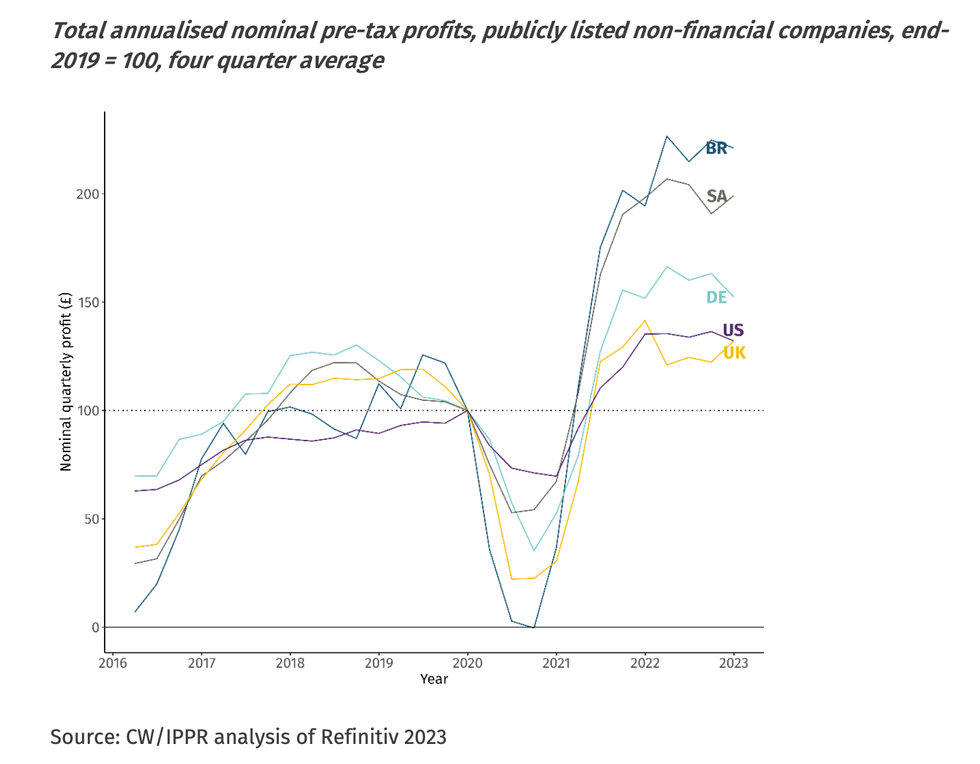
The researchers estimated that the profits of major corporations, bolstered by a relatively small number of companies, were at least 30% higher at the end of last year than they were at the end of 2019, prior to the coronavirus crisis.
As corporate executives and rich shareholders reaped the benefits of rising profits, ordinary people around the world suffered the consequences of soaring fuel, food, and housing costs.
"Our analysis of companies suggests many large firms, beyond just the commodities sector, are using their power to preserve their profit margins," said Chris Hayes, chief economist at Common Wealth and a co-author of the new report. "This pushes the shocks downstream to workers, consumers, and labor-intensive industries that are less able to absorb them."
The new report—which adds to a growing body of research on the role of corporate profits in driving inflation—offers several possible explanations for the coinciding rise of consumer prices and profit margins.
One explanation, the report says, is that "an inflationary environment might give firms cover to hike prices." Some corporate executives admitted on earnings calls that high inflation was good for business.
The report authors also suggested that corporations' growing market power gave them the ability to "increase prices more than inflation," thus maintaining or adding to their margins.
"Our research finds that markets aren't working efficiently, enabling large companies to make profits that likely amplified inflation," said Carsten Jung, a senior economist at IPPR and report co-author. "This has made the cost-of-living crisis worse for most people, and for many smaller firms across the economy."
Jung argued that economists have focused "too much on the labor market" as a source of inflationary pressure. The U.S. Federal Reserve and other central banks have explicitly targeted job markets by jacking up interest rates in a bid to rein in inflation, which has cooled substantially from its peak.
"In fact, most wage earners have taken real losses while many businesses protected their profit margins or even raised them," Jung noted. "We should be scrutinizing the role profits have played in amplifying inflation."
To prevent corporations from exploiting future inflation shocks, Jung and Hayes called for a "new international approach to taxing excess profits," which they said would help "reduce inefficient behavior by dominant corporations." The Economist estimated in July that excess corporate profits globally hit around $4 trillion over the past year.
Other interventions, such as price caps, could "help stabilize markets during economic emergencies," Jung and Hayes added.
"Such fiscal measures have been applied by about half of European economies in the last two years, and were found to be effective in helping to lower inflation," they wrote.
A pair of London-based think tanks released research Thursday showing that corporate profits contributed substantially to the high inflation that the United States, Germany, the United Kingdom, and other major nations experienced amid recent global shocks, including the coronavirus pandemic and Russia's invasion of Ukraine.
The new report by the Institute for Public Policy Research (IPPR) and Common Wealth argues that while corporate profiteering was not the "sole driver of inflation," the market dominance of a few powerful companies "amplified" economywide price increases.
Examining the profits of major firms listed on the stock exchanges of five countries, the analysis shows that many large corporations were able to keep their margins stable or even boost them—as in the case of major oil and gas companies like ExxonMobil—during pandemic-related turmoil and global energy market disruptions caused by Russia's attack on Ukraine.
The researchers estimated that the profits of major corporations, bolstered by a relatively small number of companies, were at least 30% higher at the end of last year than they were at the end of 2019, prior to the coronavirus crisis.
As corporate executives and rich shareholders reaped the benefits of rising profits, ordinary people around the world suffered the consequences of soaring fuel, food, and housing costs.
"Our analysis of companies suggests many large firms, beyond just the commodities sector, are using their power to preserve their profit margins," said Chris Hayes, chief economist at Common Wealth and a co-author of the new report. "This pushes the shocks downstream to workers, consumers, and labor-intensive industries that are less able to absorb them."
The new report—which adds to a growing body of research on the role of corporate profits in driving inflation—offers several possible explanations for the coinciding rise of consumer prices and profit margins.
One explanation, the report says, is that "an inflationary environment might give firms cover to hike prices." Some corporate executives admitted on earnings calls that high inflation was good for business.
The report authors also suggested that corporations' growing market power gave them the ability to "increase prices more than inflation," thus maintaining or adding to their margins.
"Our research finds that markets aren't working efficiently, enabling large companies to make profits that likely amplified inflation," said Carsten Jung, a senior economist at IPPR and report co-author. "This has made the cost-of-living crisis worse for most people, and for many smaller firms across the economy."
Jung argued that economists have focused "too much on the labor market" as a source of inflationary pressure. The U.S. Federal Reserve and other central banks have explicitly targeted job markets by jacking up interest rates in a bid to rein in inflation, which has cooled substantially from its peak.
"In fact, most wage earners have taken real losses while many businesses protected their profit margins or even raised them," Jung noted. "We should be scrutinizing the role profits have played in amplifying inflation."
To prevent corporations from exploiting future inflation shocks, Jung and Hayes called for a "new international approach to taxing excess profits," which they said would help "reduce inefficient behavior by dominant corporations." The Economist estimated in July that excess corporate profits globally hit around $4 trillion over the past year.
Other interventions, such as price caps, could "help stabilize markets during economic emergencies," Jung and Hayes added.
"Such fiscal measures have been applied by about half of European economies in the last two years, and were found to be effective in helping to lower inflation," they wrote.
A pair of London-based think tanks released research Thursday showing that corporate profits contributed substantially to the high inflation that the United States, Germany, the United Kingdom, and other major nations experienced amid recent global shocks, including the coronavirus pandemic and Russia's invasion of Ukraine.
The new report by the Institute for Public Policy Research (IPPR) and Common Wealth argues that while corporate profiteering was not the "sole driver of inflation," the market dominance of a few powerful companies "amplified" economywide price increases.
Examining the profits of major firms listed on the stock exchanges of five countries, the analysis shows that many large corporations were able to keep their margins stable or even boost them—as in the case of major oil and gas companies like ExxonMobil—during pandemic-related turmoil and global energy market disruptions caused by Russia's attack on Ukraine.
The researchers estimated that the profits of major corporations, bolstered by a relatively small number of companies, were at least 30% higher at the end of last year than they were at the end of 2019, prior to the coronavirus crisis.
As corporate executives and rich shareholders reaped the benefits of rising profits, ordinary people around the world suffered the consequences of soaring fuel, food, and housing costs.
"Our analysis of companies suggests many large firms, beyond just the commodities sector, are using their power to preserve their profit margins," said Chris Hayes, chief economist at Common Wealth and a co-author of the new report. "This pushes the shocks downstream to workers, consumers, and labor-intensive industries that are less able to absorb them."
The new report—which adds to a growing body of research on the role of corporate profits in driving inflation—offers several possible explanations for the coinciding rise of consumer prices and profit margins.
One explanation, the report says, is that "an inflationary environment might give firms cover to hike prices." Some corporate executives admitted on earnings calls that high inflation was good for business.
The report authors also suggested that corporations' growing market power gave them the ability to "increase prices more than inflation," thus maintaining or adding to their margins.
"Our research finds that markets aren't working efficiently, enabling large companies to make profits that likely amplified inflation," said Carsten Jung, a senior economist at IPPR and report co-author. "This has made the cost-of-living crisis worse for most people, and for many smaller firms across the economy."
Jung argued that economists have focused "too much on the labor market" as a source of inflationary pressure. The U.S. Federal Reserve and other central banks have explicitly targeted job markets by jacking up interest rates in a bid to rein in inflation, which has cooled substantially from its peak.
"In fact, most wage earners have taken real losses while many businesses protected their profit margins or even raised them," Jung noted. "We should be scrutinizing the role profits have played in amplifying inflation."
To prevent corporations from exploiting future inflation shocks, Jung and Hayes called for a "new international approach to taxing excess profits," which they said would help "reduce inefficient behavior by dominant corporations." The Economist estimated in July that excess corporate profits globally hit around $4 trillion over the past year.
Other interventions, such as price caps, could "help stabilize markets during economic emergencies," Jung and Hayes added.
"Such fiscal measures have been applied by about half of European economies in the last two years, and were found to be effective in helping to lower inflation," they wrote.

