SUBSCRIBE TO OUR FREE NEWSLETTER
Daily news & progressive opinion—funded by the people, not the corporations—delivered straight to your inbox.
5
#000000
#FFFFFF
To donate by check, phone, or other method, see our More Ways to Give page.
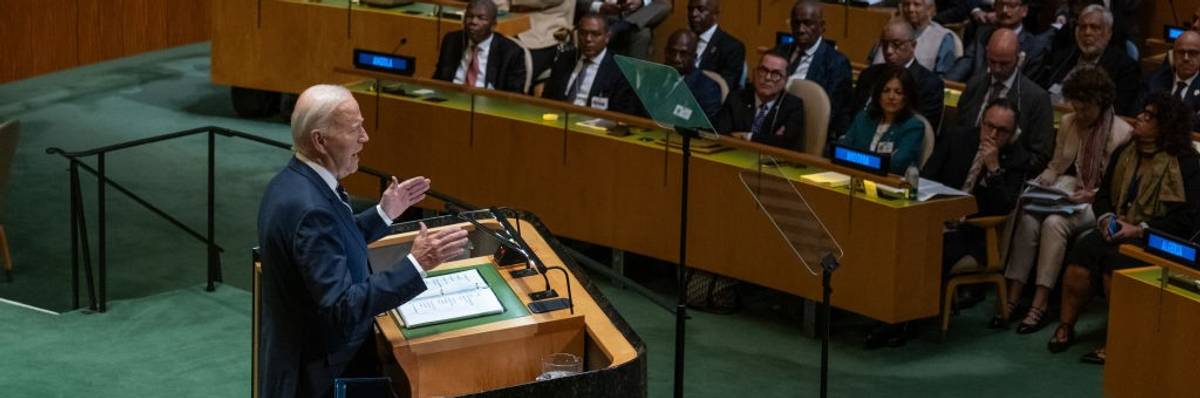
President Joe Biden claimed in a speech to the United Nations General Assembly on Tuesday that the U.S. was on track to halve greenhouse gas emissions by 2030, in line with its Paris agreement commitment, leading progressive critics to say "not true."
Biden's claim came as part of his farewell UNGA address as president, in which he laid out his accomplishments over the past four years.
The Biden administration has helped pushed the U.S. closer to reaching the goal of reducing emissions 50-52% from 2005 levels by 2030, but progressive critics say it hasn't pushed nearly hard enough, pointing to increased oil and gas production.
There is no known data to support Biden's claim. Rhodium Group, a nonpartisan energy consultancy frequently cited by the White House, recently found that the U.S. was on track to lower emissions by 32-43% below 2005 levels by 2030—"not enough for the U.S. to achieve its 2030 climate commitment... or deep decarbonization by mid-century."
Allie Rosenbluth, U.S. program manager at Oil Change International, which has warned that Rhodium's projections may if anything slightly overstate forthcoming emissions reductions, said that "unfortunately" Biden's claim was "not true."
"Biden presided over a historic oil and gas production expansion and our research shows that his administration's energy policies fall short of U.S. climate goals," she said in a statement released after the U.N. speech.
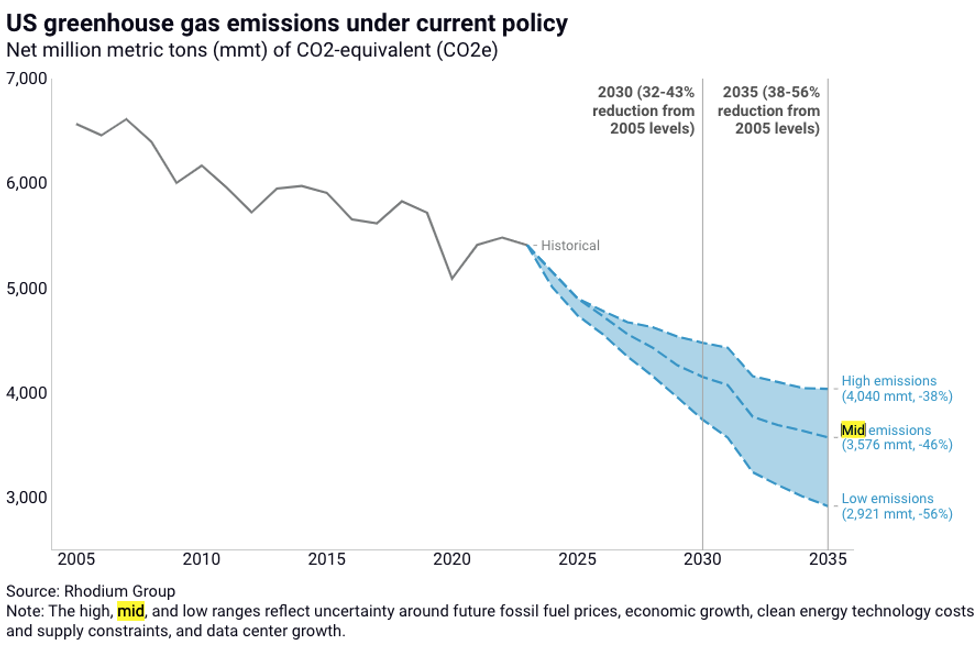 Rhodium Group, an energy consultancy, released these projections in July 2024.
Biden, who was also scheduled to give a climate-focused speech at the Bloomberg Global Business Forum on Tuesday afternoon, has called the Inflation Reduction Act of 2022 "the most significant climate legislation in the history of the world." The law did move the needle. Before it was passed, Rhodium's projections were for a 24-35% reduction in emissions by 2030.
However, progressives have argued that moving the needle further will require addressing corporate power. Kate Aronoff laid out the case in The New Republic on Tuesday:
Meeting our Paris agreement pledge would mean not just building on the modest progress made so far to invest in zero-carbon energy but adopting an altogether more confrontational approach overall. There's no way to limit electricity demand from data centers—fueled by Silicon's Valley rush into [artificial intelligence] and cryptocurrency—without placing constraints on their appetite for unchecked, unnecessary expansion.
Aronoff argued that Vice President Kamala Harris, the Democratic nominee, had shown no willingness to take such a confrontational approach, and was in fact going in the opposite direction.
"Harris pledged nearly the opposite this week on the campaign trail, vowing to help boost investment in AI and crypto if elected," Aronoff wrote. "Like Biden, she's also made keeping gasoline prices low central to her energy agenda, and boasted about its efforts to expand oil and gas production as an unalloyed good."
Just maintaining one of Rhodium's currently projected pathways is no given. The low emissions pathway laid out by the consultancy, leading to a 43% reduction, would require a lot of factors "breaking the right way," Aronoff wrote.
And that would only be possible if Harris won. Republican nominee Donald Trump would likely roll back a great deal of climate laws and regulations, increasing emissions above current projections, according to multiple analyses released by consultancies this year.
For now, Biden remains the president, and Rosenbluth of Oil Change International kept the focus on him and his legacy: "What President Biden does in the last months of his administration will determine his climate legacy. The clock is ticking for the Biden administration and for our planet."
The UNGA climate agenda includes discussions on a target, made at the COP28 climate summit in Dubai last year, to triple global renewable energy capacity. The International Energy Agency released a report this week indicating the goal was within reach.
A more contentious issue on the agenda is climate financing. Global South countries are disproportionately impacted by climate change, but rich nations have been unwilling to agree to a meaningful financing deal. The financing discussions are set to continue until the COP29 summit in Azerbaijan in November.
Rosenbluth said Biden needed to "pay up" and the U.S. was not paying its "fair share."
"The consequences of U.S. fossil fuel production are felt across the world in devastating storms, fires, and droughts," she said. "As the world's wealthiest country, largest producer and exporter of oil and gas, and biggest historical emitter, the United States has a moral and practical responsibility to finance a full, fast, funded, and fair phaseout of fossil fuels globally."
President Joe Biden claimed in a speech to the United Nations General Assembly on Tuesday that the U.S. was on track to halve greenhouse gas emissions by 2030, in line with its Paris agreement commitment, leading progressive critics to say "not true."
Biden's claim came as part of his farewell UNGA address as president, in which he laid out his accomplishments over the past four years.
The Biden administration has helped pushed the U.S. closer to reaching the goal of reducing emissions 50-52% from 2005 levels by 2030, but progressive critics say it hasn't pushed nearly hard enough, pointing to increased oil and gas production.
There is no known data to support Biden's claim. Rhodium Group, a nonpartisan energy consultancy frequently cited by the White House, recently found that the U.S. was on track to lower emissions by 32-43% below 2005 levels by 2030—"not enough for the U.S. to achieve its 2030 climate commitment... or deep decarbonization by mid-century."
Allie Rosenbluth, U.S. program manager at Oil Change International, which has warned that Rhodium's projections may if anything slightly overstate forthcoming emissions reductions, said that "unfortunately" Biden's claim was "not true."
"Biden presided over a historic oil and gas production expansion and our research shows that his administration's energy policies fall short of U.S. climate goals," she said in a statement released after the U.N. speech.
Rhodium Group, an energy consultancy, released these projections in July 2024.
Biden, who was also scheduled to give a climate-focused speech at the Bloomberg Global Business Forum on Tuesday afternoon, has called the Inflation Reduction Act of 2022 "the most significant climate legislation in the history of the world." The law did move the needle. Before it was passed, Rhodium's projections were for a 24-35% reduction in emissions by 2030.
However, progressives have argued that moving the needle further will require addressing corporate power. Kate Aronoff laid out the case in The New Republic on Tuesday:
Meeting our Paris agreement pledge would mean not just building on the modest progress made so far to invest in zero-carbon energy but adopting an altogether more confrontational approach overall. There's no way to limit electricity demand from data centers—fueled by Silicon's Valley rush into [artificial intelligence] and cryptocurrency—without placing constraints on their appetite for unchecked, unnecessary expansion.
Aronoff argued that Vice President Kamala Harris, the Democratic nominee, had shown no willingness to take such a confrontational approach, and was in fact going in the opposite direction.
"Harris pledged nearly the opposite this week on the campaign trail, vowing to help boost investment in AI and crypto if elected," Aronoff wrote. "Like Biden, she's also made keeping gasoline prices low central to her energy agenda, and boasted about its efforts to expand oil and gas production as an unalloyed good."
Just maintaining one of Rhodium's currently projected pathways is no given. The low emissions pathway laid out by the consultancy, leading to a 43% reduction, would require a lot of factors "breaking the right way," Aronoff wrote.
And that would only be possible if Harris won. Republican nominee Donald Trump would likely roll back a great deal of climate laws and regulations, increasing emissions above current projections, according to multiple analyses released by consultancies this year.
For now, Biden remains the president, and Rosenbluth of Oil Change International kept the focus on him and his legacy: "What President Biden does in the last months of his administration will determine his climate legacy. The clock is ticking for the Biden administration and for our planet."
The UNGA climate agenda includes discussions on a target, made at the COP28 climate summit in Dubai last year, to triple global renewable energy capacity. The International Energy Agency released a report this week indicating the goal was within reach.
A more contentious issue on the agenda is climate financing. Global South countries are disproportionately impacted by climate change, but rich nations have been unwilling to agree to a meaningful financing deal. The financing discussions are set to continue until the COP29 summit in Azerbaijan in November.
Rosenbluth said Biden needed to "pay up" and the U.S. was not paying its "fair share."
"The consequences of U.S. fossil fuel production are felt across the world in devastating storms, fires, and droughts," she said. "As the world's wealthiest country, largest producer and exporter of oil and gas, and biggest historical emitter, the United States has a moral and practical responsibility to finance a full, fast, funded, and fair phaseout of fossil fuels globally."
President Joe Biden claimed in a speech to the United Nations General Assembly on Tuesday that the U.S. was on track to halve greenhouse gas emissions by 2030, in line with its Paris agreement commitment, leading progressive critics to say "not true."
Biden's claim came as part of his farewell UNGA address as president, in which he laid out his accomplishments over the past four years.
The Biden administration has helped pushed the U.S. closer to reaching the goal of reducing emissions 50-52% from 2005 levels by 2030, but progressive critics say it hasn't pushed nearly hard enough, pointing to increased oil and gas production.
There is no known data to support Biden's claim. Rhodium Group, a nonpartisan energy consultancy frequently cited by the White House, recently found that the U.S. was on track to lower emissions by 32-43% below 2005 levels by 2030—"not enough for the U.S. to achieve its 2030 climate commitment... or deep decarbonization by mid-century."
Allie Rosenbluth, U.S. program manager at Oil Change International, which has warned that Rhodium's projections may if anything slightly overstate forthcoming emissions reductions, said that "unfortunately" Biden's claim was "not true."
"Biden presided over a historic oil and gas production expansion and our research shows that his administration's energy policies fall short of U.S. climate goals," she said in a statement released after the U.N. speech.
Rhodium Group, an energy consultancy, released these projections in July 2024.
Biden, who was also scheduled to give a climate-focused speech at the Bloomberg Global Business Forum on Tuesday afternoon, has called the Inflation Reduction Act of 2022 "the most significant climate legislation in the history of the world." The law did move the needle. Before it was passed, Rhodium's projections were for a 24-35% reduction in emissions by 2030.
However, progressives have argued that moving the needle further will require addressing corporate power. Kate Aronoff laid out the case in The New Republic on Tuesday:
Meeting our Paris agreement pledge would mean not just building on the modest progress made so far to invest in zero-carbon energy but adopting an altogether more confrontational approach overall. There's no way to limit electricity demand from data centers—fueled by Silicon's Valley rush into [artificial intelligence] and cryptocurrency—without placing constraints on their appetite for unchecked, unnecessary expansion.
Aronoff argued that Vice President Kamala Harris, the Democratic nominee, had shown no willingness to take such a confrontational approach, and was in fact going in the opposite direction.
"Harris pledged nearly the opposite this week on the campaign trail, vowing to help boost investment in AI and crypto if elected," Aronoff wrote. "Like Biden, she's also made keeping gasoline prices low central to her energy agenda, and boasted about its efforts to expand oil and gas production as an unalloyed good."
Just maintaining one of Rhodium's currently projected pathways is no given. The low emissions pathway laid out by the consultancy, leading to a 43% reduction, would require a lot of factors "breaking the right way," Aronoff wrote.
And that would only be possible if Harris won. Republican nominee Donald Trump would likely roll back a great deal of climate laws and regulations, increasing emissions above current projections, according to multiple analyses released by consultancies this year.
For now, Biden remains the president, and Rosenbluth of Oil Change International kept the focus on him and his legacy: "What President Biden does in the last months of his administration will determine his climate legacy. The clock is ticking for the Biden administration and for our planet."
The UNGA climate agenda includes discussions on a target, made at the COP28 climate summit in Dubai last year, to triple global renewable energy capacity. The International Energy Agency released a report this week indicating the goal was within reach.
A more contentious issue on the agenda is climate financing. Global South countries are disproportionately impacted by climate change, but rich nations have been unwilling to agree to a meaningful financing deal. The financing discussions are set to continue until the COP29 summit in Azerbaijan in November.
Rosenbluth said Biden needed to "pay up" and the U.S. was not paying its "fair share."
"The consequences of U.S. fossil fuel production are felt across the world in devastating storms, fires, and droughts," she said. "As the world's wealthiest country, largest producer and exporter of oil and gas, and biggest historical emitter, the United States has a moral and practical responsibility to finance a full, fast, funded, and fair phaseout of fossil fuels globally."