SUBSCRIBE TO OUR FREE NEWSLETTER
Daily news & progressive opinion—funded by the people, not the corporations—delivered straight to your inbox.
5
#000000
#FFFFFF
To donate by check, phone, or other method, see our More Ways to Give page.
Daily news & progressive opinion—funded by the people, not the corporations—delivered straight to your inbox.

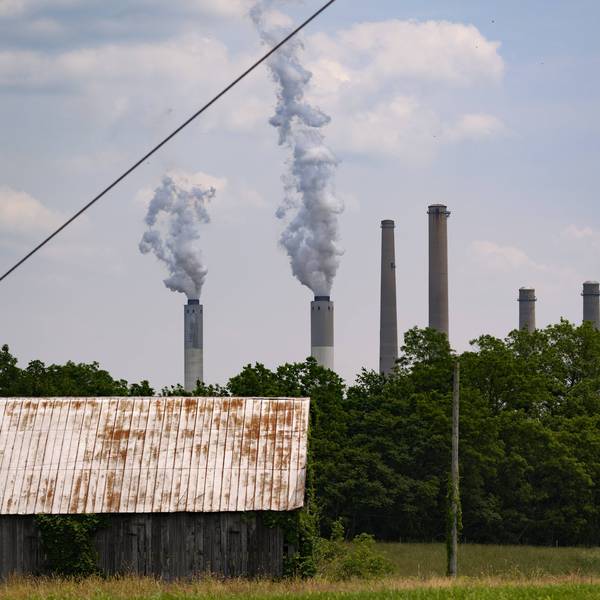
The flue-gas stacks of Mill Creek Generating Station, a coal-fired power plant, are seen from the Valley Village neighborhood on February 14, 2026 in Louisville, Kentucky.
"The repeal of these protections will mean more asthma attacks, emergency room visits, and premature deaths," said more than two dozen environmental and health groups.
A coalition of more than two dozen environmental and health groups sued the Trump administration on Monday for repealing Environmental Protection Agency rules that curbed dangerous chemical pollution from coal-fired power plants.
As part of President Donald Trump's efforts to dramatically expand the use of coal, the EPA last month finalized the repeal of the 2024 Mercury and Air Toxics Standards (MATS), which tightened existing restrictions on the emission of mercury, lead, and other brain-damaging chemicals from power plants.
Coal emits more planet-heating carbon dioxide per unit than any other fossil fuel. Coal plants also release a slew of other chemicals that can cause numerous health complications, including asthma, lung cancer, and respiratory infections.
The EPA says coal-fired power plants are also the single largest source of airborne mercury emissions, which can impair cognitive development, especially in young children.
MATS was created in 2012 to counter these effects and proved quite successful. Within six years of its enactment by the EPA, the amount of toxic mercury being emitted into the atmosphere from energy plants had declined by 90%, according to an agency report.
The Trump EPA has not repealed MATS entirely. Instead, it has targeted amendments enacted by the Biden administration in 2024 that lowered caps on mercury emissions, as well as on other toxic chemicals such as nickel and arsenic.
The EPA has also repealed rules requiring constant monitoring of toxic chemical emissions. Instead of installing expensive systems to track their outputs 24/7, plants can revert to conducting occasional checks.
The repeal came after the administration had already given dozens of coal plants a two-year exemption from the standards last April, even though, according to the agency, 93% were already on track to meet the requirements.
According to an analysis of EPA data by the Natural Resources Defense Council (NRDC) last month, sulfur dioxide pollution from coal plants increased by 18% last year, with those exempt from the rules surging almost twice as much as those not exempt.
The lawsuit, filed in the US Court of Appeals for the District of Columbia, argues that the Trump administration's actions violate the Clean Air Act, ignore the scientific record, and endanger communities living near power plants.
The suit is backed by groups including the NRDC, the Sierra Club, and the Environmental Defense Fund, as well as the American Academy of Pediatrics and the American Lung Association.
"The repeal of these protections will mean more asthma attacks, emergency room visits, and premature deaths," the groups said in a statement challenging the repeal. "This administration is not just rolling back rules, it is eliminating the monitoring infrastructure needed to know what is coming out of these smokestacks in the first place."
"It is allowing coal plants to spew out more neurotoxic mercury into our air and food supply, while simultaneously keeping the communities most at risk in the dark about how serious that threat is," they said. "This is a betrayal of the EPA’s core mission.”
Dear Common Dreams reader, It’s been nearly 30 years since I co-founded Common Dreams with my late wife, Lina Newhouser. We had the radical notion that journalism should serve the public good, not corporate profits. It was clear to us from the outset what it would take to build such a project. No paid advertisements. No corporate sponsors. No millionaire publisher telling us what to think or do. Many people said we wouldn't last a year, but we proved those doubters wrong. Together with a tremendous team of journalists and dedicated staff, we built an independent media outlet free from the constraints of profits and corporate control. Our mission has always been simple: To inform. To inspire. To ignite change for the common good. Building Common Dreams was not easy. Our survival was never guaranteed. When you take on the most powerful forces—Wall Street greed, fossil fuel industry destruction, Big Tech lobbyists, and uber-rich oligarchs who have spent billions upon billions rigging the economy and democracy in their favor—the only bulwark you have is supporters who believe in your work. But here’s the urgent message from me today. It's never been this bad out there. And it's never been this hard to keep us going. At the very moment Common Dreams is most needed, the threats we face are intensifying. We need your support now more than ever. We don't accept corporate advertising and never will. We don't have a paywall because we don't think people should be blocked from critical news based on their ability to pay. Everything we do is funded by the donations of readers like you. When everyone does the little they can afford, we are strong. But if that support retreats or dries up, so do we. Will you donate now to make sure Common Dreams not only survives but thrives? —Craig Brown, Co-founder |
A coalition of more than two dozen environmental and health groups sued the Trump administration on Monday for repealing Environmental Protection Agency rules that curbed dangerous chemical pollution from coal-fired power plants.
As part of President Donald Trump's efforts to dramatically expand the use of coal, the EPA last month finalized the repeal of the 2024 Mercury and Air Toxics Standards (MATS), which tightened existing restrictions on the emission of mercury, lead, and other brain-damaging chemicals from power plants.
Coal emits more planet-heating carbon dioxide per unit than any other fossil fuel. Coal plants also release a slew of other chemicals that can cause numerous health complications, including asthma, lung cancer, and respiratory infections.
The EPA says coal-fired power plants are also the single largest source of airborne mercury emissions, which can impair cognitive development, especially in young children.
MATS was created in 2012 to counter these effects and proved quite successful. Within six years of its enactment by the EPA, the amount of toxic mercury being emitted into the atmosphere from energy plants had declined by 90%, according to an agency report.
The Trump EPA has not repealed MATS entirely. Instead, it has targeted amendments enacted by the Biden administration in 2024 that lowered caps on mercury emissions, as well as on other toxic chemicals such as nickel and arsenic.
The EPA has also repealed rules requiring constant monitoring of toxic chemical emissions. Instead of installing expensive systems to track their outputs 24/7, plants can revert to conducting occasional checks.
The repeal came after the administration had already given dozens of coal plants a two-year exemption from the standards last April, even though, according to the agency, 93% were already on track to meet the requirements.
According to an analysis of EPA data by the Natural Resources Defense Council (NRDC) last month, sulfur dioxide pollution from coal plants increased by 18% last year, with those exempt from the rules surging almost twice as much as those not exempt.
The lawsuit, filed in the US Court of Appeals for the District of Columbia, argues that the Trump administration's actions violate the Clean Air Act, ignore the scientific record, and endanger communities living near power plants.
The suit is backed by groups including the NRDC, the Sierra Club, and the Environmental Defense Fund, as well as the American Academy of Pediatrics and the American Lung Association.
"The repeal of these protections will mean more asthma attacks, emergency room visits, and premature deaths," the groups said in a statement challenging the repeal. "This administration is not just rolling back rules, it is eliminating the monitoring infrastructure needed to know what is coming out of these smokestacks in the first place."
"It is allowing coal plants to spew out more neurotoxic mercury into our air and food supply, while simultaneously keeping the communities most at risk in the dark about how serious that threat is," they said. "This is a betrayal of the EPA’s core mission.”
A coalition of more than two dozen environmental and health groups sued the Trump administration on Monday for repealing Environmental Protection Agency rules that curbed dangerous chemical pollution from coal-fired power plants.
As part of President Donald Trump's efforts to dramatically expand the use of coal, the EPA last month finalized the repeal of the 2024 Mercury and Air Toxics Standards (MATS), which tightened existing restrictions on the emission of mercury, lead, and other brain-damaging chemicals from power plants.
Coal emits more planet-heating carbon dioxide per unit than any other fossil fuel. Coal plants also release a slew of other chemicals that can cause numerous health complications, including asthma, lung cancer, and respiratory infections.
The EPA says coal-fired power plants are also the single largest source of airborne mercury emissions, which can impair cognitive development, especially in young children.
MATS was created in 2012 to counter these effects and proved quite successful. Within six years of its enactment by the EPA, the amount of toxic mercury being emitted into the atmosphere from energy plants had declined by 90%, according to an agency report.
The Trump EPA has not repealed MATS entirely. Instead, it has targeted amendments enacted by the Biden administration in 2024 that lowered caps on mercury emissions, as well as on other toxic chemicals such as nickel and arsenic.
The EPA has also repealed rules requiring constant monitoring of toxic chemical emissions. Instead of installing expensive systems to track their outputs 24/7, plants can revert to conducting occasional checks.
The repeal came after the administration had already given dozens of coal plants a two-year exemption from the standards last April, even though, according to the agency, 93% were already on track to meet the requirements.
According to an analysis of EPA data by the Natural Resources Defense Council (NRDC) last month, sulfur dioxide pollution from coal plants increased by 18% last year, with those exempt from the rules surging almost twice as much as those not exempt.
The lawsuit, filed in the US Court of Appeals for the District of Columbia, argues that the Trump administration's actions violate the Clean Air Act, ignore the scientific record, and endanger communities living near power plants.
The suit is backed by groups including the NRDC, the Sierra Club, and the Environmental Defense Fund, as well as the American Academy of Pediatrics and the American Lung Association.
"The repeal of these protections will mean more asthma attacks, emergency room visits, and premature deaths," the groups said in a statement challenging the repeal. "This administration is not just rolling back rules, it is eliminating the monitoring infrastructure needed to know what is coming out of these smokestacks in the first place."
"It is allowing coal plants to spew out more neurotoxic mercury into our air and food supply, while simultaneously keeping the communities most at risk in the dark about how serious that threat is," they said. "This is a betrayal of the EPA’s core mission.”