SUBSCRIBE TO OUR FREE NEWSLETTER
Daily news & progressive opinion—funded by the people, not the corporations—delivered straight to your inbox.
5
#000000
#FFFFFF
To donate by check, phone, or other method, see our More Ways to Give page.
Daily news & progressive opinion—funded by the people, not the corporations—delivered straight to your inbox.
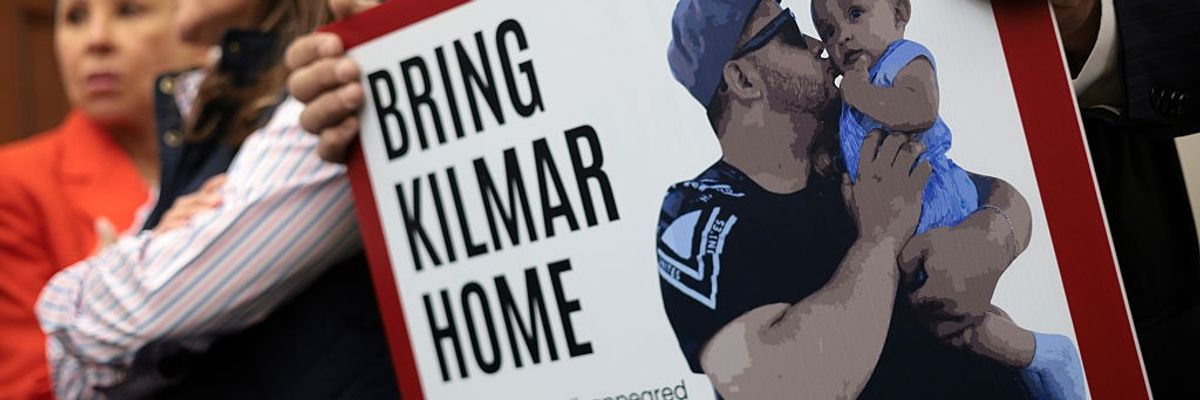
A member of the Congressional Hispanic Caucus holds a picture of Kilmar Abrego Garcia during a news conference to discuss Abrego Garcia's arrest and deportation d at Cannon House Office Building on April 9, 2025 in Washington, DC.
The judge ruled Abrego Garcia had presented "insufficient evidence" to show that the Trump administration planned his "imminent removal to Uganda."
Kilmar Ábrego García, the man whom the Trump administration wrongly deported to El Salvador earlier this year, has been denied a bid to reopen his asylum case.
The Washington Post reported on Wednesday that Immigration Judge Philip P. Taylor rejected Ábrego García's asylum request, as he found "insufficient evidence" to show that the Trump administration planned his "imminent removal to Uganda," even though the US Department of Homeland Security wrote in a social media post in late August that he would be processed for removal to that nation.
In explaining his ruling, Taylor noted that the government had not yet filed any paperwork to send Ábrego García to Uganda, and a government attorney said that deporting him to Uganda was merely a possibility not a foregone conclusion.
Ábrego García now has 30 days to appeal to the Board of Immigration Appeals.
The Trump administration this past June complied with a Supreme Court order to facilitate Ábrego García's return to United States after it acknowledged months earlier that he had been improperly deported to El Salvador, where a US immigration judge had ruled years earlier he faced direct danger from gang threats against him and his family.
While imprisoned in El Salvador’s infamous Terrorism Confinement Center (CECOT), Ábrego García's attorneys allege he was subjected to physical and psychological abuse "including but not limited to severe beatings, severe sleep deprivation, inadequate nutrition, and psychological torture."
Upon his return, the US Department of Justice promptly hit him with human smuggling charges to which he has pleaded not guilty.
President Donald Trump and Attorney General Pam Bondi have also accused Ábrego García of being a member of the gang MS-13, although they have produced no evidence to back up that assertion.
This country and this world are at a monumental crossroads. US voters have an opportunity to beat back the forces of fascism and confront the billionaires who are rigging the economy, our media system, and our democracy, making it increasingly impossible for ordinary people to get by. We’re not just talking about the election. We’re talking about what must be done once these fascist elements are vanquished from power. We need a bolder set of solutions than what either major party has so far been willing to offer and a working-class movement ready to fight like hell for it. Trump didn't emerge from nowhere. The conditions that fueled MAGA authoritarianism were created by decades of radical neoliberal economic policies and a corrupt political system dominated by corporate interests. They slashed taxes on the super-rich, promising that the benefits would trickle down. They said giveaways to the corporate titans would make life more affordable for the rest of us. It was all bullshit. And when a bitter, betrayed populace searches for someone to blame, right-wing demagogues have little trouble finding scapegoats. People know when they're being lied to, but you won't hear any of this from the corporate media. Only independent journalism—powered and funded by people who believe in building a better world—can deliver truly trustworthy daily news. If you share our vision, please contribute whatever you can to sustain our work. |
Kilmar Ábrego García, the man whom the Trump administration wrongly deported to El Salvador earlier this year, has been denied a bid to reopen his asylum case.
The Washington Post reported on Wednesday that Immigration Judge Philip P. Taylor rejected Ábrego García's asylum request, as he found "insufficient evidence" to show that the Trump administration planned his "imminent removal to Uganda," even though the US Department of Homeland Security wrote in a social media post in late August that he would be processed for removal to that nation.
In explaining his ruling, Taylor noted that the government had not yet filed any paperwork to send Ábrego García to Uganda, and a government attorney said that deporting him to Uganda was merely a possibility not a foregone conclusion.
Ábrego García now has 30 days to appeal to the Board of Immigration Appeals.
The Trump administration this past June complied with a Supreme Court order to facilitate Ábrego García's return to United States after it acknowledged months earlier that he had been improperly deported to El Salvador, where a US immigration judge had ruled years earlier he faced direct danger from gang threats against him and his family.
While imprisoned in El Salvador’s infamous Terrorism Confinement Center (CECOT), Ábrego García's attorneys allege he was subjected to physical and psychological abuse "including but not limited to severe beatings, severe sleep deprivation, inadequate nutrition, and psychological torture."
Upon his return, the US Department of Justice promptly hit him with human smuggling charges to which he has pleaded not guilty.
President Donald Trump and Attorney General Pam Bondi have also accused Ábrego García of being a member of the gang MS-13, although they have produced no evidence to back up that assertion.