SUBSCRIBE TO OUR FREE NEWSLETTER
Daily news & progressive opinion—funded by the people, not the corporations—delivered straight to your inbox.
5
#000000
#FFFFFF
To donate by check, phone, or other method, see our More Ways to Give page.
Daily news & progressive opinion—funded by the people, not the corporations—delivered straight to your inbox.
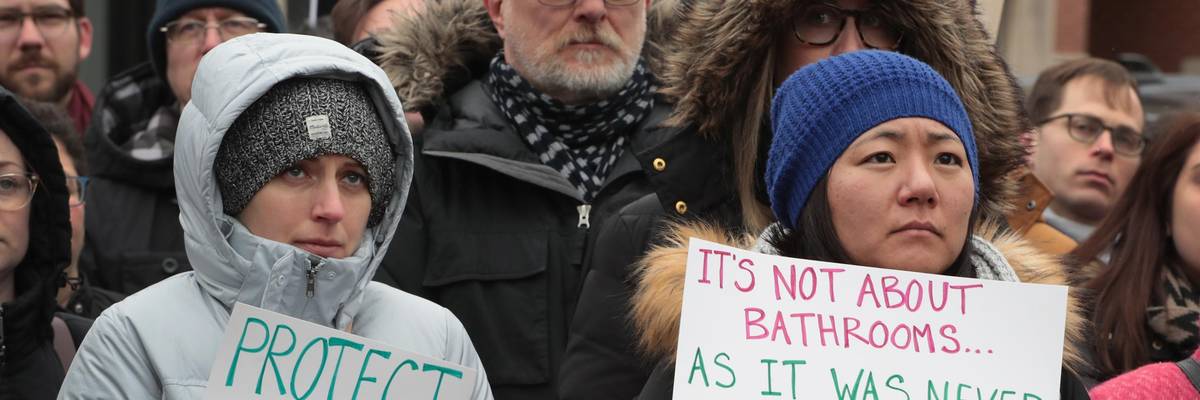
Demonstrators protest for transgender rights on February 25, 2017 in Chicago, Illinois. (Photo: Scott Olson/Getty Images)
An analysis released Monday by NPR details what one rights advocacy group called the Republican Party's "obsession" with curtailing the rights of transgender people, with U.S. state legislators proposing more than 300 pieces of legislation targeting the community over the past two years.
Lawmakers in every region of the United States have put forward a total of 306 anti-trans bills since 2020, with 86% of the bills focusing on transgender youths.
" Right-wing state lawmakers are obsessed with taking away the rights of trans people and we're obsessed with knocking them out of public office," said Agenda PAC, which works to hold anti-LGBTQ+ politicians accountable.
"Frankly, I really do think that the end goal is to ban trans-affirming medical care, period... which should scare people a lot more than it does because access to gender-affirming care is fundamentally an issue of bodily autonomy."
Fifteen percent of the bills have become law, including total bans on gender-affirming healthcare for transgender youths in Alabama and Arkansas; bans on students using bathrooms and locker rooms that correspond to their gender rather than sex assigned at birth in Tennessee, Alabama, and Oklahoma; and similar restrictions for school sports teams in at least 19 states.
Some of the proposals are based in--and threaten to perpetuate--misinformation about transgender people, including a Tennessee law which bars medical professionals from providing hormone treatments to prepubescent children. Experts on transgender health only recommend hormone treatment once a child has entered puberty.
"Frankly, I really do think that the end goal is to ban trans-affirming medical care, period... which should scare people a lot more than it does because access to gender-affirming care is fundamentally an issue of bodily autonomy," Alex Petrovnia, president of the Trans Formations Project, told NPR.
Lawmakers in more than half of states have sought to restrict access to gender-affirming care, despite evidence that such bans are harmful to the safety of young transgender people.
The Trevor Project, which advocates for LGBTQ+ youth, released a poll in January showing that 85% of transgender and nonbinary young people felt their mental health was negatively affected by legislation targeting their rights and their ability to live according to their gender.
A study by the University of Washington found earlier this year that transgender and nonbinary youth, ranging in age from 13 to 20, were 60% less likely to experience depression and 73% less likely to have suicidal thoughts and engage in self-harm if they received gender-affirming care including puberty blockers and hormonal treatment.
NPR's reporting reveals that "trans people--youth especially--continue to be under attack," said the Gender Justice Fund, an advocacy group based in Philadelphia.
Rep. Pramila Jayapal (D-Wash.) noted that the Equality Act, which would prohibit discrimination based on sex, sexual orientation, and gender identity, has passed in the U.S. House, but has yet to pass in the Senate due to the legislative filibuster, which effectively requires 60 votes for bills to pass instead of a simple majority.
"Trans rights are human rights," said Jayapal, who is the mother of a transgender child.
Dear Common Dreams reader, It’s been nearly 30 years since I co-founded Common Dreams with my late wife, Lina Newhouser. We had the radical notion that journalism should serve the public good, not corporate profits. It was clear to us from the outset what it would take to build such a project. No paid advertisements. No corporate sponsors. No millionaire publisher telling us what to think or do. Many people said we wouldn't last a year, but we proved those doubters wrong. Together with a tremendous team of journalists and dedicated staff, we built an independent media outlet free from the constraints of profits and corporate control. Our mission has always been simple: To inform. To inspire. To ignite change for the common good. Building Common Dreams was not easy. Our survival was never guaranteed. When you take on the most powerful forces—Wall Street greed, fossil fuel industry destruction, Big Tech lobbyists, and uber-rich oligarchs who have spent billions upon billions rigging the economy and democracy in their favor—the only bulwark you have is supporters who believe in your work. But here’s the urgent message from me today. It's never been this bad out there. And it's never been this hard to keep us going. At the very moment Common Dreams is most needed, the threats we face are intensifying. We need your support now more than ever. We don't accept corporate advertising and never will. We don't have a paywall because we don't think people should be blocked from critical news based on their ability to pay. Everything we do is funded by the donations of readers like you. When everyone does the little they can afford, we are strong. But if that support retreats or dries up, so do we. Will you donate now to make sure Common Dreams not only survives but thrives? —Craig Brown, Co-founder |
An analysis released Monday by NPR details what one rights advocacy group called the Republican Party's "obsession" with curtailing the rights of transgender people, with U.S. state legislators proposing more than 300 pieces of legislation targeting the community over the past two years.
Lawmakers in every region of the United States have put forward a total of 306 anti-trans bills since 2020, with 86% of the bills focusing on transgender youths.
" Right-wing state lawmakers are obsessed with taking away the rights of trans people and we're obsessed with knocking them out of public office," said Agenda PAC, which works to hold anti-LGBTQ+ politicians accountable.
"Frankly, I really do think that the end goal is to ban trans-affirming medical care, period... which should scare people a lot more than it does because access to gender-affirming care is fundamentally an issue of bodily autonomy."
Fifteen percent of the bills have become law, including total bans on gender-affirming healthcare for transgender youths in Alabama and Arkansas; bans on students using bathrooms and locker rooms that correspond to their gender rather than sex assigned at birth in Tennessee, Alabama, and Oklahoma; and similar restrictions for school sports teams in at least 19 states.
Some of the proposals are based in--and threaten to perpetuate--misinformation about transgender people, including a Tennessee law which bars medical professionals from providing hormone treatments to prepubescent children. Experts on transgender health only recommend hormone treatment once a child has entered puberty.
"Frankly, I really do think that the end goal is to ban trans-affirming medical care, period... which should scare people a lot more than it does because access to gender-affirming care is fundamentally an issue of bodily autonomy," Alex Petrovnia, president of the Trans Formations Project, told NPR.
Lawmakers in more than half of states have sought to restrict access to gender-affirming care, despite evidence that such bans are harmful to the safety of young transgender people.
The Trevor Project, which advocates for LGBTQ+ youth, released a poll in January showing that 85% of transgender and nonbinary young people felt their mental health was negatively affected by legislation targeting their rights and their ability to live according to their gender.
A study by the University of Washington found earlier this year that transgender and nonbinary youth, ranging in age from 13 to 20, were 60% less likely to experience depression and 73% less likely to have suicidal thoughts and engage in self-harm if they received gender-affirming care including puberty blockers and hormonal treatment.
NPR's reporting reveals that "trans people--youth especially--continue to be under attack," said the Gender Justice Fund, an advocacy group based in Philadelphia.
Rep. Pramila Jayapal (D-Wash.) noted that the Equality Act, which would prohibit discrimination based on sex, sexual orientation, and gender identity, has passed in the U.S. House, but has yet to pass in the Senate due to the legislative filibuster, which effectively requires 60 votes for bills to pass instead of a simple majority.
"Trans rights are human rights," said Jayapal, who is the mother of a transgender child.
An analysis released Monday by NPR details what one rights advocacy group called the Republican Party's "obsession" with curtailing the rights of transgender people, with U.S. state legislators proposing more than 300 pieces of legislation targeting the community over the past two years.
Lawmakers in every region of the United States have put forward a total of 306 anti-trans bills since 2020, with 86% of the bills focusing on transgender youths.
" Right-wing state lawmakers are obsessed with taking away the rights of trans people and we're obsessed with knocking them out of public office," said Agenda PAC, which works to hold anti-LGBTQ+ politicians accountable.
"Frankly, I really do think that the end goal is to ban trans-affirming medical care, period... which should scare people a lot more than it does because access to gender-affirming care is fundamentally an issue of bodily autonomy."
Fifteen percent of the bills have become law, including total bans on gender-affirming healthcare for transgender youths in Alabama and Arkansas; bans on students using bathrooms and locker rooms that correspond to their gender rather than sex assigned at birth in Tennessee, Alabama, and Oklahoma; and similar restrictions for school sports teams in at least 19 states.
Some of the proposals are based in--and threaten to perpetuate--misinformation about transgender people, including a Tennessee law which bars medical professionals from providing hormone treatments to prepubescent children. Experts on transgender health only recommend hormone treatment once a child has entered puberty.
"Frankly, I really do think that the end goal is to ban trans-affirming medical care, period... which should scare people a lot more than it does because access to gender-affirming care is fundamentally an issue of bodily autonomy," Alex Petrovnia, president of the Trans Formations Project, told NPR.
Lawmakers in more than half of states have sought to restrict access to gender-affirming care, despite evidence that such bans are harmful to the safety of young transgender people.
The Trevor Project, which advocates for LGBTQ+ youth, released a poll in January showing that 85% of transgender and nonbinary young people felt their mental health was negatively affected by legislation targeting their rights and their ability to live according to their gender.
A study by the University of Washington found earlier this year that transgender and nonbinary youth, ranging in age from 13 to 20, were 60% less likely to experience depression and 73% less likely to have suicidal thoughts and engage in self-harm if they received gender-affirming care including puberty blockers and hormonal treatment.
NPR's reporting reveals that "trans people--youth especially--continue to be under attack," said the Gender Justice Fund, an advocacy group based in Philadelphia.
Rep. Pramila Jayapal (D-Wash.) noted that the Equality Act, which would prohibit discrimination based on sex, sexual orientation, and gender identity, has passed in the U.S. House, but has yet to pass in the Senate due to the legislative filibuster, which effectively requires 60 votes for bills to pass instead of a simple majority.
"Trans rights are human rights," said Jayapal, who is the mother of a transgender child.