SUBSCRIBE TO OUR FREE NEWSLETTER
Daily news & progressive opinion—funded by the people, not the corporations—delivered straight to your inbox.
5
#000000
#FFFFFF
To donate by check, phone, or other method, see our More Ways to Give page.
Daily news & progressive opinion—funded by the people, not the corporations—delivered straight to your inbox.
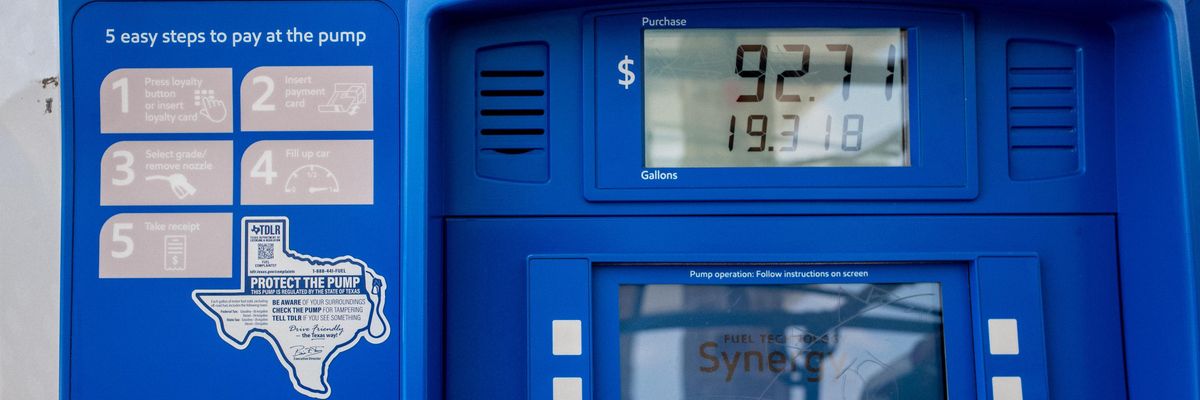
An ExxonMobil gas pumping station displays a purchase on June 9, 2022 in Houston, Texas.
Progressive demands for congressional action to curb corporate monopoly power were renewed Friday after federal data confirmed that certain heavily consolidated industries are continuing to rake in massive profits while working households struggle under the weight of high prices.
The latest figures from the Bureau for Economic Analysis show that the profits of the U.S. coal and oil industry increased 340% between the first and second quarters of 2022. Companies selling petroleum and coal products made an estimated $49.7 billion in profits from April to June, compared with $11.3 billion from January to March.
Meanwhile, executives in the nation's transportation and warehousing sector enjoyed a nearly 40% increase in profits during the same time period, pocketing $124.4 billion in the second quarter after taking home $89.4 billion over the first three months of the year.
"We've heard directly from executives in the sectors that families depend on--from oil, to auto shops, to airlines--that inflation has been good for business," Rakeen Mabud, chief economist and managing director of policy and research at the Groundwork Collaborative, said in a statement.
"The latest corporate profit data shows their price strategies are bearing fruit," she added.
Through its extensive research on corporate earnings calls, Groundwork has documented what executives have been saying about their sky-high profits. The progressive think tank compiled some key findings from its analyses of oil, motor vehicle, airline, and commercial real estate giants:
Although retailers started charging more for gasoline in 2021 as consumer demand, which plummeted during the early stages of the Covid-19 pandemic, began to outpace supply--deliberately suppressed at the behest of shareholders to boost profits--price gouging at the pump has intensified since Russia invaded Ukraine in late February.
While receiving an average of $2.8 billion dollars per day in public subsidies, the same fossil fuel corporations that are harming the planet have capitalized on war--jacking up prices and rewarding investors with massive stock buybacks.
An overwhelming 80% of U.S. voters--including 73% of Republicans--said they would support the Big Oil Windfall Profits Tax when congressional Democrats introduced the legislation in March.
Dozens of progressive advocacy groups and lawmakers have urged President Joe Biden, House Speaker Nancy Pelosi (D-Calif.), and Senate Majority Leader Chuck Schumer (D-N.Y.) to support the measure, which would redistribute an estimated $45 billion to U.S. households.
Despite Sen. Elizabeth Warren's (D-Mass.) argument earlier this year that the proposal can help Democrats win in the quickly approaching midterms, it hasn't gone anywhere in the existing Congress.
A new poll finds that the Democratic Party's "biggest gains" in voter support come when they "take on the corporate monopolies that are driving up prices, despite making super profits." Amid the ongoing cost-of-living crisis, the current majority party can highlight how the GOP minority's obstructionism is "doing big corporations' bidding on price-gouging and taxes."
The survey suggests that even if they don't have a sufficient number of votes at the moment, Democrats should publicly and aggressively push for the kinds of progressive economic policies they could enact if they win big enough House and Senate majorities in November's pivotal elections.
On Friday, Mabud stressed that "policymakers must address corporate profiteering as a driver of inflation by reining in megacorporations and addressing the unsustainably high prices facing families around the country."
This echoes the case the economist made during her congressional testimony last week, when she told House lawmakers that the Federal Reserve's interest rate hikes, which threaten to put hundreds of thousands of vulnerable workers out of a job, "will not address any of the underlying causes of our supply shortages and do nothing to address profiteering."
"Big corporations are getting away with pushing up prices to fatten their profit margins, and families are quite literally paying the price," Mabud added. "It's time to rein them in."
Dear Common Dreams reader, It’s been nearly 30 years since I co-founded Common Dreams with my late wife, Lina Newhouser. We had the radical notion that journalism should serve the public good, not corporate profits. It was clear to us from the outset what it would take to build such a project. No paid advertisements. No corporate sponsors. No millionaire publisher telling us what to think or do. Many people said we wouldn't last a year, but we proved those doubters wrong. Together with a tremendous team of journalists and dedicated staff, we built an independent media outlet free from the constraints of profits and corporate control. Our mission has always been simple: To inform. To inspire. To ignite change for the common good. Building Common Dreams was not easy. Our survival was never guaranteed. When you take on the most powerful forces—Wall Street greed, fossil fuel industry destruction, Big Tech lobbyists, and uber-rich oligarchs who have spent billions upon billions rigging the economy and democracy in their favor—the only bulwark you have is supporters who believe in your work. But here’s the urgent message from me today. It's never been this bad out there. And it's never been this hard to keep us going. At the very moment Common Dreams is most needed, the threats we face are intensifying. We need your support now more than ever. We don't accept corporate advertising and never will. We don't have a paywall because we don't think people should be blocked from critical news based on their ability to pay. Everything we do is funded by the donations of readers like you. When everyone does the little they can afford, we are strong. But if that support retreats or dries up, so do we. Will you donate now to make sure Common Dreams not only survives but thrives? —Craig Brown, Co-founder |
Progressive demands for congressional action to curb corporate monopoly power were renewed Friday after federal data confirmed that certain heavily consolidated industries are continuing to rake in massive profits while working households struggle under the weight of high prices.
The latest figures from the Bureau for Economic Analysis show that the profits of the U.S. coal and oil industry increased 340% between the first and second quarters of 2022. Companies selling petroleum and coal products made an estimated $49.7 billion in profits from April to June, compared with $11.3 billion from January to March.
Meanwhile, executives in the nation's transportation and warehousing sector enjoyed a nearly 40% increase in profits during the same time period, pocketing $124.4 billion in the second quarter after taking home $89.4 billion over the first three months of the year.
"We've heard directly from executives in the sectors that families depend on--from oil, to auto shops, to airlines--that inflation has been good for business," Rakeen Mabud, chief economist and managing director of policy and research at the Groundwork Collaborative, said in a statement.
"The latest corporate profit data shows their price strategies are bearing fruit," she added.
Through its extensive research on corporate earnings calls, Groundwork has documented what executives have been saying about their sky-high profits. The progressive think tank compiled some key findings from its analyses of oil, motor vehicle, airline, and commercial real estate giants:
Although retailers started charging more for gasoline in 2021 as consumer demand, which plummeted during the early stages of the Covid-19 pandemic, began to outpace supply--deliberately suppressed at the behest of shareholders to boost profits--price gouging at the pump has intensified since Russia invaded Ukraine in late February.
While receiving an average of $2.8 billion dollars per day in public subsidies, the same fossil fuel corporations that are harming the planet have capitalized on war--jacking up prices and rewarding investors with massive stock buybacks.
An overwhelming 80% of U.S. voters--including 73% of Republicans--said they would support the Big Oil Windfall Profits Tax when congressional Democrats introduced the legislation in March.
Dozens of progressive advocacy groups and lawmakers have urged President Joe Biden, House Speaker Nancy Pelosi (D-Calif.), and Senate Majority Leader Chuck Schumer (D-N.Y.) to support the measure, which would redistribute an estimated $45 billion to U.S. households.
Despite Sen. Elizabeth Warren's (D-Mass.) argument earlier this year that the proposal can help Democrats win in the quickly approaching midterms, it hasn't gone anywhere in the existing Congress.
A new poll finds that the Democratic Party's "biggest gains" in voter support come when they "take on the corporate monopolies that are driving up prices, despite making super profits." Amid the ongoing cost-of-living crisis, the current majority party can highlight how the GOP minority's obstructionism is "doing big corporations' bidding on price-gouging and taxes."
The survey suggests that even if they don't have a sufficient number of votes at the moment, Democrats should publicly and aggressively push for the kinds of progressive economic policies they could enact if they win big enough House and Senate majorities in November's pivotal elections.
On Friday, Mabud stressed that "policymakers must address corporate profiteering as a driver of inflation by reining in megacorporations and addressing the unsustainably high prices facing families around the country."
This echoes the case the economist made during her congressional testimony last week, when she told House lawmakers that the Federal Reserve's interest rate hikes, which threaten to put hundreds of thousands of vulnerable workers out of a job, "will not address any of the underlying causes of our supply shortages and do nothing to address profiteering."
"Big corporations are getting away with pushing up prices to fatten their profit margins, and families are quite literally paying the price," Mabud added. "It's time to rein them in."
Progressive demands for congressional action to curb corporate monopoly power were renewed Friday after federal data confirmed that certain heavily consolidated industries are continuing to rake in massive profits while working households struggle under the weight of high prices.
The latest figures from the Bureau for Economic Analysis show that the profits of the U.S. coal and oil industry increased 340% between the first and second quarters of 2022. Companies selling petroleum and coal products made an estimated $49.7 billion in profits from April to June, compared with $11.3 billion from January to March.
Meanwhile, executives in the nation's transportation and warehousing sector enjoyed a nearly 40% increase in profits during the same time period, pocketing $124.4 billion in the second quarter after taking home $89.4 billion over the first three months of the year.
"We've heard directly from executives in the sectors that families depend on--from oil, to auto shops, to airlines--that inflation has been good for business," Rakeen Mabud, chief economist and managing director of policy and research at the Groundwork Collaborative, said in a statement.
"The latest corporate profit data shows their price strategies are bearing fruit," she added.
Through its extensive research on corporate earnings calls, Groundwork has documented what executives have been saying about their sky-high profits. The progressive think tank compiled some key findings from its analyses of oil, motor vehicle, airline, and commercial real estate giants:
Although retailers started charging more for gasoline in 2021 as consumer demand, which plummeted during the early stages of the Covid-19 pandemic, began to outpace supply--deliberately suppressed at the behest of shareholders to boost profits--price gouging at the pump has intensified since Russia invaded Ukraine in late February.
While receiving an average of $2.8 billion dollars per day in public subsidies, the same fossil fuel corporations that are harming the planet have capitalized on war--jacking up prices and rewarding investors with massive stock buybacks.
An overwhelming 80% of U.S. voters--including 73% of Republicans--said they would support the Big Oil Windfall Profits Tax when congressional Democrats introduced the legislation in March.
Dozens of progressive advocacy groups and lawmakers have urged President Joe Biden, House Speaker Nancy Pelosi (D-Calif.), and Senate Majority Leader Chuck Schumer (D-N.Y.) to support the measure, which would redistribute an estimated $45 billion to U.S. households.
Despite Sen. Elizabeth Warren's (D-Mass.) argument earlier this year that the proposal can help Democrats win in the quickly approaching midterms, it hasn't gone anywhere in the existing Congress.
A new poll finds that the Democratic Party's "biggest gains" in voter support come when they "take on the corporate monopolies that are driving up prices, despite making super profits." Amid the ongoing cost-of-living crisis, the current majority party can highlight how the GOP minority's obstructionism is "doing big corporations' bidding on price-gouging and taxes."
The survey suggests that even if they don't have a sufficient number of votes at the moment, Democrats should publicly and aggressively push for the kinds of progressive economic policies they could enact if they win big enough House and Senate majorities in November's pivotal elections.
On Friday, Mabud stressed that "policymakers must address corporate profiteering as a driver of inflation by reining in megacorporations and addressing the unsustainably high prices facing families around the country."
This echoes the case the economist made during her congressional testimony last week, when she told House lawmakers that the Federal Reserve's interest rate hikes, which threaten to put hundreds of thousands of vulnerable workers out of a job, "will not address any of the underlying causes of our supply shortages and do nothing to address profiteering."
"Big corporations are getting away with pushing up prices to fatten their profit margins, and families are quite literally paying the price," Mabud added. "It's time to rein them in."