

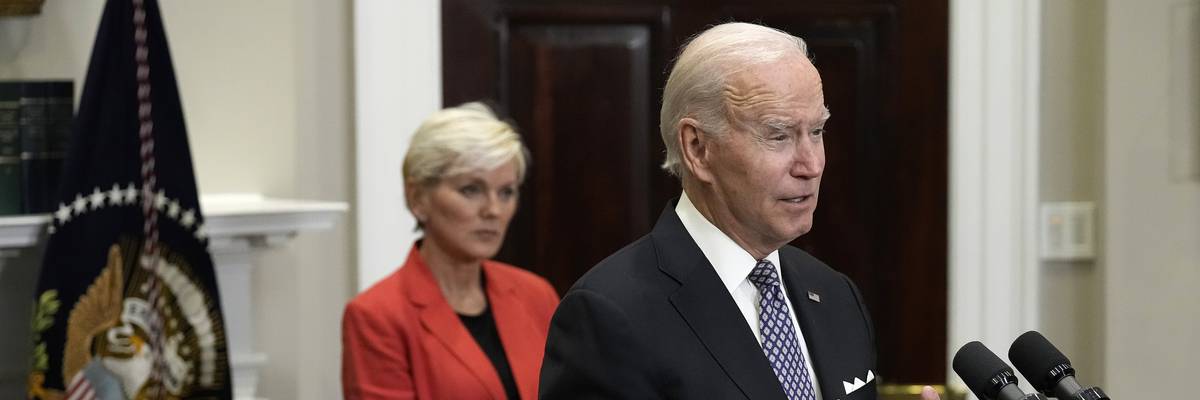
U.S. President Joe Biden delivers remarks in the Roosevelt Room of the White House on October 31, 2022 in Washington, D.C.
Critics Warn Biden $7 Billion for Hydrogen Helps 'Industry Ploy to Rebrand Fracked Gas'
"The Biden administration has clearly fallen for this scam hook, line, and sinker," said one campaigner. "This multibillion-dollar bet on greenwashed dirty energy will undermine efforts to address the climate crisis."
As U.S. Energy Secretary Jennifer Granholm on Friday celebrated the "historic investment" of up to $7 billion for seven regional hydrogen hubs as a key to achieving President Joe Biden's "goal of American industry powered by American clean energy," some climate campaigners warned that the administration is falling for—or participating in—a fossil fuel industry scam.
Roughly two-thirds of the H2Hubs investment will go toward green hydrogen, which is made using renewable energy, according to the White House. However, the bipartisan infrastructure legislation Biden signed in 2021 requires broader support, including for pink (nuclear) and blue (gas) hydrogen projects, the latter of which includes carbon capture, utilization, and storage.
"At face value—and according to the Biden playbook—the hydrogen hub grants aim to help transition the United States to clean energy. In reality, they amount to another corporate scam, one that preserves and extends the life of the extractive economy and prevents the frontline communities most impacted by climate disaster from having input," said Marion Gee, co-executive director at the Climate Justice Alliance, representing 89 rural and urban environmental justice groups.
"Hydrogen development is energy intensive to produce, could present a public safety risk in transit, can produce health-damaging air pollution when combusted, and is a play by the fossil fuel industry to extend its viability and profits," Gee stressed. "We must work to move capital and power into the hands of local communities who will center traditional ecological and cultural knowledge and create a pathway toward a regenerative future."
"The fossil fuel industry is working to continue our nation's reliance on fossil fuels by any means necessary—and hydrogen offers yet another possible inroad for Big Oil and Gas."
Earthworks policy director Lauren Pagel also asserted that "prioritizing hydrogen hubs across the United States is more about extending the life of oil and gas companies than addressing the climate crisis. These hubs are a dangerous distraction from the obvious consensus solution that the world must stop expanding fossil fuels that are warming the atmosphere."
Food & Water Watch policy director Jim Walsh was similarly critical, declaring that "the massive build-out of hydrogen infrastructure is little more than an industry ploy to rebrand fracked gas. The Biden administration has clearly fallen for this scam hook, line, and sinker. This multibillion-dollar bet on greenwashed dirty energy will undermine efforts to address the climate crisis, while increasing pollution of our air and water, and milking taxpayers for billions in new fossil fuel subsidies."
"Even the cleanest forms of hydrogen present serious problems—most notably the massive amount of water that would be waste," Walsh added. "As groundwater sources are drying up across the country, there is no reason to waste precious drinking water resources on hydrogen when there are cheaper, cleaner energy sources that can facilitate a real transition off fossil fuels."
The seven selected projects are the Appalachian (West Virginia, Ohio, and Pennsylvania), California, Gulf Coast (Texas), Heartland (Minnesota, North Dakota, and South Dakota), Mid-Atlantic (Pennsylvania, Delaware, and New Jersey), Midwest (Illinois, Indiana, and Michigan), and Pacific Northwest (Washington, Oregon, and Montana) hydrogen hubs.
As The New York Times detailed:
Not all of the $7 billion in funding will be spent at once. As a first step, the Energy Department will give awardees initial grants to create more detailed proposals for their hydrogen hubs. If the agency deems the projects viable, it will disburse more money over time—but that money is not guaranteed if any of the hubs prove unworkable.
"We're still a long, long ways away from creating a large-scale hydrogen economy," said Alex Kizer, a senior vice president at the Energy Futures Initiative, a Washington nonprofit organization. "Think of these hubs as laboratories of sorts to experiment with potential business models for hydrogen and to try to figure out some of the technological and infrastructure hurdles."
Even groups that support green hydrogen raised concerns over funding longtime polluters. Sierra Club executive director Ben Jealous warned that "the fossil fuel industry is working to continue our nation's reliance on fossil fuels by any means necessary—and hydrogen offers yet another possible inroad for Big Oil and Gas to lock in polluting and noneconomic uses of gas for decades to come."
"Decision-makers in the administration and at the local level must be wary of these attempts and ensure as much hydrogen-specific funding as possible goes to green hydrogen and its most efficient end uses to ensure this investment actually addresses climate change," he said.
Jill Tauber, vice president of litigation for climate and energy at Earthjustice, suggested that "hydrogen can be a clean energy solution, or it can drive us deeper into the climate crisis and hurt communities," and that green projects powered by renewables "can play an important role cleaning up what we cannot electrify, like steel manufacturing."
Julie McNamara, deputy policy director of the Climate and Energy Program at the Union of Concerned Scientists, joined the chorus of alarmed critics on Friday, saying that "billions of taxpayer dollars are at risk of perpetuating fossil fuel industry injustices and harms while subsidizing fossil fuel greenwashing."
"Today's announcement also sets in stark relief the significance of upcoming administration decisions around implementation of the Inflation Reduction Act's hydrogen production tax credit, which could be a bulwark against heavily polluting hydrogen—or a backdoor subsidizing it," she noted. "The Department of Energy and the Biden administration now must set rigorous implementation, evaluation, and engagement criteria to ensure the development of a hydrogen industry that is unequivocally aligned with our climate objectives and that serves our collective goal to secure a safe, clean, just, and healthy future for all."
We are at a crossroads
This country and this world are at a monumental crossroads. In a few short weeks, US voters will have an opportunity to beat back the forces of fascism and confront the billionaires who are rigging the economy, our media system, and our democracy, making it increasingly impossible for ordinary people to get by. We’re not just talking about the election. We’re talking about what must be done once these fascist elements are vanquished from power. We need a bolder set of solutions than what either major party has so far been willing to offer and a working-class movement ready to fight like hell for it. Trump didn't emerge from nowhere. The conditions that fueled MAGA authoritarianism were created by decades of radical neoliberal economic policies and a corrupt political system dominated by corporate interests. They slashed taxes on the super-rich, promising that the benefits would trickle down. They said giveaways to the corporate titans would make life more affordable for the rest of us. It was all bullshit. And when a bitter, betrayed populace searches for someone to blame, right-wing demagogues have little trouble finding scapegoats. People know when they're being lied to, but you won't hear any of this from the corporate media. Only independent journalism—powered and funded by people who believe in building a better world—can deliver truly trustworthy daily news. Our Fall Campaign is underway, and we need your help. To power our newsroom through the rest of the year, we need to raise $125,000 by midnight on October 31. So if you share our vision, please contribute whatever you can to sustain our work. |
As U.S. Energy Secretary Jennifer Granholm on Friday celebrated the "historic investment" of up to $7 billion for seven regional hydrogen hubs as a key to achieving President Joe Biden's "goal of American industry powered by American clean energy," some climate campaigners warned that the administration is falling for—or participating in—a fossil fuel industry scam.
Roughly two-thirds of the H2Hubs investment will go toward green hydrogen, which is made using renewable energy, according to the White House. However, the bipartisan infrastructure legislation Biden signed in 2021 requires broader support, including for pink (nuclear) and blue (gas) hydrogen projects, the latter of which includes carbon capture, utilization, and storage.
"At face value—and according to the Biden playbook—the hydrogen hub grants aim to help transition the United States to clean energy. In reality, they amount to another corporate scam, one that preserves and extends the life of the extractive economy and prevents the frontline communities most impacted by climate disaster from having input," said Marion Gee, co-executive director at the Climate Justice Alliance, representing 89 rural and urban environmental justice groups.
"Hydrogen development is energy intensive to produce, could present a public safety risk in transit, can produce health-damaging air pollution when combusted, and is a play by the fossil fuel industry to extend its viability and profits," Gee stressed. "We must work to move capital and power into the hands of local communities who will center traditional ecological and cultural knowledge and create a pathway toward a regenerative future."
"The fossil fuel industry is working to continue our nation's reliance on fossil fuels by any means necessary—and hydrogen offers yet another possible inroad for Big Oil and Gas."
Earthworks policy director Lauren Pagel also asserted that "prioritizing hydrogen hubs across the United States is more about extending the life of oil and gas companies than addressing the climate crisis. These hubs are a dangerous distraction from the obvious consensus solution that the world must stop expanding fossil fuels that are warming the atmosphere."
Food & Water Watch policy director Jim Walsh was similarly critical, declaring that "the massive build-out of hydrogen infrastructure is little more than an industry ploy to rebrand fracked gas. The Biden administration has clearly fallen for this scam hook, line, and sinker. This multibillion-dollar bet on greenwashed dirty energy will undermine efforts to address the climate crisis, while increasing pollution of our air and water, and milking taxpayers for billions in new fossil fuel subsidies."
"Even the cleanest forms of hydrogen present serious problems—most notably the massive amount of water that would be waste," Walsh added. "As groundwater sources are drying up across the country, there is no reason to waste precious drinking water resources on hydrogen when there are cheaper, cleaner energy sources that can facilitate a real transition off fossil fuels."
The seven selected projects are the Appalachian (West Virginia, Ohio, and Pennsylvania), California, Gulf Coast (Texas), Heartland (Minnesota, North Dakota, and South Dakota), Mid-Atlantic (Pennsylvania, Delaware, and New Jersey), Midwest (Illinois, Indiana, and Michigan), and Pacific Northwest (Washington, Oregon, and Montana) hydrogen hubs.
As The New York Times detailed:
Not all of the $7 billion in funding will be spent at once. As a first step, the Energy Department will give awardees initial grants to create more detailed proposals for their hydrogen hubs. If the agency deems the projects viable, it will disburse more money over time—but that money is not guaranteed if any of the hubs prove unworkable.
"We're still a long, long ways away from creating a large-scale hydrogen economy," said Alex Kizer, a senior vice president at the Energy Futures Initiative, a Washington nonprofit organization. "Think of these hubs as laboratories of sorts to experiment with potential business models for hydrogen and to try to figure out some of the technological and infrastructure hurdles."
Even groups that support green hydrogen raised concerns over funding longtime polluters. Sierra Club executive director Ben Jealous warned that "the fossil fuel industry is working to continue our nation's reliance on fossil fuels by any means necessary—and hydrogen offers yet another possible inroad for Big Oil and Gas to lock in polluting and noneconomic uses of gas for decades to come."
"Decision-makers in the administration and at the local level must be wary of these attempts and ensure as much hydrogen-specific funding as possible goes to green hydrogen and its most efficient end uses to ensure this investment actually addresses climate change," he said.
Jill Tauber, vice president of litigation for climate and energy at Earthjustice, suggested that "hydrogen can be a clean energy solution, or it can drive us deeper into the climate crisis and hurt communities," and that green projects powered by renewables "can play an important role cleaning up what we cannot electrify, like steel manufacturing."
Julie McNamara, deputy policy director of the Climate and Energy Program at the Union of Concerned Scientists, joined the chorus of alarmed critics on Friday, saying that "billions of taxpayer dollars are at risk of perpetuating fossil fuel industry injustices and harms while subsidizing fossil fuel greenwashing."
"Today's announcement also sets in stark relief the significance of upcoming administration decisions around implementation of the Inflation Reduction Act's hydrogen production tax credit, which could be a bulwark against heavily polluting hydrogen—or a backdoor subsidizing it," she noted. "The Department of Energy and the Biden administration now must set rigorous implementation, evaluation, and engagement criteria to ensure the development of a hydrogen industry that is unequivocally aligned with our climate objectives and that serves our collective goal to secure a safe, clean, just, and healthy future for all."
- Historic Climate Bill, Say Clear-Eyed Critics, Still 'Pours Gasoline on the Flames' ›
- Billions Wasted on Hydrogen Hype ›
- 'Climate Scam': 180+ Groups Tell Biden to Drop Support for Hydrogen ›
- Opinion | The Dirty Secret Behind the Hydrogen Hype | Common Dreams ›
- Climate Group Warns World Must Not Fall for Hydrogen 'Hype' ›
- Opinion | The Cancellation of a Blue Hydrogen Boondoggle Proves No Project Is Inevitable | Common Dreams ›
As U.S. Energy Secretary Jennifer Granholm on Friday celebrated the "historic investment" of up to $7 billion for seven regional hydrogen hubs as a key to achieving President Joe Biden's "goal of American industry powered by American clean energy," some climate campaigners warned that the administration is falling for—or participating in—a fossil fuel industry scam.
Roughly two-thirds of the H2Hubs investment will go toward green hydrogen, which is made using renewable energy, according to the White House. However, the bipartisan infrastructure legislation Biden signed in 2021 requires broader support, including for pink (nuclear) and blue (gas) hydrogen projects, the latter of which includes carbon capture, utilization, and storage.
"At face value—and according to the Biden playbook—the hydrogen hub grants aim to help transition the United States to clean energy. In reality, they amount to another corporate scam, one that preserves and extends the life of the extractive economy and prevents the frontline communities most impacted by climate disaster from having input," said Marion Gee, co-executive director at the Climate Justice Alliance, representing 89 rural and urban environmental justice groups.
"Hydrogen development is energy intensive to produce, could present a public safety risk in transit, can produce health-damaging air pollution when combusted, and is a play by the fossil fuel industry to extend its viability and profits," Gee stressed. "We must work to move capital and power into the hands of local communities who will center traditional ecological and cultural knowledge and create a pathway toward a regenerative future."
"The fossil fuel industry is working to continue our nation's reliance on fossil fuels by any means necessary—and hydrogen offers yet another possible inroad for Big Oil and Gas."
Earthworks policy director Lauren Pagel also asserted that "prioritizing hydrogen hubs across the United States is more about extending the life of oil and gas companies than addressing the climate crisis. These hubs are a dangerous distraction from the obvious consensus solution that the world must stop expanding fossil fuels that are warming the atmosphere."
Food & Water Watch policy director Jim Walsh was similarly critical, declaring that "the massive build-out of hydrogen infrastructure is little more than an industry ploy to rebrand fracked gas. The Biden administration has clearly fallen for this scam hook, line, and sinker. This multibillion-dollar bet on greenwashed dirty energy will undermine efforts to address the climate crisis, while increasing pollution of our air and water, and milking taxpayers for billions in new fossil fuel subsidies."
"Even the cleanest forms of hydrogen present serious problems—most notably the massive amount of water that would be waste," Walsh added. "As groundwater sources are drying up across the country, there is no reason to waste precious drinking water resources on hydrogen when there are cheaper, cleaner energy sources that can facilitate a real transition off fossil fuels."
The seven selected projects are the Appalachian (West Virginia, Ohio, and Pennsylvania), California, Gulf Coast (Texas), Heartland (Minnesota, North Dakota, and South Dakota), Mid-Atlantic (Pennsylvania, Delaware, and New Jersey), Midwest (Illinois, Indiana, and Michigan), and Pacific Northwest (Washington, Oregon, and Montana) hydrogen hubs.
As The New York Times detailed:
Not all of the $7 billion in funding will be spent at once. As a first step, the Energy Department will give awardees initial grants to create more detailed proposals for their hydrogen hubs. If the agency deems the projects viable, it will disburse more money over time—but that money is not guaranteed if any of the hubs prove unworkable.
"We're still a long, long ways away from creating a large-scale hydrogen economy," said Alex Kizer, a senior vice president at the Energy Futures Initiative, a Washington nonprofit organization. "Think of these hubs as laboratories of sorts to experiment with potential business models for hydrogen and to try to figure out some of the technological and infrastructure hurdles."
Even groups that support green hydrogen raised concerns over funding longtime polluters. Sierra Club executive director Ben Jealous warned that "the fossil fuel industry is working to continue our nation's reliance on fossil fuels by any means necessary—and hydrogen offers yet another possible inroad for Big Oil and Gas to lock in polluting and noneconomic uses of gas for decades to come."
"Decision-makers in the administration and at the local level must be wary of these attempts and ensure as much hydrogen-specific funding as possible goes to green hydrogen and its most efficient end uses to ensure this investment actually addresses climate change," he said.
Jill Tauber, vice president of litigation for climate and energy at Earthjustice, suggested that "hydrogen can be a clean energy solution, or it can drive us deeper into the climate crisis and hurt communities," and that green projects powered by renewables "can play an important role cleaning up what we cannot electrify, like steel manufacturing."
Julie McNamara, deputy policy director of the Climate and Energy Program at the Union of Concerned Scientists, joined the chorus of alarmed critics on Friday, saying that "billions of taxpayer dollars are at risk of perpetuating fossil fuel industry injustices and harms while subsidizing fossil fuel greenwashing."
"Today's announcement also sets in stark relief the significance of upcoming administration decisions around implementation of the Inflation Reduction Act's hydrogen production tax credit, which could be a bulwark against heavily polluting hydrogen—or a backdoor subsidizing it," she noted. "The Department of Energy and the Biden administration now must set rigorous implementation, evaluation, and engagement criteria to ensure the development of a hydrogen industry that is unequivocally aligned with our climate objectives and that serves our collective goal to secure a safe, clean, just, and healthy future for all."
- Historic Climate Bill, Say Clear-Eyed Critics, Still 'Pours Gasoline on the Flames' ›
- Billions Wasted on Hydrogen Hype ›
- 'Climate Scam': 180+ Groups Tell Biden to Drop Support for Hydrogen ›
- Opinion | The Dirty Secret Behind the Hydrogen Hype | Common Dreams ›
- Climate Group Warns World Must Not Fall for Hydrogen 'Hype' ›
- Opinion | The Cancellation of a Blue Hydrogen Boondoggle Proves No Project Is Inevitable | Common Dreams ›