SUBSCRIBE TO OUR FREE NEWSLETTER
Daily news & progressive opinion—funded by the people, not the corporations—delivered straight to your inbox.
5
#000000
#FFFFFF
To donate by check, phone, or other method, see our More Ways to Give page.
Daily news & progressive opinion—funded by the people, not the corporations—delivered straight to your inbox.
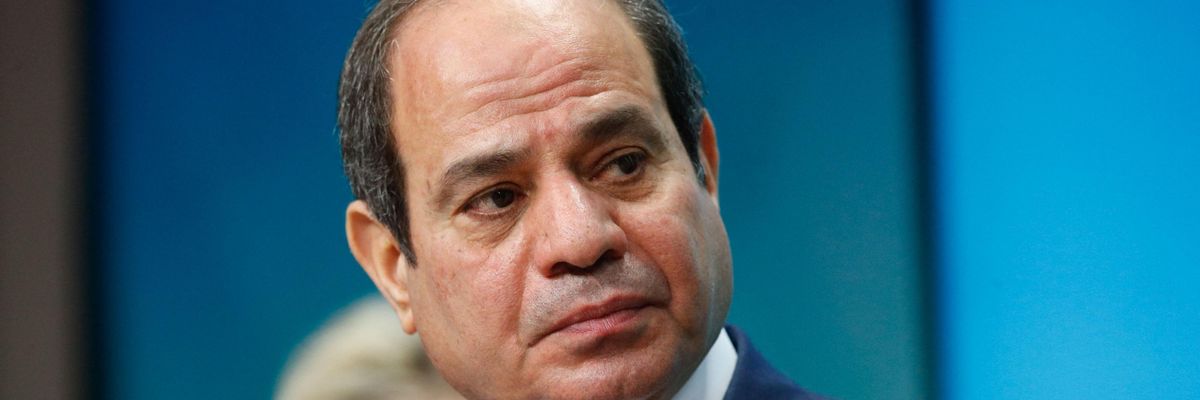
Egyptian President Abdel Fattah Al-Sisi takes part in a meeting at the European Council Building in Brussels on February 18, 2022. (Photo: Johanna Geron/POOL/AFP via Getty Images)
Three dozen global human rights groups on Tuesday called on Egyptian authorities to respect international law by allowing peaceful protests at the upcoming United Nations Climate Change Conference--and not limiting dissenters to a specific space where their impact will be weakened, as officials have suggested they will.
"The Egyptian authorities should unconditionally allow peaceful protests and gatherings around the time of COP27, including in Cairo, the Egyptian capital, and other cities."
In late May, Egyptian Foreign Minister Sameh Shoukry told The Associated Press that for those who wish to protest, the government will set up "a facility adjacent to the conference center" being used for the 12-day summit in November in Sharm el-Sheikh, suggesting that officials plan to violate international rights standards.
"If a protest or demonstration seeks to deliver a specific message to a person, group, or organization, it should, in principle, be able to be held at a place and time that allows for the visual and audio dissemination of the message," according to the U.N.'s Office of the Special Rapporteur for Freedom of Expression of the Inter-American Commission on Human Rights--a principle known as "sight and sound."
Citing the criminalization of peaceful assemblies and the arrests of thousands of Egyptians at anti-government protests in 2021, the groups--including Human Rights Watch (HRW), PEN International, and Cairo Institute for Human Rights--said Shoukry's remarks "imply that the Egyptian authorities will not tolerate protest outside this 'government-designated' space."
By cordoning off climate campaigners in a specific government-chosen location as leaders of wealthy countries are expected to face pressure to help finance climate action in the Global South at the conference, commonly known as COP27, advocates say Egyptian officials would ensure protesters' messages don't get to those who need to hear them.
"The Egyptian authorities should unconditionally allow peaceful protests and gatherings around the time of COP27, including in Cairo, the Egyptian capital, and other cities," said the organizations.
In their joint statement, the groups raised concern about "the Egyptian authorities' abysmal record of cracking down on civil society organizations and punishing human rights activism and independent journalism."
Under Law No. 107 on Organizing the Right to Public Meetings, Processions, and Peaceful Protests, Egyptian security forces are granted the right to ban protests and use excessive force against demonstrators. Thousands of peaceful protesters have been prosecuted under the law in mass trials.
The United Nations' annual climate change summit has been the site of protests in past years as campaigners demand greater action from wealthy governments. At COP26 in Glasgow last November, more than 100,000 people marched through the Scottish city to demand negotiators center developing countries which are bearing the brunt of the climate crisis while wealthy countries have done the most to cause planet-heating emissions.
"Egypt should guarantee peaceful gatherings, assembly, and expression" so advocates can make their voices heard again, said Amr Magdi, a researcher at HRW.
The groups also said Tuesday that before COP27, Egypt must end its persecution of people who are currently detained "for the peaceful exercise of their human rights or for their religion, gender identity, or sexual orientation," and amend its laws so they are in line with the country's obligations to follow international standards.
"The authorities should pledge to uphold the right to freedom of peaceful assembly at all times, including during international events, and refrain from unduly limiting protests to a specific designated area," said the organizations.
Pressure from U.N. member states, they added, could push Egypt "to end limitations on freedom of assembly, association, and expression and take other meaningful steps to address concerns by civil society and ensure their safe and meaningful participation that can contribute to a successful COP27."
Dear Common Dreams reader, It’s been nearly 30 years since I co-founded Common Dreams with my late wife, Lina Newhouser. We had the radical notion that journalism should serve the public good, not corporate profits. It was clear to us from the outset what it would take to build such a project. No paid advertisements. No corporate sponsors. No millionaire publisher telling us what to think or do. Many people said we wouldn't last a year, but we proved those doubters wrong. Together with a tremendous team of journalists and dedicated staff, we built an independent media outlet free from the constraints of profits and corporate control. Our mission has always been simple: To inform. To inspire. To ignite change for the common good. Building Common Dreams was not easy. Our survival was never guaranteed. When you take on the most powerful forces—Wall Street greed, fossil fuel industry destruction, Big Tech lobbyists, and uber-rich oligarchs who have spent billions upon billions rigging the economy and democracy in their favor—the only bulwark you have is supporters who believe in your work. But here’s the urgent message from me today. It's never been this bad out there. And it's never been this hard to keep us going. At the very moment Common Dreams is most needed, the threats we face are intensifying. We need your support now more than ever. We don't accept corporate advertising and never will. We don't have a paywall because we don't think people should be blocked from critical news based on their ability to pay. Everything we do is funded by the donations of readers like you. When everyone does the little they can afford, we are strong. But if that support retreats or dries up, so do we. Will you donate now to make sure Common Dreams not only survives but thrives? —Craig Brown, Co-founder |
Three dozen global human rights groups on Tuesday called on Egyptian authorities to respect international law by allowing peaceful protests at the upcoming United Nations Climate Change Conference--and not limiting dissenters to a specific space where their impact will be weakened, as officials have suggested they will.
"The Egyptian authorities should unconditionally allow peaceful protests and gatherings around the time of COP27, including in Cairo, the Egyptian capital, and other cities."
In late May, Egyptian Foreign Minister Sameh Shoukry told The Associated Press that for those who wish to protest, the government will set up "a facility adjacent to the conference center" being used for the 12-day summit in November in Sharm el-Sheikh, suggesting that officials plan to violate international rights standards.
"If a protest or demonstration seeks to deliver a specific message to a person, group, or organization, it should, in principle, be able to be held at a place and time that allows for the visual and audio dissemination of the message," according to the U.N.'s Office of the Special Rapporteur for Freedom of Expression of the Inter-American Commission on Human Rights--a principle known as "sight and sound."
Citing the criminalization of peaceful assemblies and the arrests of thousands of Egyptians at anti-government protests in 2021, the groups--including Human Rights Watch (HRW), PEN International, and Cairo Institute for Human Rights--said Shoukry's remarks "imply that the Egyptian authorities will not tolerate protest outside this 'government-designated' space."
By cordoning off climate campaigners in a specific government-chosen location as leaders of wealthy countries are expected to face pressure to help finance climate action in the Global South at the conference, commonly known as COP27, advocates say Egyptian officials would ensure protesters' messages don't get to those who need to hear them.
"The Egyptian authorities should unconditionally allow peaceful protests and gatherings around the time of COP27, including in Cairo, the Egyptian capital, and other cities," said the organizations.
In their joint statement, the groups raised concern about "the Egyptian authorities' abysmal record of cracking down on civil society organizations and punishing human rights activism and independent journalism."
Under Law No. 107 on Organizing the Right to Public Meetings, Processions, and Peaceful Protests, Egyptian security forces are granted the right to ban protests and use excessive force against demonstrators. Thousands of peaceful protesters have been prosecuted under the law in mass trials.
The United Nations' annual climate change summit has been the site of protests in past years as campaigners demand greater action from wealthy governments. At COP26 in Glasgow last November, more than 100,000 people marched through the Scottish city to demand negotiators center developing countries which are bearing the brunt of the climate crisis while wealthy countries have done the most to cause planet-heating emissions.
"Egypt should guarantee peaceful gatherings, assembly, and expression" so advocates can make their voices heard again, said Amr Magdi, a researcher at HRW.
The groups also said Tuesday that before COP27, Egypt must end its persecution of people who are currently detained "for the peaceful exercise of their human rights or for their religion, gender identity, or sexual orientation," and amend its laws so they are in line with the country's obligations to follow international standards.
"The authorities should pledge to uphold the right to freedom of peaceful assembly at all times, including during international events, and refrain from unduly limiting protests to a specific designated area," said the organizations.
Pressure from U.N. member states, they added, could push Egypt "to end limitations on freedom of assembly, association, and expression and take other meaningful steps to address concerns by civil society and ensure their safe and meaningful participation that can contribute to a successful COP27."
Three dozen global human rights groups on Tuesday called on Egyptian authorities to respect international law by allowing peaceful protests at the upcoming United Nations Climate Change Conference--and not limiting dissenters to a specific space where their impact will be weakened, as officials have suggested they will.
"The Egyptian authorities should unconditionally allow peaceful protests and gatherings around the time of COP27, including in Cairo, the Egyptian capital, and other cities."
In late May, Egyptian Foreign Minister Sameh Shoukry told The Associated Press that for those who wish to protest, the government will set up "a facility adjacent to the conference center" being used for the 12-day summit in November in Sharm el-Sheikh, suggesting that officials plan to violate international rights standards.
"If a protest or demonstration seeks to deliver a specific message to a person, group, or organization, it should, in principle, be able to be held at a place and time that allows for the visual and audio dissemination of the message," according to the U.N.'s Office of the Special Rapporteur for Freedom of Expression of the Inter-American Commission on Human Rights--a principle known as "sight and sound."
Citing the criminalization of peaceful assemblies and the arrests of thousands of Egyptians at anti-government protests in 2021, the groups--including Human Rights Watch (HRW), PEN International, and Cairo Institute for Human Rights--said Shoukry's remarks "imply that the Egyptian authorities will not tolerate protest outside this 'government-designated' space."
By cordoning off climate campaigners in a specific government-chosen location as leaders of wealthy countries are expected to face pressure to help finance climate action in the Global South at the conference, commonly known as COP27, advocates say Egyptian officials would ensure protesters' messages don't get to those who need to hear them.
"The Egyptian authorities should unconditionally allow peaceful protests and gatherings around the time of COP27, including in Cairo, the Egyptian capital, and other cities," said the organizations.
In their joint statement, the groups raised concern about "the Egyptian authorities' abysmal record of cracking down on civil society organizations and punishing human rights activism and independent journalism."
Under Law No. 107 on Organizing the Right to Public Meetings, Processions, and Peaceful Protests, Egyptian security forces are granted the right to ban protests and use excessive force against demonstrators. Thousands of peaceful protesters have been prosecuted under the law in mass trials.
The United Nations' annual climate change summit has been the site of protests in past years as campaigners demand greater action from wealthy governments. At COP26 in Glasgow last November, more than 100,000 people marched through the Scottish city to demand negotiators center developing countries which are bearing the brunt of the climate crisis while wealthy countries have done the most to cause planet-heating emissions.
"Egypt should guarantee peaceful gatherings, assembly, and expression" so advocates can make their voices heard again, said Amr Magdi, a researcher at HRW.
The groups also said Tuesday that before COP27, Egypt must end its persecution of people who are currently detained "for the peaceful exercise of their human rights or for their religion, gender identity, or sexual orientation," and amend its laws so they are in line with the country's obligations to follow international standards.
"The authorities should pledge to uphold the right to freedom of peaceful assembly at all times, including during international events, and refrain from unduly limiting protests to a specific designated area," said the organizations.
Pressure from U.N. member states, they added, could push Egypt "to end limitations on freedom of assembly, association, and expression and take other meaningful steps to address concerns by civil society and ensure their safe and meaningful participation that can contribute to a successful COP27."