

SUBSCRIBE TO OUR FREE NEWSLETTER
Daily news & progressive opinion—funded by the people, not the corporations—delivered straight to your inbox.
5
#000000
#FFFFFF
To donate by check, phone, or other method, see our More Ways to Give page.
Daily news & progressive opinion—funded by the people, not the corporations—delivered straight to your inbox.
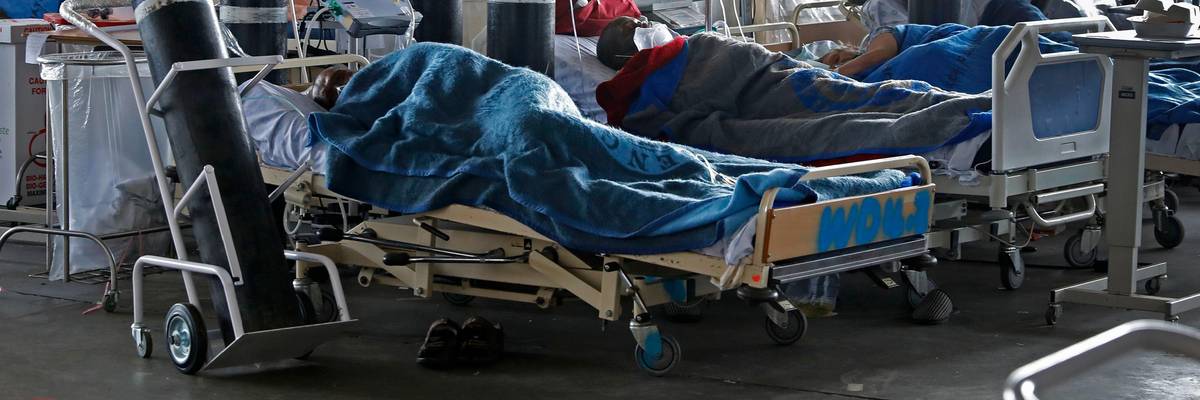
Patients are seen lying on hospital beds inside a temporary ward dedicated to the treatment of possible Covid-19 patients at Steve Biko Academic Hospital in Pretoria, South Africa on January 11, 2021. (Photo: Phill Magakoe/AFP via Getty Images)
As public health advocates prepared a global day of action to demand an end to Covid-19 vaccine inequity, international campaigners reported that the inaction by the World Trade Organization and several wealthy countries has led to the deaths of nearly 30,000 people per day since talks about widely distributing vaccines began 20 months ago.
"It is incomprehensible that we are still debating whether or not it's a good idea for poorer countries to be able to produce their own vaccines, tests, and treatments for this and any future pandemics."
Since Indian and South African officials first proposed a waiver of intellectual property rights for Covid-19 vaccines, tests, and treatments in October 2020, Oxfam International and the People's Vaccine Alliance reported, 17.5 million people worldwide have died of the disease. The groups based the calculation on The Economist's excess deaths model.
"If the world had acted immediately then many of these people could still be alive today," said Anna Marriott, health policy manager for Oxfam. "Yet, the U.K. and E.U. countries have continually sought to delay and dilute any meaningful outcome at the WTO and have refused to listen to the concerns of poorer countries."
The U.K., E.U., Canada, and Switzerland have refused to back a patent waiver for vaccines, treatments, and tests, blocking low- and middle-income countries from developing their own generic versions of products that are widely available in the U.S. and other wealthy countries.
Oxfam and the People's Vaccine Alliance released their report three days before the WTO Ministerial is set to begin, with global leaders reviewing the functioning of the multilateral trading system.
Officials at the WTO have in recent weeks been discussing an alternative to a patent waiver which would cover vaccines but not tests or treatments, impose new conditions limiting WTO rules that now allow countries to produce medications without patent-holder permission, and exclude entire countries.
The "dangerous and limited alternative" plan being considered, said Oxfam, "will not help producers in lower-income countries as it adds more hurdles preventing poorer countries from producing vaccines."
Allowing tens of thousands of people to die each day represents "outrageous hypocrisy from leaders who said vaccines should be a global public good," said Marriott.
"With the world facing multiple crises on top of Covid, it is incomprehensible that we are still debating whether or not it's a good idea for poorer countries to be able to produce their own vaccines, tests, and treatments for this and any future pandemics," she added.
The People's Vaccine Alliance, which includes Oxfam as a member, is leading several public health and social justice advocacy groups Friday in a global day of action ahead of the ministerial, with the protests titled "Earth to Europe and U.S.: End Covid Monopolies Now!"
While the Biden administration has expressed support for a narrow patent waiver, it has also requested more than $800 billion in Pentagon funding this year, a small percentage of which--just $25 billion--could enable the world to produce eight billion Covid-19 vaccine doses at regional manufacturing hubs in less than a year, according to government watchdog group Public Citizen.
In a letter sent Wednesday to WTO delegates, the People's Vaccine Alliance pointed out that the global trade body drafted the Doha Declaration at the height of the HIV crisis, stating that the WTO Agreement on Trade-Related Aspects of Intellectual Property Rights (TRIPS) "does not and should not prevent members from taking measures to protect public health."
"Without amendments, the current text under negotiation at the WTO is a reversal of the Doha declaration," the coalition wrote.
"We don't want charity; we want solidarity."
Public health officials warn that the failure of wealthy countries to ensure that vaccines are available to all will allow new variants to continue cropping up and causing outbreaks.
"Why should people in lower-income countries be forced to face today's Covid variants with yesterday's vaccines, while rich countries once again monopolize the supply of new vaccines made to protect against new variants?" said Julia Kosgei, policy advisor for the People's Vaccine Alliance.
"We don't want charity; we want solidarity, and we want our rights!" she added. "We call on all governments to finally do the right thing and back the waiving of IP for Covid vaccines, tests, and treatments, for this and any future pandemics."
The deadlock at the WTO has left African officials able to fully vaccinate less than a fifth of the continent's population and has "undermined the trust between the E.U. and countries in Africa," the groups said.
It also "undermines the credibility of the organization," they added, "especially as the global economy is facing the prospect of a recession coupled with rising food and fuel prices."
Dear Common Dreams reader, It’s been nearly 30 years since I co-founded Common Dreams with my late wife, Lina Newhouser. We had the radical notion that journalism should serve the public good, not corporate profits. It was clear to us from the outset what it would take to build such a project. No paid advertisements. No corporate sponsors. No millionaire publisher telling us what to think or do. Many people said we wouldn't last a year, but we proved those doubters wrong. Together with a tremendous team of journalists and dedicated staff, we built an independent media outlet free from the constraints of profits and corporate control. Our mission has always been simple: To inform. To inspire. To ignite change for the common good. Building Common Dreams was not easy. Our survival was never guaranteed. When you take on the most powerful forces—Wall Street greed, fossil fuel industry destruction, Big Tech lobbyists, and uber-rich oligarchs who have spent billions upon billions rigging the economy and democracy in their favor—the only bulwark you have is supporters who believe in your work. But here’s the urgent message from me today. It's never been this bad out there. And it's never been this hard to keep us going. At the very moment Common Dreams is most needed, the threats we face are intensifying. We need your support now more than ever. We don't accept corporate advertising and never will. We don't have a paywall because we don't think people should be blocked from critical news based on their ability to pay. Everything we do is funded by the donations of readers like you. When everyone does the little they can afford, we are strong. But if that support retreats or dries up, so do we. Will you donate now to make sure Common Dreams not only survives but thrives? —Craig Brown, Co-founder |
As public health advocates prepared a global day of action to demand an end to Covid-19 vaccine inequity, international campaigners reported that the inaction by the World Trade Organization and several wealthy countries has led to the deaths of nearly 30,000 people per day since talks about widely distributing vaccines began 20 months ago.
"It is incomprehensible that we are still debating whether or not it's a good idea for poorer countries to be able to produce their own vaccines, tests, and treatments for this and any future pandemics."
Since Indian and South African officials first proposed a waiver of intellectual property rights for Covid-19 vaccines, tests, and treatments in October 2020, Oxfam International and the People's Vaccine Alliance reported, 17.5 million people worldwide have died of the disease. The groups based the calculation on The Economist's excess deaths model.
"If the world had acted immediately then many of these people could still be alive today," said Anna Marriott, health policy manager for Oxfam. "Yet, the U.K. and E.U. countries have continually sought to delay and dilute any meaningful outcome at the WTO and have refused to listen to the concerns of poorer countries."
The U.K., E.U., Canada, and Switzerland have refused to back a patent waiver for vaccines, treatments, and tests, blocking low- and middle-income countries from developing their own generic versions of products that are widely available in the U.S. and other wealthy countries.
Oxfam and the People's Vaccine Alliance released their report three days before the WTO Ministerial is set to begin, with global leaders reviewing the functioning of the multilateral trading system.
Officials at the WTO have in recent weeks been discussing an alternative to a patent waiver which would cover vaccines but not tests or treatments, impose new conditions limiting WTO rules that now allow countries to produce medications without patent-holder permission, and exclude entire countries.
The "dangerous and limited alternative" plan being considered, said Oxfam, "will not help producers in lower-income countries as it adds more hurdles preventing poorer countries from producing vaccines."
Allowing tens of thousands of people to die each day represents "outrageous hypocrisy from leaders who said vaccines should be a global public good," said Marriott.
"With the world facing multiple crises on top of Covid, it is incomprehensible that we are still debating whether or not it's a good idea for poorer countries to be able to produce their own vaccines, tests, and treatments for this and any future pandemics," she added.
The People's Vaccine Alliance, which includes Oxfam as a member, is leading several public health and social justice advocacy groups Friday in a global day of action ahead of the ministerial, with the protests titled "Earth to Europe and U.S.: End Covid Monopolies Now!"
While the Biden administration has expressed support for a narrow patent waiver, it has also requested more than $800 billion in Pentagon funding this year, a small percentage of which--just $25 billion--could enable the world to produce eight billion Covid-19 vaccine doses at regional manufacturing hubs in less than a year, according to government watchdog group Public Citizen.
In a letter sent Wednesday to WTO delegates, the People's Vaccine Alliance pointed out that the global trade body drafted the Doha Declaration at the height of the HIV crisis, stating that the WTO Agreement on Trade-Related Aspects of Intellectual Property Rights (TRIPS) "does not and should not prevent members from taking measures to protect public health."
"Without amendments, the current text under negotiation at the WTO is a reversal of the Doha declaration," the coalition wrote.
"We don't want charity; we want solidarity."
Public health officials warn that the failure of wealthy countries to ensure that vaccines are available to all will allow new variants to continue cropping up and causing outbreaks.
"Why should people in lower-income countries be forced to face today's Covid variants with yesterday's vaccines, while rich countries once again monopolize the supply of new vaccines made to protect against new variants?" said Julia Kosgei, policy advisor for the People's Vaccine Alliance.
"We don't want charity; we want solidarity, and we want our rights!" she added. "We call on all governments to finally do the right thing and back the waiving of IP for Covid vaccines, tests, and treatments, for this and any future pandemics."
The deadlock at the WTO has left African officials able to fully vaccinate less than a fifth of the continent's population and has "undermined the trust between the E.U. and countries in Africa," the groups said.
It also "undermines the credibility of the organization," they added, "especially as the global economy is facing the prospect of a recession coupled with rising food and fuel prices."
As public health advocates prepared a global day of action to demand an end to Covid-19 vaccine inequity, international campaigners reported that the inaction by the World Trade Organization and several wealthy countries has led to the deaths of nearly 30,000 people per day since talks about widely distributing vaccines began 20 months ago.
"It is incomprehensible that we are still debating whether or not it's a good idea for poorer countries to be able to produce their own vaccines, tests, and treatments for this and any future pandemics."
Since Indian and South African officials first proposed a waiver of intellectual property rights for Covid-19 vaccines, tests, and treatments in October 2020, Oxfam International and the People's Vaccine Alliance reported, 17.5 million people worldwide have died of the disease. The groups based the calculation on The Economist's excess deaths model.
"If the world had acted immediately then many of these people could still be alive today," said Anna Marriott, health policy manager for Oxfam. "Yet, the U.K. and E.U. countries have continually sought to delay and dilute any meaningful outcome at the WTO and have refused to listen to the concerns of poorer countries."
The U.K., E.U., Canada, and Switzerland have refused to back a patent waiver for vaccines, treatments, and tests, blocking low- and middle-income countries from developing their own generic versions of products that are widely available in the U.S. and other wealthy countries.
Oxfam and the People's Vaccine Alliance released their report three days before the WTO Ministerial is set to begin, with global leaders reviewing the functioning of the multilateral trading system.
Officials at the WTO have in recent weeks been discussing an alternative to a patent waiver which would cover vaccines but not tests or treatments, impose new conditions limiting WTO rules that now allow countries to produce medications without patent-holder permission, and exclude entire countries.
The "dangerous and limited alternative" plan being considered, said Oxfam, "will not help producers in lower-income countries as it adds more hurdles preventing poorer countries from producing vaccines."
Allowing tens of thousands of people to die each day represents "outrageous hypocrisy from leaders who said vaccines should be a global public good," said Marriott.
"With the world facing multiple crises on top of Covid, it is incomprehensible that we are still debating whether or not it's a good idea for poorer countries to be able to produce their own vaccines, tests, and treatments for this and any future pandemics," she added.
The People's Vaccine Alliance, which includes Oxfam as a member, is leading several public health and social justice advocacy groups Friday in a global day of action ahead of the ministerial, with the protests titled "Earth to Europe and U.S.: End Covid Monopolies Now!"
While the Biden administration has expressed support for a narrow patent waiver, it has also requested more than $800 billion in Pentagon funding this year, a small percentage of which--just $25 billion--could enable the world to produce eight billion Covid-19 vaccine doses at regional manufacturing hubs in less than a year, according to government watchdog group Public Citizen.
In a letter sent Wednesday to WTO delegates, the People's Vaccine Alliance pointed out that the global trade body drafted the Doha Declaration at the height of the HIV crisis, stating that the WTO Agreement on Trade-Related Aspects of Intellectual Property Rights (TRIPS) "does not and should not prevent members from taking measures to protect public health."
"Without amendments, the current text under negotiation at the WTO is a reversal of the Doha declaration," the coalition wrote.
"We don't want charity; we want solidarity."
Public health officials warn that the failure of wealthy countries to ensure that vaccines are available to all will allow new variants to continue cropping up and causing outbreaks.
"Why should people in lower-income countries be forced to face today's Covid variants with yesterday's vaccines, while rich countries once again monopolize the supply of new vaccines made to protect against new variants?" said Julia Kosgei, policy advisor for the People's Vaccine Alliance.
"We don't want charity; we want solidarity, and we want our rights!" she added. "We call on all governments to finally do the right thing and back the waiving of IP for Covid vaccines, tests, and treatments, for this and any future pandemics."
The deadlock at the WTO has left African officials able to fully vaccinate less than a fifth of the continent's population and has "undermined the trust between the E.U. and countries in Africa," the groups said.
It also "undermines the credibility of the organization," they added, "especially as the global economy is facing the prospect of a recession coupled with rising food and fuel prices."

